Table of Contents >> Show >> Hide
- Why Deleted Scenes Matter More Than People Think
- 21 Movie Deleted Scenes That Change a Lot
- 1) Get Out The alternate ending where Chris is arrested
- 2) I Am Legend Neville realizes the Darkseekers aren’t just monsters
- 3) Titanic The alternate ending with Brock Lovett and Rose on deck
- 4) Terminator 2: Judgment Day The future epilogue with elderly Sarah Connor
- 5) The Shining The original hospital ending that Kubrick later removed
- 6) Aliens Ripley learns what happened to her daughter Amanda
- 7) Return of the Jedi Luke building his green lightsaber
- 8) Harry Potter and the Deathly Hallows – Part 1 Dudley says goodbye to Harry
- 9) The Avengers (2012) Steve Rogers trying to live in the modern world
- 10) Avengers: Endgame Tony meets adult Morgan in the way station
- 11) Batman v Superman: Dawn of Justice The “Communion” deleted scene
- 12) The Amazing Spider-Man 2 Richard Parker returns
- 13) Scott Pilgrim vs. the World The alternate ending where Scott ends up with Knives
- 14) Little Shop of Horrors (1986) The original ending where Audrey II wins
- 15) Fatal Attraction The original ending where Alex frames Dan
- 16) First Blood The ending where John Rambo dies
- 17) 28 Days Later Alternate endings where Jim dies
- 18) Clerks The original ending where Dante is shot
- 19) Paranormal Activity The original ending vs. the studio-favored shock ending
- 20) The Butterfly Effect The director’s-cut ending (the womb ending)
- 21) Dodgeball: A True Underdog Story The ending where the Average Joes lose
- What These Deleted Scenes Teach Us About Editing
- Bonus: Viewer Experiences With Deleted Scenes (500+ Words)
- Conclusion
Deleted scenes are the cinematic equivalent of opening a locked drawer and finding the director’s “Well… actually” notes. Sometimes a cut scene is just a funny extra with a flubbed line. Other times, it rewires character motivation, changes the theme, or turns a hopeful ending into emotional drywall dust. That’s what we’re diving into here: 21 movie deleted scenes (and alternate endings) that genuinely change how a film feels.
This list mixes classic deleted scenes, extended-version restorations, and alternate endings that were filmed or released as official extras. In other words: if it dramatically changes the movie and fans still argue about it online at 2 a.m., it qualifies.
Why Deleted Scenes Matter More Than People Think
A scene gets cut for many reasons: pacing, tone, test-screening reactions, rating concerns, franchise plans, or plain old runtime. But when a scene explains a character’s behavior, changes the moral center of the story, or flips the ending, the final theatrical cut can feel like a different movie entirely.
That’s why movie deleted scenes are so fascinating. They show us how films are built in the edit bay, not just on set. And yes, sometimes they prove the theatrical version was absolutely the right call. (Looking at you, a few over-explained endings.)
21 Movie Deleted Scenes That Change a Lot
1) Get Out The alternate ending where Chris is arrested
In the released version, the flashing lights trigger instant dread before the reveal that it’s Rod, not the police. The alternate ending goes darker: Chris survives the Armitage house, but he’s arrested and later seen in prison. It transforms the finale from cathartic release into a brutal commentary on systemic injustice. Same plot beats, wildly different emotional aftertaste.
2) I Am Legend Neville realizes the Darkseekers aren’t just monsters
The alternate ending completely changes the movie’s theme. Instead of a heroic self-sacrifice, Neville recognizes that the alpha is trying to rescue his mate and that he may be the monster from their perspective. Suddenly, the title “I Am Legend” becomes far more ironic and much closer to the spirit of Richard Matheson’s original idea. It’s one of the most discussed alternate endings for a reason.
3) Titanic The alternate ending with Brock Lovett and Rose on deck
In the theatrical cut, old Rose privately drops the Heart of the Ocean into the sea. In the alternate version, Brock and the crew catch her, plead with her, and witness the throw. The message becomes much more explicit: life over treasure. Some fans love the added thematic closure for Brock; others think it undercuts the quiet, mournful beauty of the final scene. Either way, it changes the tone a lot.
4) Terminator 2: Judgment Day The future epilogue with elderly Sarah Connor
This alternate ending jumps forward to an older Sarah watching a grown John Connor (now a U.S. senator) while children play in a peaceful park. It removes the uncertainty that makes the theatrical ending so powerful. The released version ends on a road and a question mark. The deleted/alternate version answers the question for you. Great for closure, less great for the film’s haunting ambiguity.
5) The Shining The original hospital ending that Kubrick later removed
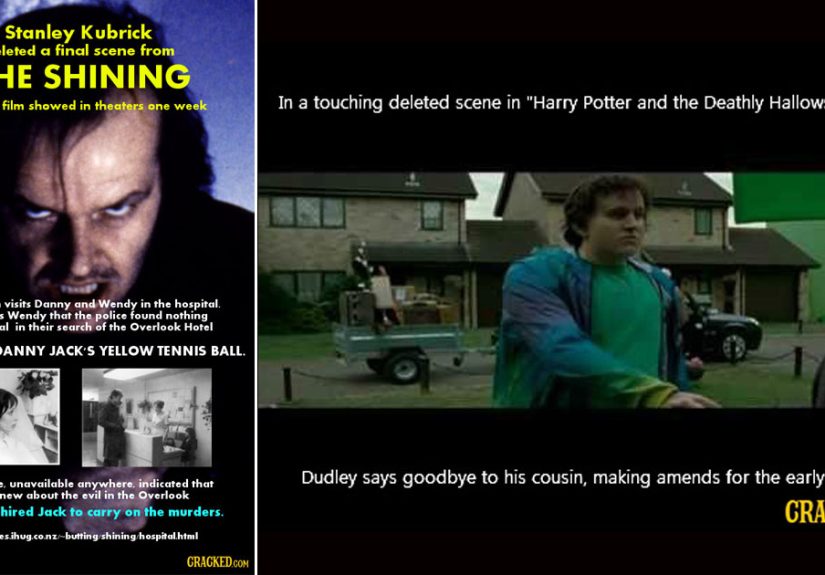
After the Overlook nightmare, the cut ending shows Wendy and Danny in a hospital, where Ullman visits Danny and gives him a familiar yellow tennis ball. That tiny prop implication is huge. It suggests the hotel’s evil influence may still be active (or at least that Ullman knows more than he admits). Kubrick reportedly removed the ending after the film opened, which makes this one of the most famous post-release cuts ever.
6) Aliens Ripley learns what happened to her daughter Amanda
The theatrical cut already gives Ripley and Newt a strong bond. The restored scene in the special edition makes it devastating. Ripley learns her daughter grew old and died while Ripley drifted in hypersleep for decades. That single scene reframes Ripley’s protectiveness of Newt from general compassion to something much more personal: grief, guilt, and a second chance at maternal care.
7) Return of the Jedi Luke building his green lightsaber
This deleted opening scene shows Luke assembling his new lightsaber before heading to Jabba’s palace. In the theatrical cut, he arrives already more composed and mysterious. The deleted scene fills in that transformation. It reinforces that Luke is no longer the impatient trainee from The Empire Strikes Back; he’s actively stepping into Jedi-knight territory. Small scene, big character upgrade.
8) Harry Potter and the Deathly Hallows – Part 1 Dudley says goodbye to Harry
The Dursleys leave Privet Drive, and in the deleted scene Dudley gives Harry a handshake and says he doesn’t think Harry is “a waste of space.” It’s a brief moment, but it softens a relationship defined by cruelty and fear. It doesn’t redeem the Dursleys entirely, but it adds complexity and maturity. Fans who wanted even a tiny emotional payoff for that long-running family dynamic usually love this one.
9) The Avengers (2012) Steve Rogers trying to live in the modern world
A deleted sequence shows Steve looking at Peggy’s file, wandering New York, and awkwardly navigating modern life, including a diner scene. It deepens his “man out of time” pain before the team-up plot takes over. The theatrical cut is tighter, but this deleted material makes his emotional arc richer and helps explain why he often feels like the loneliest guy in any roomsuper serum or not.
10) Avengers: Endgame Tony meets adult Morgan in the way station
In the deleted scene, Tony speaks with an older version of Morgan after the snap, echoing Thanos’ soul-realm moment in Infinity War. It gives Tony direct emotional reassurance that his sacrifice mattered. That’s powerful on paper, but many viewers (and the filmmakers) felt the scene added emotional explanation where the theatrical cut succeeded through silence, faces, and grief in real time.
11) Batman v Superman: Dawn of Justice The “Communion” deleted scene
Warner Bros. released this deleted scene separately, and it plays like a giant neon sign pointing toward bigger DC plans. Lex Luthor is found communing with an alien figure and technology (widely read as a setup for Steppenwolf and the Mother Boxes). It changes the movie from “self-contained messy myth fight” to “chapter in a heavily teased shared-universe roadmap.” Franchise context, cranked to eleven.
12) The Amazing Spider-Man 2 Richard Parker returns
Yes, Peter’s father appears alive in a deleted scene. And yes, that would have changed a lot. The scene adds answers to the Parker-family mystery, but it also risks shrinking Peter’s emotional growth by restoring a parent just when the story is supposed to be about loss, responsibility, and moving forward. It’s a fascinating “what if,” but probably the right cut for the final film.
13) Scott Pilgrim vs. the World The alternate ending where Scott ends up with Knives
The released ending pushes Scott toward a more mature reconciliation with Ramona (with some ambiguity, depending on how you read it). The alternate ending pairs him with Knives. That switch changes the emotional lesson of the whole movieespecially Scott’s growth, accountability, and what “leveling up” actually means in relationships. It’s one of the clearest examples of an ending changing the moral vibe of a film.
14) Little Shop of Horrors (1986) The original ending where Audrey II wins
The original ending followed the stage musical’s darker path: Seymour and Audrey die, and Audrey II goes full apocalyptic menace. Test audiences famously rejected the downer ending, and the film was changed. This isn’t just a tonal tweakit’s the difference between a cautionary monster musical and a more mainstream tragicomedy with survivable heartbreak. The original ending is brilliant, bleak, and a whole different beast.
15) Fatal Attraction The original ending where Alex frames Dan
Before the reshot ending, Alex Forrest’s death played differently: she takes her own life and frames Dan for murder. That version leaned more into psychological tragedy and legal nightmare than explosive confrontation. Test audiences wanted a more direct comeuppance, and the film was changed to the now-famous violent climax. The switch reshaped how audiences interpreted Alexand the movie’s gender politicsfor decades.
16) First Blood The ending where John Rambo dies
In an alternate ending (closer to the darker source-material outcome), Rambo dies instead of surviving. If that ending had stayed, there is no long-running action franchise version of Rambo as we know it. Beyond sequel potential, the change matters thematically: the theatrical ending leaves Rambo broken but alive, turning the story into a painful character study of trauma rather than a terminal tragedy.
17) 28 Days Later Alternate endings where Jim dies
The DVD includes multiple alternate endings, many of which kill Jim. The theatrical cut, by contrast, lands on fragile hope with Jim, Selena, and Hannah alive and signaling a passing jet. That shift matters because 28 Days Later isn’t just about rage-infected horror; it’s about whether humanity can claw its way back. The official ending says “maybe.” The alternates mostly say “probably not.”
18) Clerks The original ending where Dante is shot
Kevin Smith’s original ending had a robber enter the Quick Stop and shoot Dante. It’s abrupt, dark, and honestly kind of devastating after all the slacker-comedy chaos. Cutting it preserved the movie’s scrappy comic rhythm and rewatchable charm. It also better fits the film’s central energy: life is messy, annoying, and weirdnot necessarily tidy, but not nihilistic for the sake of shock.
19) Paranormal Activity The original ending vs. the studio-favored shock ending
Paranormal Activity had multiple endings in circulation, and the version most people know wasn’t the only option. The earlier ending favored a more tragic, lingering dread; the theatrical version amped up the final shock. That change affects how the movie “sticks” in your headslow-burn despair versus jump-scare punctuation. It also influenced the franchise’s future by leaning harder into a crowd-pleasing final jolt.
20) The Butterfly Effect The director’s-cut ending (the womb ending)
The theatrical ending is melancholy but comparatively restrained. The director’s cut goes full nightmare: Evan travels back to the womb and prevents his own birth. It’s one of the most extreme alternate endings in mainstream 2000s cinema, and it radically changes the film’s message from “sometimes letting go hurts” to “existence itself is the problem.” Subtle? Not exactly. Memorable? Absolutely.
21) Dodgeball: A True Underdog Story The ending where the Average Joes lose
The alternate ending reportedly lets Globo Gym win, and the movie just… ends. That punchline is savage and weirdly hilarious, but it flips the whole underdog sports formula. The theatrical version pays off the setup with a comeback. The alternate version turns the movie into an anti-motivational prank. It’s a perfect example of how one deleted ending can change a film from crowd-pleaser to comedy grenade.
What These Deleted Scenes Teach Us About Editing
If there’s a pattern here, it’s this: the “best” deleted scene isn’t always the one that should have stayed in the movie. Some deleted scenes are excellent on their own but too explanatory, too slow, too bleak, or too franchise-y for the finished cut.
Editing is less about finding the “coolest” material and more about protecting rhythm, tone, and emotional momentum. A scene can be well-acted, beautifully shot, and still wrong for the final film. That’s why deleted scenes are such a goldmine for movie fansthey let us see the roads not taken.
And sometimes those roads are fascinatingly terrible. Which is also a kind of art.
Bonus: Viewer Experiences With Deleted Scenes (500+ Words)
One of the most interesting experiences movie fans have is realizing that the version they love isn’t the only version that exists. You watch a film in theaters, quote it for years, and think the story is “locked.” Then a Blu-ray extra, streaming bonus, anniversary re-release, or director interview reveals a deleted scene that changes your entire interpretation. Suddenly, you’re not just watching a movie anymoreyou’re watching a creative decision.
That experience is especially powerful with endings. A deleted ending doesn’t just add information; it changes the emotional memory you carry around. Think about how your body reacts to a final scene. A hopeful ending can make a dark movie feel survivable. A bleak ending can make the same movie feel like a warning. When fans discover an alternate cut years later, they often re-evaluate everything that came before it. Characters they saw as heroic become morally murkier. Villains become more tragic. Themes that felt simple become layered. It’s like finding out your favorite song had a completely different bridge.
There’s also a communal side to deleted scenes that makes the experience fun. People don’t just watch these scenesthey debate them. They compare theatrical pacing to extended emotional beats. They argue over whether a deleted scene is “better” or just “more.” And those are not the same thing. A scene can be excellent and still ruin momentum. It can add lore while draining suspense. It can satisfy fan curiosity but weaken the film’s mystery. That tension is where some of the best movie conversations live.
For longtime movie lovers, deleted scenes also create a weirdly nostalgic ritual. You finish the movie, head into the extras menu, and suddenly the tone changes. The polished final product gives way to raw alternatives: unfinished effects, different music cues, actors trying a more dramatic read, a joke that almost made it. It feels a little like walking backstage after a play. You don’t love the performance lessyou appreciate how hard it was to make it work.
Streaming has changed that experience, too. In the DVD era, deleted scenes felt like treasure. You had to own the disc, dig through menus, and watch a grainy featurette narrated by someone who sounded suspiciously cheerful about heartbreak. Now, clips spread fast, and a deleted scene can go viral years later. That’s how younger audiences discover alternate endings to older films and react in real time, often with a mix of fascination, confusion, and “Wait, they almost did WHAT?” It keeps older movies culturally alive in a new way.
In the end, deleted scenes remind us that movies are built through choices. Not just what gets written and filmedbut what gets removed. For viewers, that’s the real thrill. You’re not only seeing a different version of the story. You’re seeing the moment where a film could have become something else entirely.
Conclusion
The best deleted scenes don’t just add triviathey expose the DNA of a movie. Whether it’s a darker ending, a restored character beat, or a franchise setup that got chopped, these scenes show how much power lives in the edit. If you love film analysis, deleted scenes are basically free graduate school… but with more aliens, superheroes, and emotionally confusing diamonds.