Table of Contents >> Show >> Hide
- Before You Buy Anything: The Quick Game Plan
- 20 Impactful Ways to Dress Multiple Windows in a Row
- 1) Run one long rod across the entire span for a “one gorgeous wall” effect
- 2) Use four (or more) panels on the same long rod to create “sections”
- 3) Hang the hardware high to fake taller ceilings
- 4) Go wide with rod placement to make the window wall feel bigger
- 5) Choose a ceiling-mounted track for a clean, modern line
- 6) Use ripple-fold drapery for effortless “designer waves”
- 7) Repeat inside-mount Roman shades for a tailored, architectural look
- 8) Try woven wood shades to add texture without visual clutter
- 9) Pick zebra shades when you want modern light control with a little attitude
- 10) Use top-down/bottom-up cellular shades for privacy that still feels bright
- 11) Layer sheers + drapes for maximum flexibility (and instant polish)
- 12) Choose double rods when you want layers without complex hardware
- 13) Make it “hotel classic” with pinch pleats across the span
- 14) Use grommet-top panels for easy glide and casual modern style
- 15) Go bold with color or pattern when windows are clustered together
- 16) Add banding, trim, or color-blocking to give structure
- 17) Coordinate windows and doors in the same sightline
- 18) Use valances when full-length curtains won’t make sense
- 19) Try cafe curtains for kitchens and casual rooms with multiple windows
- 20) Hide hardware with a cornice (or a slim box valance) for a custom finish
- Design Notes That Make a Huge Difference (Without Adding Complexity)
- Conclusion
- Extra: Real-World Experiences & Lessons From Living With a Row of Windows (About )
A row of windows is basically your home’s version of a red-carpet entrance: dramatic, attention-grabbing, and absolutely unforgiving if you show up underdressed.
The good news? Dressing multiple windows in a row doesn’t require an interior design degreeor a second mortgage. It requires a plan.
When you treat several windows as a system (not a bunch of unrelated rectangles), you can make the room feel taller, brighter, cozier, and more “finished”
with surprisingly few decisions: where the hardware goes, how much fabric you need, and how you want the light to behave at 7 a.m. on a Sunday.
Below are 20 high-impact ideassome classic, some modern, all practicalfor curtains, shades, and layered window treatments that work when windows sit side-by-side.
You’ll get the “why,” the “when,” and the “do this, not that” so your windows look intentional instead of “I panic-bought panels at 10 p.m.”
Before You Buy Anything: The Quick Game Plan
1) Decide: one big look or individual windows?
With multiple windows in a row, you have two winning strategies:
treat the whole wall like one giant opening (the “gallery wall of glass” approach), or dress each window separately for rhythm and flexibility.
A wall-length approach feels grand and can make small windows look larger. Individual treatments give you more controlespecially if furniture, built-ins,
or a kitchen counter forces your hand.
2) Measure like you mean it (your future self will thank you)
A common pro move is to mount curtain rods above the window frame to visually lift the ceiling, and to extend rods beyond the window edges so panels stack off the glass when open.
For curtain fullness, you generally want enough width so the fabric looks rich even when closedskimpy panels read “waiting room,” not “designer.”
If your rod is long, plan on center supports so it doesn’t sag like a tired noodle.
3) Match function to the room
Bedrooms need light control (hello, blackout lining or room-darkening shades). Living rooms often want flexibility (sheers + privacy layer).
Kitchens need wipeable practicality. Offices need glare reduction without turning the place into a cave. The “best” window treatment is the one you’ll actually use.
20 Impactful Ways to Dress Multiple Windows in a Row
1) Run one long rod across the entire span for a “one gorgeous wall” effect
This is the fastest way to make multiple windows feel like a single architectural feature. Mount one continuous rod above the window tops,
extend it beyond the outermost windows, and use enough panels to cover the full width if you ever want to close them.
The payoff: your wall looks taller, wider, and more expensivelike it came with the house on purpose.
2) Use four (or more) panels on the same long rod to create “sections”
If you have two or three windows, don’t stop at two panels. Add extra panels so each window grouping has its own frame.
Example: three windows in a row often looks best with panels at the far left, between window groupings (if there’s wall space), and at the far right.
It keeps things symmetrical and makes the fabric look luxurious instead of stretched thin.
3) Hang the hardware high to fake taller ceilings
When windows sit in a row, low-mounted rods emphasize the horizontal linegreat if you’re styling a bowling alley.
Raising the rod draws the eye upward and makes the entire run of windows feel like a tall, elegant feature.
If you’re choosing between “safe” and “high,” go high (as long as it still looks balanced with the ceiling line).
4) Go wide with rod placement to make the window wall feel bigger
Extending hardware beyond the window edges is one of the most reliable “why does this room suddenly look better?” tricks.
When panels open, they sit on the wall, not on the glassso you see more daylight and the windows appear wider.
On a multi-window wall, that illusion adds up fast.
5) Choose a ceiling-mounted track for a clean, modern line
Curtain tracks are the secret weapon for long spans. They glide smoothly, look minimal, and can make your ceilings feel higher because the fabric starts at the top.
Tracks are also great when you need a very long run and want the drapery to open and close without snagging on rings.
Bonus: tracks play nicely with corner turns if your window wall wraps.
6) Use ripple-fold drapery for effortless “designer waves”
Ripple fold (also called wave fold) is made for long expanses. The folds stay consistent, the drape stacks neatly, and the look reads modern and tailored.
If your windows are the main event (and they are), ripple fold is like putting them in a well-cut suit.
7) Repeat inside-mount Roman shades for a tailored, architectural look
If each window has its own frame and trim, repeated Roman shades can look crisp and intentionalespecially in dining rooms, breakfast nooks, and spaces with built-ins.
This option highlights the rhythm of the windows while keeping sightlines clean.
It’s also great when full-length curtains would crash into cabinetry, counters, or a banquette.
8) Try woven wood shades to add texture without visual clutter
Multiple windows can start to feel busy. Woven wood (bamboo-style) shades add warm texture while still feeling calm.
On a row of windows, that repeated natural material creates cohesionlike a continuous “band” of organic detail across the wall.
9) Pick zebra shades when you want modern light control with a little attitude
Zebra (dual-layer) shades can be a smart choice for offices, playrooms, and modern living spaces because they offer adjustable light filtering.
On a trio of windows, matching zebra shades can look sleek and graphicespecially if the surrounding decor leans contemporary.
10) Use top-down/bottom-up cellular shades for privacy that still feels bright
If your row of windows faces neighbors or a street, privacy can ruin your viewor your vibe.
Top-down/bottom-up shades let you cover the lower portion while keeping daylight coming in above.
Cellular styles also add insulation, which matters a lot when you have multiple panes bleeding heat or AC.
11) Layer sheers + drapes for maximum flexibility (and instant polish)
Layering is the “look good at all times” strategy. Sheers soften the window wall during the day, while drapes handle privacy and light control at night.
In rooms with many windows, layering adds depth so the wall feels designed, not bare.
Use a double rod, a double track, or a rod-and-track combo depending on your style.
12) Choose double rods when you want layers without complex hardware
Double rods are straightforward: sheer layer near the glass, heavier panel toward the room.
It’s a practical way to dress a long run of windows while keeping everything accessible.
This approach shines in bedrooms (blackout + sheer) and living rooms (privacy + softness).
13) Make it “hotel classic” with pinch pleats across the span
Pinch pleats instantly read elevated. They work especially well when you’re treating multiple windows as one unit,
because the consistent pleating turns a long wall into a single tailored composition.
Pair with a simple rod or track and let the fabric be the star.
14) Use grommet-top panels for easy glide and casual modern style
Grommets slide smoothly, making them great for wide spans you’ll open daily.
They also create clean, even folds without much fuss. If you want “modern but not precious,” this is your lane.
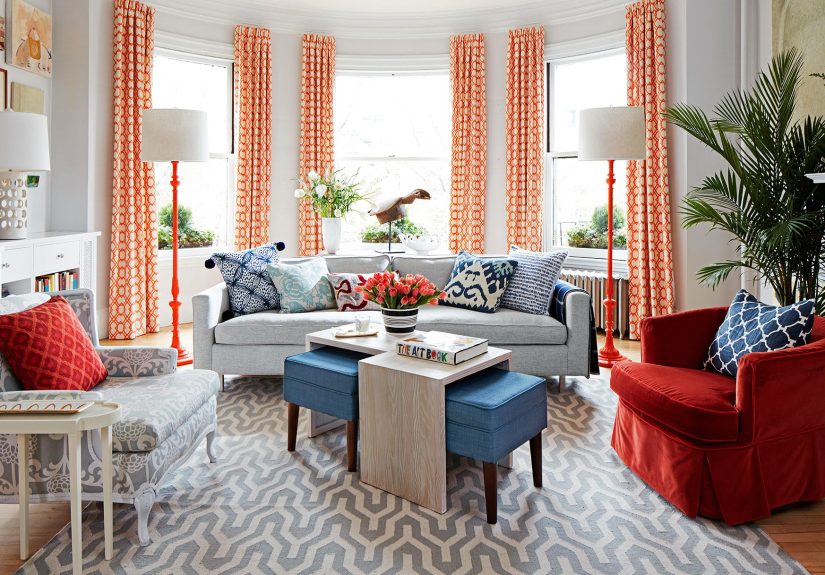
15) Go bold with color or pattern when windows are clustered together
A row of windows is prime real estate for a statement fabric. Patterned curtains across multiple windows can become the room’s focal point
(especially if your walls and furniture are more neutral). The trick is to keep the rest of the room calm so the windows get to be the fun one.
Think of it like letting your windows wear the loud shirt so your sofa doesn’t have to.
16) Add banding, trim, or color-blocking to give structure
If you love neutrals but still want impact, add a contrasting border or banding on panels or shades.
On a multi-window wall, that repeated detail creates a custom look and visually “organizes” the span.
It’s subtle, but it reads expensivelike your curtains have a résumé.
17) Coordinate windows and doors in the same sightline
If the window row shares a wall with French doors or sits near a slider, coordination matters.
Using the same fabric or a closely related color story keeps the room cohesive. You don’t need perfect matchingjust a clear relationship.
Think “same family,” not “identical twins.”
18) Use valances when full-length curtains won’t make sense
Breakfast nooks, kitchens, and any setup with a counter or banquette under the windows often need shorter solutions.
Valances can add softness and style without fighting the furniture. Pair them with simple shades if you still need privacy.
It’s the polite way to dress windows when there’s no room for drama.
19) Try cafe curtains for kitchens and casual rooms with multiple windows
Cafe curtains cover the lower half of the window, letting light in while providing privacy.
On a row of windows, repeating cafe curtains looks charming and intentionalespecially in kitchens, sunrooms, and older homes with character.
Choose an easy fabric (washable is your friend) and keep the rod line consistent across windows.
20) Hide hardware with a cornice (or a slim box valance) for a custom finish
If you want a clean, architectural top edge, a cornice or box valance can conceal rods or tracks and make the entire run look built-in.
This is especially effective for layered setups (sheers + blackout) where you’d rather not see a “hardware sandwich.”
Paint it to match the wall for quiet sophisticationor contrast it for a statement.
Design Notes That Make a Huge Difference (Without Adding Complexity)
-
Mind the “stackback.” When panels open, they need somewhere to go. If they stack on the glass, you lose light and the room feels dimmer.
Wider hardware helps your curtains clear the windows when open. - Support long spans. The longer the rod or track, the more it needs center brackets or supports to prevent sagging and keep operation smooth.
-
Pick the right length for the room. Floor-length panels feel polished in living rooms and bedrooms; sill or apron lengths often make more sense in kitchens.
Consistency across the row is what makes it look intentional. - Layer for real life. Even if you love the look of sheer panels, you’ll appreciate a second layer for nighttime privacy or afternoon glare.
Conclusion
Dressing multiple windows in a row is less about buying “the perfect curtains” and more about creating a cohesive strategy:
decide whether you’re treating the windows as one span or individual beats, place the hardware high and wide for a flattering silhouette,
and choose treatments that match how you actually live (light, privacy, insulation, and daily ease).
Get those fundamentals right, and any of the 20 ideas above can look like a professional installeven if you did it in sweatpants.
Extra: Real-World Experiences & Lessons From Living With a Row of Windows (About )
Homeowners and designers who’ve lived with a “window wall” tend to agree on one thing: the best-looking setup is the one you’ll use every single day.
A row of windows changes how a room behavessun moves across it like a spotlight, privacy changes by the hour, and the “glare factor” can sneak up on you.
Here are the most common lessons people share after they’ve tried (and tweaked) their own multi-window treatments.
Lesson one: you don’t realize how much you open/close things until you have to do it across three windows.
If your plan requires wrestling with sticky rings or tugging uneven panels, you’ll stop using it. That’s why smooth-glide solutions (tracks, quality rings,
ripple fold, or grommets) are often described as “worth it” after the honeymoon phase. When operation is easy, you actually adjust the lightmorning, afternoon,
movie nightso the room stays comfortable instead of just “pretty.”
Lesson two: glare is the enemy you didn’t invite, but it showed up anyway.
People often start with decorative side panels because they’re attractive and simple. Then summer arrives, and suddenly the TV looks like a mirror and the office desk
becomes a solar-powered headache generator. That’s when functional layers earn their keep: light-filtering roller shades, solar shades, or top-down/bottom-up options
behind the pretty fabric. The look stays soft, but the room becomes livable.
Lesson three: “too narrow” is the most common regret.
Across multiple windows, skinny panels look especially underwhelminglike your windows put on a scarf when they needed a coat.
Many people end up buying additional panels later, which costs more and complicates dye-lot matching. The takeaway: plan fullness up front.
If you want the ability to close curtains, buy enough width to cover the span with comfortable gathers. If panels are decorative only, you can still go fuller
so the drape looks intentional and plush.
Lesson four: long hardware needs serious support.
A long rod without adequate brackets can sag over timeespecially with heavier fabrics or blackout lining. People who’ve been burned by this tend to switch to tracks
(which distribute weight differently) or add more brackets than they think they need. It’s not glamorous, but it’s the difference between “luxury drapery” and
“why does the middle look sad?”
Lesson five: cleaning and maintenance matter more than you think.
In kitchens and high-traffic family rooms, washable fabrics and wipeable shades become heroes. In pet households, puddled curtains can double as a fur magnet.
In homes near busy streets, lighter fabrics may show dust faster. People who love the look but hate the upkeep often land on a compromise:
easy-care shades for daily function, plus decorative panels that don’t touch the floor.
In short: choose a system that looks great, moves easily, controls light, and doesn’t punish you for living in your own house.
That’s the real secret to making multiple windows in a row feel like a featurenot a project you keep “meaning to finish.”