Table of Contents >> Show >> Hide
- Way #1: Give Your Wallet a “Home Base” (and a Tiny Daily Routine)
- Way #2: Make Your Wallet Harder to Lose (and Less Painful If You Do)
- Way #3: Add a Safety Net (Tracker + Alerts + a “Lost Wallet Plan”)
- Quick Recap: The 3 Simple Ways (Print This in Your Brain)
- of “Wallet-Losing Experiences” (and What They Teach You)
- Conclusion
Losing your wallet is a special kind of chaos. It’s not just “Where’s my stuff?” it’s
“Where’s my ID, my cards, my sanity, and the last shred of my schedule?”
And somehow it always happens when you’re already late, holding a coffee, and trying to remember
if you locked the door (spoiler: you did… probably).
The good news: most wallet-losing isn’t a personality flaw. It’s a systems problem.
Wallets get lost when we switch contexts quickly (home → car → store), when our hands are full,
and when we don’t have a consistent “wallet script” to follow. Fix the script and you fix the outcome.
Below are three simple, repeatable ways to stop losing your wallet for good not by becoming a new
person with a color-coded life, but by making your current life harder to trip over. And because
life is life, we’ll also set up a safety net so a missing wallet becomes a minor annoyance instead
of a full-blown financial scavenger hunt.
Way #1: Give Your Wallet a “Home Base” (and a Tiny Daily Routine)
If your wallet doesn’t have a consistent home, it will “live” wherever it was last used:
couch cushions, gym locker, car cupholder, kitchen counter, that mysterious dimension under your bed.
Your goal is to stop making the wallet’s location a daily mystery novel.
Pick one landing spot then make it ridiculously easy
Choose a single “home base” near the place you naturally enter and exit: a bowl on a console table,
a small tray by the keys, a shelf by the door, a hook with a pouch anything that says,
“Wallet goes here. End of debate.”
Pro tip: visibility beats perfection. A pretty drawer is nice, but an open tray you’ll actually use
is better. The wallet doesn’t need a spa day; it needs a parking spot.
Use the habit loop: cue → routine → reward (a.k.a. “Don’t rely on vibes”)
Habits stick when they’re attached to something you already do. Think of it like a “habit loop”:
a cue (trigger) leads to a routine (action) and a reward (relief, satisfaction, not panicking later).
The simplest cue? Walking in the door.
Try this 10-second routine every time you come home:
- Cue: Keys touch the tray (or you step inside).
- Routine: Wallet goes to home base immediately.
- Reward: Say “Done.” Yes, out loud. Your brain likes closure.
It sounds silly until you realize your brain loves tiny rituals. (Also, saying “Done” makes you feel
like a capable adult, which is a rare and precious experience.)
Build an “exit check” that takes two seconds
Instead of searching for your wallet later, confirm it exists before you leave.
Pick a short check you can do without thinking the classic is:
Phone + Keys + Wallet (some people add earbuds like it’s a side quest).
Make it physical. Tap each pocket or bag compartment as you say it. The goal is to turn “Do I have it?”
into a reflex, not a philosophical question asked in a parking lot.
Set up “micro home bases” where you commonly lose it
If you lose your wallet in the same places over and over, don’t fight your life design for it.
Add a second home base where the wallet tends to wander:
- Car: a dedicated pocket in your bag, or a small zip pouch (not the cupholder).
- Work/desk: one drawer corner or tray (wallet goes there, not “somewhere on the desk”).
- Gym: always the same locker pocket, or a zippered inner pocket in your gym bag.
Your wallet shouldn’t be “free-range.” Give it fences.
Way #2: Make Your Wallet Harder to Lose (and Less Painful If You Do)
This is the “reduce friction and reduce damage” method. You’ll lose your wallet less when it’s easier to
keep track of and you’ll stress less when it contains fewer high-stakes items.
Do a 5-minute wallet diet: carry less, lose less
Overstuffed wallets are easier to drop, harder to fit into a consistent pocket, and more annoying to track.
Plus, the more you carry, the more you risk losing.
Keep only what you genuinely need day-to-day:
- Driver’s license or ID
- One debit card (optional) and 1–2 credit cards
- Health insurance card (if you need it regularly)
- A small amount of cash (think “emergency snack fund,” not “payroll”)
Try not to carry items that can turn a lost wallet into identity-theft bingo, like:
Social Security card/number documents, password lists, spare house keys, blank checks, extra gift cards,
and piles of receipts. Store those securely at home instead.
Choose a carry method that matches your life (not your fantasy life)
Wallet-losing often happens during transitions: paying, putting items away, getting in/out of cars,
juggling bags, or moving fast.
So pick a carry system that stays consistent even during chaos.
Options that work well in the real world:
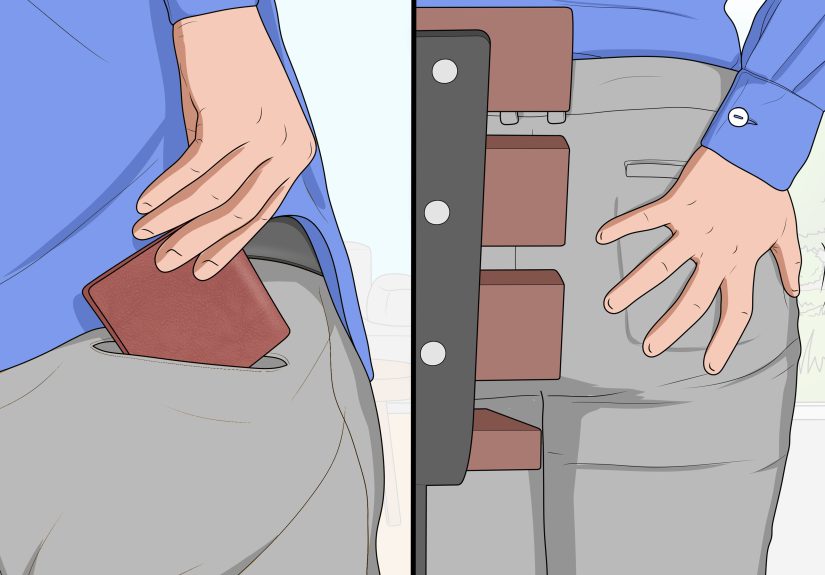
- Front pocket carry: harder to forget on a counter, harder to pickpocket, easier to notice.
- Zipper pocket or inner jacket pocket: reduces accidental drops during errands.
- A dedicated wallet pocket in your bag: always the same compartment, never “floating.”
- A bright or distinctive wallet: boring black blends into everything; bold colors don’t.
If you’re a “set it down while I do this one thing” person, commit to a rule:
Wallet never touches a random surface. It goes back into your pocket/bag or into your hand.
Those are the only two legal states.
Add a low-effort physical failsafe
A failsafe is a small physical feature that prevents the most common wallet-loss scenario:
“I put it down for one second… and then it joined the witness protection program.”
Consider one of these:
- Minimalist wallet: smaller, lighter, easier to keep in a single pocket.
- Wallet with a loop/attachment point: lets you clip it inside a bag pocket.
- Travel days: use a zip pouch or money belt so it stays secured during movement.
The goal isn’t to turn your wallet into a fortress just to stop it from escaping during your busiest moments.
Way #3: Add a Safety Net (Tracker + Alerts + a “Lost Wallet Plan”)
Even with perfect habits, life occasionally throws you a curveball:
you’ll be tired, distracted, or trying to pay while balancing a shopping basket and your dignity.
A safety net means that when the wallet goes missing, you get it back fast or you protect yourself fast.
Use a wallet tracker (because “Where is it?” should have an answer)
A tracker turns wallet-losing from a scavenger hunt into a quick lookup. For many people, that alone
reduces stress enough to keep better routines (because panic is not a productivity tool).
Common options include:
- Apple Find My-compatible trackers: great if you live in the iPhone ecosystem; some features include “left behind” alerts.
- Tile-style trackers: popular cross-platform options, including card-shaped trackers designed for wallets.
- Ultra-thin tracker cards: designed to fit where a normal round tracker won’t.
When choosing, think about:
- Shape: card-style trackers fit wallets better than bulky tags.
- Battery: replaceable vs. rechargeable (and how often you’ll actually recharge).
- Network: what your phone supports and what you’ll realistically use.
Turn on “left behind” alerts and spending notifications
Trackers are great, but alerts are even better because they can catch the problem at the moment you
walk away from your wallet, not an hour later.
Two types of alerts to enable:
-
Separation / left-behind alerts: your phone warns you if you leave the wallet behind
(especially useful in cafes, gyms, and airports). -
Card and account notifications: many banks and card issuers let you get real-time
alerts for purchases, which helps you spot unauthorized activity quickly.
Bonus: consider using a digital wallet on your phone for everyday purchases when appropriate. If you pay
with your phone more often, you pull your physical wallet out less often fewer “set it down” moments.
Create a “Lost Wallet Plan” now (future-you will write you a thank-you note)
This is the part no one wants to do… until the day they desperately want it done.
Your “Lost Wallet Plan” is a short checklist you keep in a notes app (and maybe printed at home).
It turns panic into action.
Build your plan in 10 minutes:
- List what’s in your wallet (cards, ID, membership cards, transit card, etc.).
- Save your banks’ and card issuers’ support phone numbers (or bookmark the “lock card” feature in each app).
- Know how to replace your driver’s license/ID via your state DMV site (process varies by state).
- Know where to report identity theft and get a recovery plan if fraud happens.
Many institutions recommend acting quickly: lock/freeze cards, contact issuers, replace IDs, and monitor
accounts and credit. Government resources can also guide you through reporting and recovery steps if identity theft occurs.
The 15-minute “wallet missing” drill (do this the moment you notice)
If your wallet goes missing, here’s a practical flow:
- Pause and retrace: check the last two places you used it (checkout, gas station, gym locker, car seat). Don’t spiral yet.
- Lock cards immediately: use your bank/card apps if possible. If you can’t, call the issuers.
- Check recent transactions: look for anything you don’t recognize and report it right away.
- Replace your ID: start the DMV replacement process (especially if the wallet is truly gone).
- Consider credit protection steps: if sensitive info may be at risk, follow official guidance for fraud alerts/credit freezes and identity-theft reporting.
This is not about living in fear it’s about reducing the “what now?” moment if something happens.
A plan lets you move fast, which is often the difference between “mild inconvenience” and “months of cleanup.”
Quick Recap: The 3 Simple Ways (Print This in Your Brain)
- Home base + routine: wallet has one parking spot, and you do a 2-second exit check.
- Harder to lose: carry less, carry smarter, add a physical failsafe.
- Safety net: use a tracker + alerts, and keep a ready-to-go lost wallet plan.
If you only do one thing today, do this: pick a home base and put your wallet there every time you walk in.
That single habit prevents an astonishing percentage of wallet disappearances.
Everything else just makes the system even more bulletproof.
of “Wallet-Losing Experiences” (and What They Teach You)
Because wallet-losing is so common, people tend to lose it in the same handful of ways like a greatest-hits album,
except nobody asked for it and the tour is always sold out. Here are a few very relatable wallet-loss scenarios
(and the fix that actually works).
Experience #1: The Grocery Store “One Second” Trap
You pay, you put your card away, you grab your bags, and then you set your wallet down for “just a second”
while you try to wrangle the receipt, your phone, and the shopping cart that suddenly steers like a rebellious shopping llama.
Ten minutes later, you’re in the parking lot doing the classic pat-down: pockets, bag, jacket, pockets again (as if it might have teleported).
Lesson: set a rule: after payment, the wallet goes immediately back into the same pocket/compartment
before anything else happens. Bags can wait. Receipts can crumple. Your wallet needs a strict “no random surfaces” policy.
Experience #2: The Gym Locker Shuffle
Gym routines are basically controlled chaos: you’re changing clothes, moving fast, and trying not to touch anything sticky.
Wallets disappear when they get “temporarily placed” inside a locker… but not in a consistent spot.
Then you leave in a hurry, already proud of yourself for exercising, only to realize later your wallet is still doing squats in Locker 214.
Lesson: create a micro home base: wallet always goes in the same zippered pocket of your gym bag,
or the same corner of the locker (top right, for example). Consistency is the magic trick. Your brain loves “the usual spot.”
Experience #3: The Car Seat Abyss
Cars are wallet black holes. You toss the wallet onto the passenger seat. It slides. You brake. It vanishes.
Later you’re digging between seats like an archaeologist, discovering fossilized French fries and receipts from 2019.
Lesson: never “seat” the wallet. Give it a dedicated place:
a bag pocket, a closed console compartment, or a small zip pouch. “Loose on a seat” is just an audition for disappearance.
Experience #4: The Coffee Shop Table Exit
Coffee shops are notorious because you’re often paying, chatting, and packing up at the same time.
The wallet comes out, the conversation continues, and when you leave, your wallet stays behind living its best life near the tip jar.
You don’t notice until you’re already halfway home (which is the wallet’s favorite moment to reveal its absence).
Lesson: enable left-behind alerts if you use a tracker, and use the exit check
(Phone + Keys + Wallet) at the door, not in the car. The earlier you catch it, the easier the recovery.
Experience #5: The Travel Day Wallet Spiral
Travel combines stress, crowds, and constant transitions. Your ID is out more. Your hands are full more.
You’re moving from ticket counter to security to gate to snack line and every transition is a chance to misplace something.
Lesson: on travel days, upgrade your system: keep the wallet secured in a zippered inner pocket or travel pouch.
Reduce wallet “handling” by keeping only what you need accessible. Travel is not the time for a wallet full of loyalty cards and
14 mystery receipts.
The theme in every story is the same: wallets don’t vanish randomly. They vanish during transitions, when the wallet has no assigned place.
Build a place, build a habit, and back it up with a tracker and a plan and suddenly “Where’s my wallet?” becomes a question you almost never ask.
Conclusion
Stopping wallet loss isn’t about having superhuman focus it’s about making the “right” action the easiest action.
Give your wallet a home base. Simplify what you carry. Add a tracker and alerts so you get warned before the wallet becomes missing.
And keep a quick “lost wallet plan” so you can protect yourself fast if life happens.
Start small: choose your home base tonight. Do the exit check tomorrow. You’ll feel slightly ridiculous for about two days,
and then you’ll wonder how you ever lived without it like discovering pockets for the first time.