Table of Contents >> Show >> Hide
- Why Are Some Magic: The Gathering Cards So Valuable?
- 30+ Most Valuable MTG Cards and Their Approximate Prices
- The Crown Jewel: Black Lotus
- The Power Nine: The Original Blue-Chip MTG Cards
- Reserved List Lands That Keep Climbing
- Modern Exception: The One Ring 001/001
- How to Evaluate Valuable Magic Cards Before Buying
- Experiences and Practical Lessons From Collecting Valuable MTG Cards
- Conclusion
- SEO Tags
Some hobbies politely ask for your time. Magic: The Gathering occasionally asks for your wallet, your safe deposit box, and your ability to explain to relatives why a tiny cardboard rectangle can cost more than a car. The world of valuable MTG cards is part game history, part collector culture, part finance spreadsheet, and part “wait, that card does what for zero mana?”
This guide breaks down the most valuable Magic: the Gathering cards and their price, including legendary Power Nine cards, Reserved List staples, iconic old-school lands, and modern headline-makers like the serialized 001/001 The One Ring. Prices can change quickly based on condition, grading, sales venue, and whether a collector wakes up one morning and decides they absolutely need a mint Alpha Mox Sapphire before lunch. Treat every number below as an approximate market snapshot, not a formal appraisal.
Why Are Some Magic: The Gathering Cards So Valuable?
The biggest prices in MTG usually come from a powerful mix of scarcity, playability, nostalgia, and condition. Early sets such as Alpha, Beta, Unlimited, Arabian Nights, Antiquities, and Legends had far smaller print runs than modern releases. Many cards were played without sleeves, stored in shoeboxes, traded on playgrounds, or accidentally turned into table coasters by people who now have very specific regrets.
The Reserved List Effect
Many of the most expensive MTG cards are on the Reserved List, which means Wizards of the Coast has promised not to reprint them in a functionally identical tournament-legal form. That promise makes cards like Black Lotus, Mox Diamond, Gaea’s Cradle, The Tabernacle at Pendrell Vale, and original dual lands especially attractive to collectors.
Condition Changes Everything
A heavily played card and a pristine graded copy may share the same name, but financially they are different animals. A worn Unlimited Black Lotus might already be breathtakingly expensive, while a top-grade Alpha Black Lotus can leap into museum-piece territory. Centering, corners, surface wear, ink, signatures, provenance, and grading company all influence value.
30+ Most Valuable MTG Cards and Their Approximate Prices
The table below focuses on major U.S. market indicators, public price trackers, marketplace listings, and widely reported record sales. Prices are rounded for readability.
| # | Card | Notable Version | Approximate Price | Why It Is Valuable |
|---|---|---|---|---|
| 1 | Black Lotus | Alpha, CGC Pristine 10 | Record sale around $3,000,000 | The ultimate MTG grail: iconic, scarce, powerful, and historically unmatched. |
| 2 | The One Ring | Serialized 001/001 | Reported sale around $2,000,000 | A one-of-one modern chase card bought by Post Malone, blending MTG with pop culture. |
| 3 | Black Lotus | Alpha, raw or graded | Often $50,000 to $600,000+ | The rarest tournament-legal original printing of Magic’s most famous card. |
| 4 | Black Lotus | Beta | Often $20,000 to $100,000+ | Still black-bordered, still ancient, still capable of making collectors sweat. |
| 5 | Black Lotus | Unlimited | About $15,000 to $30,000+ | More available than Alpha or Beta, but still a true Power Nine superstar. |
| 6 | Mox Sapphire | Alpha/Beta/Unlimited | About $4,700 to $50,000+ | The blue Mox is usually the most sought-after Mox because blue is historically dominant. |
| 7 | Ancestral Recall | Alpha/Beta/Unlimited | About $5,000 to $36,000+ | One blue mana to draw three cards is not fair. It is also not cheap. |
| 8 | Time Walk | Alpha/Beta/Unlimited | About $4,500 to $25,000+ | Two mana for an extra turn remains one of Magic’s most legendary effects. |
| 9 | Timetwister | Alpha/Beta/Unlimited | About $7,000 to $22,000+ | The only Power Nine card legal in Commander, which gives it extra collector demand. |
| 10 | Mox Ruby | Alpha/Beta/Unlimited | About $4,000 to $40,000+ | Free red mana, Power Nine status, and early-set scarcity keep it red-hot. |
| 11 | Mox Jet | Alpha/Beta/Unlimited | About $3,900 to $35,000+ | A black-mana member of the Power Nine with strong Vintage prestige. |
| 12 | Mox Pearl | Alpha/Beta/Unlimited | About $3,600 to $35,000+ | The white Mox is still a premium Power Nine collectible. |
| 13 | Mox Emerald | Alpha/Beta/Unlimited | About $3,500 to $37,000+ | Free green mana plus Reserved List scarcity equals long-term collector appeal. |
| 14 | Candelabra of Tawnos | Antiquities | About $3,700 to $4,500 | A scarce old artifact with combo appeal and a devoted collector base. |
| 15 | Mishra’s Workshop | Antiquities | About $3,700 to $4,300 | One of the most powerful lands ever printed for artifact strategies. |
| 16 | The Tabernacle at Pendrell Vale | Legends | About $3,350 to $4,700 | A rare land used in Legacy and prized by old-school collectors. |
| 17 | Island of Wak-Wak | Arabian Nights | About $3,500 to $4,900 | Scarce Arabian Nights nostalgia can outweigh broad play demand. |
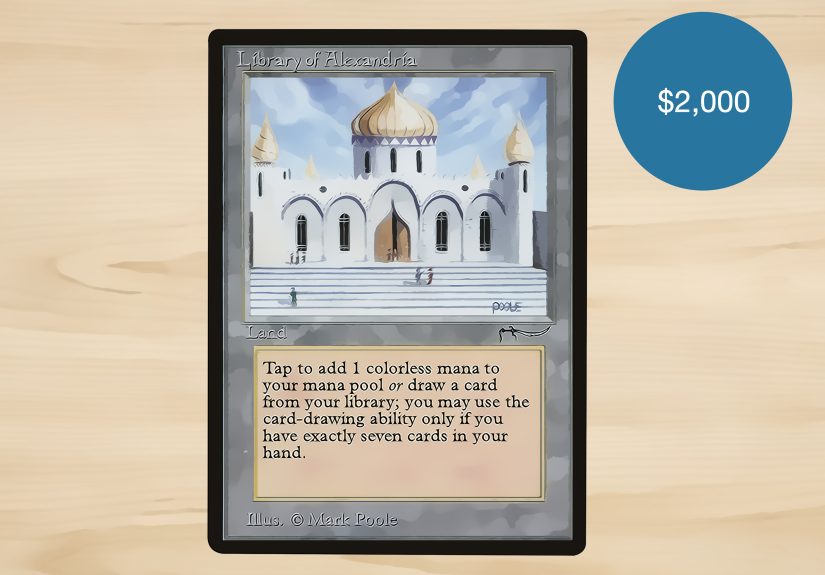
| 18 | Library of Alexandria | Arabian Nights | About $1,900 to $5,400 | A legendary draw-engine land from Magic’s earliest expansion. |
| 19 | Bazaar of Baghdad | Arabian Nights | About $2,200 to $3,000 | A Vintage powerhouse that fuels graveyard strategies like few cards can. |
| 20 | Juzam Djinn | Arabian Nights | About $1,800+ | Once the monster everyone feared, now a nostalgic collector icon. |
| 21 | Gaea’s Cradle | Urza’s Saga | About $1,450 to $1,800 | A Commander and Legacy favorite that turns creatures into a mana fountain. |
| 22 | Mox Diamond | Stronghold | About $1,395 to $1,500 | A zero-mana artifact that remains highly desirable in eternal formats. |
| 23 | Underground Sea | Revised Edition | About $1,200 | The blue-black dual land is a Legacy and Commander status symbol. |
| 24 | Volcanic Island | Revised Edition | About $1,075 to $1,100 | The blue-red dual land is heavily desired for Legacy and high-end Commander decks. |
| 25 | Chains of Mephistopheles | Legends | About $1,200 to $1,400 | A strange, rules-heavy Reserved List enchantment with collector mystique. |
| 26 | Chaos Orb | Unlimited | About $1,100+ | A banned dexterity card famous for requiring players to physically flip it. |
| 27 | Moat | Legends | About $1,100 | A powerful old enchantment that blocks non-flying creatures from attacking. |
| 28 | Lion’s Eye Diamond | Mirage | About $900 to $950 | A combo staple that looks like a downside until someone wins the game with it. |
| 29 | Drop of Honey | Arabian Nights | About $900 | Scarcity and quirky old-school design keep this card sticky in value. |
| 30 | The Abyss | Legends | About $900 | A Reserved List control card with intimidating old-border charm. |
| 31 | City of Traitors | Exodus | About $700 to $750 | A fast-mana land popular in Legacy stompy-style strategies. |
| 32 | Serendib Efreet | Arabian Nights | About $700 to $800 | An early aggressive creature with major nostalgia value. |
| 33 | Guardian Beast | Arabian Nights | About $650 to $700 | A scarce Arabian Nights rare with unusual artifact-protection text. |
| 34 | Diamond Valley | Arabian Nights | About $600 to $700 | A rare land with unique sacrifice-and-life-gain utility. |
| 35 | Tropical Island | Revised Edition | About $650 to $700 | The blue-green dual land remains a staple of premium Commander and Legacy collections. |
The Crown Jewel: Black Lotus
If Magic cards had royalty, Black Lotus would be wearing the crown, holding the scepter, and charging admission to look at the throne. Printed in Alpha, Beta, and Unlimited, Black Lotus costs zero mana and can be sacrificed for three mana of any one color. That effect is so powerful that the card is banned in most formats and restricted in Vintage.
Its value comes from more than raw gameplay strength. Black Lotus is the face of early Magic. It is the card people recognize even if they have not shuffled a deck since 1997. Alpha copies are especially desirable because Alpha was the first Magic set and had a tiny print run compared with modern releases. Add a high grade, clean corners, strong centering, and provenance, and the price can go from “very expensive” to “please call my financial advisor.”
The Power Nine: The Original Blue-Chip MTG Cards
The Power Nine are Black Lotus, the five Moxen, Ancestral Recall, Time Walk, and Timetwister. These cards were printed in the earliest core sets and are widely considered some of the strongest cards in Magic history. Their prices remain high because they combine extreme nostalgia, low supply, and genuine game significance.
Among them, Mox Sapphire often commands extra attention because blue is historically one of Magic’s strongest colors. Ancestral Recall and Time Walk are also famous because their effects are wildly undercosted by modern design standards. Drawing three cards for one mana or taking an extra turn for two mana is the kind of thing that makes game designers stare silently into the distance.
Reserved List Lands That Keep Climbing
Some of the most valuable Magic cards are not flashy dragons or mythic planeswalkers. They are lands. That may sound boring until you remember that lands are the engine of the game. Mishra’s Workshop, Bazaar of Baghdad, Gaea’s Cradle, and The Tabernacle at Pendrell Vale are all powerful because they do something normal lands do not.
Mishra’s Workshop produces three mana for artifacts. Bazaar of Baghdad supercharges graveyard strategies. Gaea’s Cradle rewards creature-heavy decks with absurd mana. The Tabernacle at Pendrell Vale punishes creature swarms by forcing upkeep payments. These cards are old, scarce, and difficult to replace. That is a dangerous recipe for your bank account.
Modern Exception: The One Ring 001/001
The serialized 001/001 The One Ring proved that modern Magic can still create a global treasure hunt. Unlike Reserved List staples, this card’s value came from absolute uniqueness. Only one copy existed with that special serialized treatment. Its sale to Post Malone turned it into a mainstream collecting story and showed how crossover sets, celebrity collectors, and serialized cards can create record-breaking demand.
However, The One Ring is not the same kind of investment object as a Power Nine card. Black Lotus has decades of market history. The One Ring has uniqueness, fame, and pop-culture gravity. Both are valuable, but for different reasons.
How to Evaluate Valuable Magic Cards Before Buying
1. Check the Exact Printing
A card name alone is not enough. Alpha, Beta, Unlimited, Revised, Collector’s Edition, International Edition, 30th Anniversary Edition, promos, foils, and reprints can all have different values. A tournament-legal Alpha card and a non-tournament-legal commemorative version may look similar to beginners but behave very differently in the market.
2. Inspect Condition Carefully
Look for whitening, bends, creases, ink, surface scratches, clouding, shuffle wear, water damage, and trimmed edges. For expensive cards, small defects can mean hundreds or thousands of dollars in difference.
3. Be Serious About Authenticity
High-end MTG cards attract counterfeiters. Use trusted sellers, compare print patterns, check light tests carefully, and consider professional authentication for major purchases. If a Black Lotus is priced like a used toaster, congratulations: you have found either a miracle or a problem. Bet on the problem.
4. Understand Buylist vs. Retail Price
The price you see listed online is not always what you can sell the card for immediately. Retail price, market price, buylist price, auction result, and private-sale price are different numbers. A store may sell a card for $1,500 and buy it for much less because it needs margin, risk protection, and inventory turnover.
Experiences and Practical Lessons From Collecting Valuable MTG Cards
Anyone who spends time around high-value Magic cards eventually learns that the hobby rewards patience more than panic. The most experienced collectors rarely chase every spike. Instead, they watch long-term patterns, compare multiple price sources, and pay attention to condition. A card can be “worth $1,000” in a headline and still be hard to sell for that amount if the copy has heavy wear, poor photos, or uncertain authenticity.
One practical experience many collectors share is that the first serious purchase feels different. Buying a $20 Commander staple is casual. Buying a Reserved List land is a small ceremony. You inspect the corners. You zoom in on seller photos like a detective in a crime drama. You ask about shipping insurance. You suddenly care deeply about top loaders, team bags, bubble mailers, and whether the postal system is emotionally prepared for your package.
Another lesson is that nostalgia is powerful, but it should not replace research. Many players remember Juzam Djinn as an unstoppable terror, and that old reputation still helps its price. But modern play demand is not the same as historical fame. By contrast, cards like Gaea’s Cradle and Mox Diamond are expensive because they are both collectible and genuinely useful in popular formats. The best long-term MTG collectibles often have more than one reason to matter.
Condition is where many beginners get surprised. A lightly played card may still look great in a binder, but high-end buyers examine everything. A tiny crease, a suspicious edge, or a small surface dent can change the conversation fast. For cards worth thousands, grading may help establish trust, but grading is not magic. A slab does not automatically make every card liquid at the highest possible number. It simply gives buyers a clearer condition benchmark.
Selling also teaches humility. The highest online listing is not always the real market. Some sellers list cards at dream prices and wait. Actual completed sales, buylist offers, and recent marketplace movement often tell a more realistic story. If you need cash quickly, you may accept less than the theoretical market value. If you can wait for the right buyer, rare cards may perform better.
Storage is another underrated part of the experience. Valuable Magic cards should be kept away from humidity, sunlight, pets, snacks, and friends who say, “Can I just hold it for a second?” Sleeves, rigid holders, graded slabs, fire-resistant storage, and insurance become part of the conversation once a collection grows beyond casual value.
Finally, collecting valuable MTG cards is more enjoyable when you understand the stories behind them. Black Lotus is not just expensive because it is rare. It is expensive because it represents the beginning of Magic. The One Ring is not just costly because it is unique. It is costly because millions of people watched a global treasure hunt unfold. The best cards carry history, gameplay, scarcity, and emotion in the same small rectangle. That is why collectors keep chasing them, even when their wallets quietly ask for a meeting.
Conclusion
The most valuable Magic: The Gathering cards are not expensive by accident. They sit at the intersection of scarcity, game power, collector passion, historical importance, and market psychology. Black Lotus remains the undisputed legend, the Power Nine still define old-school prestige, and Reserved List staples continue to shape the high-end MTG market. Meanwhile, modern chase cards like the serialized 001/001 The One Ring prove that Magic can still surprise everyone.
For collectors, the smartest move is simple: verify the printing, study condition, compare several price sources, and never buy a five-figure card from someone whose only proof is “trust me, bro.” In the world of rare MTG cards, knowledge is not just power. It is protection.