Table of Contents >> Show >> Hide
- What Is a Recurrence Relation?
- 1. Solve by Iteration or Expansion
- 2. Solve by Substitution and Induction
- 3. Solve with Recursion Trees
- 4. Solve Linear Recurrences with Characteristic Equations
- 5. Solve with Generating Functions and the Master Theorem
- How to Choose the Best Method
- Practical Experiences: What Solving Recurrences Teaches You
- Conclusion
Recurrence relations have a funny way of looking scarier than they really are. At first glance, a formula like T(n) = 2T(n/2) + n seems to be whispering, “Good luck, human.” But underneath the symbols is a simple idea: each term or problem depends on smaller previous terms or subproblems. That is why recurrence relations appear everywhere in discrete mathematics, algorithms, combinatorics, finance, dynamic programming, and computer science courses that enjoy watching students sharpen pencils dramatically.
A recurrence relation is a rule that defines a sequence using earlier values. The Fibonacci sequence, for example, is built from the recurrence F(n) = F(n – 1) + F(n – 2), with starting values such as F(0) = 0 and F(1) = 1. In algorithms, recurrence relations describe running time: merge sort famously leads to T(n) = 2T(n/2) + n, which solves to O(n log n). In short, recurrences are mathematical breadcrumbs. Follow them correctly, and you find the closed form or asymptotic behavior hiding in the forest.
This guide explains five practical ways to solve recurrence relations: iteration, substitution, recursion trees, characteristic equations, and generating functions with the Master Theorem for algorithmic recurrences. Each method has its own personality. Some are quick and visual, some are algebra-heavy, and one of themthe Master Theoremis basically the fast-food drive-thru of divide-and-conquer analysis. Convenient, but only if your order matches the menu.
What Is a Recurrence Relation?
A recurrence relation defines a sequence or function in terms of earlier values. Instead of saying directly what a(n) equals, it tells you how to build a(n) from previous terms. For example:
This means every term is three more than the previous one. The sequence begins 2, 5, 8, 11, 14, and so on. After a little inspection, the closed form is:
The goal of solving recurrence relations is usually to convert a recursive rule into a closed form, a simplified formula, or an asymptotic estimate. In math classes, you might want the exact value of the nth term. In computer science, you often want the growth rate, such as O(n), O(n log n), or O(2^n).
1. Solve by Iteration or Expansion
The iteration method, also called expansion or repeated substitution, is the most straightforward way to solve recurrence relations. You repeatedly plug the recurrence into itself until a pattern appears. This method is especially useful for first-order recurrences and simple algorithmic recurrences.
Example: A Simple Arithmetic Recurrence
Expand the recurrence step by step:
After k steps:
Set k = n so that a(n – k) = a(0):
That is the closed form. No fireworks, no mystical math ceremonyjust careful expansion.
When to Use Iteration
Use iteration when the recurrence has a simple repeated structure. It works well for recurrences such as a(n) = a(n – 1) + c, a(n) = 2a(n – 1), or even some divide-and-conquer forms like T(n) = T(n/2) + 1. The downside is that messy recurrences can turn into algebraic spaghetti very quickly.
2. Solve by Substitution and Induction
The substitution method is a two-step strategy: first, guess the answer; second, prove the guess is correct, usually by mathematical induction. This may sound suspiciously like “make something up and hope,” but the proof part keeps the method honest.
Substitution is especially common in algorithm analysis. You might use iteration, a recursion tree, or experience to guess that a recurrence grows like O(n log n). Then you prove it formally.
Example: Proving a Guess
Suppose:
This recurrence appears in merge sort. A reasonable guess is:
To prove it, assume for smaller values that:
Substitute that into the recurrence:
If c is large enough, the expression is at most cn log n. Therefore, the recurrence is O(n log n). The algebra may look like it went to the gym, but the core idea is simple: assume the claim for smaller cases, plug it in, and show the result still holds.
When to Use Substitution
Use substitution when you already have a strong guess. It is excellent for proving upper and lower bounds, especially in computer science. It is not always the best discovery method because it depends on having a good guess first. In other words, substitution is a courtroom lawyer, not a detective. It proves the case after someone finds the clues.
3. Solve with Recursion Trees
A recursion tree is a visual method for solving recurrences, especially those that describe recursive algorithms. It breaks the recurrence into levels, showing how much work happens at each level of recursion.
Consider:
At the top level, the work outside recursive calls is n. At the next level, there are two subproblems of size n/2, and each contributes n/2 work. The total work at that level is:
At the next level, there are four subproblems of size n/4:
Each level costs n. How many levels are there? Since the problem size keeps dividing by 2, the recursion reaches size 1 after log₂ n levels. Therefore:
The recursion tree makes the structure visible. Instead of staring at symbols until your coffee gets cold, you see the work spread across levels.
When to Use Recursion Trees
Use recursion trees for divide-and-conquer recurrences such as merge sort, binary search variations, and recursive matrix algorithms. They are also helpful before applying the substitution method because the tree often reveals the right guess.
4. Solve Linear Recurrences with Characteristic Equations
The characteristic equation method is one of the most powerful tools for solving linear homogeneous recurrence relations with constant coefficients. That phrase sounds like it belongs on a wizard’s diploma, but it simply means recurrences like this:
The Fibonacci recurrence is the classic example:
To solve it, assume a solution of the form:
Substitute into the recurrence:
Divide by r^(n – 2):
Rearrange:
This is the characteristic equation. Its roots are:
So the general solution has the form:
The constants A and B are found using the initial conditions. This leads to Binet’s formula for Fibonacci numbers.
Example: A Second-Order Recurrence
Suppose:
Assume a(n) = r^n. Then:
Rearrange:
Factor:
The roots are 2 and 3, so:
Again, use initial values to solve for A and B.
When to Use Characteristic Equations
This method is ideal for linear homogeneous recurrence relations with constant coefficients. It is exact, elegant, and highly reliable. However, it is not designed for divide-and-conquer recurrences like T(n) = 2T(n/2) + n. Use the right tool for the right recurrence; do not bring a violin to a basketball game.
5. Solve with Generating Functions and the Master Theorem
This final category includes two powerful methods that serve different purposes. Generating functions are a deep algebraic technique for sequence recurrences, while the Master Theorem is a quick method for many divide-and-conquer recurrences in algorithms.
Generating Functions
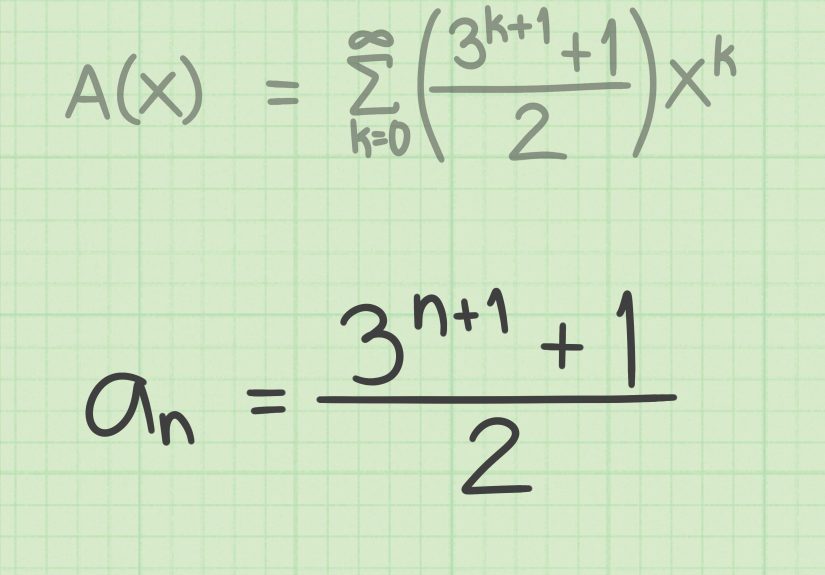
A generating function turns a sequence into a power series:
The idea is to encode the sequence inside a function, manipulate the function algebraically, and then extract a closed form or formula for the coefficients. Generating functions are especially useful in combinatorics, counting problems, and recurrences where ordinary algebra feels stuck.
For example, if a sequence satisfies:
then the generating function can be manipulated to produce a rational expression. From there, partial fractions or coefficient extraction can reveal a formula for a(n). This method may look dramatic at first, but it is basically putting the entire sequence into one algebraic suitcase.
The Master Theorem
The Master Theorem is designed for recurrences of the form:
Here, a is the number of subproblems, n/b is the size of each subproblem, and f(n) is the work done outside the recursive calls. For many common algorithm recurrences, the Master Theorem gives an asymptotic answer quickly.
For example:
Here, a = 2, b = 2, and f(n) = n. Since n^(log_b a) = n^(log_2 2) = n, the recurrence solves to:
This is why merge sort runs in O(n log n) time. The Master Theorem is fast, but it has limits. It only applies to certain recurrence forms. If the recurrence does not match the pattern, you may need a recursion tree, substitution, or another method.
How to Choose the Best Method
The best recurrence-solving method depends on the structure of the problem. If the recurrence advances by one step, start with iteration. If you need a formal proof of a bound, use substitution. If the recurrence comes from a recursive algorithm, draw a recursion tree. If the recurrence is linear with constant coefficients, try the characteristic equation. If the recurrence involves sequence counting, generating functions may be the cleanest path. If it has the divide-and-conquer form T(n) = aT(n/b) + f(n), check whether the Master Theorem applies.
Here is a practical summary:
- Iteration: Best for simple, pattern-friendly recurrences.
- Substitution: Best for proving a guessed bound.
- Recursion tree: Best for visualizing recursive algorithm costs.
- Characteristic equation: Best for linear homogeneous recurrences with constant coefficients.
- Generating functions and Master Theorem: Best for sequence-counting problems and standard divide-and-conquer algorithms.
Practical Experiences: What Solving Recurrences Teaches You
One of the biggest lessons from working with recurrence relations is that the first method you try is not always the method that finishes the job. Many students begin with the Master Theorem because it feels efficient. That is understandable. Who does not enjoy a theorem that behaves like a vending machine? Insert recurrence, receive answer. But the Master Theorem is picky. If the recurrence does not fit the exact shape T(n) = aT(n/b) + f(n), the machine refuses your dollar.
In real problem-solving, recurrence relations reward flexibility. For example, when analyzing a recursive algorithm, a recursion tree often gives the fastest intuition. You can see whether the cost is concentrated near the root, spread evenly across levels, or dominated by the leaves. Once that pattern appears, substitution can turn your visual guess into a rigorous proof. This combination is extremely useful: recursion tree first, substitution second. It is like using a map before writing the official travel report.
Another useful experience is learning not to rush the initial conditions. Many wrong answers come from solving the general shape correctly but forgetting to apply starting values carefully. In characteristic equation problems, the roots give you the form of the solution, but the initial conditions determine the actual constants. Without them, you have a nice-looking formula wearing someone else’s jacket.
Generating functions also teach patience. At first, they may seem like overkill. Why turn a sequence into an infinite series just to solve a recurrence? But after practicing with counting problems, the benefit becomes clear. Generating functions can transform complicated combinatorial rules into algebraic expressions that are easier to manipulate. They are especially helpful when a recurrence is connected to partitions, tilings, paths, or arrangements.
A final practical insight: always write out the first few terms. This habit is simple but powerful. Before launching into theorem mode, calculate a(0), a(1), a(2), and a(3). Patterns often appear early. If the values double, grow linearly, alternate signs, or resemble Fibonacci numbers, you gain a clue about which method to use. The first few terms are like gossip from the sequence; listen carefully, and they will tell you what is going on.
Solving recurrence relations is not just about formulas. It builds mathematical judgment. You learn how recursive structure creates growth, how local rules shape long-term behavior, and how algorithms spend time as input size increases. That skill transfers beautifully into computer science, data structures, dynamic programming, probability, and discrete math. Once recurrences stop feeling mysterious, they become one of the most useful tools in the mathematical toolbox.
Conclusion
Recurrence relations may look intimidating, but they become much easier once you match the problem to the right method. Iteration reveals patterns by expanding the recurrence. Substitution proves a guessed solution. Recursion trees show the cost of recursive calls level by level. Characteristic equations solve linear recurrences with constant coefficients. Generating functions handle sequence problems with algebraic power, while the Master Theorem quickly solves many divide-and-conquer recurrences.
The main trick is not memorizing every possible formula. The real skill is recognizing the recurrence type. Once you know what kind of recurrence you are facing, the solution path becomes clearer. And yes, sometimes the recurrence still makes you work for it. Mathematics has a sense of humor too.