Table of Contents >> Show >> Hide
- 1. NASA’s Crawler-Transporter: The Rocket Mover That Crawls Like a Very Determined Turtle
- 2. Bertha: The Tunnel Boring Machine That Ate Seattle’s Underground
- 3. Bagger 293: The Land Machine That Makes Buildings Look Nervous
- 4. Big Muskie: The Ohio Dragline With a Bucket Bigger Than Some Apartments
- 5. Caterpillar 797F: The Mining Truck Built to Haul 400 Tons at a Time
- 6. P&H 4100XPC: The Electric Rope Shovel That Feeds Giant Trucks
- 7. Liebherr LR 13000: The Crane Built for Lifts That Make Engineers Hold Their Breath
- What These Monster Machines Teach Us About Engineering
- Experience Notes: What It Feels Like to Encounter Monster Machines
- Conclusion
Some machines are designed to be useful in a thousand different situations. A pickup truck can haul mulch, move furniture, tow a boat, or sit proudly in a driveway looking like it has big weekend plans. Then there are monster machines: gigantic, absurdly specialized engineering beasts built to do one job so specific that using them for anything else would be like using a chainsaw to slice birthday cake.
These are not “big” in the ordinary sense. They are not merely taller than a person or louder than a leaf blower at 7 a.m. They are machines so large that they need special roads, special crews, custom parts, or an entire industrial ecosystem just to wake up and go to work. Their jobs include moving rockets, chewing tunnels through city soil, scraping away mountains, hauling impossible loads, and lifting objects that make regular cranes look like office staplers.
Below are seven monster machines built for very specific taskseach one a reminder that when human beings face a problem too huge for ordinary tools, our answer is often: “Fine, let’s build something the size of a neighborhood.”
1. NASA’s Crawler-Transporter: The Rocket Mover That Crawls Like a Very Determined Turtle
NASA’s crawler-transporter is one of the most wonderfully strange machines ever built because its purpose sounds both simple and impossible: move an assembled space launch vehicle from the Vehicle Assembly Building to the launch pad without tipping, shaking, or embarrassing humanity in front of the moon.
Originally built in the 1960s for the Apollo program, the crawler-transporter carried Saturn V rockets toward Launch Complex 39 at Kennedy Space Center. Later, it hauled space shuttle stacks, and upgraded versions continue supporting modern deep-space missions. It is roughly 131 feet long and 114 feet wide, with huge crawler tracks at each corner. It does not sprint. It does not even jog. When carrying a launch vehicle, it moves with the careful patience of a museum guard carrying a tray of priceless glassware.
That slowness is the point. Rockets are tall, delicate, expensive towers of controlled violence. The crawler’s job is not to be fast; it is to be steady. Its leveling systems help keep the mobile launcher stable even as the vehicle climbs the gentle grade toward the pad. In normal language, this means it can carry a skyscraper-shaped spacecraft while making the ride smoother than many city buses.
Why It Exists
The crawler was built for one task: transporting launch vehicles between assembly and launch. It is a moving foundation, a giant steel servant that makes spaceflight possible before the engines ever ignite. Without it, the drama of a rocket launch would be missing a crucial behind-the-scenes star.
2. Bertha: The Tunnel Boring Machine That Ate Seattle’s Underground
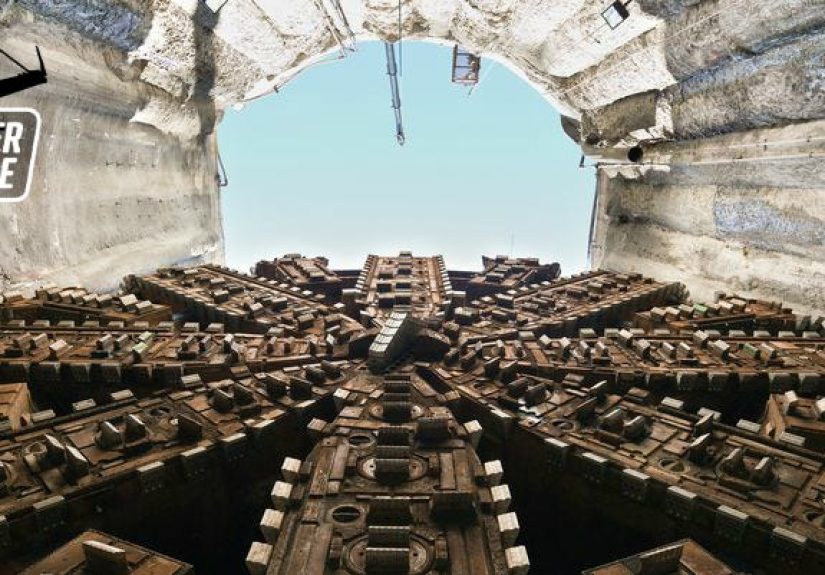
Bertha was not just a tunnel boring machine; she was a mechanical earthworm with a public relations department. Built for the State Route 99 tunnel project in Seattle, Bertha was designed to carve a highway tunnel beneath the city as part of the replacement for the aging Alaskan Way Viaduct.
Her cutting face measured about 57.5 feet across, making her one of the largest tunnel boring machines of her time. The machine began digging in 2013, completed the bore in 2017, and the tunnel opened to traffic in 2019. That timeline also included mechanical trouble, repairs, delays, and enough civic suspense to make infrastructure fans reach for popcorn.
A tunnel boring machine works by grinding through soil and rock with a rotating cutterhead, while conveyor systems remove the excavated material and crews install tunnel lining behind it. Bertha’s job was highly specific: dig a nearly two-mile highway tunnel through complicated urban ground while Seattle continued being Seattle above her. That means traffic, buildings, utilities, groundwater, and the occasional local opinionall stacked over the project like a very judgmental layer cake.
Why It Exists
Bertha existed to solve a city-scale problem: move a vulnerable elevated highway underground without ripping open the entire waterfront. She was not built for general digging. She was built for one path, one tunnel, one long subterranean assignment. When she finished, she was dismantled, because a machine that big does not simply park behind the garage for next weekend.
3. Bagger 293: The Land Machine That Makes Buildings Look Nervous
Bagger 293 is what happens when someone looks at a mountain of earth and says, “We need a machine that can take bites out of that all day.” This giant bucket-wheel excavator is often listed among the largest land vehicles ever built. It stands roughly 310 feet tall, stretches more than 700 feet long, and weighs more than 14,000 metric tons. In other words, it is less like a vehicle and more like a moving industrial skyline.
The machine’s job is continuous excavation. Its enormous wheel carries a ring of buckets that scoop material as the wheel rotates. The earth is then moved onto conveyor belts, which carry it away. This system allows Bagger 293 to remove huge volumes of overburdenthe soil and rock that sit above coal seamsin open-pit mining operations.
Unlike a traditional excavator that digs, stops, swings, dumps, and repeats, a bucket-wheel excavator is built for nonstop appetite. It is a factory on tracks, a conveyor-fed digging city with a tiny crew compared to its outrageous size. Watching it work is like watching a ferris wheel decide to become a geological problem.
Why It Exists
Bagger 293 was built for one broad but very specialized task: remove massive quantities of earth in surface mining. It is not versatile in the cute, multi-tool sense. It is versatile in the “I can rearrange your landscape” sense.
4. Big Muskie: The Ohio Dragline With a Bucket Bigger Than Some Apartments
Big Muskie was an American mining legend and one of the largest dragline excavators ever built. Operating in Ohio from 1969 to 1991, this colossal machine was created to remove overburden for coal mining. Its bucket alone held about 220 cubic yards and weighed hundreds of tons when loaded. The surviving bucket is now displayed at Miners’ Memorial Park in Ohio, where it looks less like a bucket and more like a steel cathedral for people who appreciate dirt.
A dragline excavator works differently from a shovel. Instead of pushing a bucket into material, it casts a huge bucket out on cables, drags it back across the ground to fill it, then swings and dumps the load. Big Muskie’s mission was brutally specific: uncover coal by moving enormous amounts of earth as efficiently as possible.
Its walking mechanism made it even stranger. Big Muskie did not roll on tires or tracks in the usual way. It “walked” using massive shoes, shifting itself slowly across the mine site. The movement was not graceful, but grace was never the point. When your job is to peel back acres of land, elegance is optional.
Why It Exists
Big Muskie existed because conventional earthmoving equipment would have taken far too long to move the same amount of overburden. It was a one-machine answer to a mining challenge: remove the top layers of earth so coal could be reached below.
5. Caterpillar 797F: The Mining Truck Built to Haul 400 Tons at a Time
The Caterpillar 797F is a haul truck, but calling it a truck feels slightly unfair to regular trucks. A pickup truck may carry lumber. A highway semi may move freight. The 797F is built to haul around 400 short tons of material in mining operations. That is the kind of payload number that makes a bathroom scale file for retirement.
Designed for large open-pit mines, the 797F carries ore, coal, or overburden from loading areas to crushers, stockpiles, or waste dumps. It uses a massive diesel engine, enormous tires, heavy-duty braking systems, and a frame designed to survive loads that would flatten ordinary equipment into modern sculpture.
The key to understanding the 797F is production rhythm. A mine is a system. Shovels load trucks. Trucks move material. Crushers process it. If one part slows down, the whole operation suffers. Ultra-class haul trucks like the 797F reduce the number of trips needed to move a given amount of material. More tons per load means fewer cycles, lower cost per ton, and a smoother flow through the mine.
Why It Exists
The 797F was built for one job: haul extreme payloads in large-scale mining. It is not intended for highways, errands, or dramatic grocery runs. Its natural habitat is the mine road, where “large load” means something very different from a moving-day rental van.
6. P&H 4100XPC: The Electric Rope Shovel That Feeds Giant Trucks
If ultra-class haul trucks are the hungry mouths of a mine, machines like the P&H 4100XPC are the giant spoons. This electric rope shovel is designed to load massive mining trucks quickly and repeatedly. It can use dippers in the range of dozens of cubic yards and is matched with large haul trucks so mines can move material at industrial speed.
An electric rope shovel is not the same as the hydraulic excavators seen on construction sites. It uses electric motors, cables, a boom, and a dipper handle to dig into blasted rock or overburden. The machine crowds the dipper into the bank, hoists the material, swings over a haul truck, and dumps. Then it does it again. And again. And again. Mining is not glamorous choreography, but when these machines are tuned well, the rhythm is impressive.
The 4100XPC exists because loading time matters. A 400-ton truck sitting empty is an expensive metal waiting room. The shovel’s job is to fill that truck in a small number of passes so the haul cycle keeps moving. In a mine where every minute affects production, a machine that can load giant trucks efficiently is not a luxury; it is the heartbeat of the operation.
Why It Exists
The P&H 4100XPC was built for high-volume loading in surface mines. Its specific task is not “dig a hole.” Its real task is to convert blasted earth into truckloads at a pace that keeps a mine profitable.
7. Liebherr LR 13000: The Crane Built for Lifts That Make Engineers Hold Their Breath
The Liebherr LR 13000 is a crawler crane designed for ultra-heavy lifting. It has a maximum lifting capacity of about 3,000 metric tons and can reach impressive hook heights with specialized boom configurations. This is the kind of crane called in when the object being lifted is not just heavy, but “please check the math three more times” heavy.
Its work includes industrial modules, power plant components, petrochemical equipment, and offshore-related structures. These are not objects that can be lifted by ordinary construction cranes. They require immense capacity, careful ground preparation, precise rigging, and crews who understand that gravity is not open to negotiation.
The LR 13000’s value lies in combining huge lifting power with mobility on crawler tracks. It can reposition on site, assemble into different boom configurations, and perform lifts that reduce the need to break large modules into smaller pieces. In major industrial projects, fewer separate lifts can mean shorter schedules, less welding, fewer alignment problems, and fewer chances for something to become a very expensive paperweight.
Why It Exists
This crane exists for the specialized world of ultra-heavy lifting. Its purpose is to raise objects so massive that the lift itself becomes a project within the project. It is a machine built not for everyday construction, but for moments when engineering quietly says, “We’re going to need the big crane.”
What These Monster Machines Teach Us About Engineering
The most fascinating thing about these machines is not simply that they are huge. Size is only the visible part of the story. Their real beauty lies in how narrowly they are designed. Each machine solves a problem that is too large, too repetitive, too risky, or too precise for ordinary equipment.
NASA’s crawler-transporter shows the value of controlled movement. Bertha proves that cities sometimes need machines that can work invisibly below daily life. Bagger 293 and Big Muskie demonstrate how mining transforms scale into efficiency. The Caterpillar 797F and P&H 4100XPC reveal the importance of matching machines inside a production system. The Liebherr LR 13000 reminds us that lifting is not just about strength; it is about planning, stability, and trust in every bolt, cable, counterweight, and calculation.
These machines also show the trade-off between specialization and flexibility. A Swiss Army knife can do many things adequately. A monster machine does one thing spectacularly. That is why they are expensive, difficult to transport, and sometimes obsolete once their mission ends. But when the task is big enough, specialization wins.
Experience Notes: What It Feels Like to Encounter Monster Machines
For most people, the first experience with a monster machine is not technical. It is emotional. You see a photo, a video, or a display piece like Big Muskie’s bucket, and your brain needs a second to resize the world. A person standing next to one of these machines looks tiny, almost like an accessory. The usual sense of scale disappears. A tire becomes taller than a room. A bucket becomes a garage. A crane boom seems to draw a line across the sky.
That sense of awe is useful because it makes engineering feel real. Textbook numbers can be hard to imagine. A 400-ton payload sounds impressive, but seeing the size of a haul truck makes the number land differently. The same is true for tunnel boring machines. A city tunnel may feel abstract until you understand that a rotating steel face had to grind through soil while workers, sensors, pumps, conveyors, and lining systems followed behind it in a carefully controlled underground procession.
People who visit mines, construction sites, industrial museums, or launch facilities often notice that these machines are slower than expected. Movie logic teaches us that big machines should roar around dramatically. Real monster machines are often methodical. They creep, swing, lift, load, and crawl with discipline. Their power is not in speed; it is in repeatability. A haul truck that safely completes thousands of cycles is more valuable than one that looks exciting for ten seconds. A crane lift that takes hours of preparation may be successful precisely because nothing dramatic happens.
There is also a strong lesson in teamwork. None of these machines operates alone in a meaningful sense. The crawler-transporter depends on roads, launch towers, technicians, and mission schedules. A mining shovel depends on blasting crews, truck dispatch systems, maintenance teams, and fuel or electric power infrastructure. A giant crane depends on riggers, lift plans, soil assessments, transport crews, and weather windows. The machine may be the celebrity, but the operation is the real star.
Another experience these machines create is respect for maintenance. Huge equipment does not simply “run.” It is inspected, lubricated, monitored, repaired, and sometimes redesigned. A single worn component can stop a project worth millions of dollars. Bertha’s delays in Seattle are a famous reminder that the bigger the machine, the bigger the consequences when something goes wrong. Monster machines are miracles, but they are not magic. They obey physics, wear, heat, friction, and the occasional unpleasant surprise buried underground.
Finally, these machines make people think differently about human ambition. They can be controversial because they often serve industries with environmental, financial, or urban impacts. Mining machines reshape landscapes. tunnel machines reshape cities. Rocket movers support exploration beyond Earth. Heavy cranes help build the infrastructure that powers modern life. A fair view of monster machines should include both admiration and scrutiny. They are not just toys for engineers; they are tools that reveal what societies choose to build, extract, move, and prioritize.
That is why monster machines remain so compelling. They are giant answers to giant questions. Sometimes the answer is elegant. Sometimes it is noisy, slow, expensive, and covered in grease. But it is always a reminder that when a task becomes too big for ordinary thinking, engineering has a habit of getting wonderfully, ridiculously large.
Conclusion
Monster machines are more than mechanical curiosities. They are purpose-built solutions to problems that ordinary equipment cannot handle. From NASA’s crawler-transporter carrying rockets to the pad, to Bertha carving Seattle’s underground highway, to mining giants that move earth by the mountain-load, each machine proves that size becomes meaningful only when matched to a mission.
The best monster machines are not big for the sake of being big. They are big because the task demands it. Their scale reflects the scale of human goals: exploring space, rebuilding cities, extracting resources, lifting industrial giants, and solving logistical puzzles that would otherwise be impossible. They may be slow, costly, and wildly specialized, but when the job is specific enough, nothing else will do.
Note: This article is written in original wording and based on real public information from reputable engineering, manufacturer, transportation, space, mining, and historical sources.