Table of Contents >> Show >> Hide
- The Viral Story Was About Books, But The Real Argument Was About Control
- Why Teen Reading Choice Matters So Much
- When A Stepparent Jumps Straight Into Rule-Enforcement Mode
- Book Censorship At Home Is Smaller Than A National Ban, But It Feels Personal In A Different Way
- The Dad’s Biggest Mistake Was Confusing Obedience With Reconnection
- What A Healthier Response Would Have Looked Like
- Why So Many Readers Took The Teen’s Side
- Extra Perspective: Real-Life Experiences Behind Conflicts Like This
- Conclusion
There are family disagreements, and then there are “please hand over the fantasy novel, young citizen” disagreements. This story lands firmly in the second category.
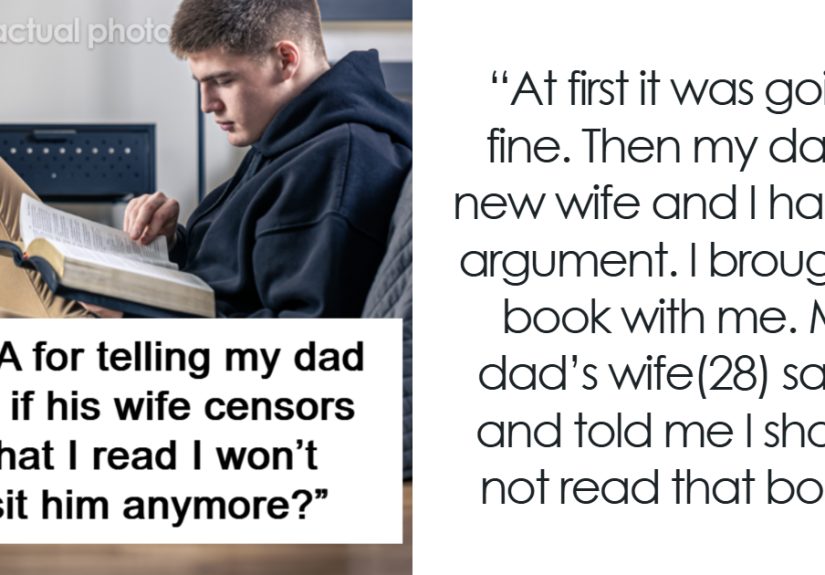
A widely discussed online post described a 16-year-old boy reconnecting with his father after a long absence, only to have the reunion go sideways when his stepmother objected to the book he brought with him. Her problem was not the writing style, the pacing, or the fact that some YA novels could use fewer cliffhangers and more naps. Her issue was that the book featured a bisexual protagonist. The teen pushed back, the father backed his wife, and the boy decided that if reading freely was too much to ask, he simply would not keep visiting.
On the surface, it sounds like one more juicy family blowup tailor-made for the internet. Underneath, though, it taps into several very real questions: How much control should adults have over what teens read? What happens when a stepparent enters a family and immediately starts laying down rules? And why do conflicts over books so often become conflicts over identity, trust, and power?
This is why the story resonated. It is not really just about a book. It is about who gets to decide what a teenager is allowed to think about, explore, and understand. That is a much bigger fight than one copy of a YA novel sitting in a backpack.
The Viral Story Was About Books, But The Real Argument Was About Control
The boy in the story was not sneaking around with anything illegal, dangerous, or secretly outrageous. He was reading age-typical young adult fiction. What turned the moment explosive was the message behind the stepmother’s demand: I get to decide what ideas you are allowed to encounter.
That tends to go over badly with teenagers, especially older teens. Sixteen is an age when young people are forming opinions that feel like their own. They are sorting out values, interests, identity, taste, and boundaries. They are not little kids asking whether dragons are real. They are old enough to understand nuance, disagree with adults, and notice when a rule is less about safety and more about control.
That is why this story struck a nerve. The teen was not simply refusing a household rule. He was rejecting a power grab. And honestly, most readers could see the difference from a mile away.
There is also a detail that makes the whole thing even messier: the father was trying to rebuild a relationship after being absent. In situations like that, trust is already fragile. A parent who is re-entering a teen’s life does not have much room for grand speeches, sudden authority, or a spouse acting like the newly appointed Minister of Approved Literature. If the goal is reconnection, starting with censorship is an almost cartoonishly bad strategy.
Why Teen Reading Choice Matters So Much
Adults sometimes talk about books as if they are sealed containers of moral contamination. Read one “wrong” title and suddenly the child will collapse onto a chaise lounge, whispering, “Alas, I have been ruined by chapter seven.” Real life is less dramatic and far more interesting.
Reading is one of the safest ways teens explore complicated ideas. A novel lets them encounter people unlike themselves, compare perspectives, test values, and think through difficult emotions before life throws the final exam at them with no study guide. Books give teenagers rehearsal space for empathy and judgment.
That is especially true with fiction aimed at adolescents. Teen readers are often drawn to stories that help them make sense of friendship, power, difference, family tension, belonging, and identity. They read for escape, yes, but also for orientation. A good book can help a teenager think, Oh, so I am not the only person who has ever felt weird, angry, invisible, curious, boxed in, or misunderstood.
When adults ban or shame those reading choices, they are not just removing pages. They are sending a message that certain questions are off-limits and certain parts of human experience are too threatening to be named. That message does not usually produce wisdom. It usually produces secrecy, resentment, and a teenager who suddenly finds the library way more interesting.
It is also worth pointing out that reading motivation is fragile. If a teen is voluntarily picking up books in an era of endless scrolling, that is not a problem to solve. That is a minor miracle deserving snacks and maybe a gift card. A teenager who reads by choice is building vocabulary, comprehension, focus, and critical thinking while also staying off the family group chat for at least a little while. That is practically a public service.
When A Stepparent Jumps Straight Into Rule-Enforcement Mode
Blended families are complicated even when everybody is trying their best. They involve shifting loyalties, unclear roles, old wounds, new expectations, and the emotional equivalent of assembling furniture without the instructions. So when a stepparent enters the picture, timing and tone matter a lot.
One reason so many people sided with the teen is that the stepmother in this story appears to have skipped a few levels. Instead of building trust first, she went directly to censorship. Instead of curiosity, she brought command. Instead of relationship, she brought rule enforcement.
That usually backfires, especially with older children and teens. In many stepfamily situations, the biological parent remains the main disciplinarian at first while the stepparent slowly earns influence through consistency, warmth, and respect. That is not weakness. That is realism. Teenagers do not usually respond well to a relative stranger barging in and acting like their personal moral customs officer.
The father made it worse by immediately siding with his wife instead of slowing the moment down. A better response would have sounded something like this: “Let’s all take a breath. Nobody is confiscating anybody’s book. We can talk about concerns without trying to control him.” That would have protected the relationship while still leaving room for discussion.
Instead, the father basically told his son that keeping the peace with his wife mattered more than respecting his son’s boundary. And teenagers are many things, but they are rarely confused about where they rank when adults make that kind of choice in public.
Book Censorship At Home Is Smaller Than A National Ban, But It Feels Personal In A Different Way
America has been arguing loudly about books for years now. School libraries, public libraries, classroom shelves, and reading lists have all become cultural battlegrounds. So when a family conflict like this shows up online, it plugs directly into a larger national mood.
That helps explain the intensity of the reaction. People are tired of seeing reading framed as a threat, especially when the targeted material involves race, sexuality, or identity. A lot of adults hear a story like this and think, Great, the book-ban debate has now entered the living room and is trying to inspect the teenager’s backpack.
But private censorship can cut differently from public censorship. A law may feel abstract. A household argument feels intimate. When a teen is told by a parent or stepparent, “You should not read that,” the unspoken message is often, “I do not trust your mind.” That can sting much more deeply than a school board headline.
And in this case, the book was reportedly flagged because it included bisexual representation. That matters. Teen readers notice when adults treat certain identities as inherently suspicious. Even if the teen is not personally identifying with the character, he is still learning what kinds of people the adults around him think are acceptable to talk about. That lesson lands hard.
The Dad’s Biggest Mistake Was Confusing Obedience With Reconnection
Parents who are trying to repair a broken relationship with a teen sometimes make a strange mistake: they assume authority will create closeness. It usually does the opposite.
Reconnection works better when the adult leads with humility. That means listening more than lecturing, asking instead of assuming, and being careful not to treat the teen like an extension of the household brand. A father who has already lost time with his child cannot act as though access is guaranteed no matter what. Teens have feet. They can leave. As this story demonstrates, they sometimes do.
The father in this situation seemed to interpret his son’s boundary as a threat. But a boundary is not the same as blackmail. “If this continues, I won’t come back” is not emotional terrorism. It is often just a plain description of consequences. Teenagers may not always phrase those consequences elegantly, but they are still allowed to have them.
That is another reason readers sympathized with the boy. He was not demanding that the adults change their private opinions. He was saying he would not voluntarily place himself in an environment where his reading choices were policed. That is a pretty understandable response, especially for a 16-year-old trying to figure out whether this renewed relationship is safe, respectful, and worth the emotional effort.
What A Healthier Response Would Have Looked Like
Adults do not have to agree with every book a teenager reads. They do not even have to like it. But there is a huge difference between guidance and censorship.
If the stepmother had concerns, she had better options:
1. Ask before accusing
“What is the book about?” works much better than “You should not read that.” Curiosity opens a door. Control slams it shut.
2. Talk about content, not identity panic
If an adult is worried about a theme, discuss the actual theme. Do not act as though the existence of an LGBTQ+ character is itself a crisis requiring immediate literary intervention.
3. Respect age and context
A 16-year-old is not a first grader. Older teens need increasing room to think, choose, and respond to ideas with adult support rather than constant censorship.
4. Let the biological parent handle the heavy lifting
In stepfamilies, role confusion can turn ordinary disagreements into loyalty wars. The parent should lead, and the stepparent should avoid coming in hot unless there is a clear safety issue.
5. Protect the relationship first
One conversation about one book should never become a loyalty test that costs a parent access to their child. If it does, the adults have badly misread the assignment.
Why So Many Readers Took The Teen’s Side
The internet is not always known for nuance. Sometimes it behaves like a raccoon with Wi-Fi. But in this case, the reaction followed a pretty clear logic.
People saw an older teen reading voluntarily. They saw a stepmother trying to ban the book because of queer representation. They saw a father who should have been rebuilding trust choose alliance over empathy. And they saw a teen set a boundary instead of sticking around to be managed like a child.
That combination made the outcome feel obvious. The issue was never merely “respect the rules of the house.” It was “whose dignity matters more in this house?” Once the father answered that question the wrong way, the teen answered with his feet.
And that may be the most important takeaway from the whole saga. Parents and stepparents often imagine authority as the thing that keeps a family together. With teenagers, respect is usually the stronger glue. You can demand compliance for only so long. Connection lasts longer when a teen feels heard, trusted, and treated like a developing person instead of a project under supervision.
Extra Perspective: Real-Life Experiences Behind Conflicts Like This
Stories like this spread because they feel familiar. Plenty of adults remember being told not to read certain books, watch certain movies, ask certain questions, or mention certain topics at the dinner table. And years later, what they remember most is not usually the title that got confiscated. It is the feeling of being underestimated.
For some people, being policed around reading turned books into forbidden treasure. They got better at hiding library checkouts, borrowing from friends, or reading under the covers with a flashlight like tiny literary fugitives. The irony, of course, is that censorship often boosts a book’s mystique. Tell a teenager a story is too dangerous, and congratulations: you have just become that book’s unpaid marketing department.
Other people remember the emotional side more than the sneaking. They remember adults assuming that exposure equals agreement, that reading about a character means becoming that character, or that curiosity is a form of rebellion. Those assumptions can make a young person feel deeply unseen. A teen might read about grief without being depressed, read about injustice without becoming cynical, or read about a bisexual character without the sky opening up and issuing a parental advisory. Literature is exploration, not mind control.
In blended families, these experiences can get even more intense. A biological parent may still have emotional credit built up over time, even when the relationship is strained. A stepparent often does not. That means the same comment can land very differently depending on who says it and how. “I have concerns about that book” may sound protective from a longtime parent and intrusive from a newer authority figure. Context matters. History matters. Timing matters. Families ignore those facts at their own peril.
There is also a practical lesson here for parents trying not to lose influence during the teen years. Influence grows when a teenager believes an adult can handle honesty. If a teen thinks every difficult topic will trigger panic, punishment, or moral theater, they stop sharing. They do not stop thinking. They just move the thinking elsewhere. Friends, phones, secret group chats, school libraries, and private browser tabs are standing by with refreshments.
That is why the smartest adults are often the calmest ones. They can say, “Tell me what you like about that book.” They can ask, “Did anything in it confuse you or bother you?” They can discuss values without acting like a paperback is an active crime scene. Those conversations are not just better for literacy; they are better for trust.
In the end, this story is memorable because it captures a choice many families eventually face. You can build a relationship where a teenager feels respected enough to stay in the room, or you can build a system of control that makes the room itself feel optional. The stepmother tried to censor a book. The teen responded by editing his weekend plans. And that, in one painfully efficient plot twist, is how families learn that authoritarian energy is not a substitute for connection.
Books rarely break families apart by themselves. People do that when they choose fear over conversation, control over trust, and ideology over relationship. The good news is that the opposite is also true: families can hold together when adults are brave enough to listen, flexible enough to grow, and wise enough to let a teenager read a book without behaving like the paperback has joined a criminal syndicate.
Conclusion
“Stepmom Tries To Censor What 16YO Reads, He Decides Not To Visit His Dad Anymore” became click-worthy because it mixed a viral family fight with a bigger cultural debate. But the reason it stayed with people is simpler. Most readers recognized the emotional math immediately. A teenager who is reading, thinking, and setting boundaries is not the problem. The problem is an adult trying to control him into trust.
When parents and stepparents treat books as invitations to conversation, they strengthen connection. When they treat books as contraband, they often end up banning more than a title. They ban openness, honesty, and the possibility of closeness. This teen did not walk away because he loved one series more than his father. He walked away because respect was missing from the equation. And without that, even the best reunion story can close its cover fast.