Table of Contents >> Show >> Hide
- What Is a Flow Battery, Really?
- What Makes a Flow Battery “Open Source”?
- Why Flow Batteries Are a Natural Match for the Renewable Grid
- How an Open-Source Flow Battery Could Be Designed
- Chemistries Worth Watching
- The Hard Parts Nobody Should Pretend Are Easy
- Real Progress Already Exists
- What an Open-Source Flow Battery Could Change
- Where the Hype Should Stop
- Conclusion
- Practical Experiences and Lessons From the Open-Source Flow Battery World
- SEO Tags
If lithium-ion batteries are the overachievers of modern energy storage, flow batteries are the practical cousins who show up in work boots, bring extra tools, and quietly solve the problem nobody else wants to touch: storing renewable power for a long time without turning the whole system into a fire-drill simulation. That is exactly why the idea of an open-source flow battery is getting people excited. It combines two powerful ideas: long-duration energy storage and open hardware collaboration.
In plain English, a flow battery stores energy in liquid electrolytes held in external tanks. When electricity is needed, those liquids are pumped through a cell stack where electrochemical reactions do the real work. It sounds a little like a battery mated with a plumbing project, and honestly, that is not a bad mental image. The great advantage is that the power section and the energy section can be scaled separately. Want more energy? Make the tanks bigger. Want more power? Improve the stack. That design flexibility is one of the reasons flow batteries keep showing up in serious conversations about the future of the grid.
Now add the phrase open source, and the concept becomes even more interesting. Instead of treating every stack design, membrane choice, pump configuration, and control board like a state secret guarded by patents and marketing decks, an open-source flow battery approach shares designs, test methods, bills of materials, firmware, and performance data. The result is not magic. It is something better: faster learning, wider participation, lower research barriers, and a shot at more affordable stationary storage.
What Is a Flow Battery, Really?
A conventional battery stores energy inside the battery cell itself. A flow battery stores energy mostly in liquid electrolytes outside the cell, then moves those liquids through the system during charge and discharge. This makes redox flow batteries especially attractive for grid-scale and long-duration energy storage applications where size matters less than cost, safety, service life, and scalability.
That distinction is more important than it sounds. A phone battery needs to be tiny. A neighborhood energy-storage system does not. A solar-plus-storage installation at a commercial site does not care whether the battery fits in a pocket. It cares whether the system is durable, safe, maintainable, and capable of shifting renewable energy from sunny afternoons into evening demand. Flow batteries are built for that kind of job.
Why utilities and researchers keep coming back to flow batteries
Flow batteries keep getting attention because they solve a problem lithium-ion systems do not always solve elegantly: longer discharge durations. Once storage needs stretch from the familiar four-hour range toward eight, ten, or even twelve hours, the economics and operating logic change. That is where flow-battery designs start looking less quirky and more strategic.
Another big selling point is safety. Many flow-battery chemistries use water-based electrolytes, which can reduce some of the fire-risk concerns that follow more energy-dense chemistries. They are not toy-safe, picnic-safe, or “let’s spill this in the garage” safe. But in stationary energy storage, where planners worry about siting, maintenance, and public acceptance, lower flammability matters a lot.
What Makes a Flow Battery “Open Source”?
An open-source flow battery is not just a battery with a Git repository and a heroic README. The phrase should mean that the hardware designs, assembly methods, operating instructions, testing procedures, and ideally some portion of the control software are available for others to study, replicate, improve, and validate. In a stronger version of the model, the project also avoids restrictive licensing and publishes performance data honestly, including the boring parts where seals leak, pumps misbehave, or membranes decide to ruin everyone’s afternoon.
This matters because battery innovation is often slowed by high equipment costs and siloed development. If only well-funded labs or venture-backed startups can afford to experiment with flow-cell hardware, progress stays narrow. Open hardware lowers the entry barrier. A university lab, community workshop, independent researcher, or small manufacturer can build and test parts of the system without reinventing the entire wheel every time.
The most credible open-source efforts also understand a crucial truth: transparency is not enough. Standardized testing is just as important. A battery project that publishes beautiful CAD files but no repeatable test method is basically posting engineering fan fiction. Open-source battery development becomes valuable when shared results are reproducible and comparable.
Why the open-source model fits stationary storage
Flow batteries are unusually compatible with open-source development because they are inherently modular. The tanks, pumps, tubing, sensors, stack hardware, and control electronics can all be improved in parallel. A researcher might optimize electrolyte chemistry. A mechanical engineer might refine manifolds and flow fields. A hardware hacker might publish a lower-cost control board. A manufacturer might simplify assembly. Nobody has to own every layer of the stack to contribute something meaningful.
That collaborative structure mirrors the way open-source software and open scientific hardware tend to evolve. One team publishes a usable version. Another team makes it cheaper. Someone else improves the documentation. A fourth group stress-tests the design and reveals the flaw everyone politely ignored. Progress becomes cumulative rather than theatrical.
Why Flow Batteries Are a Natural Match for the Renewable Grid
Solar and wind power are excellent at producing clean electricity. They are less excellent at caring whether people want that electricity at the exact same moment. A sunny noon can flood a grid with power. A calm evening can leave a gap. Long-duration energy storage exists to bridge that mismatch.
Flow batteries are attractive here because their architecture lets developers add storage capacity by enlarging electrolyte tanks instead of stuffing more electrochemical material into tightly packaged battery packs. That feature can make them appealing for applications such as microgrids, community resilience hubs, utility substations, campuses, and industrial sites where space is available and duty cycles are demanding.
They are also built for patience. Stationary storage does not always need race-car acceleration. It often needs steady cycling, long service life, and predictable maintenance. A flow battery is less “look at my acceleration curve” and more “I will still be here after ten thousand boring but useful shifts.” In energy infrastructure, boring is often a compliment.
How an Open-Source Flow Battery Could Be Designed
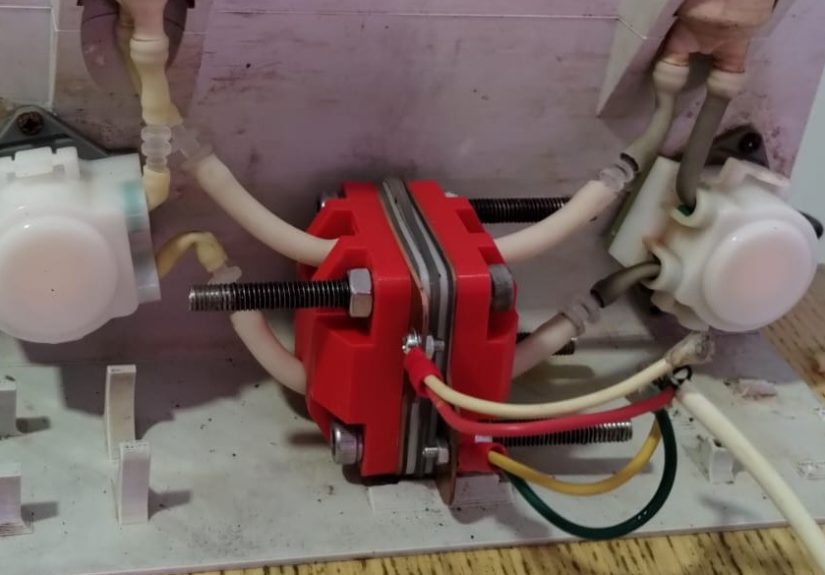
A serious open-source flow battery would likely include several major subsystems. First is the cell stack, where the electrochemical reactions happen. This includes electrodes, current collectors, flow frames, gaskets, separators or membranes, and compression hardware. Second are the electrolyte tanks, which hold the charged liquids. Third is the balance of plant: pumps, tubing, valves, filters, sensors, safety interlocks, and control electronics. Finally, there is the software layer, which monitors voltage, current, flow rate, temperature, and state-of-charge behavior.
In an open-source framework, each of those sections can be documented separately. The bill of materials should prioritize off-the-shelf parts when possible. Fabrication files should be accessible. Firmware should be readable. Testing protocols should specify cycling conditions clearly. Safety documentation should be blunt, not decorative.
The dream scenario is not that thousands of people suddenly build grid batteries in their basements. Please do not give your insurance company that kind of storyline. The real value is that open-source development can accelerate research, training, prototyping, and local manufacturing capacity.
Chemistries Worth Watching
No discussion of flow batteries is complete without chemistry, because chemistry is where all battery optimism goes to either become a product or a cautionary tale.
Vanadium redox flow batteries
Vanadium redox flow batteries are the most established and commercialized flow-battery family. They are well known, well studied, and often treated as the default reference point for the category. Their advantage is chemical symmetry: both sides use vanadium in different oxidation states, which can simplify some contamination concerns. Their disadvantage is that vanadium can be expensive and supply-sensitive, which puts pressure on cost.
Iron flow batteries
Iron flow batteries are attractive because iron is abundant, familiar, and generally much easier to talk about at a public meeting than exotic materials with price volatility. Researchers and companies have pursued multiple iron-based approaches because they offer a path toward lower-cost, safer stationary storage. The trade-off is that lower-cost chemistry still has to prove competitive system performance and long-term durability.
Organic and metal-free flow batteries
Organic flow batteries are one of the most fascinating directions in the field. They aim to replace or reduce reliance on metals by using organic active materials. On paper, that can improve tunability, cost potential, and sustainability. In practice, long-term stability remains the test. A chemistry that looks gorgeous in a paper and falls apart in real cycling is just an expensive mood board.
Zinc-based systems
Zinc-based systems, including zinc-bromine and zinc-iodide variants, keep drawing interest because they can offer appealing cost and energy-density trade-offs. They also bring engineering headaches such as plating behavior, side reactions, and component wear. In other words, they are promising, which in battery language usually means “worth the effort, but keep the wrench set nearby.”
The Hard Parts Nobody Should Pretend Are Easy
This is where honest writing must take over from marketing copy. An open-source flow battery is a powerful idea, but it is not a shortcut around hard electrochemistry.
Membranes and separators remain a major challenge. They affect ion transport, crossover, efficiency, durability, and cost. The membrane is one of those components that looks innocent in a diagram and then casually dominates your performance budget.
Electrolyte stability is another headache. A flow battery depends on liquids staying chemically useful over long operating periods. If the electrolyte degrades, precipitates, contaminates the opposite side, or becomes costly to refresh, the system loses its edge quickly.
Pumps and parasitic loads are the unglamorous tax on flow-battery performance. You do not just store and release electricity; you also spend energy moving fluid. That means the hydraulic design matters. A bad flow path can quietly eat efficiency for breakfast.
Sealing and manufacturability matter more than people think. A prototype can work beautifully on day one and still fail the moment somebody has to assemble it repeatedly at scale. Open-source projects that want real impact must think beyond “can this work?” and ask “can ordinary people build this consistently?”
Commercialization is still a hurdle for the whole category. While pilots and demonstrations continue, flow batteries remain less mature in the market than lithium-ion. The technology case is increasingly compelling for longer duration, but the bankability case is still catching up.
Real Progress Already Exists
The idea of an open-source flow battery is no longer just a thought experiment. Community-driven projects have started publishing development kits, design files, and roadmaps built around the idea of democratizing flow-battery technology. Some of these efforts focus first on educational and research-scale platforms rather than ready-to-deploy home or utility systems, which is exactly the sensible order of operations.
That detail matters. A credible open-source project should not pretend that a benchtop kit is a turnkey residential energy system. The smarter approach is to start with research and teaching tools, publish the hardware openly, standardize testing, and build toward larger formats gradually.
Academic research is also pushing the same philosophy from another angle. Open-source redox-flow research equipment has been proposed specifically to reduce the cost barrier for laboratories. That is a big deal. Making the research tools cheaper and more reproducible can speed up battery innovation even before the final commercial products are ready.
Meanwhile, the broader U.S. ecosystem keeps advancing the category. National labs and universities are exploring all-liquid iron systems, organic electrolytes, flow-through architectures, and materials that could improve energy density, durability, recyclability, or domestic manufacturability. The open-source movement does not replace that research. It complements it by widening access and shortening the feedback loop between design and experimentation.
What an Open-Source Flow Battery Could Change
If this idea matures well, an open-source flow battery could change more than battery hardware. It could reshape who gets to participate in energy-storage development.
Universities could train students on real, documented systems instead of black-box devices. Independent labs could validate results without needing custom-machined mystery parts. Small manufacturers could build around transparent designs. Communities interested in resilience could better understand what stationary storage really requires instead of shopping by buzzword.
There is also a strategic manufacturing angle. Open designs built around accessible materials and standardized components can help regional supply chains emerge faster. That does not eliminate the need for quality control, certification, or serious engineering. It does create a healthier foundation than betting everything on one proprietary box and hoping the warranty survives contact with reality.
Where the Hype Should Stop
An open-source flow battery is not likely to power electric cars, replace your laptop battery, or turn every garage into a mini utility next year. Flow batteries generally have lower energy density than lithium-ion systems, which is why they make more sense for stationary use. They are also system-heavy: tanks, pumps, piping, controls, and maintenance all matter.
And yes, open source does not automatically mean cheap, safe, or good. It means transparent and improvable. Those are wonderful qualities, but only when paired with rigorous testing, honest documentation, and a healthy respect for chemistry. Energy storage is not a place for fake-it-till-you-make-it engineering.
Conclusion
An open-source flow battery is one of the most compelling ideas in clean-energy hardware right now because it sits at the intersection of need and possibility. The need is obvious: the grid requires safer, longer-duration, more flexible energy storage as solar and wind grow. The possibility is equally real: flow batteries already offer modular scaling, promising safety profiles, and chemistry pathways based on abundant materials. Open-source development adds something the battery sector badly needsshared learning.
The smartest version of this future is not a gimmick and not a garage fantasy. It is an ecosystem where research tools, prototype cells, test methods, control systems, and eventually larger stationary designs are openly documented, reproducible, and improved by a broader community. If that happens, the flow battery may stop being the “interesting alternative” and start becoming what the grid has needed all along: a durable workhorse with a user manual everyone can actually read.
Practical Experiences and Lessons From the Open-Source Flow Battery World
One of the most interesting things about the open-source flow battery conversation is that the practical lessons are already arriving before the category becomes mainstream. Across public project updates, research papers, and experimental hardware efforts, the same pattern shows up again and again: the concept is elegant, but the reality lives in details. A flow battery can look beautifully simple in a diagramtwo tanks, a membrane, a pump loop, done. Then you try to assemble, test, clean, calibrate, cycle, and reproduce it, and suddenly you discover that every gasket, hose barb, current collector, and software threshold has opinions.
That is not bad news. It is exactly why open development is useful. People working on public flow-battery hardware have shown that accessible parts and standardized methods can lower the barrier for experimentation. They have also shown that reproducibility is the real boss battle. A design that works in one lab under one set of conditions is only the opening act. The harder challenge is getting the same behavior when a different builder sources parts from another vendor, uses a different pump, tightens clamps a little more aggressively, or runs the cell in a room that is five degrees warmer. In other words, battery performance is not just chemistry. It is workflow.
Another lesson is that open-source energy hardware attracts a wide range of contributors, and that diversity is surprisingly useful. Chemists care about electrolyte stability. Mechanical builders care about sealing and alignment. Electronics people care about sensing and control. Documentation-minded contributors care about whether another human can actually repeat the process without swearing at a CAD file for two hours. Flow batteries benefit from all of those perspectives because they are system technologies, not just materials technologies.
There is also a refreshing honesty in the best public discussions around these projects. The most credible builders do not pretend an experimental kit is ready to anchor a house, school, or community microgrid tomorrow. They treat early versions as research and education tools, which is the right move. That kind of restraint builds trust. It says the goal is not flashy battery cosplay; the goal is to create a documented path from experimentation to something robust enough for real-world stationary storage.
And perhaps the biggest practical takeaway is this: open-source flow batteries make the energy transition feel less abstract. Instead of talking about grid storage as a distant industrial miracle that arrives fully formed from a factory, they show the messy middlethe testing, the revisions, the trade-offs, and the shared learning. That mess is not a weakness. It is the sound of a technology growing up in public, where more people can understand it, challenge it, and help make it better.