Table of Contents >> Show >> Hide
- The Unlucky Beginning of a Very Unusual Black Rescue Cat
- Why Black Cats Still Fight an Unfair Reputation
- Finding a Forever Home Changed Everything
- The Hidden Talent: How Cole Became the Tarot Cat
- Why Netizens Fell in Love With Cole
- The Real Science Behind “Talented” Cats
- Rescue Cats Often Need Patience Before Their Personalities Bloom
- What Adopters Can Learn From Cole’s Story
- Why This Viral Cat Story Feels So Good
- Experience-Based Reflections: Living With a Rescue Cat Like Cole
- Conclusion
Every once in a while, the internet gets exactly what it deserves: not another argument about pineapple on pizza, not another celebrity “soft launch,” but a black rescue cat with a flair for the dramatic and a talent so oddly specific it sounds like a plot rejected from a cozy fantasy novel. Meet Cole, a black rescue cat whose early life included a rough streak of bad luck, shelter returns, illness, and shyness. Then he found his forever homeand, as if rewriting his own destiny with tiny velvet paws, revealed a hidden talent for pulling tarot cards.
The story is charming on the surface: a cat selects cards, drops them on the carpet, and becomes a mystical TikTok darling. But underneath the viral sparkle is something deeper and more relatable. Cole’s rise from overlooked rescue pet to internet-famous “tarot cat” highlights the power of adoption, the unfair stigma black cats still face, and the surprising intelligence cats show when humans give them patience, safety, and a reason to trust.
In other words, this is not just a cute cat story. It is a tiny, whiskered reminder that sometimes the animal everyone passes by is the one carrying the best plot twist.
The Unlucky Beginning of a Very Unusual Black Rescue Cat
Cole’s life did not begin with viral fame, cozy readings, or adoring fans asking what the universe had planned for their love life. Before finding stability, he had already been returned to a shelter twice before he was even six months old. For a young kitten, that kind of disruption matters. Cats are creatures of routine, scent, territory, and predictable relationships. When those pieces keep changing, many cats respond by becoming cautious, withdrawn, or downright suspicious of human intentions.
When Emily Cook met Cole, he was reportedly sick and kept away from the main adoption area. He was not the bright, outgoing kitten performing acrobatics at the front of a cage. He was the opposite: a black cat with a cautious temperament, an uncertain past, and the kind of quiet presence many adopters might accidentally overlook.
That is part of what makes the story so powerful. Cole was not adopted because he was already a star. He was adopted because someone looked beyond the obvious sales pitch. Emily saw a cat who needed a home, not a flawless little influencer-in-training. The internet got the magic later. Cole got the safety first.
Why Black Cats Still Fight an Unfair Reputation
Black cats have been carrying humanity’s weird baggage for centuries. Depending on the culture and time period, they have been seen as unlucky omens, witchy companions, symbols of mystery, protectors, or elegant little house panthers. The problem is that in modern shelters, even old myths can have real consequences.
Some animal welfare professionals and researchers have studied what is often called “black cat bias” or “dark cat syndrome,” the idea that darker-coated cats may be judged less favorably or adopted less quickly than lighter cats. The picture is not perfectly simple. Some newer animal-level shelter data challenges the broad claim that black cats always struggle more than other cats, especially around Halloween. Still, many shelters and welfare groups continue to report that myths, poor visibility in online photos, and old-fashioned superstition can influence adopter attention.
That is why Cole’s story matters beyond the “aww” factor. A black cat associated with “bad luck” did not bring misfortune. He brought personality, comfort, laughter, and an online community. If anything, Cole seems to have performed a neat public relations trick for black cats everywhere: he took the spooky stereotype, put a bow on it, and turned it into a reason people adored him.
Finding a Forever Home Changed Everything
A forever home is not just a sentimental phrase. For a rescue cat, it can mean the difference between survival mode and personality mode. A cat who is frightened in a shelter may not show curiosity, playfulness, affection, or problem-solving skills. Shelters can do incredible work, but they are also full of unfamiliar smells, sounds, people, routines, and animals. Even the most loving shelter environment is still not the same as a stable home with consistent care.
Once Cole settled in with Emily and her son, his real character had room to unfold. That is often how rescue pets work. They do not always arrive as finished stories. They arrive as first draftssometimes nervous, messy, and heavily edited by past experiences. With time, security, and respect, the best chapters begin to appear.
In Cole’s case, one of those chapters involved tarot cards. Because naturally, when a black cat decides to rebrand himself, he does not choose something ordinary like “fetch.” He chooses “mystical consultant.”
The Hidden Talent: How Cole Became the Tarot Cat
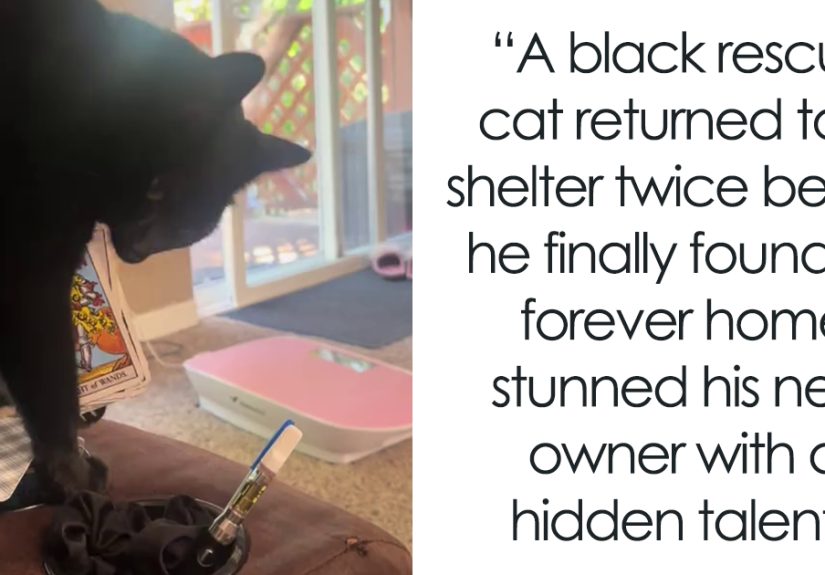
Emily was already interested in tarot and astrology, and she kept a traditional tarot deck near the couch. One day, Cole began investigating the cards. He did not simply bat them under furniture like a standard chaos goblin. Instead, he started grabbing cards with his mouth and dropping them onto the carpet. It looked intentional enough to catch Emily’s attention, and funny enough to make any cat owner ask the universal question: “Is my pet brilliant, weird, or both?”
Emily began rewarding him with treats when he selected cards. This is where the story becomes more than internet magic. Positive reinforcement is a real, well-established approach to animal training. When a cat does something voluntarily and receives something he enjoyssuch as a treat, praise, play, or attentionhe is more likely to repeat that behavior. Cole was not forced into performing. He was encouraged, rewarded, and allowed to participate when he felt like it.
That point matters. Cats are not tiny employees with quarterly performance reviews. They are independent animals with preferences, moods, boundaries, and an Olympic-level commitment to doing whatever they were already planning to do. Emily has emphasized that Cole’s readings happen on his terms, which may be the most cat-accurate business model ever invented.
Why Netizens Fell in Love With Cole
Social media loves animals, but it especially loves animals with a “thing.” A dog who presses talking buttons? Viral. A raccoon who paints? Viral. A cat who pulls tarot cards with the emotional gravitas of a tiny velvet oracle? Absolutely viral.
Cole’s online appeal comes from several ingredients working together. First, he is visually striking: sleek black coat, expressive eyes, mysterious energy. Second, the tarot-card behavior is unusual enough to feel magical without needing a Hollywood budget. Third, his backstory gives the whole thing heart. He is not just a novelty act; he is a rescue cat who got a second chance.
There is also something wonderfully funny about a cat giving life advice. Humans spend years overthinking relationships, jobs, timing, and personal growth. Then a black cat walks over, selects a card, drops it on the carpet, and suddenly everyone says, “Honestly, that tracks.” The comedy is built in. The cat does not explain. The cat simply delivers the message and wanders away, possibly to knock something off a table.
The Real Science Behind “Talented” Cats
While Cole’s tarot readings are presented as charming entertainment rather than laboratory research, his behavior fits something cat behavior experts have been saying for years: cats can learn, problem-solve, and participate in training when the environment supports them.
Studies and shelter-training resources have shown that cats can learn cued behaviors such as touching a target, sitting, spinning, or giving a high-five. Training can also act as enrichment, giving cats mental stimulation and positive interaction with people. In shelters, enrichment can help cats feel safer and may make them more comfortable showing their personalities to potential adopters.
This is important because many people still underestimate cats. Dogs are often treated like trainable companions, while cats are treated like decorative roommates with opinions. But cats learn constantly. They learn when the food bowl appears. They learn which human wakes up first. They learn which cabinet contains treats. They learn that walking across a keyboard produces immediate emotional results.
What Cole demonstrates in a playful way is that cats are not indifferent. They are observant. They are capable. And when humans pay attention to what interests them, cats can surprise everyone.
Rescue Cats Often Need Patience Before Their Personalities Bloom
One of the biggest lessons from Cole’s story is that a shy or cautious shelter cat should not be dismissed as “boring” or “unfriendly.” Many cats shut down in stressful environments. A cat hiding in the back of a kennel might become affectionate at home. A cat who seems reserved might become playful after several weeks. A cat who avoids strangers might bond deeply with one trusted person.
Adoption is not a one-day personality test. It is a relationship. The first meeting matters, but it does not reveal everything. Some cats need time to decompress in a quiet room. Some need predictable meals, soft bedding, clean litter, gentle handling, and slow introductions. Some need humans who can accept that trust is not delivered by express shipping.
Cole’s transformation from frightened rescue cat to beloved tarot performer shows what can happen when a cat is given room to become himself. Not every rescue cat will develop a viral talent, of course. Some will simply become excellent nap supervisors, biscuit makers, hallway sprinters, or bathroom-door philosophers. That is still magic.
What Adopters Can Learn From Cole’s Story
Look beyond color and first impressions
Adopters often gravitate toward cats who are outgoing, colorful, young, or photogenic. There is nothing wrong with falling in love at first sight, but it is worth remembering that quieter cats may be just as loving. Black cats, senior cats, shy cats, and cats with imperfect backstories can become extraordinary companions.
Use positive reinforcement
If your cat does something you like, reward it. That reward might be a small treat, a toy, praise, or gentle petting. The goal is not to turn your cat into a circus act. The goal is to build communication. Positive reinforcement can help with practical skills such as carrier training, scratching-post use, coming when called, or sitting calmly before meals.
Respect the cat’s choice
Cole’s popularity works because he is not treated like a machine. He participates when he wants to. That principle applies to all cats. Training and enrichment should be fun, short, and low-pressure. If a cat hides, hisses, growls, flattens his ears, or walks away, the session is over. The cat has voted.
Create enrichment at home
Cats need more than food and a litter box. They benefit from scratching posts, window perches, puzzle feeders, cardboard boxes, safe toys, climbing spaces, and interactive play. A bored cat may invent activities you do not approve of, such as “midnight opera” or “let’s remove every item from this shelf.” Enrichment gives that intelligence somewhere better to go.
Why This Viral Cat Story Feels So Good
Part of Cole’s appeal is that his story reverses expectations. The black cat associated with bad luck becomes the bringer of joy. The kitten returned twice becomes deeply wanted. The shy rescue becomes famous. The animal once hidden from view becomes the star everyone wants to see.
That kind of reversal is emotionally satisfying because it mirrors what people hope is true in their own lives: that a rough beginning does not decide the ending. Cole did not need to be perfect to be loved. He needed the right home. Once he had that, the rest of the story unfolded in a way nobody could have scripted.
And yes, the tarot angle makes it extra delicious. A black cat pulling cards is almost too on-brand. It is spooky, sweet, funny, and oddly elegant. But the real hidden talent may not be fortune-telling. It may be Cole’s ability to remind thousands of people that rescue animals are full of surprises.
Experience-Based Reflections: Living With a Rescue Cat Like Cole
Anyone who has lived with a rescue cat knows that the first few days can feel like hosting a very small, furry witness protection client. The cat may vanish under the bed. Food may disappear only at night. You may find yourself whispering encouraging speeches toward a shadow behind the laundry basket. This is normal. Rescue cats often need a decompression period, and the best thing a new adopter can do is resist the urge to rush the relationship.
A good first step is to give the cat a starter room: quiet, safe, and stocked with essentials. Include food and water, a clean litter box, a scratching surface, soft bedding, and a hiding place. Hiding is not failure. Hiding is a coping strategy. When the cat learns that nothing bad happens in that space, curiosity begins to win little battles against fear.
With a black rescue cat, photography and visibility can also become part of the experience. Black cats are famously difficult to photograph in dim rooms. One moment you are looking at a majestic mini-panther; the next, your camera captures a black sweater with eyes. Good lighting helps, but so does patience. The same is true emotionally. You may not see the cat’s full personality immediately. Then one day, the cat who used to hide will chase a toy, chirp at a bird, sleep near your feet, or place one paw on your hand like a tiny contract has been signed.
Training can become a beautiful bonding tool. Start with something simple. Reward your cat for looking at you, touching a target, stepping onto a mat, or entering a carrier voluntarily. Keep sessions shortjust a few minutes. End before your cat gets bored. The goal is not perfection; it is communication. When a cat realizes he can make good things happen by choosing certain behaviors, confidence grows.
For shy cats, confidence is everything. A cat who feels in control is more likely to explore, play, and engage. That is why Cole’s tarot-card habit is so delightful. Whether people view it as mystical, funny, symbolic, or simply clever, the behavior grew from curiosity and reward. He chose the cards. He learned the routine. He became part of a shared game.
There is also an emotional lesson for adopters: do not compare your rescue cat to anyone else’s pet. Some cats become lap cats. Some become shoulder cats. Some become hallway greeters. Some become private little souls who show affection by sitting three feet away and blinking slowly, which in cat language is practically a handwritten love poem. Your cat’s hidden talent may not be tarot. It may be trust.
Living with a rescue cat teaches you to celebrate small milestones. The first relaxed nap. The first purr. The first time the cat eats while you are in the room. The first time he chooses to sit near you. These moments may not go viral, but inside a home, they feel enormous. Cole’s fame is fun, but his real victory is quieter: he found a person who let him feel safe enough to become strange, joyful, and fully himself.
That is the heart of every good adoption story. A shelter animal does not need a perfect past to build a wonderful future. Sometimes all it takes is one patient human, one safe room, one favorite reward, and enough time for the magic to show itself. In Cole’s case, the magic came with tarot cards. In another home, it may come with purrs, head bumps, zoomies, or the sacred daily ritual of sitting directly on whatever you are trying to read.
Conclusion
Cole’s story is more than a viral moment about a black rescue cat with an unusual hidden talent. It is a hopeful reminder that shelter animals are not defined by rejection, superstition, or a rough beginning. Returned twice before six months old and once too cautious to charm a crowd, Cole found a forever home where patience helped his personality shine. His tarot-card habit may be quirky, but the lesson is beautifully practical: rescue cats thrive when they are given safety, respect, enrichment, and love.
For anyone considering adoption, Cole makes a persuasive case for looking twice at the quiet cat, the black cat, the shy cat, or the one who does not immediately perform for visitors. The next overlooked shelter pet may not read tarot, but they may still change the atmosphere of a home in ways no one can predict. And if they do happen to pull The Sun card from a deck on your couch, well, congratulationsyou may have adopted a tiny consultant with whiskers.