Table of Contents >> Show >> Hide
- Before You Start: Safety, Tools, and Timing
- Step-by-Step: How to Take Oleander Cuttings
- Rooting Oleander Cuttings in Water vs. Soil
- Caring for Newly Rooted Oleanders
- Common Problems When Propagating Oleanders (and How to Fix Them)
- Frequently Asked Questions About Oleander Cuttings
- Real-World Experiences: Lessons from Rooting Oleanders
- Conclusion
Oleanders are the drama queens of the shrub world: big, glossy foliage, nonstop
blooms, and serious Mediterranean vacation vibes. They’re also famously tough
and drought-tolerant, which makes them popular in hot, dry climates. The best
news? You don’t have to buy a dozen plants to get that lush hedge. You can grow
oleanders from cuttings and clone your favorite shrub for almost no money.
In this step-by-step guide, we’ll walk through exactly how to propagate oleanders
from cuttings, whether you root them in water or in potting mix. You’ll learn
when to take cuttings, how to prepare them, how to avoid rot and failure, and
what to do once those roots finally appear. We’ll also cover an essential topic
many guides gloss over: oleanders are highly toxic, so we’ll talk about how to
handle them safely while still enjoying their beauty.
Before You Start: Safety, Tools, and Timing
Important Safety Warning: Oleanders Are Highly Toxic
Let’s get the serious part out of the way first. All parts of the oleander plant
are poisonous if ingested leaves, flowers, stems, and even the sap. Ingesting
enough plant material can affect the heart, and smoke from burning oleander
clippings can also be toxic. Handle oleanders with respect and basic safety
precautions:
- Always wear gloves when cutting or repotting oleanders.
- Avoid touching your face, eyes, or mouth while handling the plant.
- Wash your hands and tools thoroughly after you’re done.
- Keep cuttings and plants away from children, pets, and grazing animals.
- Do not burn oleander prunings; bag and dispose of them with household trash where allowed.
With sensible precautions, millions of people grow oleanders safely. Just treat
them like you would any other toxic ornamental and you’ll be fine.
Best Time of Year to Take Oleander Cuttings
Oleanders root most easily from softwood or semi-hardwood cuttings that is,
from the current season’s growth that’s still flexible but not mushy. For most
warm climates, that means:
- Late spring to mid-summer: ideal for softwood or semi-hardwood cuttings.
- Late summer to early fall: still workable in many areas if nights are warm.
You can also root hardwood cuttings taken during pruning in late fall or winter,
but they tend to take longer and may have lower success compared to lively
spring growth. If you’re a beginner, aim for late spring or early summer when
the plant is actively growing and the sap is flowing.
Tools and Materials You’ll Need
Gather everything before you start, so you’re not running around with sap on your hands.
- Healthy, established oleander plant (your “mother” plant)
- Sharp bypass pruners or a clean knife
- Disposable or washable gloves
- Rubbing alcohol or bleach solution for sterilizing tools
- Small pots or nursery cells (with drainage holes)
- Well-draining rooting medium: a mix such as perlite + peat/coco coir, or perlite + potting mix
- Optional: rooting hormone powder or gel
- Clear plastic bag, humidity dome, or plastic container to create a mini greenhouse
- Labels and a marker (future you will forget which cutting is which)
Step-by-Step: How to Take Oleander Cuttings
Oleanders are generally easy to root once you pick the right stems and give them
the conditions they like. Here’s a simple, repeatable process.
Step 1: Choose a Healthy Parent Plant
Start with a vigorous, disease-free oleander that’s receiving plenty of sun and
regular water. Don’t take cuttings from a plant that’s stressed, infested with
pests, or struggling in poor soil. Cuttings copy whatever mood the mother plant
is in a sulking parent makes a sulking baby.
Step 2: Select the Right Stem
Look for stems that:
- Are from the current season’s growth, still somewhat flexible but not floppy
- Are about the thickness of a pencil or slightly thinner
- Do not currently carry open flowers if possible (flowering drains energy)
Aim for cuttings about 6–8 inches (15–20 cm) long. The stem should have
several sets of leaves and obvious nodes (the little bumps or joints where leaves
attach or where side shoots form).
Step 3: Make a Clean, Precise Cut
- Put on your gloves.
- Sterilize your pruners or knife with rubbing alcohol or a 1:10 bleach solution.
- Cut the stem just below a node, at a slight angle.
Cutting right below a node gives you a section rich in hormones that encourage
root growth. The angle cut also helps water run off the stem.
Step 4: Strip the Lower Leaves
Remove all leaves from the bottom half to two-thirds of the cutting, leaving only
a small cluster of leaves at the tip. This reduces moisture loss and keeps leaves
from rotting in the rooting medium or water.
If there are flower buds or open blooms, remove those as well. You want the
cutting focused on growing roots, not putting on a floral show.
Step 5: Optional Wounding and Rooting Hormone
Oleanders root well without hormone, but if you want to increase your chances:
- Use your pruners or a clean knife to make two shallow vertical nicks in the bark at the base of the cutting.
- Dip the wounded end into rooting hormone powder or gel, tapping off the excess.
This exposes more tissue where roots can form and gives them a little chemical
nudge to get going.
Rooting Oleander Cuttings in Water vs. Soil
You can root oleanders either in water or directly in a potting mix. Both work,
and many gardeners end up with a favorite method. Here’s how to do each.
Method 1: Rooting Oleander Cuttings in Water
Water rooting is very satisfying because you can actually see the roots develop.
It’s also a good way to monitor whether the cutting is rotting or thriving.
- Fill a clean glass or jar with lukewarm water.
- Place the cutting in the water, making sure no leaves are submerged.
- Set the container in bright, indirect light avoid harsh midday sun that can overheat the jar.
- Change the water every few days to keep it fresh and oxygenated.
In warm, bright conditions, you may see roots starting in 1–3 weeks, with
stronger root systems forming over 4–6 weeks. Once roots are a few inches long
and branching, the cutting is ready to pot into a soil mix.
Method 2: Rooting Oleander Cuttings in Potting Mix
Rooting directly in a well-draining medium is closer to how the cutting will live
long-term and avoids transplant shock from water to soil.
- Fill small pots with a light, airy rooting mix: equal parts perlite and peat/coco coir, or a high-quality potting mix cut with perlite.
- Moisten the mix thoroughly, then let excess water drain.
- Use a pencil or dibber to poke a planting hole in the center.
- Insert the cutting so at least one or two nodes are buried below the surface.
- Gently firm the mix around the stem so it stands upright.
- Label the pot with the plant name and date.
To keep humidity high, cover the pot with a clear plastic bag or place it in a
clear plastic container. Leave a small gap for air exchange so your cuttings don’t
suffocate or mold. Place them in bright, indirect light and keep the temperature
around 65–75°F (18–24°C).
Keep the rooting medium slightly moist but never soggy. If you’re unsure, err
slightly on the dry side oleander cuttings often fail more from rot than from
mild dryness.
How Long Do Oleander Cuttings Take to Root?
Under good conditions, softwood or semi-hardwood oleander cuttings often start
forming roots within 2–4 weeks. Cooler temperatures, lower light, or very woody
cuttings can stretch that to 6–8 weeks or more.
Signs your cutting has rooted:
- New leaf growth at the tip
- Cutting resists a gentle tug (don’t yank just test lightly)
- Roots peeking out of the drainage holes at the bottom of the pot
Caring for Newly Rooted Oleanders
Potting Up and Hardening Off
Once your cutting has a solid root system, it’s time to graduate it to a slightly
larger pot.
- Prepare a pot one size larger with a well-draining potting mix.
- Gently tip out the rooted cutting, supporting the root ball with your hand.
- Place it in the new pot at the same depth it was growing before.
- Backfill with potting mix, firm lightly, and water thoroughly.
For the first week or two, keep your new oleander in bright, indirect light. Then
gradually introduce it to stronger sun, especially if it will live outdoors. This
process “hardening off” prevents sun scorch on tender leaves.
Feed lightly with a balanced, slow-release fertilizer or a diluted liquid feed
once you see steady new growth. Oleanders are not delicate, but young plants still
appreciate a gentle start.
When to Plant Rooted Cuttings Outdoors
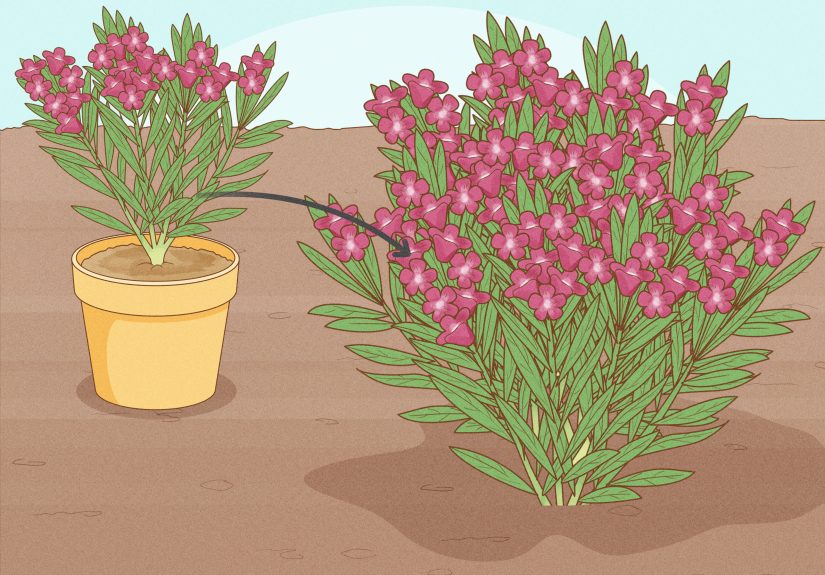
If you live in a climate where oleanders are hardy (roughly USDA Zones 8–11),
wait until all danger of frost has passed and nights are consistently warm before
planting outside. Choose a spot with:
- Full sun for best flowering
- Well-drained soil (oleanders hate soggy feet)
- Enough space mature plants can reach 8–20 feet tall and 6–10 feet wide
Space plants according to their expected mature width; for hedges, many gardeners
plant them 5–8 feet apart. If your winters are cold, you can grow oleanders in
large containers and move them to a protected spot when temperatures drop.
Common Problems When Propagating Oleanders (and How to Fix Them)
Problem: Cuttings Rot Before Rooting
If the base of the cutting turns brown or black and mushy, rot has moved in.
Typical causes include:
- Medium kept too wet
- Poor drainage or heavy garden soil instead of a light mix
- Cool temperatures combined with high moisture
- Dirty tools or containers introducing pathogens
Solution: use a sterile, airy rooting mix; water only when the surface feels just
dry; provide warmth; and always clean your tools before cutting.
Problem: Cuttings Wilt and Collapse
Wilting can happen if the cutting loses more moisture through its leaves than the
stem can replace while it’s still rootless.
- Remove more leaves so the cutting has less to support.
- Improve humidity with a clear cover, but allow some ventilation.
- Move the cutting out of direct sun into bright, indirect light.
Problem: No Roots After Many Weeks
Sometimes you wait six or eight weeks and still get no roots. Common reasons:
- Cuttings taken from very old, woody stems
- Cuttings taken in the wrong season (too cold or too dormant)
- Weak or stressed parent plant
- Temperatures too low for active rooting
Try again with younger, semi-hardwood stems in late spring or early summer and
keep them in a consistently warm, bright spot.
Frequently Asked Questions About Oleander Cuttings
Can I Grow Oleanders from Hardwood Cuttings?
Yes, it’s possible to root hardwood cuttings taken during the dormant season, but
they usually take longer and may have lower success rates than softwood or
semi-hardwood cuttings. If you’re pruning your oleander back in fall or winter
anyway, it’s worth sticking a few hardwood pieces into pots as an experiment
just don’t rely on them as your only batch.
Do I Really Need Rooting Hormone?
Rooting hormone isn’t mandatory for oleanders, which are naturally quite willing
to root, but it can meaningfully boost your success rate, especially in cooler or
less-than-perfect conditions. Think of it as extra encouragement, not a magic
spell.
Are Oleanders Safe to Grow Around Kids and Pets?
Oleanders are widely grown in public landscapes, but they are not snack-safe
plants. If you have small children or curious pets that chew on vegetation, think
carefully about where you plant them. You might:
- Use oleanders only in areas that kids and pets can’t access easily.
- Teach older children that this plant is “look, don’t touch, definitely don’t taste.”
- Consider kid- and pet-friendly alternatives if you’re worried.
If you suspect ingestion of oleander leaves or flowers, contact your local poison
control center or veterinarian immediately.
Real-World Experiences: Lessons from Rooting Oleanders
On paper, propagating oleanders from cuttings is straightforward: cut, stick,
wait, celebrate. In real gardens, it’s more like: cut, stick, second-guess, poke
the stem too often, and finally celebrate. Here are some experience-based tips
that don’t always make it into the textbooks.
First, oleanders reward patience. Many gardeners get nervous after a week and
start tugging hard on the cutting to “check” for roots. That’s the propagation
version of opening the oven every two minutes to see if the cake is done. Roots
are delicate at the beginning. A hard tug can rip them off and set the cutting
back or kill it altogether. A better approach is to watch for subtle signs:
slightly firmer stems, perkier leaves, and, later on, resistance to a very gentle
wiggle.
Second, “bright, indirect light” really does matter. Oleander cuttings sitting
in deep shade may root slowly, but those baking in harsh midday sun under plastic
covers can cook in hours. Gardeners who have the best results often keep their
cuttings on a covered porch, under shade cloth, or near an east-facing window
spots where the light is strong but filtered. Indoors, a bright window with sheer
curtains or a spot under a grow light set a bit higher than usual works well.
Third, the rooting medium is not the place to get sentimental about garden soil.
Many of us feel tempted to scoop up a shovel of backyard earth to make the process
feel “natural.” Unfortunately, garden soil in a pot compacts, holds too much
water, and often brings fungal spores along for the ride. Lightweight mixes with
perlite or coarse sand look annoyingly artificial, but they supply the air space
that developing oleander roots love. Gardeners who switch from heavy soil to
airy mixes usually see an immediate jump in success.
Another common lesson is that “more is more” when it comes to the number of
cuttings. Even with an easy plant like oleander, not every cutting will root. If
you want a hedge of six plants, don’t take six cuttings take twelve or more.
You can always give extras away, and having backups takes the emotional pressure
off each individual stem. It’s much easier to experiment with different methods
(water vs. soil, hormone vs. no hormone) when your entire dream doesn’t hinge on
a single cutting.
Finally, don’t underestimate how helpful labels and notes can be. Oleander
cuttings all look suspiciously similar after a few weeks. A simple tag with the
variety name and date, plus a quick note in your phone about which mix and method
you used, turns each batch into a mini experiment. Over time, you’ll discover
patterns: maybe your pink variety roots faster in water, while the white one does
better in a perlite-heavy mix; or maybe a seedling heat mat cuts rooting time by
a third. That’s how gardeners quietly become experts not by memorizing charts,
but by paying attention to what works in their own conditions.
When you finally plant out a row of blooming shrubs that you started yourself
from small cuttings, the satisfaction is enormous. You didn’t just buy a landscape;
you built it from scratch. And every time those oleanders flower, you’ll remember
the little jars, the plastic bags, the patient waiting, and the moment you saw
those first white roots fuzzing out along the stem. That’s the kind of gardener
confidence no store-bought shrub can replicate.
Conclusion
Growing oleanders from cuttings is a budget-friendly, beginner-friendly way to
multiply one of the most dramatic flowering shrubs in the garden. With basic
safety precautions, the right timing, and a simple rooting setup, you can turn a
single plant into a whole row of future showstoppers. Start with healthy
semi-hardwood stems, root them in water or a light potting mix, keep humidity and
warmth steady, and resist the temptation to fuss too much.
Treat your cuttings like a slow project rather than a quick fix. In a few weeks
to a couple of months, you’ll have sturdy young oleander plants ready to move
into larger pots or into the garden. Each one is a clone of a plant you already
know and love same flowers, same growth habit, same toughness. That’s the magic
of propagation: you’re not just growing plants; you’re multiplying your favorite
pieces of the garden, one cutting at a time.