Table of Contents >> Show >> Hide
- Why Making Things Helps (Even If They’re a Little Lopsided)
- What the Research and Big-Name Health Orgs Point To
- 7 Ways Arts and Crafts Support Mental Health (With Specific Examples)
- 1) Lower stress and a calmer body
- 2) A practical tool for anxiety and grounding
- 3) Mood boosts through small wins (especially helpful for depression)
- 4) Emotional expression without needing perfect words
- 5) Better coping skills and resilience
- 6) Social connection (without the pressure of constant talking)
- 7) Cognitive stimulation and healthy aging
- Craft Ideas That Work Even If You “Aren’t Creative”
- How to Get the Mental Health Benefits (Without Turning It into Homework)
- When It’s More Than a Hobby: Art Therapy vs. Casual Crafting
- Quick Start: A 15-Minute “Mental Reset” Craft Routine
- Common Questions (Because Your Brain Will Ask Them)
- Conclusion: Your Brain Secretly Likes Glue Sticks
- Real-World Experiences: What Crafting Feels Like in Practice (About )
If your brain has been acting like a browser with 37 tabs open (two are playing music, one is frozen, and you
can’t find the one with the important thing), arts and crafts can be a surprisingly effective “refresh” button.
Not because glitter is magical (though it does show up everywhere like it pays rent), but because making something
with your hands nudges your nervous system toward calmer settings and gives your mind a place to land.
This isn’t about becoming a capital-A Artist or producing museum-ready pottery. It’s about the process: cutting,
folding, stitching, coloring, shaping, buildingsmall actions that can create big psychological benefits. And yes,
your first attempt can look like a raccoon made it in the dark. The mental health perks still count.
Why Making Things Helps (Even If They’re a Little Lopsided)
1) It pulls you into the present moment
Crafting naturally steers attention toward what’s right in front of you: the texture of yarn, the drag of pencil on
paper, the click of knitting needles, the “wait, where did my scissors go?” scavenger hunt. That gentle focus can
feel a lot like mindfulnessanchoring your attention to something concrete when your thoughts want to sprint into
the future or replay the past.
2) It gives your mind a “job” that isn’t worrying
Anxiety loves an idle brain. Give your hands a taskespecially a repetitive or step-by-step oneand your mind often
quiets down because it’s busy tracking the next stitch, brushstroke, or fold. You’re not “escaping” your feelings;
you’re giving your nervous system a safer channel to move through them.
3) It creates a sense of control and agency
Mental health struggles can make life feel unpredictable. Crafting offers a small, reliable loop: you do a thing,
and something changes. You pick colors. You make choices. You finish a row. You fix a mistake. That sense of “I can
influence outcomes” can be groundingespecially on days when everything else feels messy.
4) It can nudge you into “flow”
Flow is that sweet spot where you’re absorbed in an activitynot bored, not overwhelmed, just engaged. Crafting is
excellent at this because it often sits in the “pleasantly challenging” zone. When flow happens, rumination and
self-criticism tend to get quieter because your attention is fully occupied.
5) It turns emotions into something you can hold
Feelings can be abstract and slippery. Creative work externalizes them. A collage can become a mood board of “what
my week feels like.” A messy painting can be a safe place for anger to exist without hurting anyone. A neatly
organized bead pattern can be a break from chaos. You don’t have to explain your emotions perfectly to benefit from
expressing them.
What the Research and Big-Name Health Orgs Point To
Across mental health organizations, medical centers, and research settings, a few themes show up repeatedly:
creative activities can reduce stress, support emotional expression, improve coping, and help people feel more
connected to themselves and others. Some findings are especially practical:
-
Stress relief is a common outcome. In some studies, making art has been associated with lower
stress hormones after a single sessionsuggesting your body may respond quickly to creative engagement. -
Hobbies correlate with better well-being. Large-scale research on hobbies (including creative
ones) links them with improvements in mood and overall well-being across diverse populations. -
Art therapy is a recognized mental health approach. Licensed or credentialed professionals use
creative processes in structured ways to support people coping with anxiety, depression, trauma, pain, and more. -
Even simple activities count. Coloring, collage, and low-pressure crafts may help calm the mind,
promote relaxation, and provide an accessible “entry ramp” for people who don’t identify as creative.
In other words: you don’t need to carve a marble statue of your emotions. You can start with a glue stick and
a half-finished coloring page and still get meaningful benefits.
7 Ways Arts and Crafts Support Mental Health (With Specific Examples)
1) Lower stress and a calmer body
Stress isn’t just a thought; it’s a whole-body experience. Crafting can cue your system to downshift by focusing
attention, slowing breathing, and giving your brain a soothing task. Repetitive crafts (knitting, crochet,
weaving, beading) are especially good at this because the rhythm itself can be calming.
Example: After a tense workday, you spend 15 minutes coloring while dinner cooks. Your mind stops
rehearsing that awkward meeting, and your shoulders drop about half an inch. Not a miraclejust your nervous system
getting a more peaceful signal.
2) A practical tool for anxiety and grounding
Anxiety often pulls attention into “what if?” spirals. Crafts pull attention back into “what is.” That makes them
useful as grounding tools: something you can do when anxious energy needs a safe place to go.
Example: You keep a small “anxiety kit” with origami paper and a simple fold sequence. When you feel
jittery, you fold one cranenot to solve everything, but to stop the spiral from snowballing.
3) Mood boosts through small wins (especially helpful for depression)
Depression can make even easy tasks feel heavy. Crafts offer “micro-accomplishments” that are tangible and
realistic. Completing a row, finishing a card, or even organizing supplies can build momentum and counter the
brain’s “nothing matters” soundtrack.
Example: You set a goal to cut out five magazine images for a collagejust five. You finish, and your
brain gets a tiny but real hit of achievement. That matters more than it sounds.
4) Emotional expression without needing perfect words
Sometimes we don’t have language for what we feel (or we have language, but it’s currently trapped behind a wall of
“I’m fine”). Art gives emotions a different route out. You can express complexity through color, shape, texture, and
symbolismno TED Talk required.
Example: You paint with only two colors for a weekone for “energy” and one for “exhaustion.” By the end,
you can literally see patterns in your mood that were hard to name.
5) Better coping skills and resilience
Crafting teaches you to handle mistakes, adjust plans, and keep goingskills that transfer surprisingly well to
mental health. When you learn, “Oops, wrong stitch… I can fix it,” you also rehearse, “Oops, rough day… I can cope
with it.”
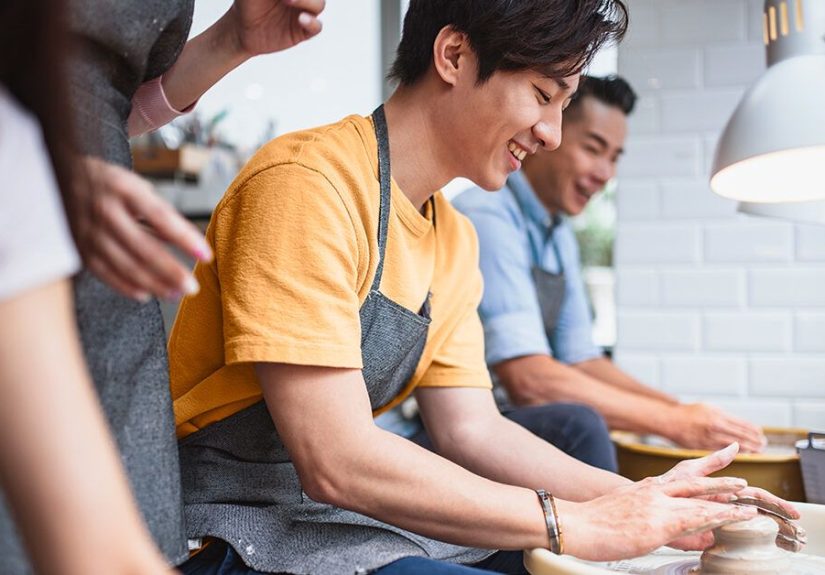
Example: Your clay mug collapses. Instead of spiraling into self-criticism, you turn it into a small bowl.
That flexibility is resilience practice in disguise.
6) Social connection (without the pressure of constant talking)
Loneliness and isolation can worsen mental health symptoms. Craft groups create “side-by-side” connection: you’re
with people, doing something, but you don’t have to perform socially the whole time. Conversation can happen
naturallyor not at all.
Example: You join a community crochet circle. Half the time you chat, half the time you just stitch in
comfortable silence. Either way, you leave feeling more human.
7) Cognitive stimulation and healthy aging
Creative activities can engage attention, memory, planning, and fine motor skills. For older adults, arts
participation is often discussed as one promising route to supporting well-being, independence, and quality of life.
It’s not a “brain insurance policy,” but it is meaningful mental exerciseespecially when it’s enjoyable.
Example: You try a weekly watercolor class. Remembering techniques, mixing colors, and practicing shapes
keeps your brain active while also improving mood.
Craft Ideas That Work Even If You “Aren’t Creative”
If you’ve ever said, “I’m not creative,” congratulations: you’re a normal person who has been bullied by
perfectionism. Here are options that are low-pressure and high-reward.
Low-mess, low-commitment starters
- Coloring: Adult coloring books, simple mandalas, or freehand doodles.
- Collage: Scissors, magazines, glue. Curate images that match your mood (or your dream mood).
- Origami: Repetitive folds + clear steps = calm brain.
- Sticker journaling: Minimal effort, maximal dopamine.
Tactile, rhythmic crafts for soothing repetition
- Knitting or crochet: Great for “busy hands” and steady pacing.
- Beading: Pattern-based and satisfyinglike tiny puzzles you can wear.
- Embroidery: Slow, focused, and oddly meditative.
- Macramé: Knots that make your brain stop tying itself in knots (sometimes).
Creative “life crafts” that still count
- Cooking or baking projects: Decorate cupcakes, try bread shaping, experiment with plating.
- Gardening + DIY planters: Painting pots, labeling herbs, simple terrariums.
- Upcycling: Turn old jars into candle holders or storagefunctional creativity is still creativity.
How to Get the Mental Health Benefits (Without Turning It into Homework)
Crafting helps most when it feels doable and kindnot like another performance metric. Here’s how to set yourself
up for success:
Make it ridiculously easy to start
- The 10-minute rule: Promise yourself you’ll do it for 10 minutes. If you keep going, great. If
you stop, you still win. - Keep a “grab-and-go” kit: One box with your basics (scissors, glue, markers, yarn). Less
friction = more follow-through. - Choose projects with quick feedback: Coloring, collage, simple patternsanything that feels
rewarding fast.
Practice “process over product”
A useful mantra from art therapy circles is that the benefit is in the doing, not the outcome. If the goal is
mental health support, your craft is allowed to be imperfect. Frankly, it’s allowed to be weird.
Use crafts as a mood check-in
Try rating your stress from 1–10 before and after. Over time, you’ll learn what types of crafts help you most:
repetitive ones for anxiety, expressive ones for emotions, social ones for loneliness, structured ones for
overthinking.
Protect your joy from the comparison trap
Social media can turn crafting into a highlight reel competition. If you notice your mood dropping after scrolling
“perfect” projects, consider a simple boundary: create first, then browse later (or not at all).
When It’s More Than a Hobby: Art Therapy vs. Casual Crafting
Crafting at home can be great for mental health, but it’s not identical to art therapy. Art therapy is a mental
health profession where trained clinicians use creative processes within a therapeutic relationship to support
specific goals (like emotion regulation, trauma processing, coping skills, and communication).
Consider professional support if:
- You’re coping with trauma and want guidance to feel safe while expressing difficult material.
- Your anxiety, depression, or stress is interfering with daily functioning.
- You’re using substances or self-harm behaviors to cope.
- You want structure, feedback, and mental health tools alongside creativity.
If you’re curious about art therapy, look for a credentialed professional (requirements vary by state). A qualified
therapist can help you use creativity as a support tool without getting overwhelmed by what comes up.
Quick Start: A 15-Minute “Mental Reset” Craft Routine
- Pick one tiny project: a doodle page, a mini-collage, one crochet square, or a single origami fold sequence.
- Set a timer for 15 minutes (not “until it’s perfect”).
- Choose a mood intention: calm, release, focus, or comfort.
- Create without judgment: if your inner critic shows up, thank it for its concern and keep gluing.
- Close with one sentence: “Right now I feel ____.” That’s it. No essay required.
Common Questions (Because Your Brain Will Ask Them)
“Do I have to be good at art for this to work?”
Nope. The mental health value is strongly tied to engagement and expression, not talent. In fact, low-stakes,
imperfect crafting is often better because it keeps pressure low.
“What if crafting frustrates me?”
Then your craft is giving you useful information. Try simplifying the project, switching to a more structured
activity (coloring, patterns), or shortening the time. The goal is regulation, not endurance training.
“Does digital art count?”
It can. Some people love the convenience and freedom of digital tools. If screens ramp up your stress, consider
balancing digital creativity with a tactile craft, especially before bed.
Conclusion: Your Brain Secretly Likes Glue Sticks
Arts and crafts can support mental health in a way that’s approachable, flexible, andimportantlyhuman. You get
stress relief, grounding, emotional expression, and a sense of progress that doesn’t require a life overhaul.
Whether you’re painting, knitting, collaging, or coloring outside the lines like a rebel, you’re practicing skills
your mind and body understand: focus, calm, and meaning-making.
Start small. Stay kind. And remember: if the worst thing that happens today is that your paper snowflake looks like
a confused amoeba, you’re doing fine.
Real-World Experiences: What Crafting Feels Like in Practice (About )
People often assume the benefit of crafting is the final productthe scarf, the drawing, the candle, the perfectly
lettered quote that makes your kitchen look like a Pinterest board. But when you listen to real stories (from
friends, support groups, clinicians, and everyday humans), the “aha” moments are almost always about how crafting
feels while it’s happening.
One common experience is what you might call the post-meeting decompression. Someone finishes a
stressful Zoom call, feels their heart still racing, and reaches for something simple: coloring, a small embroidery
hoop, or a paint-by-number set. Ten minutes later, their breathing is slower, their jaw unclenches, and their brain
stops replaying every sentence they said. The craft doesn’t erase the stressorit helps their body stop acting like
the stressor is still happening.
Another frequent report shows up with anxiety: crafting as a “safe channel” for nervous energy.
Think of the person who can’t sit still during a tough week. They try meditation, but their thoughts do parkour.
Then they discover crochet or beadingsomething repetitive that requires just enough focus to keep the mind from
spinning out. Their hands stay busy, and the anxious energy doesn’t have to explode into doom-scrolling or
catastrophizing. It gets converted into stitches, patterns, and tiny moments of “okay, I can do the next step.”
People dealing with depression often describe a different kind of experience: the power of visible proof.
Depression can whisper, “You didn’t do anything today.” A small craft pushes back with receipts. You made a card.
You folded paper. You painted one corner of a canvas. Even if it’s not “finished,” it exists. That physical
evidence can be surprisingly emotionalbecause it challenges the idea that you’re stuck or incapable. It’s not a
cure, but it’s a crack of light in a heavy day.
There’s also a social side that people underestimate: connection without pressure. In craft groups,
conversation isn’t the only point; the activity carries some of the weight. People who struggle with social anxiety
often say a knitting circle or community art night feels easier than a pure “let’s talk” hangout. If you want to
chat, you can. If you don’t, you can still belong. The craft becomes a shared language.
Finally, many describe crafting as an emotional translator. On days when feelings are too big or too
confusing for words, they choose colors, shapes, or textures that match what’s inside. Sometimes they don’t
understand the meaning until afterward. Sometimes they never “decode” itand still feel better. The point isn’t
producing a perfect interpretation. The point is giving your inner world a safe way to move.
If any of these experiences sound familiar, you don’t need to wait for motivation to strike. Set up the smallest
possible versionone page, one square, one tiny project. Let your hands lead for a while. Your brain often follows.