Table of Contents >> Show >> Hide
- Why an A-Frame Ladder Shelf Works (A Little Design + Physics)
- Project Overview
- Tools and Materials
- Plan Your Size (So It Fits Like It Was Meant to Be There)
- Cut List (Example for a 5-Shelf, 72-In Tall Ladder Shelf)
- Safety First (Because Fingers Are Not “Replaceable Parts”)
- Step-by-Step: Build Your A-Frame Ladder Shelf
- Step 1: Pick Straight Lumber and Decide Your Lean
- Step 2: Mark Shelf Heights with a “Story Stick”
- Step 3: Attach Shelf Supports (Cleats) to the Side Rails
- Step 4: Cut the Shelves (Neat Edges = “I Bought This” Energy)
- Step 5: Dry Fit Everything Before Final Assembly
- Step 6: Fasten the Shelves to the Supports
- Step 7: Add a Top Spacer (Helps Stability and Looks Finished)
- Step 8: Anchor for Safety (Highly Recommended)
- Sanding and Finishing (Where It Goes from “DIY” to “Dang, Nice”)
- Styling Ideas for a Ladder Shelf That Looks Intentional
- Troubleshooting: Common Issues and Quick Fixes
- Conclusion
- Builder Experiences: Real-World Notes That Make Your Build Easier (500+ Words)
- 1) The “Baseboard Surprise” Is Real
- 2) Level Shelves on Angled Rails Feel Weird (But It’s Correct)
- 3) Plywood Cuts: Tear-Out Is the Drama You Didn’t Ask For
- 4) Pocket Holes Are Amazing… Until You Use the Wrong Screws
- 5) Finishing Takes Longer Than the Build (Emotionally and Literally)
- 6) Styling Can Make It Look Wider (or Smaller)
- 7) The Biggest “Wish I’d Done This” Upgrade: Anchoring
If your home had a “stuff-to-square-foot” ratio, would it be… a little spicy? Same. The good news: an A-frame ladder shelf is one of those rare DIY projects
that looks designer, stores a surprising amount, and doesn’t require you to own a workshop the size of a Costco.
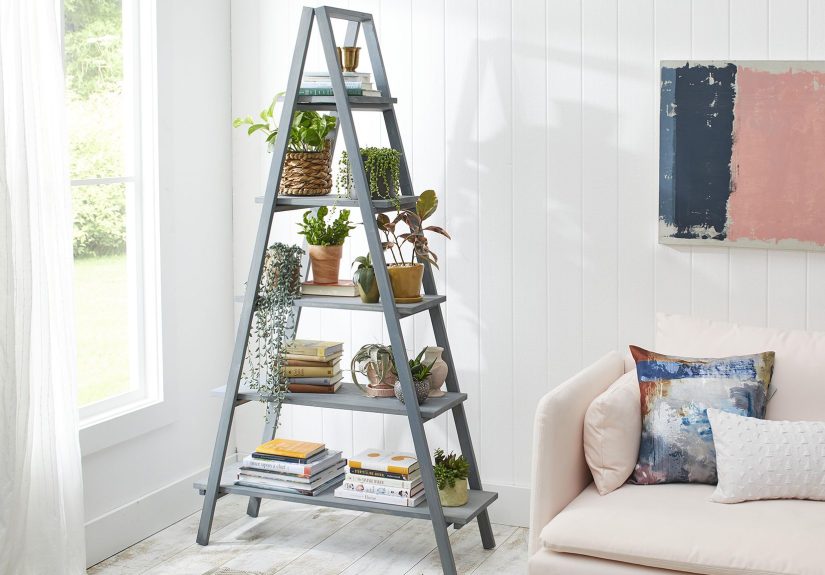
In this guide, you’ll build a slim, wall-leaning ladder shelf with that classic A-frame silhouette (wider at the bottom, narrower at the top). It’s ideal for
small-space storage, open shelving displays, and making a sad blank wall finally contribute something to the household.
Why an A-Frame Ladder Shelf Works (A Little Design + Physics)
Ladder shelves look “light,” but the shape is doing real work. The angled side rails create a stable footprint at the bottom and a smaller profile up top, so the
shelf feels airy while still being supportive. The wall-leaning design also helps resist tipping when loaded correctly (heavier items low, lighter items high).
The best part: you can customize width, shelf spacing, and finish to match your spacemodern, farmhouse, Scandinavian, “I swear I’m organized,” you name it.
Project Overview
- Style: Wall-leaning A-frame ladder shelf (5 shelves)
- Skill level: Beginner-friendly with careful measuring
- Typical time: One weekend (build day + finish day)
- Best use: Books, plants, baskets, decor, bathroom storage, entryway drop zone
Tools and Materials
Tools (Choose What You Have)
- Measuring tape, pencil, and a straightedge
- Level (or a level app in a pinch)
- Drill/driver + bits
- Pocket-hole jig (optional but very helpful)
- Saw for cutting boards (miter saw, circular saw with a guide, or store-cut lumber)
- Clamps (two is good, four is better)
- Sander or sanding block
- Stud finder (for anchoring)
Materials
- Side rails: 2 boards, 1×3 or 1×4, 8 ft long (select straight boards)
- Shelf supports (cleats): 10 pieces, 1×2 or 1×3 (two per shelf)
- Shelves: 3/4-in plywood or 1×12 boards (see cut list below)
- Wood screws (1-1/4 in for most assembly; adjust to your lumber thickness)
- Wood glue
- Optional: edge banding (for plywood shelf edges)
- Optional: wall anchor strap / anti-tip kit (strongly recommended)
- Finish: primer + paint OR stain + clear topcoat
- Sandpaper: 80, 120, 180, 220 grit (and 320 grit if you’re feeling fancy)
Plan Your Size (So It Fits Like It Was Meant to Be There)
Before you cut anything, decide where the shelf will live. Measure:
- Ceiling height (don’t let your shelf meet the ceiling like it’s trying to start a fight)
- Wall width (leave breathing room for trim, outlets, and “oops”)
- Baseboard depth (important: baseboards can push the shelf out and change the lean angle)
Example Dimensions (A Solid “Standard” Size)
- Total height: 72 in
- Bottom footprint depth: 16–18 in (how far the base sits from the wall)
- Overall shelf width: 24–30 in
- Shelf depths: 12 in bottom shelf, stepping down to 8–10 in near the top
If you’re storing books, aim for deeper and sturdier shelves; for decor and baskets, you can go slimmer.
Cut List (Example for a 5-Shelf, 72-In Tall Ladder Shelf)
This cut list is a practical starting point. Adjust to your space, but keep both sides symmetrical.
Side Rails
- 2x side rails @ 72 in (1×3 or 1×4)
Shelf Supports (Cleats)
- 10x cleats @ 22 in (1×2 or 1×3) two per shelf, one for each side
Shelves (3/4-in plywood recommended)
- Bottom shelf: 24 in wide x 12 in deep
- Shelf 2: 22 in wide x 11 in deep
- Shelf 3: 20 in wide x 10 in deep
- Shelf 4: 18 in wide x 9 in deep
- Top shelf: 16 in wide x 8 in deep
Pro customization: If you want a more dramatic A-frame shape, taper the widths more. If you want maximum storage, taper less and keep the shelf depths
consistent.
Safety First (Because Fingers Are Not “Replaceable Parts”)
Woodworking is fun, but it’s still a power-tool-adjacent hobby. Wear eye protection, manage dust, and keep your work stable with clamps. If kids or pets are in
the home, anchoring furniture is a smart moveespecially tall pieces like ladder shelves.
- Wear eye/face protection and protect against flying particles and dust.
- Cut on a stable surface and support sheet goods properly to reduce binding.
- Use clampsyour hands should not be the “clamp option.”
- Plan a wall anchor/anti-tip strap, especially in busy households.
Step-by-Step: Build Your A-Frame Ladder Shelf
Step 1: Pick Straight Lumber and Decide Your Lean
Choose side-rail boards that are straight (sight down the length like you’re judging a pool cue). Your shelf will only be as straight as the rails you start with.
Next, decide how steep the lean should be. A gentle lean looks modern and feels stable; too steep can feel top-heavy.
Tip: Baseboards matter. If you have chunky baseboards, you may need small spacers behind the top or notch around trim so the shelf sits evenly.
Step 2: Mark Shelf Heights with a “Story Stick”
A story stick is just a scrap board where you mark your shelf spacing oncethen transfer those marks to both side rails. It reduces measurement mistakes and
keeps the shelves aligned.
- Bottom shelf top line: ~10 in from floor (or higher if you want cleaning clearance)
- Then mark additional shelves 12–14 in apart (adjust for baskets/books)
Keep in mind: shelves should be level, even though the side rails are angled. That means your supports won’t be “square” to the railstotally normal.
Step 3: Attach Shelf Supports (Cleats) to the Side Rails
This is the skeleton of the project. You’ll attach cleats to the inside face of each side rail at your marked shelf heights.
Option A (Clean + Strong): Pocket-Hole Screws
- Drill pocket holes into the ends of each cleat.
- Clamp cleat to the rail at the shelf mark (use a level reference).
- Add wood glue, then drive screws to secure.
- Repeat for each shelf height, then mirror on the second side rail.
Option B (Simple): Countersunk Screws from the Outside
- Clamp cleat in place.
- Pre-drill and countersink from the outside of the side rail into the cleat.
- Add glue, then drive screws. Fill holes later with wood filler.
Build check: Once both rails have cleats installed, stand them up like a giant “A” shape and confirm the shelf marks match side-to-side.
Fixing alignment now is easy. Fixing it after shelves go on is… a character-building experience.
Step 4: Cut the Shelves (Neat Edges = “I Bought This” Energy)
If you’re using plywood, a circular saw with a straightedge guide helps you get crisp, repeatable cuts. Cut the shelves to your planned widths and depths.
- Label each shelf after cutting (Top, Shelf 4, Shelf 3…)
- If using plywood, consider edge banding for the front edge
- Lightly sand edges to remove splinters
Step 5: Dry Fit Everything Before Final Assembly
Place shelves on cleats without screws first. Adjust anything that looks off:
- Are shelves centered?
- Do both sides sit at the same height?
- Does the unit lean evenly and feel stable?
Step 6: Fasten the Shelves to the Supports
Once the dry fit looks good, secure each shelf. You can screw down from the top (simplest) or from underneath (cleaner top surface).
- From top: Pre-drill and countersink, then screw into cleats (fill holes later).
- From underneath: Drive screws up through cleats into shelf (be careful with screw length).
Step 7: Add a Top Spacer (Helps Stability and Looks Finished)
A top spacer is a small board that connects the side rails near the top. It keeps the rails from flexing and gives a “finished” look.
- Cut a 1×2 or 1×3 to span between rails at the top.
- Glue + screw it in place.
Step 8: Anchor for Safety (Highly Recommended)
Ladder shelves are tall and narrow, so anchoring is a smart habitespecially in homes with kids, pets, or energetic roommates who “gesture wildly” during
storytelling. Use a furniture anti-tip strap into a wall stud.
Sanding and Finishing (Where It Goes from “DIY” to “Dang, Nice”)
Step 1: Sand in Stages
- Start with 80 grit if surfaces are rough (or 120 grit if boards are already smooth)
- Move to 180 grit for general smoothing
- Finish with 220 grit for stain-ready surfaces
Wipe dust off between grits. Dust is basically glitter for DIYers: it gets everywhere and will absolutely show up in your finish.
Step 2: Choose Your Finish
- Paint: Great for modern looks and forgiving on cheaper wood.
- Stain + clear coat: Highlights grain and feels “furniture-like.”
If You’re Staining Softwood (Like Pine): Use Conditioner
Softwoods can stain blotchy. A pre-stain wood conditioner helps stain absorb more evenly. Always test stain on a scrap or on the underside of a shelf first.
Clear Coat Tips (Polyurethane)
- Apply thin coats (thick coats love dripslike, romantically).
- Let each coat dry fully.
- Lightly sand between coats (commonly 180–220 grit) and wipe clean before the next coat.
Styling Ideas for a Ladder Shelf That Looks Intentional
The difference between “storage” and “styled storage” is usually about spacing and variety. Try:
- Put heavier items (books, pottery) on the bottom shelves for stability.
- Use baskets to hide small items and make it look tidy in 0.4 seconds.
- Mix vertical and horizontal book stacks.
- Add a plant or two (or three, if you’re emotionally supported by greenery).
- Leave a little breathing roomevery shelf doesn’t need to be filled edge-to-edge.
Troubleshooting: Common Issues and Quick Fixes
“My shelf wobbles.”
- Check that both side rails are the same length and not twisted.
- Add felt pads or adjustable feet at the bottom.
- Add a top spacer (or a second spacer slightly lower) for rigidity.
- Anchor it to the wall for real-world stability.
“My shelves aren’t level.”
- Use a level when installing cleats, not just a tape measure.
- Shim under a cleat if needed (thin shims can fix tiny errors).
“My stain looks blotchy.”
- Sand to 220, remove dust thoroughly, and use conditioner on softwoods.
- Test your stain method (wipe vs brush) on scrap first.
Conclusion
An A-frame ladder shelf is one of the most satisfying DIY storage projects because it checks all the boxes: it’s useful, customizable, and it makes your space
look like you have your life together (even if your junk drawer says otherwise). Build it with solid supports, keep shelves level, finish it with care, and
anchor it for safetythen style it like the effortless home-improvement wizard you clearly are now.
Builder Experiences: Real-World Notes That Make Your Build Easier (500+ Words)
Here’s what DIYers commonly report after building an A-frame ladder shelfthings you won’t always catch in a perfect diagram, but absolutely show up in your
garage/living room/reality.
1) The “Baseboard Surprise” Is Real
A lot of first-time ladder-shelf builders assume the shelf will lean neatly against the wall. Then the baseboard steps in like, “Hello, I exist,” and suddenly the
shelf sits an inch away from the wall at the top. The fix is simple: plan for it. Some people add a spacer block behind the top contact point so the shelf leans
evenly, while others notch the back edge of the side rails to clear the trim. The key lesson: measure the wall where the shelf will actually touchdon’t assume
the wall is flat all the way down.
2) Level Shelves on Angled Rails Feel Weird (But It’s Correct)
Another “wait, what?” moment: when you install shelf supports on angled rails, the supports won’t look perfectly perpendicular to the rails. That can feel wrong
if you’re used to square furniture. But shelves need to be level to hold items, so the supports must be aligned to the floor, not to the rail. Many builders use a
story stick for spacing and a level for the support angleand once the first support is right, the rest go faster.
3) Plywood Cuts: Tear-Out Is the Drama You Didn’t Ask For
If you’re using plywood, the top veneer can splinter on cuts. Builders often avoid this by using a sharp blade, supporting the sheet well, and cutting with a
straightedge guide. Some DIYers also put painter’s tape over the cut line, then cut through it to reduce splintering. Even if you get minor tear-out, don’t panic:
sanding and edge banding can hide a lot, and a painted finish hides even more.
4) Pocket Holes Are Amazing… Until You Use the Wrong Screws
Pocket-hole joinery is popular for ladder shelves because it’s strong and clean. The common mistake is screw length (too long = pokes through; too short = weak
joint) or thread type (fine vs coarse). DIYers tend to get the best results when they match screws to material thickness and pre-test on scrap. Also: clamp your
joint. Many “my frame shifted” stories end with, “I didn’t clamp it.”
5) Finishing Takes Longer Than the Build (Emotionally and Literally)
People often underestimate finishing time. Sanding, dust removal, stain testing, dry times, and multiple clear coats can easily take longer than assembly.
Builders who end up happiest with the final look usually do three things: (1) they test stain on scrap or the underside of a shelf, (2) they apply thin, even coats,
and (3) they sand lightly between clear coats. The shelf may be “done” structurally in a day, but the furniture-grade look comes from patience on the finish.
6) Styling Can Make It Look Wider (or Smaller)
Once the shelf is up, builders notice something interesting: what you put on it changes how big it feels. Large baskets and a few bigger decor pieces make the
shelf feel substantial and grounded. Lots of tiny items make it feel busy and visually narrow. A popular approach is “big at the bottom, light at the top,” which
also helps stability. And yesplants make everything look intentional. It’s basically science.
7) The Biggest “Wish I’d Done This” Upgrade: Anchoring
Even if the shelf feels stable, many builders say they sleep better after anchoring itespecially if the shelf holds breakables or lives in a high-traffic area.
Anchoring doesn’t ruin the look, and it’s one of those practical steps that turns a cool DIY into a safer piece of furniture.
Bottom line: most ladder-shelf “problems” aren’t hardthey’re just the normal little realities of building something that has to live in an imperfect house with
imperfect floors and very real baseboards. Plan for the wall, level the supports, be patient with finishing, and you’ll end up with a shelf that looks custombecause
it is.