Table of Contents >> Show >> Hide
- What Is Barometric Pressure?
- Station Pressure vs. Sea-Level Pressure
- Common Units Used for Barometric Pressure
- How to Calculate Barometric Pressure: 6 Steps
- Quick Barometric Pressure Conversion Examples
- Why Calculating Barometric Pressure Matters
- Common Mistakes When Calculating Barometric Pressure
- How to Calculate Barometric Pressure Without a Barometer
- A Simple Barometric Pressure Worksheet
- Personal Experience: What Calculating Barometric Pressure Teaches You
- Conclusion
Note: This article is for educational, home weather, gardening, hiking, classroom, and general science use. For aviation, emergency planning, laboratory calibration, or official weather reporting, always rely on certified instruments and official meteorological data.
Barometric pressure sounds like something that belongs in a storm-chaser’s notebook, a pilot’s checklist, or a science teacher’s “today we make clouds in a bottle” lesson. But it is also something you can calculate, compare, and actually use in everyday life. If you have ever watched a weather app and wondered why 29.92 inches of mercury seems to be treated like a magic number, congratulationsyou have already stepped into the surprisingly practical world of atmospheric pressure.
In simple terms, barometric pressure is the weight of the air pressing down on Earth. Air may look like nothing, but the atmosphere has mass, and gravity pulls that mass toward the surface. A barometer measures that pressure. Meteorologists use it to track weather systems, pilots use pressure settings for altitude reference, hikers use it to understand changing conditions, and home weather hobbyists use it to decide whether the sky is about to behave or throw a tantrum.
This guide explains how to calculate barometric pressure in six clear steps. You will learn the difference between station pressure and sea-level pressure, how to convert between inches of mercury and hectopascals, how elevation changes the reading, and how to avoid the common mistakes that make pressure calculations look more mysterious than they really are.
What Is Barometric Pressure?
Barometric pressure, also called atmospheric pressure or air pressure, is the force exerted by the atmosphere on a surface. At sea level under standard atmospheric conditions, the accepted standard pressure is 1013.25 hectopascals, 1013.25 millibars, 29.92 inches of mercury, or 101,325 pascals. Those numbers all describe the same thing, just in different unitslike saying someone is six feet tall instead of 72 inches, except the atmosphere is much less likely to complain about being measured.
The key idea is that pressure changes with altitude and weather. Higher elevations have lower pressure because there is less air above them. Low-pressure systems are often associated with clouds, rain, wind, and unsettled weather. High-pressure systems are more commonly linked with calm, dry, and clearer conditions. That does not mean pressure alone predicts everything, but it gives you one of the most useful clues in the weather puzzle.
Station Pressure vs. Sea-Level Pressure
Before calculating anything, you need to know which kind of pressure you are working with. This is where many beginners get tangled.
Station Pressure
Station pressure is the actual pressure measured at your location and elevation. If your barometer sits on a porch in Denver, it measures the pressure at that porchnot at sea level, not at the airport, and not in a textbook fantasyland where every city is conveniently located at the beach.
Sea-Level Pressure
Sea-level pressure is an adjusted value. It estimates what the pressure would be if your measuring station were located at sea level. Meteorologists use sea-level pressure because it allows fair comparison between places at different elevations. Without that adjustment, mountain towns would always appear to have “low” pressure, even on beautiful days.
Altimeter Setting
An altimeter setting is another pressure-related value used mainly in aviation. It adjusts pressure readings so an aircraft altimeter can indicate elevation properly when set to local conditions. It is similar to sea-level adjustment, but it follows aviation-specific assumptions. For home weather calculations, you usually care most about station pressure and sea-level pressure.
Common Units Used for Barometric Pressure
Barometric pressure is commonly reported in several units:
- inHg: inches of mercury, widely used in U.S. weather reports.
- hPa: hectopascals, commonly used in meteorology and equal to millibars.
- mb: millibars, still common in weather maps and forecasts.
- Pa: pascals, the SI scientific unit of pressure.
- kPa: kilopascals, often used in science and engineering.
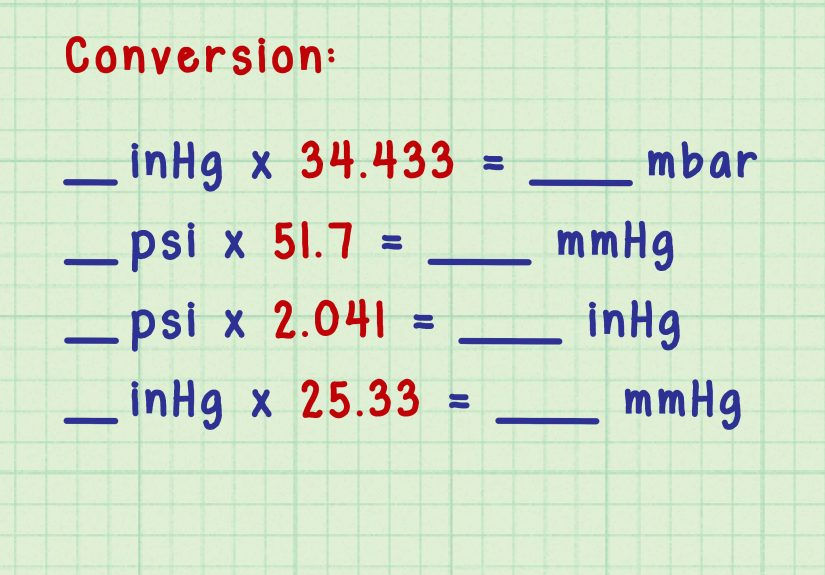
The most useful conversion for everyday weather work is:
1 inHg = 33.8639 hPa
That means:
29.92 inHg × 33.8639 = about 1013.25 hPa
Since one hectopascal equals one millibar, 1013.25 hPa is the same as 1013.25 mb. When you see those units switching around in weather articles, do not panic. The atmosphere has not changed; only the label has.
How to Calculate Barometric Pressure: 6 Steps
Now let’s walk through the actual process. The steps below are designed for practical use, whether you are using a home barometer, a weather station, a sensor, or a pressure value from a local report.
Step 1: Get a Pressure Reading
Start with a measured pressure value. This may come from a digital weather station, an aneroid barometer, a mercury barometer, a phone-connected weather sensor, or a nearby weather station. If you are using your own device, place it away from direct heat sources, strong drafts, air conditioners, sunny windows, and other sneaky little pressure-reading troublemakers.
For example, suppose your home barometer reads:
29.25 inHg
This reading is likely your local or station pressure, especially if the device has not been adjusted to sea level. If your weather station app already displays sea-level pressure, check the settings before doing extra math. Double-adjusting pressure is like salting soup twice: technically possible, rarely pleasant.
Step 2: Identify Your Elevation
Elevation matters because pressure decreases as you go higher. A barometer at 5,000 feet will naturally read lower than one at sea level, even if the weather pattern is similar.
Find your elevation using a topographic map, GPS device, local weather station information, or a reliable mapping service. For this example, assume your elevation is:
500 feet above sea level
Pressure calculations are easier in metric units, so convert feet to meters:
500 feet × 0.3048 = 152.4 meters
Your elevation for the formula is therefore 152.4 m.
Step 3: Record the Air Temperature
Temperature affects the relationship between pressure and altitude because warm air and cold air have different densities. For a more accurate sea-level pressure estimate, record the current outside air temperature near your barometer or weather station.
Suppose the temperature is:
20°C
If your thermometer uses Fahrenheit, convert it to Celsius:
°C = (°F − 32) × 5/9
For example, 68°F equals 20°C. That is conveniently tidy, which almost never happens in real life, so enjoy it when it does.
Step 4: Convert Pressure Units if Needed
If your pressure reading is in inches of mercury and you want hectopascals, multiply by 33.8639:
Pressure in hPa = Pressure in inHg × 33.8639
Using our example:
29.25 × 33.8639 = 990.52 hPa
So a station pressure of 29.25 inHg equals about 990.5 hPa.
To convert hectopascals back to inches of mercury, divide by 33.8639:
Pressure in inHg = Pressure in hPa ÷ 33.8639
For example:
1013.25 hPa ÷ 33.8639 = 29.92 inHg
Step 5: Adjust Station Pressure to Sea-Level Pressure
To compare your pressure with weather maps and forecasts, you usually want sea-level pressure. A practical approximation is:
Sea-level pressure = station pressure × (1 − (0.0065 × elevation) ÷ (temperature + 0.0065 × elevation + 273.15))−5.257
Where:
- Station pressure is your measured pressure.
- Elevation is in meters.
- Temperature is in Celsius.
- 0.0065 represents the standard temperature lapse rate in °C per meter.
- 273.15 converts Celsius to Kelvin.
Now plug in the example:
- Station pressure = 29.25 inHg
- Elevation = 152.4 m
- Temperature = 20°C
The result is approximately:
Sea-level pressure = 29.77 inHg
Convert that to hectopascals:
29.77 × 33.8639 = about 1008.1 hPa
So your barometer’s raw local reading of 29.25 inHg becomes an estimated sea-level pressure of about 29.77 inHg, or 1008.1 hPa. That adjusted number is much easier to compare with a weather map.
Step 6: Interpret the Result
Once you have a pressure value, the final step is understanding what it means. Standard sea-level pressure is about 29.92 inHg or 1013.25 hPa. A reading below that may suggest lower pressure; a reading above it may suggest higher pressure. But the trend is often more useful than one isolated number.
Here is a simple guide:
- Rising pressure: often points to improving, drier, or more stable weather.
- Falling pressure: may signal clouds, wind, rain, or an approaching storm system.
- Steady pressure: suggests the current weather pattern may continue.
- Rapid pressure drop: can indicate a stronger weather change and deserves attention.
For example, if your sea-level pressure is 1008 hPa and falling quickly, you might expect unsettled weather. If it is 1022 hPa and rising slowly, the atmosphere may be settling down. Weather, of course, is a dramatic character, so combine pressure with radar, clouds, wind direction, humidity, and official forecasts.
Quick Barometric Pressure Conversion Examples
Example 1: Convert 30.10 inHg to hPa
30.10 × 33.8639 = 1019.30 hPa
A pressure of 30.10 inHg is about 1019.3 hPa, which is above standard sea-level pressure.
Example 2: Convert 1005 hPa to inHg
1005 ÷ 33.8639 = 29.68 inHg
A pressure of 1005 hPa equals about 29.68 inHg.
Example 3: Estimate Pressure Change with Elevation
Near sea level, pressure drops roughly about 1 hPa for every 8 to 9 meters of elevation gain, though the exact value depends on temperature and atmospheric conditions. That is why a mountain town can have a much lower station pressure than a coastal town even on the same calm day.
Why Calculating Barometric Pressure Matters
Learning how to calculate barometric pressure is not just a science-class party trick, though it would absolutely make you the most interesting person near the punch bowl. It has practical uses.
Weather Forecasting
Pressure patterns help meteorologists identify high- and low-pressure systems. A falling barometer can warn of changing weather, while a rising one may indicate clearing skies. Home weather watchers often track pressure trends to understand local conditions before they show up dramatically on radar.
Hiking and Outdoor Planning
For hikers, campers, hunters, anglers, gardeners, and boaters, pressure trends can be useful clues. A sudden drop in pressure may suggest that wind or rain is on the way. A steady rise can be a comforting sign before a long day outside.
Gardening and Agriculture
Barometric pressure does not water your tomatoes, sadly, but it can help you understand changes in weather patterns. Gardeners who track pressure alongside humidity and temperature can better anticipate storms, frost risks, and irrigation needs.
Aviation and Altitude Awareness
Aviation uses pressure in a highly specialized way. Pilots use altimeter settings and pressure altitude concepts to maintain safe altitude references. This guide should not replace aviation training, but it does explain why pressure and altitude are inseparable friends, even if they argue sometimes.
Common Mistakes When Calculating Barometric Pressure
Mistake 1: Confusing Station Pressure with Sea-Level Pressure
This is the big one. If your home barometer gives station pressure, it will be lower at higher elevations. If a weather website gives sea-level pressure, it has already been adjusted. Comparing the two directly can make your local atmosphere look more dramatic than it is.
Mistake 2: Forgetting to Convert Units
Mixing inches of mercury, hectopascals, pascals, and millibars without converting is a fast way to create numerical soup. Always label your units before calculating.
Mistake 3: Ignoring Elevation
Elevation is not optional. A pressure reading from a mountain cabin and a pressure reading from a beach house cannot be compared fairly unless both are adjusted to the same reference level.
Mistake 4: Treating One Reading as a Forecast
A single pressure reading is useful, but the trend tells a better story. Record pressure over several hours. If it is rising, falling, or changing quickly, that trend gives you stronger clues than one lonely number sitting in your notebook.
Mistake 5: Using an Uncalibrated Barometer
Many home barometers need calibration. If your instrument allows adjustment, compare it with a reliable nearby weather station at a similar elevation or use a trusted local sea-level pressure report and set the device according to the manufacturer’s instructions.
How to Calculate Barometric Pressure Without a Barometer
You cannot directly measure local pressure without a pressure sensor or barometer, but you can estimate or obtain it in a few ways. A nearby weather station may publish sea-level pressure. If you know your elevation and temperature, you can estimate station pressure from sea-level pressure using the inverse of the adjustment process. Many smartphones also contain pressure sensors, but accuracy varies by device, case design, calibration, and software.
For casual learning, a digital weather station is the easiest tool. For more serious use, choose a calibrated sensor that reports pressure clearly and allows altitude correction. For official decisions, rely on professional weather data.
A Simple Barometric Pressure Worksheet
Use this mini worksheet when calculating pressure at home:
- Write down your raw pressure reading: ________
- Write down the unit: inHg / hPa / mb / kPa / Pa
- Write down your elevation: ________ feet or meters
- Convert elevation to meters if needed: feet × 0.3048
- Write down the outdoor temperature in Celsius: ________
- Convert pressure units if needed.
- Adjust station pressure to sea-level pressure if you want weather-map comparison.
- Record the pressure again later and note whether it rose, fell, or stayed steady.
That last step is where pressure becomes genuinely useful. A number tells you what is happening now. A trend tells you what may be changing.
Personal Experience: What Calculating Barometric Pressure Teaches You
The first time you calculate barometric pressure by hand, it may feel like the atmosphere has personally chosen violence. There are decimals, units, elevation adjustments, and a formula that looks like it wandered in from a college physics exam. But after a few tries, the process becomes surprisingly satisfying. It turns the invisible weight of the air into something you can measure, compare, and understand.
One practical experience many home weather watchers have is realizing that their barometer is not “wrong”it is simply reporting a different type of pressure. Imagine buying a small weather station, setting it on your desk, and seeing a number much lower than the local forecast. Your first thought might be, “Great, I bought the bargain-bin drama queen of weather instruments.” But if you live above sea level, the device may be showing station pressure while the forecast shows sea-level pressure. Once you adjust for elevation, the numbers suddenly make sense. The problem was not the barometer; it was the reference level.
Another useful lesson comes from tracking pressure trends before a storm. Suppose the sky is still bright, the birds are still doing bird things, and your neighbor is confidently washing a cara traditional invitation for rain. Your barometer, however, begins falling steadily over several hours. Later, clouds build, wind picks up, and rain arrives. That experience teaches you why pressure is so valuable: it often changes before the most obvious weather signs appear. It is not magic. It is physics with better timing.
Calculating barometric pressure also helps outdoor planning feel less like guessing. Hikers, gardeners, anglers, and campers often learn to combine pressure with other clues. Falling pressure plus increasing humidity and shifting winds may suggest a change is coming. Rising pressure after a rainy spell may hint that conditions are improving. The calculation itself gives you the number, but repeated observation gives you judgment.
There is also a humbling side. Pressure does not predict everything by itself. A high-pressure day can still have local fog. A low-pressure pattern may not bring rain to your exact backyard. Weather is a large, moving system with many ingredients. Barometric pressure is one ingredient, not the whole recipe. Think of it as the flour in weather cake: important, but not especially delicious alone.
For students, calculating barometric pressure makes abstract science feel real. Gravity, gas density, altitude, temperature, and units all show up in one everyday measurement. For homeowners, it makes weather apps easier to understand. For curious people, it is a reminder that the atmosphere is not empty space above usit is an active, measurable ocean of air.
The best experience-based advice is simple: write your readings down. Note the pressure, time, temperature, sky condition, and wind. Do it for a week. Patterns will start to appear. The numbers will stop looking random, and the weather will start looking like a story you can follow instead of a daily surprise party hosted by clouds.
Conclusion
Calculating barometric pressure becomes much easier once you separate the process into clear steps: get a pressure reading, identify your elevation, record the temperature, convert units, adjust station pressure to sea-level pressure, and interpret the trend. The math may look intimidating at first, but the idea is straightforward: air has weight, elevation changes that weight, and pressure trends help reveal what the atmosphere is doing.
Whether you are checking a home barometer, building a weather worksheet, planning a hike, studying meteorology, or simply trying to understand why your weather app loves numbers like 29.92 and 1013.25, barometric pressure is worth learning. It is practical, scientific, and oddly satisfyinglike balancing a checkbook, except the bank is the sky.