Table of Contents >> Show >> Hide
- What Is Oriental Bittersweet?
- Why Oriental Bittersweet Is Such a Headache
- How to Identify Oriental Bittersweet
- Oriental Bittersweet vs. American Bittersweet
- Where You Are Most Likely to Find It
- How to Remove Oriental Bittersweet
- Best Timing for Control
- Common Mistakes to Avoid
- How Long Does It Take to Get Rid of It?
- What to Plant Instead
- Final Thoughts
- Real-World Experiences and Practical Lessons From Fighting Oriental Bittersweet
Oriental bittersweet is one of those vines that looks charming from a distance and absolutely unhinged up close. In fall, it shows off with bright yellow-orange capsules and red fruit like it is auditioning for a holiday wreath. Meanwhile, it is busy swallowing shrubs, climbing trees, twisting trunks, and making woodlands look like they lost a wrestling match with a very determined rope. If you have spotted this invasive vine on your property, in a fence row, or creeping into the edge of a wooded area, now is the time to act.
This guide walks you through how to identify Oriental bittersweet, how to tell it apart from native American bittersweet, and how to remove it without accidentally making the problem worse. Because yes, some removal methods can backfire. This vine loves a second chance.
What Is Oriental Bittersweet?
Oriental bittersweet, Celastrus orbiculatus, is an invasive woody vine introduced from East Asia as an ornamental plant. It spread because the berries are flashy, birds happily move the seeds around, and the plant grows with the confidence of a species that has never heard the word “boundaries.” Today, it is a serious invader in many parts of the United States, especially in forest edges, roadsides, old fields, hedgerows, and disturbed woodlands.
The problem is not just that it grows fast. Oriental bittersweet climbs high into trees, wraps tightly around trunks, shades out native plants, weighs down branches, and can pull down saplings or weaken larger trees over time. It also spreads by seed and by underground roots, so one pretty vine can turn into a full-on neighborhood takeover.
Why Oriental Bittersweet Is Such a Headache
Gardeners usually notice Oriental bittersweet when it is already doing something dramatic. Maybe a tree looks mummified in vines. Maybe a shrub border has disappeared under a tangle of glossy leaves. Maybe there is a suspiciously festive branch in the woods wearing orange berries like costume jewelry.
Here is why this invasive vine is so difficult to manage:
- It grows quickly and can climb high into the canopy.
- It spreads through seeds carried by birds.
- It can resprout from roots and cut stems.
- It roots where stems touch the ground.
- It outcompetes native vegetation for light, space, and moisture.
- It can hybridize with native American bittersweet, making conservation even trickier.
In other words, this is not a vine you ignore and hope will become someone else’s problem. That strategy has an excellent track record of failing.
How to Identify Oriental Bittersweet
Correct identification matters because Oriental bittersweet is often confused with native American bittersweet, and the native species is far less aggressive. In some areas, American bittersweet is uncommon or protected. Before you cut, pull, or treat anything, make sure you are looking at the invasive vine.
1. Look at the Growth Habit
Oriental bittersweet is a woody, twining vine. Young stems are thinner and flexible, while mature vines become thick, heavy, and rope-like. Older stems can get surprisingly large, with bark that turns brown to grayish-brown. The vine often climbs trees, wraps around trunks, and trails over shrubs, fences, and brush piles.
If a woodland edge looks like it has been gift-wrapped by a plant with bad intentions, Oriental bittersweet is a strong suspect.
2. Check the Leaves
The leaves are alternate, glossy to slightly dull green, and usually rounded to oval with finely toothed edges. Many are broader and more rounded than the leaves of native American bittersweet. In fall, the foliage often turns yellow, which makes the berries stand out even more.
Leaf shape alone is not the best clue, though. Oriental bittersweet can be variable, and some leaves may look more pointed than others. Think of leaves as helpful supporting evidence, not the star witness.
3. Inspect the Flowers and Fruit
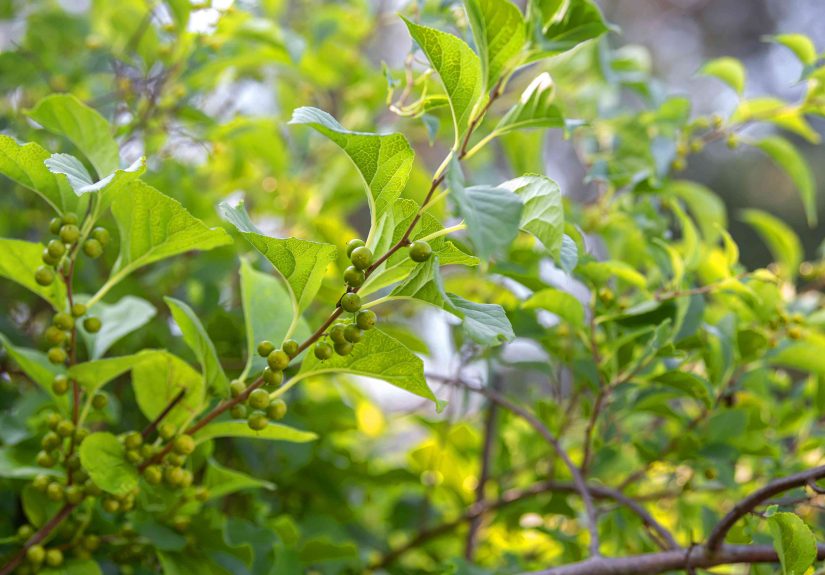
This is the big one. Female Oriental bittersweet plants produce small clusters of fruit along the stem at the leaf axils. That means the berries are strung down the vine, not just gathered at the tip. The fruit capsules are yellow to yellow-orange and split open to reveal bright red or orange-red fleshy seeds.
In late summer through fall, these berries are the easiest way to identify the plant. They often persist into winter, which is both useful for identification and infuriating because they keep feeding birds that spread the seeds farther.
4. Look at the Roots
Seedlings and young plants often have orange to orange-red roots. That color can be a surprisingly useful identification clue when you are hand-pulling small vines. Established plants also spread through underground roots and rhizomes, which is why simple cutting often leads to resprouting.
Oriental Bittersweet vs. American Bittersweet
This is the comparison every homeowner, gardener, and volunteer land steward should know.
Oriental Bittersweet
- Fruit appears in clusters along the stem from the leaf axils.
- Fruit capsules are usually yellow to yellow-orange.
- Leaves are often more rounded.
- Growth is typically more aggressive and invasive.
American Bittersweet
- Fruit appears in clusters at the ends of the branches.
- Fruit capsules are darker orange to reddish.
- Leaves tend to be more elongated or elliptical.
- It is a native vine and generally much less destructive.
If you remember only one thing, remember this: Oriental bittersweet fruits along the stem; American bittersweet fruits at the tips. That single detail can save you from pulling the wrong plant.
Where You Are Most Likely to Find It
Oriental bittersweet thrives in edges and disturbed places, but it is not picky. It often starts in sunny openings and then pushes into semi-shaded woods. Common places include:
- Woodland edges
- Fencerows
- Roadsides
- Abandoned fields
- Backyard tree lines
- Stone walls and brushy thickets
- Under bird perches such as conifers or hedgerows
Because birds spread the seeds, you may first notice seedlings beneath trees, shrubs, utility lines, or anywhere birds like to stop for a snack and an opinion.
How to Remove Oriental Bittersweet
The best removal method depends on the size of the infestation. One tiny seedling is a very different project from a vine that has wrapped itself around a maple like a boa constrictor.
For Small Seedlings and Young Plants
Hand-pulling works best when plants are young and the soil is moist. Grab low on the stem and pull steadily so you remove as much of the root system as possible. If the vine snaps off, dig carefully around the base and remove remaining roots. Small plants are easiest to control early, before they become woody and before they start fruiting.
Do not toss pulled plants with berries into the woods or compost pile. Bag the fruiting material and dispose of it with the trash if local guidance allows. Otherwise, follow your municipality’s invasive plant disposal rules.
For Medium Patches on the Ground
If you have a spreading mat of vines across the ground, you can cut and dig, but expect repeat visits. The goal is to exhaust the roots by removing every resprout before it can feed the underground system again. This works, but it is not glamorous. Think less “one heroic weekend” and more “steady campaign with snacks.”
Repeated mowing can weaken patches in some settings, but occasional mowing usually stimulates more sprouting. If you go this route, it has to be consistent and frequent. Half measures tend to turn this vine into a motivated overachiever.
For Large Vines Climbing Trees
Do not yank mature vines out of a tree canopy unless you enjoy showering yourself with debris and regrettable choices. Instead, cut the vine near ground level and again a few inches higher so you remove a section of stem. This disconnects the upper vine from the roots. Leave the upper portion in the tree to die in place and break down over time.
Then deal with the rooted lower portion. If you only cut the vine and walk away, Oriental bittersweet often resprouts from the stump or root system. That is why cutting alone is rarely enough.
When Herbicide Makes Sense
For established infestations, a labeled systemic herbicide is often the most effective option because it moves into the roots. Homeowners commonly use products with active ingredients such as glyphosate or triclopyr for cut-stump or foliar treatment, depending on the situation. Always read and follow the product label, wear protective gear, and check local regulations before use.
Two common strategies are:
- Cut-stump treatment: Cut the vine and treat the freshly cut stump so the herbicide moves into the root system.
- Foliar treatment: Spray leaves on actively growing low vines when drift to desirable plants can be avoided.
Triclopyr is often favored around grasses because it targets broadleaf plants and woody vines, while glyphosate is nonselective and can injure almost anything green it touches. Either way, sloppy application is a terrific way to turn one problem into six.
What About Fire or Just Cutting It Back?
Prescribed fire alone is usually not enough for Oriental bittersweet, and casual cutting can stimulate more sprouting. If you cut, you need follow-up. If you burn, you need a larger integrated plan. This plant does not respond to wishful landscaping.
Best Timing for Control
You can remove seedlings anytime the soil is workable, but timing matters for bigger jobs.
- Spring and early summer: Great for spotting new growth and pulling young plants.
- Late summer to fall: Useful for identifying fruiting vines and planning cut-stump work.
- Fall: Often a practical time for systemic herbicide treatments because the plant is moving energy to the roots.
- Winter: Fruit helps with identification, and leaf-off conditions make larger vines easier to see.
The truth is, the best time to start is when you first notice it. The best time to follow up is repeatedly.
Common Mistakes to Avoid
- Pulling the wrong vine: Verify it is not native American bittersweet.
- Cutting and forgetting: Oriental bittersweet often resprouts.
- Leaving berries behind: Fruit can still help spread seeds.
- Composting fruiting vines: Bad idea unless your local program specifically allows it and handles invasive material properly.
- Trying to rip vines out of trees: That is a great way to damage the tree or yourself.
- Expecting one treatment to solve everything: Monitoring is part of removal.
How Long Does It Take to Get Rid of It?
Longer than you want, shorter than if you ignore it. Small infestations can be controlled in a season or two with careful pulling and follow-up. Large, established colonies can take multiple years of cutting, digging, treating, and monitoring. Persistence matters more than drama.
The good news is that even partial control can quickly reduce stress on trees and stop seed production. Every vine removed before it fruits is a future problem you just canceled.
What to Plant Instead
If you are removing Oriental bittersweet from a landscape, it helps to replace it with something that behaves better. Good alternatives depend on your region, but native climbing or sprawling plants may include American bittersweet where appropriate and locally sourced, trumpet honeysuckle, native clematis, or other noninvasive vines recommended by your state extension office. The goal is to fill space with plants that support wildlife without turning the garden into a botanical hostage situation.
Final Thoughts
Oriental bittersweet is attractive in the same way a scam email can look professional. The surface charm hides a lot of trouble. Once you know the key features, especially the fruit clusters along the stem, this invasive vine becomes much easier to spot. Once you understand that cutting alone usually does not work, your removal plan becomes smarter too.
Start with accurate identification. Pull seedlings early. Cut large vines carefully. Treat or dig rooted portions so they do not rebound. Bag fruiting material. Monitor the area for several years. That may sound like a lot, but compared with letting the vine keep climbing, spreading, and toppling its way through your yard or woodlot, it is the better deal by a mile.
And the next time you see those flashy berries in a wreath, you can nod politely and think, “Not today, woodland menace.”
Real-World Experiences and Practical Lessons From Fighting Oriental Bittersweet
People who deal with Oriental bittersweet in real landscapes usually describe the same pattern. At first, it seems minor. There is a vine on a fence, a few shiny leaves at the edge of the woods, maybe some colorful berries that look almost decorative. Nothing about that first impression screams emergency. Then one season passes, then another, and suddenly the vine is in the hedge, in the lilac, in the young maple, and somehow halfway up a pine. That is when most homeowners realize they are not dealing with a quirky woodland plant. They are dealing with a very organized criminal enterprise run by a vine.
One of the most common experiences is discovering seedlings under bird perches. A homeowner may clear a big vine from a back corner, feel victorious, and then find dozens of baby plants the following spring under evergreens or along a wire fence where birds had been resting. That moment teaches the first big lesson: removing the obvious vine is only part of the job. Seedlings keep appearing for a while, and the cleanup phase matters just as much as the dramatic first cut.
Another common lesson comes from large vines wrapped around mature trees. Many people understandably want to pull the entire vine down at once. In practice, that usually turns into a dangerous tug-of-war with dead branches, loose bark, and gravity. More experienced gardeners learn to cut the vine low, remove a section of stem, and leave the top growth to die slowly in place. It feels incomplete at first, almost lazy, but it is usually the safer and smarter move. Over time, that dead upper vine becomes brittle and drops away naturally.
There is also the emotional whiplash of cutting Oriental bittersweet and seeing it come back. Plenty of people assume one good chop means the problem is solved. Then, a few weeks later, fresh sprouts appear at the base like the plant took the whole thing as constructive feedback. That experience is frustrating, but it teaches the second big lesson: Oriental bittersweet is a management project, not a one-day event. The people who succeed are usually the ones who schedule check-ins, revisit the area, and treat resprouts while they are still small.
Gardeners also talk about how satisfying it is to reclaim a space. After a season or two of control, shrubs regain shape, young trees stop bending under the weight, and woodland edges start looking like actual ecosystems instead of tangled extension cords. Light reaches the ground again. Native plants reappear. The area feels breathable. That kind of recovery is one reason many land stewards stick with the work even when it is repetitive.
Perhaps the most practical shared wisdom is this: start early, travel light, and keep records. A pair of gloves, pruners, a digging tool, trash bags for fruiting material, and a simple map or phone note can make the work far more efficient. People who mark problem spots and return on purpose usually get ahead of the vine. People who wait until the berries look pretty usually end up with a larger problem and a stronger opinion about invasive plants.