Table of Contents >> Show >> Hide
- How the Cartman Voice Started: Bored Film Students, Dangerous Free Time
- “We Got in Trouble for Those Voices”: Why Professors (Allegedly) Hit the Eject Button
- Why Cartman’s Voice Is Such a Perfect “Get Out” Button
- From Campus Nonsense to a TV Pilot: When a Joke Gets a Budget
- What This Says About Trey Parker and Matt Stone’s Comedy DNA
- A Practical Lesson for Creators: Turning “Stupid Voices” Into a Creative System
- SEO-Friendly Quick Facts (Because the Internet Loves Context)
- Bonus: of Relatable “Cartman Voice” Experiences (Without Getting Expelled)
- Conclusion: The Voice That Broke Class Became the Voice That Built a Career
Every college has that sound: the squeak of a dry-erase marker, the hum of a projector that’s older than the professor,
andif you’re unluckythe unmistakable nasal whine of a student doing a cartoon voice at precisely the wrong moment.
Now imagine that voice is Eric Cartman’s. Now imagine it’s not a student… it’s the guys who invented Cartman.
And yes: by their own telling, Trey Parker and Matt Stone were the kind of film-school goblins who could get tossed out of class
for committing the ultimate academic crimebeing funny on schedule.
The punchline, of course, is that the very voice that could derail a lecture eventually helped build one of the biggest comedy
franchises in American TV history. This is the story of how the “don’t do that in class” Cartman voice became a creative weapon,
a brand, and a weirdly practical lesson in comedy writing, voice acting, and turning boredom into art.
How the Cartman Voice Started: Bored Film Students, Dangerous Free Time
Trey Parker and Matt Stone met at the University of Colorado Boulder, where they were film students spending weekends on sets for
other students’ projects. If you’ve ever been on a student film set, you know the truth: there’s a lot of “cinema” and even more
“standing around pretending to be busy.” That dead time matters. It’s where jokes get invented, friendships get welded, and
questionable impressions are born.
According to Parker, the voices began as a way to entertain themselves during those long, boring shootstwo guys running camera
or sound and killing time by talking like little kids to make each other laugh. The “proto-Cartman” voice wasn’t a business plan;
it was a survival mechanism. When your brain has been staring at a boom mic for six hours, comedy becomes oxygen.
And it wasn’t just private nonsense. The voice started showing up in their early animation experiments, especially their cutout
shorts (including The Spirit of Christmas projects that helped lead to South Park). Once you’ve found a sound that
reliably makes your best friend wheeze-laugh, you start building scenes around itbecause you’re a comedian, not a monk.
“We Got in Trouble for Those Voices”: Why Professors (Allegedly) Hit the Eject Button
Here’s where the legend gets spicy. In interviews and commentary recollections, Stone has described how those kid voicesearly
versions of what would become the show’s core soundcould irritate the adults in charge. One version of the story is that the
voice was so disruptive (or just so irresistibly dumb) that they’d get thrown out of class for doing it.
Whether it was a formal “leave now” or a professor’s slow-burning “I’m going to pretend I didn’t hear that” glare, the dynamic
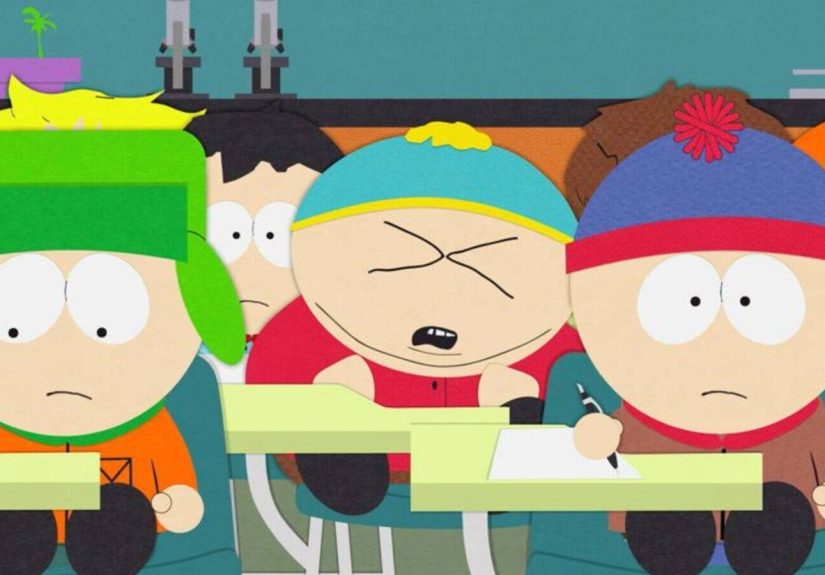
makes perfect sense. Cartman’s voice is not designed to blend in. It’s designed to dominate space. It’s weaponized attention.
In a classroom built on order, a voice built on chaos is basically a fire drill with catchphrases.
The funniest part is how the story ends: the same voice that could get them in trouble in college became something they were paid
to dohandsomelyonce the world decided it wanted chaos on cable television, neatly packaged into 22 minutes and a commercial break.
Why Cartman’s Voice Is Such a Perfect “Get Out” Button
Let’s break down why Cartman’s voice is uniquely qualified to ruin a serious moment:
1) It’s instantly recognizable
Even people who haven’t watched South Park can often identify “that Cartman voice.” It’s auditory branding: you hear it,
your brain supplies the attitude. In a classroom, that instant recognition acts like a mental pop-up ad.
2) It has built-in entitlement
Cartman doesn’t sound like a kid asking a question. He sounds like a kid issuing a demand. The voice carries a comedic arrogance
that automatically changes the power dynamic in the roomwhich is exactly what teachers work all day to keep from happening.
3) It’s funny because it’s wrong
The whole joke is the mismatch: a child voice with adult-level manipulation, insults, and melodrama. Comedy thrives on contrast.
Academia thrives on “please stop doing that.” Put them together and you get… well, a very tense syllabus.
From Campus Nonsense to a TV Pilot: When a Joke Gets a Budget
South Park didn’t begin with a corporate pitch deck and a tasteful font. It began with cutout animation, crude kid voices,
and an irreverent sensibility that was already dialed in while Parker and Stone were still students. Early shorts (especially the
holiday-themed Spirit of Christmas pieces) spread widely in the pre-YouTube era, helped by people duplicating and sharing
tapes like they were passing forbidden spell books.
Once the show was picked up, those voices were ready. The first episode, “Cartman Gets An Anal Probe,” premiered in 1997, and it
didn’t exactly whisper its way into American culture. The animation style was simple, the kid voices were blunt, and the show’s
attitude was unmistakable: this was not here to be polite.
If you’re looking for the sneaky genius of the “kicked out of class” story, it’s this: the voice wasn’t created in a vacuum.
It was battle-tested in real social environmentssets, screenings, and, allegedly, classrooms where adults did not consent to
chaos comedy.
What This Says About Trey Parker and Matt Stone’s Comedy DNA
A lot of creators build careers by learning rules, following them perfectly, and then bending them later. Parker and Stone built
a career by bumping into the rules, shrugging, and asking, “What if we push harder?” The Cartman voice story is a miniature
version of their larger approach: discomfort as fuel.
It also reveals something important about their writing style. South Park works best when it feels like kids are being kids:
rude, impulsive, obsessed with status, and wildly confident about things they do not understand. That “kids are corrupt first,
then learn to be decent later” point of view is baked into the sound of the show. The voice isn’t just performanceit’s philosophy.
A Practical Lesson for Creators: Turning “Stupid Voices” Into a Creative System
You don’t need to be building an animated empire to learn something here. If you’re a writer, comedian, podcaster, actor,
or even a marketer trying to sound human, the Cartman voice origin story offers a few surprisingly useful takeaways:
Use boredom as an incubator
Some of the best comedic ideas show up when you’re stuckon a long shoot, in a tedious meeting, or in the part of a group project
where everyone pretends to “circle back.” Boredom creates mental pressure. Humor is the release valve.
Build characters from voices, not just traits
A character isn’t only what they believeit’s how they sound when they’re trying to win. The Cartman voice carries entitlement,
insecurity, and manipulation without needing a monologue. If a voice can imply psychology, it becomes a storytelling shortcut.
Test jokes in real time
Parker and Stone reportedly tested humor on themselves constantly. That’s not vanity; it’s calibration. If it doesn’t make you
laugh in the room, it probably won’t survive contact with an audience.
SEO-Friendly Quick Facts (Because the Internet Loves Context)
- Who are the South Park creators? Trey Parker and Matt Stone, who met while attending the University of Colorado Boulder.
- Who does Cartman’s voice? Trey Parker performs Eric Cartman’s voice (along with many other characters).
- What’s the “kicked out of class” story? In their recollections, the creators have said they got in trouble in college for the kid voices that later became core South Park voicesincluding a proto-Cartman sound.
- Why does it matter? It’s a reminder that comedic instincts often form long before successand usually in places where adults would prefer silence.
Bonus: of Relatable “Cartman Voice” Experiences (Without Getting Expelled)
If you’ve ever been in a classroom, dorm, office, or group chat, you already know a universal law: one person does a cartoon voice,
and suddenly everyone forgets what the meeting was about. The Cartman voice is especially powerful because it’s not just a sound
it’s a mood. It’s the audio equivalent of putting your feet on the table and saying, “I run this place now,” even when you
absolutely do not.
A lot of people’s first “Cartman voice experience” happens the same way: a friend with questionable timing drops an impression
during a serious moment. Maybe it’s a quiet lecture where the professor is explaining something delicate, and a classmate whispers
a Cartman line under their breath. One laugh escapes, then another, and suddenly half the row is shaking like a badly parked car.
Nobody wants to be the first to laugh, but everyone wants to be the first to stop laughing. It’s comedy peer pressure.
In college, impressions often become social currency. You’re tired, you’re stressed, you’re living on coffee and whatever food
counts as “dinner” at 1 a.m.so you create tiny moments of entertainment. A Cartman impression is like an instant party trick:
it signals, “I know this cultural thing, and I can perform it.” The trouble is that the voice doesn’t behave like a polite party
trick. It tends to escalate. Someone does a mild impression. Someone else goes louder. A third person adds a whole fake argument.
By the time you realize what’s happening, your study group has become an unauthorized one-act comedy show starring a fictional
fourth-grader with boundary issues.
The funniest “grown-up” version of this happens at work. Cartman’s voice is a shortcut for sarcasm, frustration, and mock outrage,
so people use it when they’re trying to survive corporate nonsense. A deadline shifts. A meeting runs long. Someone says “quick
question” and then asks twelve. You can practically hear the Cartman voice hovering in the air like a ghost: “Screw you guys…”
It becomes a shared pressure valvesomething you reference so you don’t say what you’re actually thinking in your normal voice.
And that’s the real connection back to Parker and Stone’s college story: the voice isn’t just funny; it’s functional. It’s a way
to cope with boredom, authority, and the weird theater of everyday life. The difference is that most of us keep it as a private
joke (or at least we try). Parker and Stone turned that same impulse into a creative engine: voices that made a professor furious,
jokes that killed time on set, and a kid-sound that eventually anchored entire plots.
If you want the “responsible adult” takeaway, it’s simple: timing is everything. Do the voice with friends? Great. Do it in a
classroom while someone is teaching? That’s how you become a campus legend for all the wrong reasons. But if you’re creating,
writing, or performing, the Cartman lesson is goldyour dumbest recurring joke might be the seed of something bigger, as long as
you shape it into craft instead of chaos.
Conclusion: The Voice That Broke Class Became the Voice That Built a Career
The idea that Trey Parker and Matt Stone could get kicked out of college classes for doing a proto-Cartman voice is funny on its
faceand also oddly inspiring. It’s a reminder that creative identity often starts as a private joke, a bored moment, or a childish
impulse you’re not sure you should be proud of.
In their case, that impulse wasn’t just tolerated; it was refined, weaponized, and broadcast to millions. The Cartman voice became
a comedic scalpel for satire, a signature sound of modern animation, and (depending on your personality) either a sacred artifact
of TV comedy or the reason your teacher developed a thousand-yard stare.
So yesmaybe the Cartman voice got them thrown out of class. But it also carried them out of the classroom and into a career that
basically runs on the same rebellious energy: making the joke that’s too loud, too honest, and too tempting not to say.