Table of Contents >> Show >> Hide
- Why This False Rumor Was So Easy to Satirize
- The Best Late-Night Jokes About Those Trump Death Rumors
- Why These Jokes Worked Better Than the Rumor Ever Did
- What the Monologues Were Really Saying About Modern Media
- Late-Night Comedy Still Knows How to Puncture a Hoax
- Conclusion
- Additional Reflections: The Experience of Watching a Death Hoax Turn Into Late-Night Material
Every once in a while, the internet takes a deep breath, loses its mind, and decides that a quiet news cycle is too boring to survive. That is more or less what happened when false rumors about Donald Trump’s death started ricocheting across social media. A few blurry photos, a brief stretch without a public appearance, a bruise people would not stop zooming in on, and suddenly the online rumor mill was spinning like it had been fed espresso and conspiracy podcasts at the same time.
But while political corners of the internet treated the hoax like a citizen-detective emergency, late-night comedy did what late-night comedy does best: it grabbed the panic by the collar, sat it under a spotlight, and made it explain itself. The result was a wave of jokes that were not really about whether Trump was dead, because he was not. They were about modern media, political celebrity, online paranoia, and the ridiculous fact that when one of the most overexposed people on earth goes missing from the camera for five minutes, half the country starts acting like it is the opening scene of a prestige thriller.
That is what made the best late-night jokes about those Trump death rumors so effective. They did not just chase a trending topic. They exposed the weird machinery behind it. These monologues were funny because they understood the real punchline: in 2025 and beyond, a false rumor does not need evidence to travel. It just needs a little mystery, a lot of boredom, and an algorithm that thinks chaos is premium content.
Why This False Rumor Was So Easy to Satirize
Before getting to the jokes, it helps to understand why this story was basically delivered to late-night hosts on a silver platter. Trump’s public image has always depended on visibility. He is not a politician who quietly exists in the background like a sensible office printer. He is a political reality-show character who has spent years making constant visibility feel like proof of power. That means a brief absence does not read as ordinary downtime to online spectators. It reads like a missing frame in a movie trailer, and the internet hates unanswered questions.
That vacuum is exactly where the hoax grew. Social media users turned a short stretch without a normal public event into a sprawling amateur mystery board. Suddenly there were trending hashtags, “proof-of-life” theories, wildly confident thread readers, and people interpreting ordinary images like they were analyzing the Zapruder film with Wi-Fi. By the time Trump publicly dismissed the speculation, the rumor had already achieved peak absurdity. Which, naturally, made it irresistible to comedians.
Late-night writers love a story that reveals how broken the discourse has become. A false death rumor about the most media-saturated political figure in America? That is not just a news item. That is a buffet.
The Best Late-Night Jokes About Those Trump Death Rumors
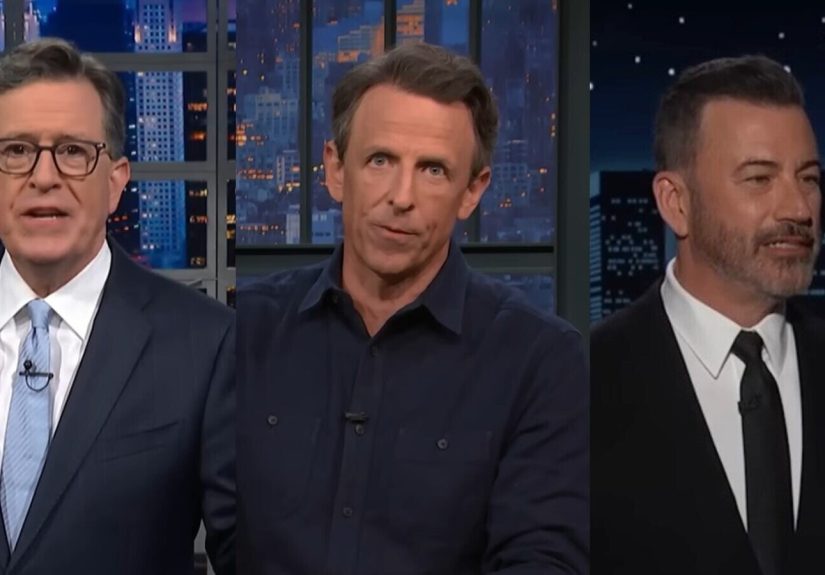
Jimmy Kimmel: If He’s Not on Camera, People Assume the Worst
Jimmy Kimmel’s angle was brutally simple and therefore wonderfully effective. He zeroed in on the fact that Trump is so omnipresent, so relentlessly in the public eye, that a short gap in visibility was apparently enough for people to conclude he must have died. That joke worked because it cut in two directions at once. It mocked the rumor itself, but it also mocked the media ecosystem that has trained everyone to expect Trump to appear constantly, loudly, and preferably while complaining about something in all caps.
Kimmel’s broader style in this stretch of Trump coverage leaned into the idea that Trump has become less like a conventional politician and more like an indestructible television villain. He pushed that image even further by riffing on Trump’s bruising and health chatter as if America had somehow ended up governed by a gothic monster who survives on attention instead of blood. In Kimmel’s telling, the death rumor was absurd precisely because Trump had achieved the strange pop-cultural status of someone who feels less mortal than obnoxiously permanent.
That is a very Kimmel move. He tends to take a piece of political weirdness and filter it through show-business logic. In this case, the line of thinking was basically: if the star of the longest-running one-man scandal carnival disappears for a beat, the audience starts checking the theater exits. It is a joke about Trump, sure, but it is also a joke about us. We have all been trained to notice when the circus music stops.
Stephen Colbert: The “Proof-of-Life” Photos Were Doing Bigfoot Numbers
Stephen Colbert attacked the story from the angle of presentation. He made hay out of the blurry photos that circulated as supposed proof Trump was alive and golfing, comparing their quality to the sort of grainy evidence usually reserved for mythical creatures and paranormal cable specials. That was one of the sharpest comedic turns in the whole late-night response because it reframed the coverage from “presidential update” to “cryptid sighting.”
Colbert’s joke landed because everyone immediately understood the visual grammar. America was apparently being asked to calm down because somewhere, far away, in a fuzzy image that looked one step above a potato, a familiar silhouette existed. That is not exactly reassuring. That is how people describe spotting the Loch Ness Monster from a canoe. By treating the photos like comic evidence from the world’s dumbest mystery hunt, Colbert exposed how unserious the whole online frenzy had become.
He also added a layer of dark elegance that has long defined his anti-Trump humor: the performance of concern wrapped around obvious disbelief. Colbert often sounds like a man trying to maintain civility while reality itself keeps slipping on a banana peel. So when he reassured viewers that Trump was, in fact, alive, the line was funny not because it was surprising, but because it treated basic reality like a public-service announcement. In the age of viral hoaxes, even the obvious now needs a host desk and applause.
Jimmy Fallon: Eyeliner, Bigfoot, and the Beauty of Going Slightly Weird
Jimmy Fallon’s best material came from not trying to out-rage anyone. Instead, he floated above the panic with that familiar Tonight Show energy: less courtroom cross-examination, more surreal side-eye. His sharpest joke was that he would know something was truly wrong with Trump when JD Vance started stocking up on eyeliner. That line did what great late-night lines do. It swerved. It arrived from the side. And because it did not sound like a standard political jab, it felt fresher than a lot of direct attack material.
Fallon also joined the blurry-image parade, joking that either Trump was perfectly fine or he had become Bigfoot. Again, the genius of that joke was its refusal to dignify the rumor while still making the visual absurdity do the heavy lifting. Instead of debating health records or pretending internet detectives were onto something, Fallon just pointed out that the available “evidence” looked like the sort of photo people post right before saying, “Enhance this.”
What made Fallon’s approach stand out was tone. He did not sound like he was trying to prove a case. He sounded like a guy who had walked into the middle of the internet’s latest nonsense, looked around at the blurry golf photos, the speculation, the baggage of Trump’s public image, and decided the only sane response was to get a little weirder than the rumor itself. That can be a surprisingly effective strategy in political comedy. Sometimes you do not beat absurdity by sounding more serious. Sometimes you beat it by reminding viewers how cartoonish it already is.
Jon Stewart: The Rumor Was Ridiculous, but the Atmosphere Was the Real Joke
Jon Stewart returned to the topic with a more layered kind of comic disgust. Stewart’s joke structure often works like this: first he acknowledges the obvious insanity, then he turns and points out the deeper rot that made the insanity possible. So yes, he mocked the exaggerated “Trump is dead” chatter. But he also used it to talk about the broader spectacle of a presidency so saturated with ego, image control, and health speculation that even a ludicrous hoax can feel plausible for half a second to people marinating in online distrust.
His riff about Trump being alive, though not exactly “alive and kicking,” carried a classic Stewart flavor. It was caustic without pretending the rumor itself had merit. And his joke about Trump potentially dying in office just to take credit for something Biden had already done was vintage Stewart: political commentary sharpened into a line so absurdly specific that it revealed a character truth. He was not merely saying Trump is attention-hungry. He was saying Trump’s relationship to public credit is so pathological that even death would become branding.
That is why Stewart’s jokes often linger longer than the nightly news cycle. He rarely stops at the headline. He wants the psychology, the hypocrisy, the institutional weakness, and the national self-own all in one package. In this case, the rumor was the setup. The real target was the spectacle of a country now so conditioned by disinformation, celebrity politics, and constant performance that even a fake obituary can become a temporary national subplot.
Why These Jokes Worked Better Than the Rumor Ever Did
The best late-night jokes about those Trump death rumors succeeded because they understood a simple rule: a bad rumor becomes comedy gold when you stop asking whether it is true and start asking why so many people were ready to believe it. That shift is where the best material lived.
Kimmel found humor in Trump’s exhausting omnipresence. Colbert found it in the blurry “proof” that looked like a creature feature. Fallon found it in the internet’s ability to transform uncertainty into fan fiction. Stewart found it in the national sickness underneath the whole episode. Different comic voices, same essential insight: the rumor was false, but the public behavior around it was painfully real.
That distinction matters because it separates satire from amplification. The strongest monologues were not laundering misinformation into entertainment. They were mocking the attention economy that made misinformation feel inevitable. Good political comedy does not merely repeat the crazy thing everyone said online. It reveals why the crazy thing spread in the first place.
What the Monologues Were Really Saying About Modern Media
Underneath the jokes was a pretty bleak media diagnosis. In another era, a false death rumor about a president would have lived on the fringes, circulated among cranks, and died from lack of oxygen. Now it can trend before lunch. Why? Because the structure of online discourse rewards the performance of discovery. People do not just want facts anymore. They want the thrill of being first, the rush of seeing a pattern, the ego boost of saying, “I noticed something no one else did.”
Late-night comedy has become unusually good at exposing that performance. Hosts are now less like jesters standing outside politics and more like nightly translators of internet derangement. They take whatever social-media panic is exploding that day and decode its emotional logic for viewers. With the Trump death rumor, the emotional logic was obvious: people distrust official narratives, obsess over health optics, and treat silence as evidence. Add a polarizing figure and a long weekend, and the internet starts writing spooky fan fiction with hashtags.
That is why these jokes resonated beyond simple partisanship. Even viewers who were not especially invested in Trump as a political figure could recognize the broader pattern. We have all seen the same online movie before. One odd image. One weird schedule gap. One shaky clip. Then a whole civilization of amateur detectives appears, as if the comments section just got deputized by the FBI.
Late-Night Comedy Still Knows How to Puncture a Hoax
There is also something reassuring about how these monologues functioned. For all the hand-wringing about whether late-night still matters, moments like this show its value. When a false rumor starts behaving like breaking news, comedians can serve as cultural pressure valves. They are not fact-checkers in the formal sense, but they can make a lie look ridiculous faster than a press release can make it look false.
That is exactly what happened here. The rumor was stripped of its pretend importance and recast as what it really was: a bizarre internet overreaction fed by optics, boredom, ideology, and platform incentives. Once Kimmel, Colbert, Fallon, and Stewart got hold of it, the story stopped feeling like a mystery and started feeling like a national self-own with punchlines.
And maybe that is the deepest reason these bits landed. They let audiences laugh at something they had already half-experienced in real time: the exhausting sensation of watching the internet sprint into the woods because someone posted a blurry photo and a suspicious vibe. The joke was never just on Trump. It was on the digital culture that turns every uncertainty into a community-theater conspiracy.
Conclusion
The best late-night jokes about those Trump death rumors were not great because they were cruel, or because they repeated a hoax, or because they tried to turn a false claim into fake gravitas. They were great because they understood the true absurdity of the moment. Trump was alive. The rumor was nonsense. But the panic around it revealed something hilariously broken about American political media.
Kimmel used overexposure as the punchline. Colbert turned “proof-of-life” photos into a monster movie. Fallon made the whole thing feel like a surreal internet hallucination with a makeup tutorial attached. Stewart used the moment to diagnose a larger civic illness. Together, they transformed a dumb rumor into something unexpectedly revealing.
And that is what the best late-night comedy does. It takes a noisy, messy, highly online moment and finds the one truth hiding under all the nonsense. In this case, the truth was not that Trump had died. It was that our information culture is so warped, so dramatic, and so permanently caffeinated that a little silence can produce a full-blown digital ghost story. Thankfully, the monologue writers showed up with flashlights.
Additional Reflections: The Experience of Watching a Death Hoax Turn Into Late-Night Material
If you followed this story in real time, the experience was less like reading ordinary news and more like wandering through a giant online escape room built by people who had confused speculation with expertise. That feeling is part of what made the late-night response so satisfying. Viewers had already lived through the weirdness. They had seen the trending tags, the blurry photos, the overheated reactions, and the confident posts written by people who somehow always sound like they are both guessing and lecturing at the same time.
There is a very specific kind of modern exhaustion that comes from watching a false rumor become a temporary national obsession. First you laugh because it sounds too ridiculous to survive. Then you check your phone an hour later and realize it has mutated into a thousand variations, each one more dramatic than the last. Then comes the part where people begin treating silence as evidence, skepticism as complicity, and random visual details as if they were clues in a courtroom exhibit. By then, the whole thing no longer feels like information. It feels like improv performed by strangers with ring lights.
That is why late-night comedy mattered here as an audience experience, not just an entertainment product. The jokes offered a kind of collective reset. They took all that shapeless online anxiety and gave it structure. Suddenly the chaos had a beginning, middle, and punchline. The rumor went from creepy internet fog to something you could point at and say, “Oh, right, this is absurd.” Comedy did not erase the misinformation problem, but it did restore proportion. It reminded people that not every trending mystery deserves the emotional tone of a constitutional crisis.
There is also something oddly revealing about how audiences react to this kind of material. People do not just watch these monologues for jokes. They watch for calibration. They want to know whether the culture still recognizes nonsense as nonsense. When Kimmel or Colbert or Stewart turns a rumor into a bit, viewers are not only laughing. They are measuring whether public reality still has a pulse. In that sense, the experience of watching late-night after a viral hoax is almost therapeutic. It is a group session with better lighting and more sarcasm.
The whole episode also highlighted how bizarrely intimate the audience’s relationship with political visibility has become. People felt Trump’s absence because his presence has been over-learned. The public is used to the constant stream of statements, images, appearances, and noise. When that stream pauses, some people no longer assume normal human downtime. They assume plot. That is a strange cultural condition, and the best comedians recognized it immediately. Their jokes were funny because they captured the sensation of living in a country where the line between governance, celebrity, spectacle, and internet rumor has been sanded down to almost nothing.
So in the end, one of the most relatable experiences attached to this story was not believing the rumor. It was feeling the whiplash of watching a false claim grow, harden, spread, and then get deflated by punchlines. That arc now feels almost standard in American public life. First comes the viral overreaction. Then comes the media scramble. Then comes the monologue that finally says what everyone with a functioning frontal lobe has been trying to say all day: this is ridiculous, but the fact that it happened tells us something real. And sometimes that is the closest thing the internet gives us to closure.