Table of Contents >> Show >> Hide
- Why Desert Driving and Tire Pressure Are Such a Weird Little Marriage
- The Moment the Portable Air Compressor Became the Hero
- What Makes a Portable Air Compressor Actually Worth Carrying?
- Why This Tool Feels So Different From Other Emergency Gear
- How I Would Choose One Today
- How to Use a Portable Air Compressor Smartly After Off-Road Driving
- Mistakes That Turn a Good Tool Into a Bad Plan
- Who Really Needs One?
- 500 More Words From the Desert: The Part I Still Think About
- Conclusion
There are few sounds lonelier than a tire that suddenly decides it no longer believes in air. Mine made that decision in the desert, miles from pavement, with the kind of confidence usually reserved for motivational speakers and raccoons stealing dog food.
At first, the situation did not look dramatic. The truck was still moving. The sun was still shining. My ego was still insisting I had everything under control. But once I stopped and looked at the tire, the whole scene changed from “fun little off-road detour” to “excellent, now I live here.” That was the moment a portable air compressor stopped being a gadget and started being a ticket home.
This is not really a story about a flashy accessory. It is a story about why a small, reliable tire inflator belongs in every desert vehicle, trail rig, overlanding setup, road-trip trunk, and glovebox-adjacent pile of “I’ll probably never need this” gear. Because eventually, you probably will.
And when that moment arrives, you do not care about buzzwords. You care that the compressor turns on, reaches the tire, fills it accurately, and does not wave a tiny white flag halfway through the job.
Why Desert Driving and Tire Pressure Are Such a Weird Little Marriage
Desert driving teaches you one lesson very quickly: the tire pressure that feels perfect on pavement can feel downright rude on sand, washboard roads, and loose rock. Highway pressure is great for stable, efficient road driving. Off-road terrain is a different party entirely.
That is why drivers often air down when they leave pavement. Lower tire pressure increases the size of the tire’s contact patch, which helps traction and flotation on soft surfaces. It also smooths out the ride, which matters when your suspension is doing its best but the trail looks like it was designed by a blender.
But here is the catch: airing down is only half of the process. The other half is airing back up. That is the part many people underestimate until they are stuck in the middle of nowhere, staring at four soft tires and a long stretch of asphalt they absolutely should not attack at highway speed.
Driving fast on underinflated tires is a bad idea for a whole list of reasons. Soft tires build extra heat, wear improperly, reduce fuel economy, and can compromise handling and braking. In plain English, the tire gets hotter, squishier, and less interested in cooperating. That is not what you want when you finally get back to a paved road and would prefer not to turn your triumphant return into a roadside cautionary tale.
The Moment the Portable Air Compressor Became the Hero
In my case, the desert problem started as a familiar off-road routine. I had aired down earlier for better traction and a smoother ride across loose terrain. Everything felt great until one tire started losing pressure faster than the others. Not a dramatic Hollywood explosion. Just a slow, stubborn hiss that said, “Today is about character development.”
I had a repair kit. I had a gauge. I had enough optimism to make several poor decisions in a row. What I really needed, though, was a compressor that could do more than just puff encouragement into the valve stem.
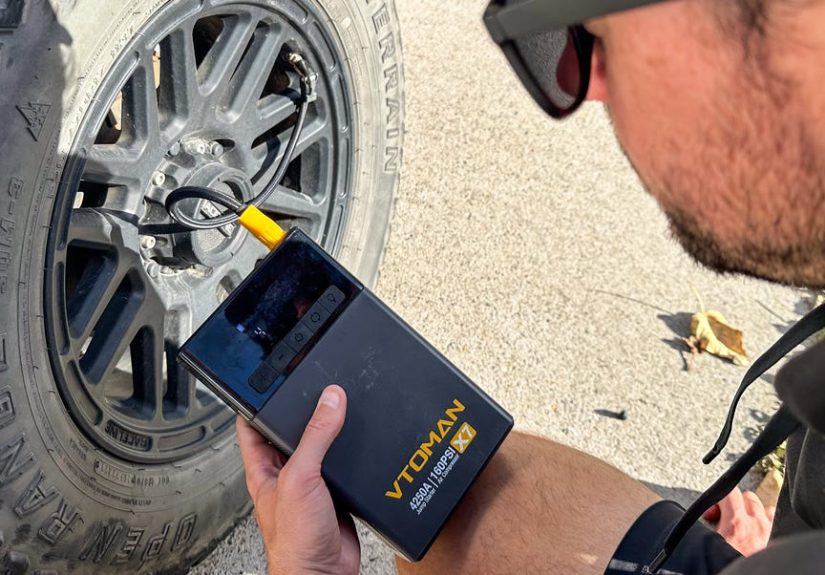
Once the leak was managed well enough to move, the real challenge began: getting enough air back into the tire to return to pavement safely. That is where a portable air compressor earns its keep. It is not only about emergency inflation after a puncture. It is also about restoring proper road pressure after airing down, topping off a slow leak, and giving you back the one thing remote driving steals first: options.
The best part is psychological. When you know you can air back up wherever you are, the trail feels less like a trap and more like an adventure. The desert stops feeling like a place that can strand you over something as silly as missing PSI.
What Makes a Portable Air Compressor Actually Worth Carrying?
Not all portable air compressors are created equal. Some are compact and convenient but better suited to occasional top-offs on passenger cars. Others are built for trucks, SUVs, trailers, and off-road tires that seem to contain the volume of a studio apartment.
1. Duty Cycle Matters More Than Marketing
If you remember only one technical term, make it this one: duty cycle. It tells you how long a compressor can run before it needs to cool down. That sounds boring until you are inflating larger tires in the heat and the compressor decides it has emotionally logged off after the second wheel.
For desert drivers, overlanders, and truck owners, a stronger duty cycle is a huge advantage. It can mean the difference between airing up all four tires in one session and waiting around while your compressor takes a snack break.
2. Power Source Changes the Experience
Some inflators plug into a 12-volt outlet. Some clip directly to the battery. Some run on rechargeable tool batteries. Some combine a built-in battery with other emergency features. None of these formats is automatically best for everyone.
If you want maximum convenience for quick top-offs, a compact cordless unit is hard to dislike. If you drive a truck or SUV, run bigger tires, or routinely air down off-road, battery-clamp units and higher-output compressors tend to make more sense. They are less cute, more serious, and a lot better at not wheezing their way through the job.
3. Hose Length and Cord Reach Are Sneaky Dealbreakers
A compressor can be powerful, affordable, and beautifully reviewed, then still become annoying if the hose or power cord cannot comfortably reach all four tires. This is one of those details people ignore right up until they are dragging the unit around the vehicle like a stubborn carry-on bag.
Good reach matters even more when the ground is sandy, hot, muddy, rocky, or otherwise interested in making simple tasks feel theatrical.
4. A Good Gauge and Auto Shutoff Save Time
Digital pressure readouts are not just fancy-looking. They help you hit your target pressure more accurately, which matters because desert driving is often about changing tire pressure on purpose and then reversing that decision later with some precision.
Auto shutoff is another feature that sounds minor until you use it. Set the target PSI, let the compressor work, and avoid the old routine of overfilling, bleeding air, muttering, and pretending that was the plan all along.
5. Extra Features Can Be More Than Gimmicks
Some modern units combine an inflator with a jump starter, work light, USB charging, and multiple inflation modes. Normally I roll my eyes at “all-in-one” gear, because sometimes that phrase means “kind of mediocre at everything.” But in a vehicle emergency kit, a combo device can make real sense.
If one tool can inflate a tire, jump a dead battery, light up the repair area, and live in one organized case instead of seven separate zippered pouches, that is not a gimmick. That is less chaos.
Why This Tool Feels So Different From Other Emergency Gear
Jumper cables are useful, but they usually require another vehicle. A spare tire is essential, but not every tire problem is solved with a swap. Tire sealant can help in limited situations, but it is not magic and often still requires inflation afterward. A portable air compressor is one of the rare pieces of emergency gear that solves several common problems by itself.
It handles the obvious crisis, like a low or leaking tire. It also handles the less dramatic but equally important stuff: restoring proper road pressure after trail driving, adjusting for load, compensating for temperature swings, and correcting the slow pressure loss that can sneak up on a trip.
That last point matters more than people think. Tire pressure changes with temperature, and desert travel loves temperature drama. Cool morning, blazing afternoon, chilly night, elevation shifts, washboard roads, heavy gear in the back, maybe a trailer, maybe a rooftop tent, maybe too many snacks. Your tires are working hard. A compressor lets you manage that instead of guessing.
How I Would Choose One Today
After the desert incident, my shopping priorities changed. I stopped caring about the cheapest option and started caring about the least annoying option. That is not the same thing.
If I were buying a portable air compressor for off-road travel today, I would prioritize these traits:
- Enough output for truck or SUV tires, not just sedan emergencies.
- A duty cycle that can handle multiple tires without constant cooldown breaks.
- A reliable pressure gauge that is easy to read in bright light.
- Auto shutoff so I can set a number and focus on the trail, the weather, or my own poor life choices.
- Battery-clamp power or a robust internal battery for stronger performance.
- A durable hose and a carrying case because desert dust gets into absolutely everything.
- A compact enough shape to live in the vehicle full-time, because the best emergency tool is the one that is actually there.
I would also keep a separate tire gauge, a plug kit, gloves, and a flashlight nearby. A compressor is excellent. A compressor with backup gear is how you avoid becoming a long story at someone else’s campfire.
How to Use a Portable Air Compressor Smartly After Off-Road Driving
Using the tool is simple, but using it smartly matters.
Start With the Right Target Pressure
Do not guess. Use the vehicle placard or owner’s manual for your road-pressure baseline, not the maximum PSI printed on the tire sidewall. Those are not the same number, and mixing them up is a classic way to make a tire do something dramatic later.
Check Pressure When Tires Are Cold Whenever Possible
Cold readings are more accurate. If you are adjusting in the field after a long drive, remember that heat can change the numbers. The goal is not perfection worthy of a laboratory. The goal is getting safely back to proper road pressure with a clear, informed method.
Inspect Before You Inflate
Look for nails, cuts, sidewall damage, or anything that suggests the tire has been run severely underinflated. A compressor is a solution, not a miracle. If the tire is damaged, no amount of cheerful buzzing will turn it back into a trustworthy highway companion.
Inflate Evenly and Recheck
Bring each tire to the target pressure, recheck with a gauge, and make sure the numbers are consistent. One tire that keeps dropping faster than the others is not “probably fine.” That is your vehicle trying to send you a memo.
Mistakes That Turn a Good Tool Into a Bad Plan
The first mistake is buying an inflator sized for bicycles, beach balls, and hopes, then asking it to air up four all-terrain tires in desert heat. That is not fair to the tool, and it is definitely not fair to you.
The second mistake is forgetting that convenience features do not replace core performance. I love a digital display and a built-in light. I love them even more when the compressor can actually sustain enough airflow to finish the job.
The third mistake is thinking a compressor replaces routine tire care. It does not. You still need to check pressures regularly, inspect for damage, and treat underinflation as a warning sign instead of a personality trait.
The fourth mistake is pushing a questionable tire back onto the highway because it “looks okay now.” If a tire has been run severely low, it may have internal damage you cannot see. That is not the moment for optimism. That is the moment for caution.
Who Really Needs One?
If you drive deep into sand, onto forest roads, across desert tracks, or through long stretches where roadside help is more fantasy than service plan, you need one. Full stop.
If you tow, road-trip, camp, overland, or live where temperature swings mess with tire pressure, you should strongly consider one.
If you commute three miles to work, park in a garage, and have never knowingly seen dirt, it is still not a bad idea. Portable air compressors are not just for dramatic wilderness rescues. They are for ordinary flats, seasonal pressure drops, and the deeply annoying Monday morning discovery that one tire has chosen chaos.
500 More Words From the Desert: The Part I Still Think About
The thing I remember most is not the tire itself. It is the transition.
One minute, I was having the kind of day that makes you romanticize desert driving. The sky was huge. The road was a ribbon of dust. Every photo looked like an advertisement for freedom, bad decisions, and expensive suspension upgrades. Then the tire lost pressure, and suddenly the same landscape felt very different. Not hostile, exactly. Just indifferent. The desert does not panic with you. It just keeps being the desert.
I pulled over, stepped out, and the heat hit like an open oven door. There was no dramatic soundtrack, no heroic gust of wind, no movie-trailer narration about survival. Just me, a low tire, and that deeply specific moment when you start inventorying your gear with unusual sincerity.
I checked the valve, checked the tread, checked my repair kit, checked my attitude. The attitude was not helping.
What saved the mood was having a compressor that turned the problem into a process. That sounds like a small thing, but it is not. In remote places, the biggest gift a piece of gear can give you is a sequence. First do this. Then do this. Then do this. Panic loves a vacuum. Good tools fill it.
Hook up the compressor. Set the pressure. Watch the number climb. Listen to the motor. Feel the whole situation shift from “maybe I am stranded” to “okay, this is annoying, but manageable.” That is the real value. Not just the air, but the return of momentum.
I also remember how different the vehicle felt once the tires were back where they needed to be for pavement. Steering tightened up. The truck stopped feeling vague and floaty. The road stopped feeling like a suggestion. It was a vivid reminder that tire pressure is not some fussy maintenance detail for people who alphabetize their sockets. It changes how the vehicle behaves. It changes safety, comfort, and confidence.
That day also changed what I keep in the truck permanently. I no longer treat emergency tools like optional accessories that can be shuffled between garage shelves depending on mood. The compressor now lives in the vehicle. Not in the house. Not in a bin I mean to repack later. In the truck. Because the day you need it is usually the day you are farthest from where you left it.
And maybe that is the broader lesson. Off-road driving is full of big, glamorous conversations about suspension, tires, lockers, lifts, and terrain management. Those things matter. But sometimes the most valuable gear is the least glamorous item in the kit: the one that quietly solves a boring problem before it becomes a dangerous one.
My portable air compressor did not make the desert less wild. It did something better. It gave me a reliable way to leave.
Conclusion
A portable air compressor is one of those tools that feels easy to postpone buying until the exact day it becomes unforgettable. In the desert, it can help fix a slow leak, recover from an air-down, restore safe road pressure, and turn a stressful situation back into a manageable one. On ordinary days, it is still useful for maintenance, road trips, and surprise tire-pressure drama in a parking lot that smells faintly of fast food and regret.
Mine helped get me out of the desert and back to pavement, but the bigger lesson was simpler: the right compressor does not just inflate tires. It buys back control. And when you are miles from help, that is worth a lot more than trunk space.