Table of Contents >> Show >> Hide
- What the ThruNite Archer 2A V3 Actually Is
- Design and Build Quality
- Beam, Brightness, and Real-World Performance
- User Interface: Simple Enough for Anyone
- Battery Life and the AA Advantage
- Durability and Reliability
- Who Should Buy the Archer 2A V3?
- Where It Falls Short
- Final Verdict
- Extended Everyday-Carry Experience: What Living With the Archer 2A V3 Feels Like
- SEO Tags
If you spend any amount of time reading flashlight forums, gear reviews, or the opinions of people who take “everyday carry” a little too seriously, you start to notice a pattern. The flashlights that win hearts are not always the brightest, fanciest, or most tacticool. Usually, they are the ones that work without drama, fit in a pocket without feeling like a medieval club, and do not require a PhD in button presses just to turn on. That is exactly why the ThruNite Archer 2A V3 keeps showing up in conversations about the best budget EDC flashlights.
On paper, it is not trying to be a monster light. It runs on two AA batteries, tops out at 500 lumens, and uses a dual-switch setup with a tail switch for power and a side switch for mode changes. That may sound almost boring in a market full of tiny rechargeable flashlights that brag like action-movie heroes. But boring can be beautiful. Especially when the power is out, the dog needs walking, the breaker panel is in a creepy corner, or something rolled under the car seat at exactly the wrong time.
So is the Archer 2A V3 actually good, or is it just the flashlight equivalent of a sturdy pair of socks? After sorting through current specs, real-world testing, and long-term impressions, my take is simple: this is one of the easiest flashlights to recommend to normal people. It is also easy to recommend to gear nerds who want a dependable AA light that does not behave like a moody science project.
What the ThruNite Archer 2A V3 Actually Is
The Archer 2A V3 is a compact aluminum EDC flashlight powered by two AA alkaline or NiMH batteries. Its top output is 500 lumens, beam distance is rated at 93 meters, and it offers five modes total: Firefly, Low, Medium, High, and Strobe. It also includes mode memory, so it returns to the last-used mode except for strobe. That feature alone saves you from the old flashlight ritual of click-click-click-click-why-is-it-strobing-in-my-face.
ThruNite pairs that output with a forward-clicky tail switch, which means you can half-press for momentary light or fully click for constant-on. The side switch handles brightness changes. In practical terms, that means the light feels straightforward the first time you use it. You do not need to memorize some weird secret handshake just to get from “read a map” to “what was that noise behind the shed?”
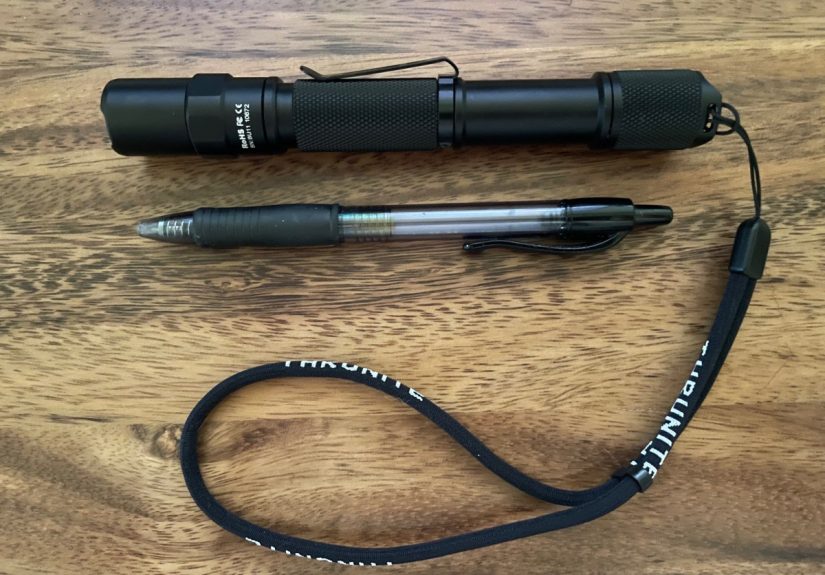
The body is slim, about 6 inches long, and light enough to disappear in a pocket when you are moving around the house, heading outside, or tossing it into a backpack. It is not a micro-light, and nobody will mistake it for a keychain gadget. But it is compact in the useful sense of the word: easy to grab, easy to hold, and easy to find when you need it fast.
Design and Build Quality
A body built like a tool, not a toy
One of the Archer 2A V3’s biggest strengths is that it feels like a real flashlight the moment you pick it up. The aluminum body has knurling for grip, a hard-anodized finish, and enough texture that it does not feel slippery when your hands are wet, cold, or occupied with whatever problem made you reach for a flashlight in the first place.
This is not a flashy design. It is a practical one. The shape is familiar, the grip is secure, and the light looks like it belongs in a kitchen drawer, a glove box, a hiking pack, or a pocket. There is something refreshing about a product that does not try to look like it was designed by a superhero’s accountant.
The clip is useful, but not perfect
The pocket clip is one of the few areas where criticism shows up repeatedly. It works, and some users like that it can be removed or repositioned, but the clip placement is not universally loved. Because it sits closer to the middle of the light than some people prefer, the Archer can ride a little higher in the pocket than ideal. In other words, it is pocketable, but not quite “deep carry ninja invisible.”
That does not make it a deal-breaker. It just means the Archer feels best clipped where fast access matters more than perfect concealment. For everyday carry, that is still a fair trade.
Beam, Brightness, and Real-World Performance
The 500-lumen rating is enough to make the Archer 2A V3 feel genuinely useful without turning it into a hand-held sunbeam. This light is not meant to dominate a football field. It is meant to handle the jobs most people actually have: walking the dog, checking the yard, navigating a campsite, finding tools in a garage, seeing under the sink, and getting around during a power outage without stepping on something that crunches.
The beam pattern is one of the more underrated parts of the package. Reviewers consistently describe it as balanced and practical rather than wildly throwy or overly floody. That makes sense for an everyday carry light. You want a beam that gives you a useful hotspot, enough spill to understand your surroundings, and a smooth transition between the two. You do not want a laser pointer pretending to be a flashlight.
Medium and Low are where this flashlight earns its paycheck. High mode is nice when you want a bigger punch of light, but Medium is often the setting that feels most realistic for daily use. It is bright enough for night walks and general outdoor tasks while being far easier on battery life. Low is equally practical for indoor work, especially when you do not want harsh glare bouncing off white walls, mirrors, or the suspiciously reflective object you forgot was in the closet.
Firefly mode deserves its own paragraph because it tends to divide opinion. In theory, ultra-low modes are excellent for preserving night vision, reading in a tent, or moving around a dark room without waking everyone else. In practice, some people love it and others think it is so dim it borders on philosophical. If you enjoy extremely low-output modes, the Archer gives you one. If not, you will probably use Low and move on with your life.
User Interface: Simple Enough for Anyone
This is one of the Archer 2A V3’s strongest selling points. The dual-switch setup is easy to understand and easy to teach. Tail switch for on and off. Side switch to cycle brightness. Hold for strobe. Done. No frantic clicking, no accidental trip into some hidden mode group, no need to consult an online chart that looks like flight software.
The forward-clicky tail switch is especially nice in real life because momentary-on is genuinely useful. Need a quick burst of light without fully committing? Half-press. Want the flashlight to stay on? Click. That sounds basic, but in actual use it feels fast, natural, and satisfying. Plenty of flashlights try to be clever. The Archer succeeds by being understandable.
Mode memory also helps it feel friendly. If you like using Medium for most tasks, the flashlight will not force you to start from scratch every time. That alone makes it better for routine carry than a lot of lights that insist on treating every activation like a fresh negotiation.
Battery Life and the AA Advantage
The Archer 2A V3 runs on two AA batteries, and that is either a brilliant feature or an old-school compromise depending on your lifestyle. Personally, I think it is both. If you are used to USB-C rechargeable lights, popping in AAs can feel a little retro. But “retro” becomes “smart” the moment you are traveling, camping, in a storm, or standing in a grocery store where AA batteries are easy to find and specialty cells are nowhere to be seen.
With NiMH rechargeables, the Archer gets even more appealing. You can keep spare batteries charged at home and swap them in seconds. No waiting for the flashlight itself to recharge. No proprietary cable. No fragile port cover. Just batteries in, light on, problem solved.
Runtime is also respectable, especially outside the top mode. On paper, the light can stretch dramatically on its lower settings, with Firefly running far longer than most people will ever need. More importantly, independent testing has shown that the Medium and Low modes are impressively stable and practical, which matters far more than marketing numbers you will only admire once.
Durability and Reliability
For a budget-friendly flashlight, the Archer 2A V3 has a strong reputation for toughness. It carries an IPX8 water-resistance rating and a 1-meter impact rating, which puts it comfortably into “don’t baby it” territory. Reviewers have praised its sturdy build, and some hands-on comparisons have found it more durable than expected for the price.
That said, this is where a balanced review matters. While most impressions are positive, not every comment is glowing. A few reviewers and users have reported quality-control hiccups or minor issues over time. That does not seem to define the product overall, but it is fair to say the Archer is admired mainly because it gets the fundamentals right, not because it is some flawless unicorn forged inside a volcano.
Still, when a flashlight is repeatedly described as reliable, simple, and durable across different publications and user feedback, that pattern is worth taking seriously. The Archer’s reputation was not built on marketing copy alone. It was built on people actually using the thing.
Who Should Buy the Archer 2A V3?
This flashlight makes the most sense for people who want a dependable everyday carry light without spending premium-money on premium-drama. It is especially appealing if you value easy controls, common batteries, and a beam that is practical for daily life rather than optimized for winning imaginary brightness arguments online.
It is also a strong choice for:
People who want a no-nonsense home flashlight
If you want one flashlight that can live in a drawer, work instantly, and not confuse other people in your house, this is a good pick.
Campers, travelers, and emergency-kit builders
AA compatibility is a legitimate advantage when charging options are limited or backup batteries matter.
EDC users who prefer reliability over novelty
The Archer does not try to impress you with party tricks. It tries to be useful. Weirdly enough, that is impressive.
Where It Falls Short
No flashlight review is complete without a little healthy nitpicking, so here it is. The Archer 2A V3 is longer than many modern pocket lights, the clip could be better, and it does not include built-in charging. If you want a tiny USB-C light with a deep-carry clip and absurd output bursts, there are newer options that will look sexier on paper.
Its top mode is also not the most stable thing in the universe. The light is more convincing as a practical multi-mode AA tool than as a max-output showoff. And while Firefly mode helps the spec sheet look like it has a monk-like level of enlightenment, some users will never touch it except by accident.
In short, the Archer’s weaknesses are real, but they are also easy to understand. None of them feel like fatal flaws. They feel like trade-offs that come with a simple, durable, budget-conscious design.
Final Verdict
The ThruNite Archer 2A V3 earns its reputation the old-fashioned way: by being useful. It is bright enough for real life, light enough to carry, simple enough for anyone to use, and flexible enough to shine in everything from household tasks to outdoor trips. It also benefits from one of the most practical power setups in the flashlight world: two humble AA batteries that you can find almost anywhere.
Is it the most advanced flashlight you can buy? Not even close. Is it one of the easiest everyday carry flashlights to recommend without caveats the size of a carry-on suitcase? Absolutely. If your idea of a great flashlight is one that shows up, does the job, and does not make you regret your purchase three weeks later, the Archer 2A V3 is still a very smart buy.
That is why this light keeps ending up in pockets, packs, glove boxes, and gear lists. It is not trying to be legendary. It is just trying to be there when you need it. Funny enough, that is how legends usually start.
Extended Everyday-Carry Experience: What Living With the Archer 2A V3 Feels Like
Here is the part that matters most, because specs are nice, but daily experience is where a flashlight either becomes “my light” or “the thing I forgot in a drawer next to expired batteries.” The Archer 2A V3 keeps getting positive long-term feedback for one simple reason: it fits naturally into ordinary life. It does not feel like specialized gear waiting for a heroic moment. It feels like a tool that is ready for a hundred small moments that add up.
Picture a normal weekday. You leave early, it is still dim outside, and you need to check around the car, the gate, or the porch without waking the whole neighborhood. The Archer makes sense here because its controls are immediate. You do not have to think. Half-press, quick light, done. Later that day, maybe something falls behind a storage shelf, maybe you need to look at a fuse box, maybe the dog wants one last walk after sunset. Same story. The light is bright enough to help, small enough not to be annoying, and simple enough that you are never standing there muttering, “Why is this thing flashing at me?”
That practicality carries over into outdoor use. For camping, it is not the kind of light that turns your campsite into a movie set, but it is exactly the kind of light you keep reaching for. Low and Medium are useful around a tent, around a picnic table, or on a short walk to the restroom building you really should have visited before dark. Firefly can be handy for people who like ultra-low light late at night, and High is there when you need to scan farther ahead on a trail or check what made that branch snap. Usually, it was nothing. Occasionally, it was a raccoon with excellent timing.
The AA battery setup also changes the ownership experience in subtle but important ways. With many rechargeable lights, you eventually get that low-level anxiety of wondering whether the battery is topped off. The Archer sidesteps some of that. If you keep spare AAs around, you are covered. If you use rechargeable NiMH cells, even better. You can rotate batteries and keep moving. That makes the flashlight feel less fragile and less precious. It behaves like a tool you can rely on, not a gadget you have to manage.
There is also something appealing about the Archer’s honesty. It does not pretend to be tiny when it is not. It does not pretend that 500 lumens will replace a dedicated high-output tactical light. It just lives in that sweet spot where most real-world tasks happen. It is comfortable in the hand, easy to pocket, and capable enough that you stop thinking about whether it is “good enough” and just use it.
That, in the end, is the strongest compliment I can give based on the most consistent reviewer experiences: the Archer 2A V3 disappears in the best possible way. Not literally, although it is compact. It disappears from your list of worries. It becomes the flashlight you grab without debate, the one you lend to family without a tutorial, the one you keep by the bed during storm season, and the one that earns a permanent spot in your bag because it has already proved its worth. Plenty of flashlights can impress you for five minutes. The Archer’s real talent is being the flashlight that still makes sense five months later.