Table of Contents >> Show >> Hide
- 1) Plate Tectonics: The Slow-Motion Planet Remodel
- 2) Atmospheric Rivers: “Rivers in the Sky” That Drown (or Snowpack) a Continent
- 3) Auroras: The Sky Gets Lit Up by Space Weather
- 4) Saharan Dust Plumes: A Desert Sends “Air Mail” Across an Ocean
- 5) Phytoplankton Blooms: The Ocean Turns Into a Living Paint Spill
- 6) Synchronized Coral Spawning: A Reef-Wide “Snow Globe” of Life
- 7) Harmful Algal Blooms and “Red Tides”: When the Water Turns Against the Vibes
- 8) Periodical Cicada Emergences: Billions of Bugs on a Group Schedule
- 9) Monarch Migration: A Flying Ribbon Across a Continent
- 10) Desert Superblooms: The Landscape Suddenly Decides to Be a Painting
- Big Takeaway: Nature’s “Massive Scale” Isn’t Just SizeIt’s Coordination
- 500-Word Experience Guide: How to Witness Mega-Nature Without Becoming the Warning Label
- Conclusion
Nature has two modes: “aww, a ladybug,” and “I have rearranged the planet while you were making coffee.”
This is the second mode.
If you’ve ever looked at a radar loop and thought, Why does the sky look like it’s pouring from a garden hose?
or stared at the ocean and wondered why it’s suddenly neon, you already know the vibe:
some natural phenomena aren’t just bigthey’re systems, operating at a scale where “Wow” feels like an understatement.
Below are 10 massive-scale natural events that look like special effects, behave like science class, and remind us that the Earth is a living machine.
I’ll break down what they are, why they happen, and what makes each one so wildly, gloriously extra.
1) Plate Tectonics: The Slow-Motion Planet Remodel
What it looks like
Mountain ranges rise. Ocean basins widen. Continents drift like enormous rafts. Volcanoes line up like they got a group text.
The “crazy” part is that this is the default setting for Earthjust on a time scale that makes humans feel impatient and slightly irrelevant.
Why it happens (and why it’s massive)
Earth’s outer shell is broken into plates that move relative to each other. Where they collide, you can get mountain building and big earthquakes.
Where they pull apart, new crust forms. It’s like a global conveyor-belt system fueled by heat from Earth’s interior.
The result is planet-wide architecture: coastlines, continents, and hazards all shaped by plates that refuse to sit still.
2) Atmospheric Rivers: “Rivers in the Sky” That Drown (or Snowpack) a Continent
What it looks like
On satellite imagery, atmospheric rivers appear as long, narrow bands of moisture streaming across oceans toward landlike the atmosphere is carrying a firehose.
When they make landfall, you can see days of heavy rain, intense mountain snow, flooding, and landslides (depending on terrain and temperature).
Why it happens (and why it matters)
These moisture plumes transport huge amounts of water vapor from the tropics/subtropics into higher latitudes.
When the flow hits mountains or frontal systems, air rises, cools, and dumps precipitationsometimes feeding reservoirs and snowpack,
and sometimes turning roads into surprise rivers. Atmospheric rivers are a perfect example of “massive scale” because they can span
thousands of miles and affect entire regions in a single event.
3) Auroras: The Sky Gets Lit Up by Space Weather
What it looks like
Curtains and ribbons of green, red, and purple light dance across polar skiessometimes spreading farther from the poles during stronger geomagnetic activity.
It’s like the atmosphere is hosting a concert, and the headliner is: the Sun.
Why it happens (the short version)
Energetic particles from the Sun interact with Earth’s magnetic field and atmosphere. During geomagnetic storms,
more particles get funneled toward the poles, exciting atmospheric gases and producing those iconic glowing colors.
Auroras are nature’s reminder that Earth doesn’t stop at “weather”we also live inside a cosmic environment.
4) Saharan Dust Plumes: A Desert Sends “Air Mail” Across an Ocean
What it looks like
A thick haze stretches from Africa across the Atlantic, dimming sunlight and painting sunsets like a postcard filter.
Sometimes it reaches the Caribbean and parts of the United States, turning the sky slightly milky and the air a bit gritty.
Why it happens (and why it’s weirdly important)
Strong winds loft tiny mineral particles from the Sahara into a hot, dry air layer that can travel thousands of miles.
It’s a massive-scale transportation system for dustone that can influence air quality and visibility and even interact with weather patterns.
The “crazy” part: what happens in one of the world’s largest deserts doesn’t stay there.
5) Phytoplankton Blooms: The Ocean Turns Into a Living Paint Spill
What it looks like
Satellite images show huge swirls of green and blue spread across seassometimes resembling watercolor brushstrokes.
From the shore, you might see greener water, surface streaks, or (in certain cases) bioluminescent glow at night.
Why it happens (and why it’s a big deal)
Phytoplankton are tiny organisms that form the base of marine food webs. When conditions line uplight, nutrients, temperature, mixing
their populations can explode into blooms visible from space. Some blooms are beneficial and fuel ecosystems;
others can be harmful depending on the species involved. Either way, the scale is jaw-dropping: entire ocean regions can “change color” in days.
6) Synchronized Coral Spawning: A Reef-Wide “Snow Globe” of Life
What it looks like
At certain times of year, corals release eggs and sperm into the water in coordinated bursts. Underwater, it can look like a blizzard of tiny pinkish pearls
floating upwardequal parts beautiful and slightly surreal.
Why it happens (timing is everything)
Many corals synchronize spawning to maximize fertilization success: release together, mix together, increase the odds.
Environmental cues like water temperature, day length, and lunar cycles help line up the event. It’s nature doing calendar management at ecosystem scale
because when you’re a coral, your dating strategy is basically: “Everybody show up at the same time.”
7) Harmful Algal Blooms and “Red Tides”: When the Water Turns Against the Vibes
What it looks like
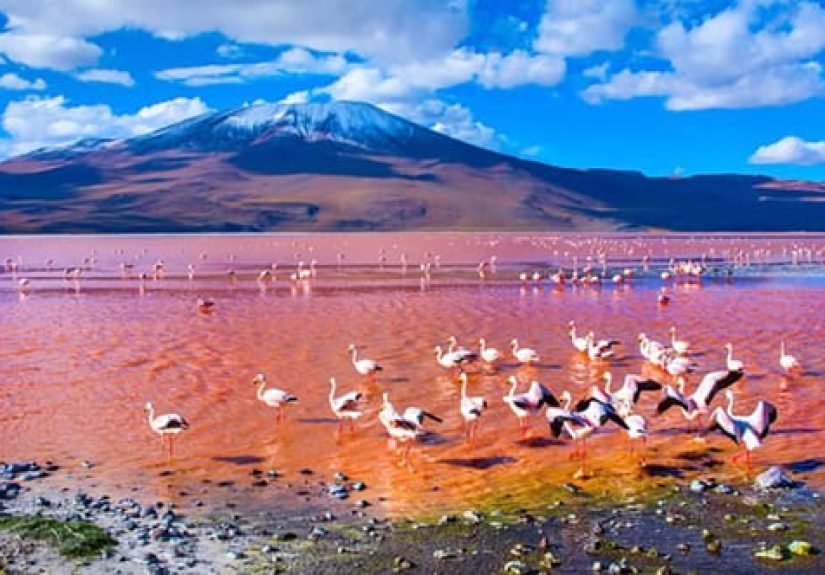
Discolored waterreds, browns, greenssometimes with fish kills, respiratory irritation near shore, or beach closures.
The ocean can look like it’s wearing the wrong foundation shade.
Why it happens (and why it’s not just a color change)
“Red tide” is a common term for certain harmful algal blooms. These blooms occur when algae grow out of control and can produce toxins or otherwise harm
fish, shellfish, marine mammals, birds, and people. The massive-scale part is how quickly a bloom can spread across coastlines and how widely it can ripple
through ecosystems, tourism, and public health.
8) Periodical Cicada Emergences: Billions of Bugs on a Group Schedule
What it looks like
One year everything is normal. Then suddenly: red-eyed insects everywhere, shells on trees, and a soundtrack that feels like a sci-fi engine room.
It’s not an invasionit’s a synchronized life cycle.
Why it happens (13-year and 17-year math, but make it biological)
Periodical cicadas spend most of their lives underground as nymphs, then emerge in synchronized broods on a 13- or 17-year cycle.
The mass emergence overwhelms predators (“You can’t eat us all!”), giving enough cicadas a chance to reproduce.
Nature basically uses volume as a survival strategyand it works.
9) Monarch Migration: A Flying Ribbon Across a Continent
What it looks like
In the right season and places, monarchs appear in steady wavesan orange-and-black confetti stream moving with purpose.
In overwintering areas, they cluster by the thousands (and beyond), turning trees into living stained glass.
Why it happens (and why it’s extraordinary)
Monarchs are famous for long-distance migration and for forming large overwintering clusters.
This isn’t just “a butterfly flew far.” It’s a population-level movement spanning countries and generations,
with navigation cues that still inspire research and awe. It’s one of the most poetic examples of massive-scale nature that still fits in the palm of your hand.
10) Desert Superblooms: The Landscape Suddenly Decides to Be a Painting
What it looks like
A desert that usually whispers in beige suddenly shouts in yellow, purple, pink, and white. Hillsides become carpets.
Photographers become feral. People say “It looks fake” while taking 900 photos to prove it’s real.
Why it happens (and why it’s rare)
Superblooms are above-average wildflower displays triggered by a very specific recipe: enough rain at the right time,
good temperatures, and conditions that let dormant seeds finally cash in their “one day” plan.
Some places average these spectacular displays only occasionally, making them one of nature’s most dramatic “limited-time offers.”
Big Takeaway: Nature’s “Massive Scale” Isn’t Just SizeIt’s Coordination
What connects these phenomena isn’t only that they’re huge. It’s that they’re organized.
Plates follow physics. Moisture follows atmospheric flows. Life follows timing cues, seasons, and survival strategies.
The result is a planet that doesn’t just sit thereit performs.
500-Word Experience Guide: How to Witness Mega-Nature Without Becoming the Warning Label
You don’t need to be a research scientist or an extreme adventurer to experience massive-scale nature. You just need three things:
curiosity, timing, and a healthy respect for the fact that the Earth does not care about your itinerary.
Start with the “safe spectacle” category. Auroras are the classic: they’re breathtaking, usually harmless to watch,
and oddly emotionallike the sky is personally congratulating you for showing up. If you’re planning a trip, treat it like wildlife viewing:
give yourself multiple nights, pick dark skies, and remember that clouds are the ultimate spoiler. The best “experience hack” is patience.
The aurora rewards people who are willing to stand around in the cold saying, “Maybe in 10 minutes,” for two hours.
Superblooms are another crowd favorite because they feel like magic you can walk through. The trick is not just showing up,
but showing up at the right time. Deserts don’t do schedulesthey do conditions. If rains were good and temperatures cooperate,
blooms can peak fast and fade fast. When you go, stay on trails, don’t trample flowers for the perfect photo,
and resist the urge to treat the desert like your personal studio set. (The plants waited years for this moment. Let them have it.)
For “big but sneaky,” try watching the sky and seas for patterns. Atmospheric rivers are impressive on maps and radar loops,
but in person they look like relentless weather. The experience here is less “wow, pretty” and more “wow, powerful.”
If you live in a region that gets them, your best front-row seat is preparation: clear drains, know flood routes,
and appreciate that these storms can be both beneficial (water supply) and dangerous (flooding). Nature loves complexity.
Want something that feels like a documentary happening in your backyard? Periodical cicadas are the perfect low-risk,
high-drama event. The experience is sensory: the sound, the shells, the sheer density. Go outside during peak chorus,
stand under trees, and let the weirdness wash over you. Then, if you have young trees, protect thembecause cicadas are harmless to humans,
but they can be rough on tender branches when laying eggs.
Ocean phenomena deserve extra caution. A glowing beach can be bioluminescent plankton (magical) or a harmful algal bloom (not magical).
If local advisories say avoid water, listen. The best experience strategy is to respect closures, check local conditions,
and keep your awe separate from your impulse to wade in. Your lungs and skin will thank you.
Finally, the most rewarding “experience” is noticing scale in ordinary life: realizing that dust can cross oceans, that tiny plankton can color seas,
that butterflies can stitch continents together. Massive-scale nature isn’t only a travel goalit’s a mindset. Once you start seeing the patterns,
the whole planet becomes the exhibit.
Conclusion
The world is full of gigantic natural phenomena that feel “too big to be true”until you realize they’re happening all the time, whether we’re paying attention or not.
From the slow grind of plate tectonics to the sudden chaos of blooms and storms, nature doesn’t just do “large.”
It does connected, coordinated, and occasionally “Are we sure this isn’t CGI?”