Table of Contents >> Show >> Hide
- Why Childhood Cartoon Villains Hit So Hard
- 15 Terrifying Cartoon Characters From Your Childhood
- 1. King Ramses – Courage the Cowardly Dog
- 2. HIM – The Powerpuff Girls
- 3. The Other Mother – Coraline
- 4. The Lich – Adventure Time
- 5. Hexxus – FernGully: The Last Rainforest
- 6. Chernabog – Fantasia
- 7. Rasputin – Anastasia
- 8. Judge Doom – Who Framed Roger Rabbit
- 9. Mumm-Ra – ThunderCats
- 10. The Horned King – The Black Cauldron
- 11. Slade – Teen Titans
- 12. Aku – Samurai Jack
- 13. The Beast – Over the Garden Wall
- 14. Zim – Invader Zim
- 15. Ursula – The Little Mermaid
- What These Creepy Cartoon Characters Have in Common
- Why We Secretly Love the Characters Who Scared Us
- Personal Experiences: Growing Up With Cartoon Nightmare Fuel
- Conclusion
Childhood cartoons were supposed to be safe, colorful little playgrounds where talking dogs solved mysteries, magical girls saved the day, and nobody had to think too deeply about taxes. Then, without warning, a character would appear who made your cereal spoon freeze halfway to your mouth. Suddenly, Saturday morning felt less like a cozy ritual and more like a tiny psychological obstacle course with commercials for fruit snacks.
The scariest cartoon characters from childhood were not always the loudest, ugliest, or most obviously evil. Sometimes they were quiet. Sometimes they smiled too much. Sometimes they were shaped like triangles, pollution clouds, ancient curses, or suspiciously polite mothers with button eyes. What made them unforgettable was how perfectly they slipped horror into kid-friendly animation without fully breaking the rules. They were creepy enough to live rent-free in your brain, but not so explicit that your parents immediately turned off the TV.
This list celebrates those terrifying cartoon characters who scared kids, fascinated adults, and proved that animation can be funny, beautiful, strange, and deeply unsettling all at once. Lock the basement door, turn on a night-light, and let us revisit the animated nightmares that made growing up just a little more dramatic.
Why Childhood Cartoon Villains Hit So Hard
Cartoons have a special power: they exaggerate everything. Eyes get bigger, shadows stretch longer, voices become stranger, and ordinary fears turn into unforgettable images. A scary character in live action might look dated years later, but a scary animated character can remain frozen in peak nightmare condition forever. No wrinkles, no awkward CGI, no mercy.
These characters also appeared when viewers were young enough to believe that maybe, just maybe, the monster on TV could climb out of the screen if the living room got too dark. That is why creepy cartoon villains still work decades later. They do not simply scare us; they remind us of the exact couch, blanket, snack, and emotional damage.
15 Terrifying Cartoon Characters From Your Childhood
1. King Ramses – Courage the Cowardly Dog
Few animated characters have done so much with so little. King Ramses did not need a complicated backstory, a dramatic monologue, or a villain song. He simply appeared in the middle of nowhere, looking like cursed computer animation accidentally left in a children’s cartoon, and demanded that his slab be returned.
What made King Ramses terrifying was the mismatch. Courage the Cowardly Dog was already weird, but Ramses felt different from the rest of the show. His stiff movement, echoing voice, and lonely desert atmosphere made him feel like something from a forgotten educational CD-ROM that had become haunted. He was not just a villain; he was a bad dream with excellent posture.
2. HIM – The Powerpuff Girls
HIM was proof that the scariest villain in a superhero cartoon does not need to punch the hero through a building. Sometimes all it takes is a silky voice, crab-like claws, and the confidence of someone who knows the room got colder when he arrived.
Unlike Mojo Jojo, who was often ridiculous in the best way, HIM felt supernatural and unpredictable. He toyed with fear, guilt, anger, and insecurity. The Powerpuff Girls could defeat giant monsters before dinner, but HIM made the battle psychological. He was glamorous, theatrical, and deeply creepy, like a haunted lounge singer who also happened to be evil incarnate. Childhood viewers may not have understood the full camp brilliance, but they knew one thing: when HIM showed up, things got uncomfortable fast.
3. The Other Mother – Coraline
The Other Mother, also known as the Beldam, might be one of the most effective animated villains ever created because she starts with comfort. She gives Coraline better food, better attention, better entertainment, and a better version of home. Then the trap begins to close.
Her button eyes are iconic because they turn something domestic into something deeply wrong. Buttons belong on coats, not faces. Her horror is not just visual; it is emotional. She represents the fear that love can be fake, that kindness can be bait, and that a perfect world may come with fine print written in nightmare ink. No wonder an entire generation looked at sewing kits differently afterward.
4. The Lich – Adventure Time
Adventure Time was colorful, silly, musical, and full of candy people, which made the Lich feel even more alarming. He entered the story like a reminder that underneath the jokes and mathematical catchphrases, the Land of Ooo had real darkness buried in its history.
The Lich was terrifying because he was calm. He did not rant like a cartoon villain trying to win a local theater award. He spoke with cold certainty, as though destruction was not a plan but a natural law. Against Finn’s energy and Jake’s humor, the Lich felt ancient, patient, and almost impossible to fully erase. He was the animated equivalent of the lights flickering during a sleepover.
5. Hexxus – FernGully: The Last Rainforest
Hexxus made pollution charismatic, which is honestly rude. Voiced with dangerous charm and animated as a shifting cloud of toxic menace, he turned environmental destruction into something seductive, theatrical, and genuinely scary.
Many childhood villains wanted power, revenge, or treasure. Hexxus wanted decay. That made him feel bigger than a single character. He was smoke, sludge, greed, and destruction wrapped in a performance so memorable that kids learned the rainforest was in danger while also wondering why the villain had the best song. A confusing awakening, environmentally speaking.
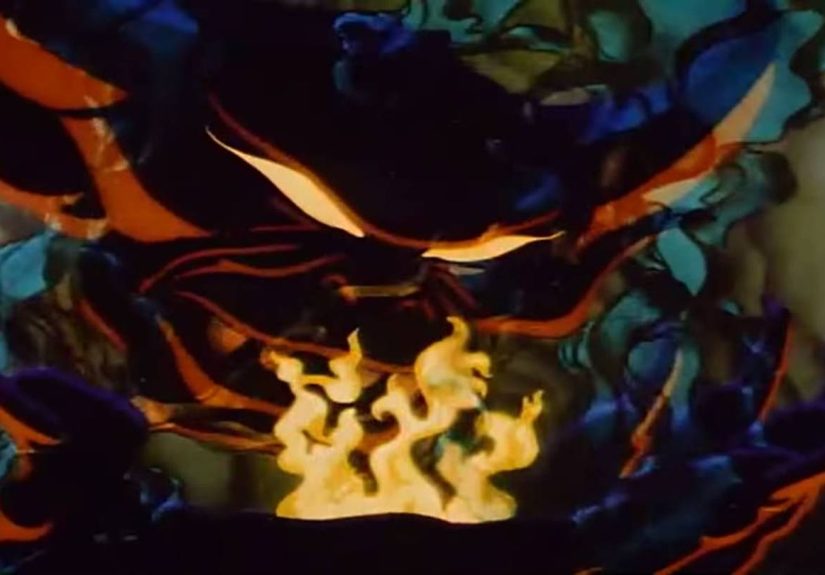
6. Chernabog – Fantasia
Chernabog is old-school Disney nightmare fuel. Emerging from the mountain in the “Night on Bald Mountain” segment of Fantasia, he is less a character with dialogue and more a towering symbol of darkness. He does not need jokes. He does not need a sidekick. He simply spreads his wings and ruins bedtime.
The genius of Chernabog is scale. He feels enormous, mythic, and untouchable. For children expecting dancing hippos and magical brooms, this sudden plunge into shadowy supernatural imagery was a lot to process. He remains one of the scariest Disney animated villains because he does not behave like a person. He behaves like midnight itself got angry.
7. Rasputin – Anastasia
Rasputin from Anastasia had all the ingredients of a childhood nightmare: a dramatic curse, a creepy relic, a decaying appearance, and a little talking bat who made everything somehow both funnier and stranger. He was theatrical in the grand tradition of animated villains, but his design pushed into darker territory than many kids expected.
What made Rasputin memorable was the contrast between the film’s sweeping romance and his eerie obsession with revenge. One moment, the movie was sparkling gowns and lost royalty. The next, Rasputin was crawling back into the plot like a history lesson that had taken a hard left into gothic fantasy. Educational? Maybe. Disturbing? Absolutely.
8. Judge Doom – Who Framed Roger Rabbit
Judge Doom is technically a live-action character in a hybrid animated world, but any list of terrifying childhood cartoon-adjacent figures that leaves him out should be placed under investigation. He haunted kids because he understood cartoon logic and used it with terrifying seriousness.
His blank stare, rigid posture, and hatred of Toons made him unsettling long before his final reveal. The real horror came from seeing a world of rubbery slapstick suddenly treated with cold cruelty. Judge Doom made viewers realize that even in a universe built on anvils, whistles, and impossible physics, danger could still feel permanent. That is a lot to learn before middle school.
9. Mumm-Ra – ThunderCats
Mumm-Ra looked like someone opened an ancient tomb and the tomb immediately joined a gym. As the undead sorcerer of ThunderCats, he brought a heavy dose of dark fantasy to a show packed with action, heroes, and extremely committed hair.
His transformation sequence was a major part of the fear factor. He began as a frail mummy-like figure, then became a towering villain powered by ancient evil. For kids, that was the cartoon equivalent of watching the final boss charge up while you still had one life left. Mumm-Ra was dramatic, powerful, and visually intense enough to make bedtime feel like a tactical decision.
10. The Horned King – The Black Cauldron
The Horned King from Disney’s The Black Cauldron did not feel like he wandered in from the usual Disney villain department. He felt like he took a wrong turn from a dark fantasy film and decided to stay.
With his skeletal design, shadowy castle, and obsession with raising an unstoppable army, the Horned King gave the movie a grim atmosphere that stood apart from brighter Disney classics. He was not funny in the usual villain way. He did not sparkle with sarcasm. He simply loomed. For children expecting a cozy animated adventure, he was a firm reminder that animation could absolutely wear a black cloak and mean business.
11. Slade – Teen Titans
Slade from Teen Titans was terrifying because he was not loud. He was controlled, patient, and always seemed three steps ahead. His mask gave him an unreadable presence, and his calm voice made every threat feel heavier.
While many cartoon villains were exaggerated for comedy, Slade felt unusually serious. His manipulation of Robin gave the show some of its darkest emotional moments, turning superhero action into a story about obsession, control, and fear. Kids may have tuned in for powers and teamwork, but Slade brought psychological pressure with him. He was the villain who made the room quiet.
12. Aku – Samurai Jack
Aku was funny, yes, but never harmless. His towering shape, flaming eyebrows, jagged silhouette, and booming voice made him one of the most iconic villains in American animation. He could be ridiculous one minute and genuinely frightening the next, which is a dangerous combination. That is how you get trust issues.
As the shape-shifting master of darkness in Samurai Jack, Aku represented more than a single enemy. He was the corrupted world Jack had to survive. His design pulled from myth, theater, and nightmare imagery, giving him a presence that felt ancient and larger than the screen. Also, the man knew how to make an entrance.
13. The Beast – Over the Garden Wall
The Beast from Over the Garden Wall is a masterclass in restraint. He is frightening not because the show shows too much, but because it shows just enough. He lives in silhouettes, whispers, and woods that feel older than any map.
His power comes from atmosphere. The Unknown already feels like autumn turned into a dream, and the Beast is the shadow behind that dream. He tempts, manipulates, and waits. Unlike villains who attack with obvious force, he works through despair and confusion. For viewers who discovered the miniseries young, he made forests feel a little less friendly and lanterns feel suspiciously important.
14. Zim – Invader Zim
Zim is hilarious, but let us be honest: he is also deeply unsettling. Invader Zim took alien invasion, school anxiety, body weirdness, malfunctioning technology, and social paranoia, then wrapped them in neon-green chaos.
Zim himself is not scary in the same way as Chernabog or the Lich. He is too incompetent for that. But his world is scary. Everything feels sticky, loud, broken, and one bad experiment away from disaster. Zim’s intensity, giant eyes, mechanical backpack, and complete lack of normal human behavior made him unforgettable. He was the kid in class who definitely had a secret lab, and somehow the adults still gave him homework.
15. Ursula – The Little Mermaid
Ursula is one of Disney’s greatest villains because she is charming before she is frightening. She sells Ariel a dream, dresses manipulation as opportunity, and makes bad decisions sound fabulous. That is villainy with customer service skills.
Her design is unforgettable: part sea witch, part stage diva, part deep-ocean nightmare. Ursula’s scary power comes from how well she understands desire. She does not simply grab what she wants; she convinces others to hand it over. For kids, that was a surprisingly advanced lesson in contracts, temptation, and why you should never trust someone who turns legal paperwork into musical theater.
What These Creepy Cartoon Characters Have in Common
The most terrifying cartoon characters from childhood usually share a few traits. First, they break the tone of their world. King Ramses looks strange even inside a strange show. The Lich feels cold in a warm, funny universe. The Other Mother makes comfort feel unsafe. These characters scare us because they do not quite belong, and the brain notices.
Second, they use voice brilliantly. A creepy voice can do more than a dozen jump scares. HIM’s whispery theatricality, Slade’s controlled calm, Aku’s thunderous performance, and the Lich’s icy certainty all prove that sound is half the nightmare. You may forget plot details, but you remember the way a villain made the air feel different.
Third, they are visually simple enough to become icons. A triangle with one eye. A mountain-sized demon. Button eyes. A mask with one dark side. A cursed figure demanding a slab. The designs are easy to remember, which is exactly the problem when you are eight years old and trying to sleep.
Why We Secretly Love the Characters Who Scared Us
Here is the funny thing about childhood cartoon trauma: many of us went back for more. We rewatched the episodes, rented the movies, bought the merch, quoted the villains, and eventually turned fear into nostalgia. The characters who scared us became proof that children’s animation did not have to be soft or forgettable. It could be bold, weird, artistic, and emotionally intense.
These villains also helped young viewers practice fear in a safe way. A scary cartoon character can make your heart race, but the story usually gives you a hero, a joke, a song, or a sunrise. Courage survives. Coraline fights back. Jack keeps going. Ariel finds her voice again. The fear has shape, and the shape can be defeated, outsmarted, or at least paused until next week’s episode.
Personal Experiences: Growing Up With Cartoon Nightmare Fuel
Watching terrifying cartoon characters as a kid was a very specific experience. You were not trying to analyze themes, animation style, voice direction, or cultural impact. You were trying to decide whether you could make it from the couch to the hallway without looking behind you. That was the scholarship of childhood: advanced monster avoidance with a minor in blanket-based defense systems.
Many people remember the exact moment a cartoon crossed the line from “fun spooky” to “why is my room suddenly enormous and full of shadows?” Maybe it was King Ramses standing alone in the desert. Maybe it was the Other Mother smiling too perfectly. Maybe it was Chernabog rising over Bald Mountain like Disney had briefly forgotten children existed. Whatever the moment, it stuck because it arrived inside something trusted. Cartoons were supposed to be friendly. When they became frightening, it felt personal.
There was also the social side of it. At school, kids compared scary cartoon memories like tiny veterans of the same animated battlefield. Someone would mention Courage the Cowardly Dog, and suddenly three other people would shout, “The slab!” with the urgency of witnesses identifying a suspect. Someone else would bring up Coraline, and the whole table would agree that button eyes were unacceptable under all circumstances. Childhood fear became a shared language.
Parents often underestimated these scenes because, to adult eyes, they were “just cartoons.” But children know better. Animation can sneak past logic and go directly to imagination. A live-action monster is trapped in a movie. A cartoon monster feels like it could be redrawn anywhere: in a notebook margin, on a cereal box, in the pattern of clothes piled on a chair at 2 a.m. That flexibility makes animated fear weirdly durable.
As adults, revisiting these characters can be surprisingly delightful. The fear is still there, but now it comes with appreciation. You notice the lighting, the music, the pacing, the design choices, and the courage it took for animators to make children’s entertainment that did not sand down every sharp edge. The characters who once made you hide behind a pillow now look like evidence of creative risk-taking. They were scary because somebody cared enough to make them memorable.
And maybe that is why these terrifying cartoon characters remain beloved. They gave childhood a little danger without taking away the safety of the story. They made us nervous, but they also made heroes matter. They taught us that fear could be strange, funny, stylish, musical, and survivable. Most importantly, they gave us excellent conversation material decades later. After all, anybody can remember a cute cartoon sidekick. It takes real artistic power to make an entire generation hear “Return the slab” and instantly need a lamp turned on.
Conclusion
The scariest cartoon characters from childhood did more than frighten viewers for a few minutes. They became cultural bookmarks, emotional jump scares, and oddly beloved reminders that animation can be fearless. From King Ramses and HIM to the Other Mother, the Lich, Chernabog, and Ursula, these characters proved that cartoons could explore fear with style, humor, and surprising depth.
They scarred us, yes, but in the best possible way: with unforgettable designs, eerie voices, bold storytelling, and enough nightmare energy to keep the night-light industry thriving. Childhood may be over, but these animated terrors are still waiting in the memory archives, whispering from the VHS shelf, the streaming menu, or the dusty corner of your brain labeled “absolutely not before bedtime.”