Table of Contents >> Show >> Hide
- Why the 2025 Minimalism Photography Awards Matter
- The Grand Winner: Alexandros Othonos and “Threads of Memory’s”
- 35 Photos, One Big Lesson: Less Can Carry More
- Architecture, Geometry, and the Beauty of Control
- Nature, Space, and the Art of Not Overdoing It
- Street and Portrait Photography: Minimalism With a Pulse
- Night, Long Exposure, and the Poetry of Waiting
- What Makes These Minimalist Photos So Good?
- Why Minimalist Photography Feels So Modern in 2025
- Lessons for Photographers Inspired by the 2025 Winners
- Experience Notes: What These 35 Photos Teach Us About Seeing
- Conclusion
- SEO Tags
Minimalism sounds easy until you try it. “Just remove everything unnecessary,” people say, as if the average photo does not already contain twelve power lines, three parked cars, a confused pigeon, and someone’s uncle walking through the frame with a sandwich. The best minimalist photography does not happen by accident. It is careful, disciplined, emotionally sharp, and occasionally so quiet that it makes your phone notifications feel personally rude.
That is exactly why the 2025 Minimalism Photography Awards feel so refreshing. In a year when visual culture often seemed determined to shout in neon, these 35 standout images whisperedand somehow got the room’s full attention. The awards gathered more than 2,600 entries and over 7,000 images from photographers in more than 50 countries, proving that simplicity is not a trend taking a nap in a Scandinavian furniture catalog. It is a global visual language.
The big story of the year was Alexandros Othonos, named Minimalist Photographer of the Year 2025 for his deeply moving series Threads of Memory’s. The project uses vintage family photographs altered with delicate thread interventions, turning old images into meditations on memory, absence, nostalgia, and emotional inheritance. It is minimalist not because it feels empty, but because every element has a joband nobody in the frame is freeloading.
Why the 2025 Minimalism Photography Awards Matter
The Minimalism Photography Awards have become a serious stage for contemporary photographers who believe a photograph does not need visual clutter to be powerful. The 2025 edition marked the seventh year of the competition and included 12 major categories, covering Abstract, Aerial, Architecture, Conceptual, Fine Art, Landscape, Long Exposure, Night Photography, Open, Photomanipulation, Portrait, and Street photography.
That category range is important. Minimalism is sometimes misunderstood as “one tiny object in a lot of blank space.” That can work beautifully, but the 2025 winners show a much wider definition. Minimalism can be a snow-covered landscape, a lone figure in a foggy street, a building sliced into geometric silence, a swan emerging from darkness, or a vintage photo made newly strange by a single red thread.
What connects the best images is restraint. They ask one clear question: how much can be removed before the picture loses its soul? The answer, based on this year’s winners, is “quite a lotbut not the important stuff.”
The Grand Winner: Alexandros Othonos and “Threads of Memory’s”
Othonos’ Threads of Memory’s stands apart because it uses minimalism as emotional archaeology. Instead of presenting family photographs as fixed historical objects, the series reopens them. Thread moves across faces, bodies, and blank areas like memory itself: fragile, tangled, sometimes beautiful, sometimes uncomfortable.
The result is not loud. It does not need to be. A small intervention changes the meaning of an entire image. That is the secret engine of minimalist art: tiny choices create enormous echoes. In Threads of Memory’s, the viewer is not just looking at old photographs. The viewer is looking at what time does to photographs, what families keep, what families lose, and what the imagination tries to repair.
35 Photos, One Big Lesson: Less Can Carry More
The 35 featured photos from the 2025 awards are not simply a “best of” gallery. They are a crash course in how minimalist photography works across different subjects. Some images lean on negative space. Others rely on geometry, repetition, color restraint, fog, shadow, scale, or the careful isolation of a single figure. A few look so simple that you almost miss the amount of patience required to make them.
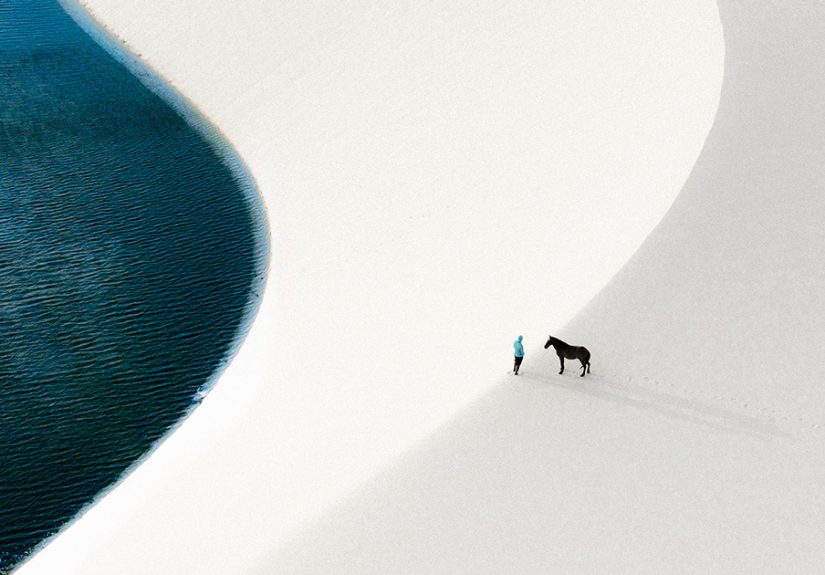
Consider Nicolas Ferri’s Laços, the first-place Aerial winner. Photographed in Lençóis Maranhenses in Brazil, the image places a person and horse near the edge of a freshwater lagoon surrounded by sweeping pale dunes. From above, the landscape becomes almost abstract. The human presence is small but essential, like a comma in a very elegant sentence.
Robert Bolton’s Dream Land, the Fine Art winner, also uses the surreal beauty of Lençóis Maranhenses, where sand dunes and lagoons create pastel fields of shape and color. The scene feels otherworldly, but not overworked. It understands that a landscape does not always need drama; sometimes it just needs enough space to breathe without someone yelling “epic” at it.
Architecture, Geometry, and the Beauty of Control
Minimalist architecture photography had a strong year, especially with Geoffrey Goddard’s Sentinel Ghost. The image features BOK Tower in Tulsa, Oklahoma, a structure connected visually and historically to the architectural language of the World Trade Center’s Twin Towers. In the photograph, the building becomes a solemn vertical form, stripped of urban distraction and turned into a symbol of memory and presence.
Yevhen Kostiuk’s Shapes of Pools, the second-place Architecture entry, approaches architecture from above. Swimming pools become graphic forms: blue shapes, hard edges, symmetry, and human traces reduced to visual rhythm. It is the kind of image that makes you wonder whether architects secretly design for drone photographers now. Honestly, they might.
Noel Clegg’s Capanne studies rows of beach huts along the Lido di Venezia shoreline. The repetition, red roofs, pale sand, and quiet symmetry turn ordinary seaside structures into a lesson in order. The subject is simple, but the pattern gives it authority.
Nature, Space, and the Art of Not Overdoing It
Nature often plays beautifully with minimalism because the natural world already knows how to edit. Snow, fog, sand, water, and open sky are basically nature’s built-in Photoshop toolsexcept with better ethics and fewer subscription reminders.
Martin Rak’s Art of Winter, the Landscape winner, uses snow to simplify the world into trees, silence, and a small human-scale presence. Kalle Saarikko’s Whirl uses intentional camera movement to transform the edge of a forest into a blurred, almost calligraphic line. Alexandre Brisson’s Dreamscape of Etosha isolates a single tree in Namibia’s desert plains, giving the viewer an image of stillness that feels both lonely and strong.
Sebastian Wohlfeil’s Suðurland, an Aerial third-place winner, reveals the abstract patterns of Icelandic river landscapes. From above, water, sediment, and earth become lines and tones. The photograph reminds us that minimalism is not always about man-made neatness. Sometimes the planet is already doing graphic design; we just need to look from the right altitude.
Street and Portrait Photography: Minimalism With a Pulse
Some of the strongest 2025 images prove that minimalism does not have to feel cold. Selaru Ovidiu’s Together, the Street winner, shows two people under an umbrella in Paris. Fog, reflection, and distance reduce the city to mood. The image is romantic without becoming sugary, cinematic without needing a soundtrack, and simple without being thin.
Ole Arnt Thomsen’s Blurry Man uses frosted glass to turn a human figure into a soft mystery. Yongseok Chun’s Crosswalk transforms pedestrians and street markings into a study of pattern and timing. In both cases, the city is not shown as chaos. It is edited into rhythm.
Portrait photography also benefits from restraint. Giuseppe Gradella’s Past Present, the Portrait winner, places a woman in relation to architecture, shadow, and shape. Ernesto Fiorentino’s Mrs Shadow uses dramatic light and minimal styling to create a portrait that feels elegant, controlled, and slightly hauntedin the fashionable way, not the “call a priest” way.
Night, Long Exposure, and the Poetry of Waiting
Minimalist photography rewards patience, and the Night Photography and Long Exposure winners make that very clear. William Shum’s Window in the Sky pairs circular architectural openings with the moon, creating a dialogue between human design and the natural world. Kotomi Sakai’s Orbit captures the full moon aligned with the center of a Ferris wheel, turning a fleeting moment into a crisp visual metaphor.
Long exposure work takes a different route. Nick Green’s The Shy Fishermen, the Long Exposure winner, uses fishing huts and calm water to produce a mood of quiet observation. Carsten Velten’s Misty Venice makes Venice appear almost weightless, with San Giorgio Maggiore softened by atmosphere. Richie Johns’ Branching Out uses a 30-second exposure to turn a lake scene into something gentle, still, and almost meditative.
What Makes These Minimalist Photos So Good?
1. Negative Space That Actually Says Something
Negative space is not just “empty background.” In the best minimalist photos, emptiness becomes active. It frames the subject, creates mood, suggests scale, and gives the viewer room to feel something. In images like Laços, Dreamscape of Etosha, and Evening Peace, space is not decoration. It is the emotional weather.
2. One Clear Visual Idea
Great minimalist photography usually knows what it wants. One subject. One tension. One relationship between line and space. That clarity is why these images work on a phone screen and still reward longer viewing. They do not require the viewer to decode a visual traffic jam.
3. Geometry Without Sterility
Architecture, pools, beach huts, crosswalks, and windows all appear in the 2025 selection because geometry is one of minimalism’s best friends. But geometry alone can become stiff. The strongest photos add feeling: loneliness, nostalgia, humor, peace, or mystery. Clean lines are nice; clean lines with emotional consequences are better.
4. Color That Knows When to Leave the Party
Many of the best images use restrained color palettes: pale blues, soft yellows, snowy whites, deep blacks, muted grays, or a single strong accent. Othonos’ red thread works because it is controlled. Ferri’s lagoon blue works because the surrounding dunes are calm. Minimalist color is like seasoning: enough to wake up the dish, not enough to make the viewer cough.
Why Minimalist Photography Feels So Modern in 2025
Minimalist photography lands especially well now because everyday visual life is crowded. Feeds are packed. Ads chase us around like caffeinated raccoons. Screens compete for attention. Against that backdrop, a quiet image can feel almost rebellious.
The 2025 awards also arrive at a moment when AI-generated imagery has made people think harder about what photography means. The competition’s strong global participation suggests that photographers are still deeply invested in observation, timing, place, materiality, and lived experience. Minimalist photography, in particular, depends on human attention. It asks someone to notice the one thing everyone else walked past.
Lessons for Photographers Inspired by the 2025 Winners
If you want to create better minimalist photos, start by subtracting. Remove distracting elements. Change your angle. Wait for a person to leave the frameor enter it. Use walls, snow, fog, sky, water, sand, or shadow as visual breathing room. Look for repetition, lone subjects, simple color contrasts, and geometry that gives the image structure.
Most importantly, do not confuse minimalism with laziness. A boring empty frame is still boring. Minimalism works when the remaining elements become stronger because everything unnecessary has been removed. It is not about having less effort. It is about making fewer things matter more.
Experience Notes: What These 35 Photos Teach Us About Seeing
Spending time with the best 35 photos of 2025 according to the Minimalism Photography Awards feels like stepping into a quieter room after leaving a crowded party. At first, the silence is almost strange. Then the details begin to arrive. A line becomes important. A tiny figure changes the scale of a landscape. A shadow explains the mood. A patch of color does the work that, in another photograph, might have required an entire parade.
That is the real experience of looking at minimalist photography: it slows you down without asking permission. You cannot skim these images the same way you skim a busy travel snapshot or a loud advertising photo. They do not throw everything at you. They place one carefully chosen thing in front of you and trust that you are smart enough to meet it halfway. How rude of them to be so elegant.
One of the biggest lessons from the 2025 selection is that minimalism is not a single style. It can be warm, cold, mysterious, funny, melancholy, architectural, natural, urban, or dreamlike. Evening Peace feels almost meditative, while It’s Complicated uses a red telephone receiver to turn still life into emotional comedy. Window in the Sky feels precise and cosmic. When The Angels Cry feels blurred, rainy, and human. These works share restraint, but they do not share the same emotional temperature.
For viewers, the experience can change how we look at ordinary surroundings. After studying images like Shapes of Pools or Crosswalk, a city stops looking like a mess and starts looking like a collection of patterns waiting for a patient eye. A parking lot becomes geometry. A foggy window becomes atmosphere. A lone swan becomes a full theatrical production, minus the expensive costumes.
For photographers, the lesson is even more practical: the best photo is not always found by adding more. Sometimes it appears when you step back, wait longer, crop tighter, simplify the background, or accept that one strong subject is enough. Minimalism trains the eye to respect silence. It also trains the ego to calm down, which is useful because cameras are already heavy enough without carrying artistic panic as extra luggage.
The 2025 winners remind us that great images do not always announce themselves loudly. Some arrive softly, wearing fog, snow, shadow, thread, moonlight, or a single clean line. They stay with us because they leave room for us inside the frame. And that may be the highest compliment for minimalist photography: it removes so much that, somehow, we feel more.
Conclusion
The Best 35 Photos Of 2025 According To The Minimalism Photography Awards prove that simplicity is not a shortcut. It is a discipline. From Alexandros Othonos’ emotionally charged Threads of Memory’s to the aerial calm of Laços, the snowy restraint of Art of Winter, and the urban tenderness of Together, this year’s winning images show how minimalist photography can carry memory, beauty, humor, and atmosphere with astonishing precision.
In a world addicted to moremore pixels, more effects, more noise, more everythingthese photographs make a persuasive case for less. Not less meaning. Not less skill. Less clutter. Less distraction. Less visual shouting. And perhaps that is why the 2025 Minimalism Photography Awards feel so timely: they remind us that the strongest image in the room is sometimes the one that knows when to stop talking.