Table of Contents >> Show >> Hide
- Quick Setup: 5 Minutes Now = Less Chaos Later
- 24 Laundry Room Storage Solutions
- 1) Go vertical with shelves above the washer and dryer
- 2) Add upper cabinets for “hide-it” storage
- 3) Install a shelf-and-rod combo for hanging + storage
- 4) Use a pegboard to organize tools and accessories
- 5) Create a “stain station” on a tray or small caddy
- 6) Add a slim rolling cart for tight gaps
- 7) Choose stackable, matching bins to control categories
- 8) Try floor-to-ceiling shelving for maximum capacity
- 9) Add a countertop over front-loading machines
- 10) Use wall hooks to get items off the floor
- 11) Mount an ironing board (or choose a fold-down wall version)
- 12) Install an over-the-door drying rack
- 13) Add a wall-mounted drying rack (foldable style)
- 14) Use pull-out hampers or a sorter cabinet
- 15) Pick a rolling hamper for transport and sorting
- 16) Use behind-the-door shelves for supplies
- 17) Add a utility rail with baskets and hooks
- 18) Decant detergent and pods into clear canisters
- 19) Store dryer sheets in a dispenser you’ll actually use
- 20) Use a “lost sock” bin (because reality is a sock-based mystery)
- 21) Add a narrow drawer unit for small items
- 22) Use labeled baskets for linens and cleaning cloths
- 23) Don’t waste the space above a sinkadd shelves or a small cabinet
- 24) Upgrade the room’s durability so it stays fresh longer
- How to Make These Ideas Look “Done,” Not “Dumped”
- Bonus: Real Experiences That Made My Laundry Room Finally Work (500+ Words)
- Conclusion: A Fresher Laundry Room Is Really a Better System
Laundry rooms are basically the backstage of your home: nobody claps for them, but if the crew is a mess,
the whole show falls apart. The good news? You don’t need a full-blown renovation (or a personal assistant
named “Laundry Trevor”) to make your space feel calmer, cleaner, anddare we saykind of cute.
This guide pulls together proven organization tactics designers love and real-home strategies that actually work:
using vertical space, adding closed storage, creating “zones,” and giving every bottle and basket a job.
You’ll get 24 laundry room storage solutions (with practical examples), plus a bonus section of lived-in lessons
at the end so you can skip the “I bought 14 bins and somehow got more clutter” phase.
Quick Setup: 5 Minutes Now = Less Chaos Later
1) Measure first (yes, before you add anything)
Most laundry room organization fails for one reason: the storage doesn’t fit the room’s workflow.
Measure the wall behind the machines, the gap beside them, and the space above. Even “just 6 inches” can become
the perfect slot for a slim rolling cart or a wall-mounted tool rail.
2) Create zones that match your routine
A functional laundry room has a few predictable stations: sort, wash,
treat stains, dry, and fold/put away. When storage supports
these zones, you stop shuffling stuff around like it’s musical chairs.
3) Declutter like a ruthless editor
If you haven’t used that “miracle spray” since 2019, it’s not part of your laundry routineit’s set dressing.
Keep what you use weekly within arm’s reach, store occasional items up high, and relocate anything that doesn’t
belong (paint rollers: we see you).
4) Reduce visual noise
Bright detergent labels can make a tidy space look messy. Decanting into clear, labeled containers isn’t just
“Pinterest pretty”it’s also easier to see what’s running low and prevents the avalanche of half-empty bottles.
5) Make it maintainable (the “Sunday reset” trick)
The best laundry room storage solutions are the ones you’ll actually keep up. A 5-minute weekly resetrefill,
wipe down surfaces, toss empties, return straysstops clutter from respawning like a videogame enemy.
24 Laundry Room Storage Solutions
Below are 24 practical, real-life-ready ideas. Mix and match based on your space: a dedicated laundry room,
a hallway nook, a closet “laundry cave,” or the classic combo mudroom-utility room situation.
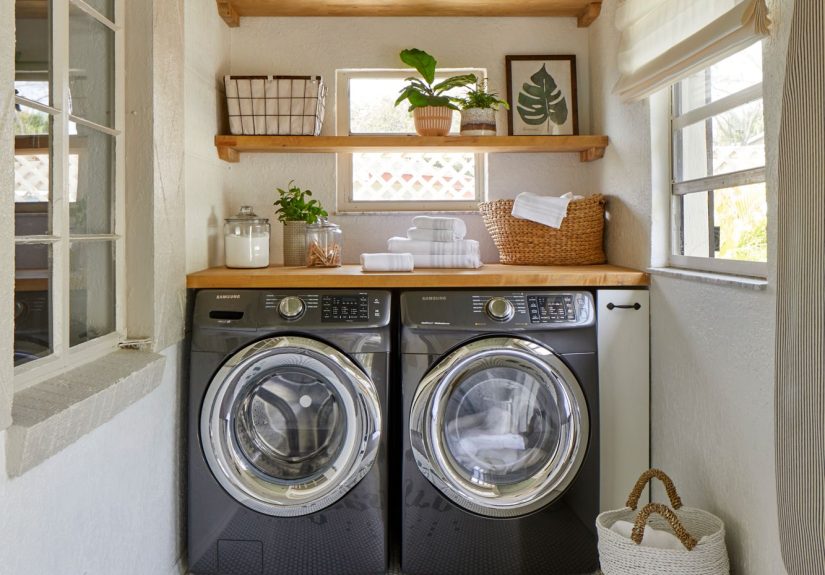
1) Go vertical with shelves above the washer and dryer
The wall above your machines is prime real estate. Install open shelves for daily essentials (detergent,
stain remover, dryer balls) and keep them in matching bins to avoid “bottle parade” vibes.
Tip: leave enough clearance so you can easily open lids and reach items without doing laundry yoga.
2) Add upper cabinets for “hide-it” storage
If you want an instantly fresher look, closed storage is your best friend. Upper cabinets hide backup supplies,
toolkits, awkward-sized refills, and anything you don’t want on display. This is especially helpful if your
laundry room doubles as a walkway or mudroom.
3) Install a shelf-and-rod combo for hanging + storage
A shelf with a hanging rod underneath gives you two functions in one: store baskets up top, and hang shirts
or delicates below to air-dry. It’s a game changer for small laundry room ideas because it turns a blank wall
into a drying station without taking up floor space.
4) Use a pegboard to organize tools and accessories
Pegboards aren’t just for garages. In a laundry room, they’re perfect for lint rollers, clothespins,
small spray bottles, brushes, and even extra hangers. You can customize hooks and little shelves as your
routine changesbecause your laundry habits evolve, even if your socks don’t.
5) Create a “stain station” on a tray or small caddy
Keep your stain removers, a soft brush, a clean cloth, and a small bowl on one contained tray. That way,
treating a stain doesn’t become a scavenger hunt across three rooms and an emotional spiral.
6) Add a slim rolling cart for tight gaps
That skinny space beside your washer? It can hold a rolling cart for detergents, cleaning cloths, and backups.
Pick one with handles so it doesn’t become “the cart we can never pull out again.”
7) Choose stackable, matching bins to control categories
Bins are most useful when they’re assigned to categories: “stain care,” “machine cleaning,” “pet laundry,”
“guest bedding,” “seasonal.” Matching bins make the room look calmer and prevent the visual clutter that makes
spaces feel smaller.
8) Try floor-to-ceiling shelving for maximum capacity
If your space is petite, go tall. A floor-to-ceiling shelving unit can store everything from detergent to
towels to spare paper goodsespecially helpful in laundry rooms that also serve as household storage hubs.
Use the bottom shelves for heavy items and the top shelves for lighter, occasional-use supplies.
9) Add a countertop over front-loading machines
A solid counter across the top of front loaders creates a folding zone instantly. It also keeps baskets
and laundry piles from migrating to your couch like they pay rent there.
10) Use wall hooks to get items off the floor
Hooks are the low-cost, high-impact MVP of utility room storage. Use them for brooms, mops, dusters,
reusable bags, and garment bags. When tools live on the wall, the floor stays clearand cleaning gets easier.
11) Mount an ironing board (or choose a fold-down wall version)
Ironing boards are awkward. A wall-mounted holder or a fold-down ironing board cabinet keeps it accessible
without leaning in a corner like a sad surfboard. Bonus: some cabinets include storage for irons and spray.
12) Install an over-the-door drying rack
If you live in an apartment, or your laundry room is basically a closet, over-the-door drying racks are a
brilliant way to add air-dry space with zero footprint. Use it for delicates, workout gear, and anything you
don’t want shrink-wrapped by heat.
13) Add a wall-mounted drying rack (foldable style)
A foldable drying rack mounted on the wall gives you drying space when you need it and disappears when you
don’t. This is one of the best laundry room storage solutions for “small space, big laundry energy.”
14) Use pull-out hampers or a sorter cabinet
Pre-sorting saves time. Pull-out hampers (built into lower cabinets) or a vertical sorter with labeled bins
turns laundry day into a smoother process. If you have kids, label by person. If you have roommates, label by
“the one who keeps stealing my hoodies.”
15) Pick a rolling hamper for transport and sorting
A hamper on wheels is underrated. It reduces heavy lifting, keeps piles contained, and makes it easier to move
loads from bedroom to laundry room. Choose one with removable bags so you can carry just the bag if needed.
16) Use behind-the-door shelves for supplies
The back of the laundry room door is a secret storage zone. Slim shelves can hold stain sprays, lint rollers,
fabric refreshers, and small refills. It’s especially useful when wall space is limited.
17) Add a utility rail with baskets and hooks
Utility rails (often used in kitchens) work beautifully in laundry rooms. Hang small baskets for clothespins,
mesh bags, and brushes. Add hooks for scissors, gloves, and that one missing measuring scoop you’ll find
months later.
18) Decant detergent and pods into clear canisters
Decanting is practical and pretty. Clear containers help you track inventory, reduce spills, and create a more
cohesive look. Label everything so nobody mistakes oxygen booster for “snack dust” (please don’t).
19) Store dryer sheets in a dispenser you’ll actually use
Instead of a crumpled cardboard box, use a lidded container or a tissue-style dispenser. It keeps sheets tidy,
makes grabbing one easier, and cuts down on visual clutter.
20) Use a “lost sock” bin (because reality is a sock-based mystery)
Designate a small bin or jar for unmatched socks. Once a month, do a quick reunion session. If a sock remains
unclaimed after two months, it can either become a cleaning rag… or be promoted to “legend.”
21) Add a narrow drawer unit for small items
If you have space under a counter or beside a sink, a slim drawer unit can store sewing kits, spare buttons,
garment tags, lint tools, and appliance manuals. Small items need drawers, or they’ll become countertop confetti.
22) Use labeled baskets for linens and cleaning cloths
Baskets are perfect for soft categories: towels, rags, microfiber cloths, dryer balls, and delicates bags.
Keep them uniform and labeled so the household can “help” without creating a new archaeological layer of chaos.
23) Don’t waste the space above a sinkadd shelves or a small cabinet
If you have a laundry sink, the wall above it is ideal for storing hand-wash supplies, brushes, and
cleaning sprays. Keep daily-use items at chest height, and stash backups up high.
24) Upgrade the room’s durability so it stays fresh longer
Storage isn’t only containersit’s also finishes that survive real life. Durable paint, wipeable wall
coverings, and moisture-friendly materials make it easier to keep the space clean. Add a washable rug for
comfort and a small trash can for lint and packaging (so it doesn’t “temporarily” live on the counter forever).
How to Make These Ideas Look “Done,” Not “Dumped”
- Keep daily items in reach: detergent, stain remover, dryer balls, lint tool.
- Hide backups: refills, bulk paper goods, seasonal items go up high or behind doors.
- Label with purpose: labels should match how you think (“Delicates,” “Kids,” “Dog Stuff”).
- Limit open storage: open shelves look best with bins; bins look best when they match.
- Protect surfaces: trays under bottles and canisters prevent drips and sticky rings.
Bonus: Real Experiences That Made My Laundry Room Finally Work (500+ Words)
I used to think the secret to a fresh laundry room was buying “the right organizers.” Spoiler: I bought the
organizers… and then lived among them like a raccoon with a credit card. The room looked better for about
48 hours, and then it slowly slid back into chaos because I hadn’t changed the systemjust the containers.
The first breakthrough was admitting that my laundry room needed to match my habits, not my aspirations.
For example, I wanted a minimalist shelf with three perfectly decanted jars like a spa. In reality, I needed
a “drop zone” basket for the random stuff that shows up during laundry (coins, receipts, tiny toys, mystery
screws). Once I gave that randomness a home, the counters stopped collecting clutter like it was their job.
The second breakthrough was creating a real folding zone. I used to pull warm clothes out of the dryer and
set them on top of the machines, where they would become a soft mountain range. Then I’d tell myself,
“I’ll fold it later,” which is a beautiful lie we tell ourselves to feel optimistic. Adding a countertop over
the machines (even a simple fitted surface) changed everything. Suddenly, folding was easy, fast, and didn’t
require relocating piles to the bed. It also made the room feel more finishedlike a workspace, not a storage
closet with appliances.
Third: labels saved my sanity. Not the fancy kind (though they are adorable), but clear labels that match how
people actually search for things. “Cleaning” was too vague. “Stain Care” was better. “Machine Cleaning” was
a lifesaver because it stopped me from mixing washer tablets with random sprays. The best part? Other people
in the house could find things without asking me, which is the true definition of luxury.
I also learned that open shelving is a commitment. It’s not badjust honest. If your shelves are open, you’re
basically agreeing to keep them consistently tidy. My solution was to use open shelves for pretty,
low-maintenance categories (rolled towels, matching bins) and keep the chaotic stuff behind cabinet doors or
inside opaque baskets. That way, the room still looks calm, but I’m not spending my life staging detergent.
Finally, the “weekly reset” is what made the whole thing stick. Once a week, I take five minutes to:
(1) put stray items back in their bins, (2) toss empties, (3) wipe the counter, and (4) shake out lint.
Five minutes. That’s it. I used to wait until the room was a disaster and then attempt a heroic overhaul,
which always took an hour and felt like punishment. The reset keeps the room fresh without dramaand if there’s
one thing laundry doesn’t need, it’s more drama.
Conclusion: A Fresher Laundry Room Is Really a Better System
The best laundry room storage solutions don’t just “add space”they reduce friction. When you store items where
you use them, build up vertically, hide backups, and keep a folding/drying zone handy, laundry stops feeling
like a never-ending side quest. Start with 2–3 changes (shelves, a sorter, and labeled bins), then build from
there. Your future selfstanding in a calm, organized laundry roomwill be extremely grateful.