Table of Contents >> Show >> Hide
- Before You Write: Know What a “News Report” Actually Needs
- Way #1: Build the Story on the Inverted Pyramid (a.k.a. “Start With the Point”)
- Way #2: Make It Trustworthy With Verification + Attribution + Smart Quotes
- Way #3: Make It Easy to Read With Clean Structure, Context, and a Final Tightening Pass
- Putting It All Together: A Short Sample News Report
- FAQ: Common Questions About Writing a News Report
- Conclusion: Your 3-Way News Writing System (Use It Forever)
- Experience Notes: What Usually Happens in Real News Writing (and How to Handle It)
- 1) The hardest part is choosing the lead, not writing it
- 2) Interviews rarely hand you a perfect quote (so you have to earn it)
- 3) Documents save stories, but only if you read them like a reporter
- 4) The “second-day” angle is your friend when the basics are already known
- 5) Editing under deadline works best as a routine, not a mood
- 6) Your goal is not to sound smartit’s to make readers informed
Writing a news report can feel like trying to juggle flaming torches while someone yells, “Deadline in 12 minutes!”
But here’s the secret: good news writing isn’t magicit’s a repeatable process. If you can answer the basic questions,
organize information logically, and write with clean, honest clarity, you can write a solid news report on demand.
This guide breaks the craft into three clear and easy ways you can use for almost any storywhether
you’re covering a school board vote, a local business opening, a sports win, or a weather emergency. You’ll get practical
steps, specific examples, and a few gentle jokes to keep your brain from staging a walkout.
Before You Write: Know What a “News Report” Actually Needs
A news report is not an essay, a diary entry, or a dramatic monologue (even if the city council meeting felt like theater).
A news report is a fact-based account that helps readers quickly understand:
what happened, who it affects, why it matters, and what’s next.
The “must-have” ingredients
- A clear lead (lede) that gives the most important information first.
- Strong verification (facts checked, numbers confirmed, claims attributed).
- Useful context (background that explains why this matters now).
- Quotes that add authority, perspective, and humanity.
- A logical structure that makes skimming easy and meaning obvious.
Keep those in mind, and you’re already ahead of the person who starts writing with:
“Since the dawn of time, humans have always…” (Please don’t.)
Way #1: Build the Story on the Inverted Pyramid (a.k.a. “Start With the Point”)
If news writing had a home base, it would be the inverted pyramid: put the most important,
most time-sensitive facts at the top, then layer in supporting details and background as you go.
This structure respects how people actually readquickly, on phones, sometimes while standing in a checkout line.
Step 1: Decide your top fact (your “headline in a sentence”)
Ask: If the reader only reads one paragraph, what must they know? That answer becomes the core of your lead.
Most leads can include some combination of the 5 Ws and H:
Who, What, When, Where, Why, and How.
You don’t need all six every time, but you do need enough to make the event clear and real.
Step 2: Write a lead that is simple, specific, and not allergic to verbs
Strong leads usually:
- Use plain language
- Put the key action in the first sentence
- Avoid stuffing every detail into a single mega-sentence
Step 3: Add a “nut graf” to explain the “so what?”
After the lead, many reports quickly add a summary paragraph that answers:
Why should the reader care? This is often called a nut grafit frames the meaning,
stakes, and direction of the story. Think of it as the part that makes the facts matter.
Mini example: A clean, classic structure
Lead: The Brookdale City Council voted Tuesday night to approve a $12 million downtown street redesign, a project officials say will reduce traffic injuries and boost small businesses.
Nut graf: Construction is expected to begin in March and last about eight months, affecting commuters, local shops, and weekend events in the city’s busiest corridor.
Key details: The plan includes protected bike lanes, shorter crosswalks, new lighting, and updated bus stops, according to city documents.
A fast “inverted pyramid” checklist
- Top: What happened + who + impact
- Next: Why it matters + what changes now
- Then: Numbers, timeline, location details
- Later: Background, history, previous debates
- Bottom: Secondary details and color that can be trimmed if space is tight
In short: if your news report feels “buried,” it probably is. Move the real point up.
Way #2: Make It Trustworthy With Verification + Attribution + Smart Quotes
News writing runs on credibility. Readers don’t just want a story that sounds confidentthey want a story that’s
earned its confidence. That comes from three habits: verifying facts, attributing claims,
and using quotes that do real work.
Step 1: Verify the “sharp edges” first
The most dangerous facts in a news report are the ones that are:
specific (numbers, dates, names, locations), emotional (allegations), or
viral (claims spreading quickly online). Verify those first.
- Spell names correctly (and confirm preferred titles if relevant).
- Confirm dates and times (especially across time zones and scheduling changes).
- Double-check numbers (budgets, vote counts, percentages, injuries, attendance).
- Separate what you know from what someone says.
Step 2: Attribute information so readers can judge it
Attribution is not just a journalism ruleit’s a reader service. It tells the audience where information came from:
a public document, an official statement, a witness, a subject-matter expert, or a data source.
Helpful attribution often looks like:
- “According to the police report…”
- “In budget documents released Friday…”
- “The company said in a statement…”
- “A spokesperson confirmed…”
Step 3: Use quotes like evidence, not decoration
A good quote adds at least one of these:
- Authority (someone responsible explaining decisions)
- Clarity (a complex issue simplified)
- Impact (how people are affected)
- Conflict (competing viewpoints, accurately represented)
A quote that adds nothing sounds like: “We are very excited to be excited,” said an excited person. (We can do better.)
Example: Upgrading a weak quote into a useful one
Weak: “This is great for the community,” said Councilmember Rivera.
Better: “We’ve had 14 pedestrian injuries on this stretch in the last two years,” Rivera said. “This redesign shortens crossings and slows turning trafficchanges we should have made a decade ago.”
A practical rule for attribution verbs
In straight news writing, simple attribution verbs like “said” often work best because they’re neutral
and don’t distract. Fancier verbs (“exclaimed,” “laughed,” “pontificated”) can accidentally inject tone or bias.
Save the fireworks for actual fireworks.
Way #3: Make It Easy to Read With Clean Structure, Context, and a Final Tightening Pass
Even a perfectly accurate report can still fail if readers can’t follow it. Good news writing is
information design: you’re organizing facts so they land quickly and clearly.
Step 1: Use a “one idea per paragraph” approach
News paragraphs should usually be short. Each paragraph should introduce one main idea, then move on.
This makes the report skimmable and reduces the chance readers lose the thread.
Step 2: Add context without drifting into a history documentary
Context answers: What does this connect to? It can be:
- Background (What led to this vote/event?)
- Magnitude (Is this normal or unusual?)
- Comparison (How does this change things?)
- Next steps (What happens now?)
The trick is to give readers what they need without wandering into the “and in 1847…” zone unless it’s truly relevant.
Step 3: Do a fast edit pass that fixes the usual suspects
- Cut throat-clearing: Remove warm-up sentences that don’t add facts.
- Replace vague words: “Several” → “Seven.” “Soon” → “By March.”
- Check fairness: Did the report include key perspectives and accurate framing?
- Check timeline logic: Are readers clear on what happened first and what happens next?
- Check names and numbers again: The tiniest typo can cause the biggest correction.
A quick readability upgrade example
Before: The council met and discussed traffic and other issues and then eventually voted on changes that will happen later.
After: The City Council voted 4–3 Tuesday to approve a street redesign aimed at reducing crashes downtown. Construction is expected to begin in March.
Putting It All Together: A Short Sample News Report
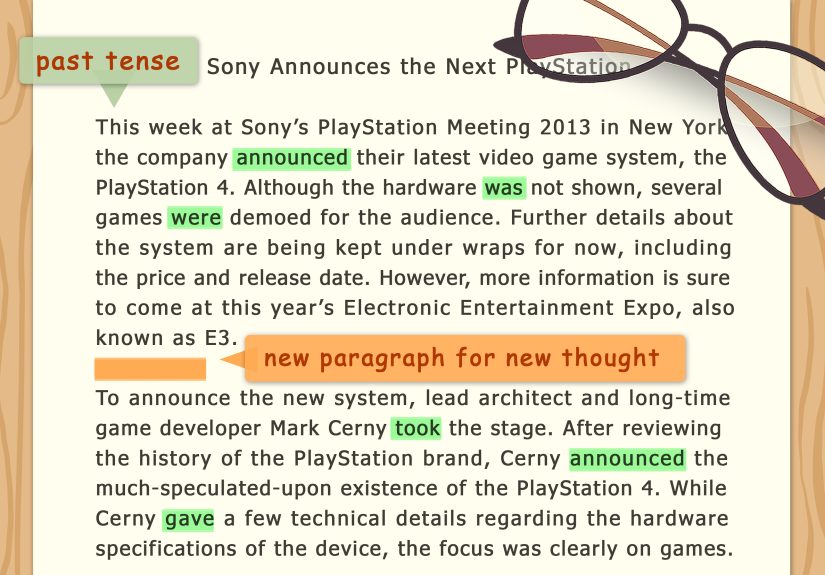
Here’s a compact example that uses all three waysstrong top, trustworthy reporting, and clean readability:
Sample
The Brookdale City Council voted 4–3 Tuesday to approve a $12 million redesign of Main Street, a project officials say will reduce pedestrian injuries and improve bus access downtown.
Construction is expected to begin in March and last about eight months, which could affect weekend events and access to several storefronts along the corridor.
The plan includes protected bike lanes, shortened crosswalks, and new lighting, according to city documents presented at the meeting.
“We’ve had repeated close calls and real injuries here,” Councilmember Ana Rivera said. “This redesign makes crossings shorter and turning traffic slower.”
Business owner Malik Thompson, who operates a coffee shop on Main Street, said he supports the safety upgrades but worries about the construction timeline. “Eight months is a long time to lose foot traffic,” he said.
The council directed city staff to return next month with a detailed construction schedule and a plan to maintain pedestrian access during work.
FAQ: Common Questions About Writing a News Report
What’s the difference between a news report and an opinion piece?
A news report focuses on verified facts, attribution, and multiple viewpoints where relevant. An opinion piece argues a position.
If your report starts telling readers what to think instead of giving them well-supported information, you’ve crossed the streams.
Do I always need the 5 Ws and H in the first sentence?
Not always. But early in the story, readers should quickly understand the essential who/what/when/where, plus the why/how as needed.
The key is claritydon’t force it into one sentence if it becomes unreadable.
How long should a news report be?
Long enough to answer the reader’s obvious questions, short enough to keep momentum. If you can cut a paragraph without losing meaning,
that paragraph was probably freeloading.
Conclusion: Your 3-Way News Writing System (Use It Forever)
If you want a simple method you can repeat under pressure, remember the three ways:
- Start strong with the inverted pyramid: lead with the most important verified fact.
- Earn trust through verification, clear attribution, and quotes that add value.
- Make it readable with short paragraphs, smart context, and a fast editing pass.
Do this consistently, and your news reports will feel clear, fair, and professionaleven when the deadline is breathing down your neck like a caffeinated dragon.
Experience Notes: What Usually Happens in Real News Writing (and How to Handle It)
Writing advice is nice in theory, but news reporting happens in the real worldwhere phones ring, documents are messy,
quotes arrive late, and the “simple” story turns into a three-tab spreadsheet of confusion. Here are practical, experience-based
patterns that many writers run into when producing news reports, plus tactics that keep the work clean and sane.
1) The hardest part is choosing the lead, not writing it
Beginners often stall because they want the lead to be perfect. In practice, the lead is usually a decision:
Which fact matters most right now? A useful habit is writing three possible leadsone focused on impact,
one on conflict, one on the most surprising numberthen picking the one that best matches what readers would ask first.
This speeds up writing because you’re no longer waiting for inspiration; you’re comparing options.
2) Interviews rarely hand you a perfect quote (so you have to earn it)
Real interviews include detours, repeated phrases, and people speaking like… well, people. A common newsroom move is to ask
a “translation question” near the end: “If you had to explain this in one sentence to a neighbor, what would you say?”
That prompt often produces a quote that’s clear, human, and publishable. Another practical trick is to confirm specifics on the spot:
“Just to make sure I got it rightwas it $12 million or $21 million?” That one question can prevent the kind of error that follows you around forever.
3) Documents save stories, but only if you read them like a reporter
Public records, agendas, budgets, and reports can turn a vague story into a solid one. The real-world challenge is that documents
are often long and written in a language best described as “committee-coded.” Many writers learn to scan for:
numbers, timelines, named decision-makers, and defined terms.
Then they pull the 2–3 facts that actually change the story for readers. You don’t need to summarize every pageyou need to extract the facts that matter.
4) The “second-day” angle is your friend when the basics are already known
Sometimes the big news is already out: “The vote happened.” “The storm hit.” “The company announced layoffs.”
What readers want next is meaning: Who is affected most? What comes next? What does the data show? This is where a nut graf
and a clear “what’s next” section become powerful. In real newsroom routines, that follow-up framing often separates a forgettable report
from one that people share because it answers their practical questions.
5) Editing under deadline works best as a routine, not a mood
Waiting to “feel ready” to edit is a trap. A reliable experience-based approach is a three-pass system:
(1) Accuracy pass (names, numbers, dates, attribution),
(2) Clarity pass (shorter sentences, one idea per paragraph),
(3) Flow pass (does the order make sense if you only skim the first two screens?).
This routine is fast, repeatable, and protects you from the classic late-stage mistake: polishing a sentence that shouldn’t exist.
6) Your goal is not to sound smartit’s to make readers informed
A common “experience lesson” is learning that news writing is not the place for fancy phrasing. The cleanest reports use simple structure
and specific facts. When writers get stuck, it’s often because they’re trying to write around what they don’t fully understand.
The fix is surprisingly straightforward: identify the one point you can explain clearly, write that, then add the next piece of verified information.
Clarity is not a decorationit’s the result of honest thinking and careful reporting.
If you practice these real-world habits alongside the three core ways in this article, you’ll not only write better news reportsyou’ll write them faster,
with fewer corrections, and with the kind of clarity that makes readers trust you even when the topic is complicated.