Table of Contents >> Show >> Hide
- Why mattresses slide in the first place
- Quick diagnosis: figure out what’s moving (and where)
- Way #1: Add a non-slip layer (rug pad, gripper pad, or shelf liner)
- Way #2: Use targeted grip points (Velcro, carpet tape, or non-slip “grippers”)
- Way #3: Add a physical stop (retainer bar/rails) and tighten the base
- Extra troubleshooting if your mattress still slides
- Common mistakes (and how to avoid them)
- FAQ: quick answers people actually want
- Real-life experiences: 3 Easy Ways to Stop a Mattress from Sliding (the “what actually happens” edition)
- Conclusion: pick the easiest fix first
If your mattress keeps drifting across the bed like it’s trying to escape your responsibilities, you’re not alone.
Mattress sliding is one of those tiny life problems that turns into a nightly nuisance: you make the bed, you lie down,
and by morning the mattress has scooted two inches south like it’s following the sun.
The good news: you usually don’t need a new mattress, a new bed frame, or a degree in mechanical engineering.
You need more friction, better grip, or a simple physical stop.
Below are three easy, proven ways to stop a mattress from sliding, plus a quick diagnosis checklist,
common mistakes to avoid, and real-world “yep, that happened” experiences at the end.
Why mattresses slide in the first place
Most mattress movement comes down to a few common culprits:
- Low friction surfaces: Smooth platforms, polished wood, slick metal, or certain bed foundations don’t “grab” the mattress well.
- Size mismatch: A mattress that’s slightly smaller than the frame (or a frame that’s a bit too roomy) has space to wander.
- Weak support or shifting base: Slats that flex, a worn foundation, or a bed frame that wiggles can encourage sliding.
- Dust and debris: Yepdust can act like tiny rollers. A quick clean sometimes helps more than people expect.
- Active sleepers (or pets/kids): Nightly tossing, turning, and trampoline-level enthusiasm adds sideways force.
Quick diagnosis: figure out what’s moving (and where)
Before you fix it, take two minutes to confirm the real problem. This prevents “I bought a thing and nothing changed” syndrome.
- Is it the mattress or the topper? Sometimes the mattress is finebut the topper is skating on top.
- Is the base solid? Push the bed frame side-to-side. If the frame shifts, the mattress often follows.
- Is there a gap? Look along the edges. If you can see daylight between mattress and rails, you’ve got wiggle room.
- Is the surface slick? Platform beds and metal frames often feel smooth to the touchtranslation: low friction.
Way #1: Add a non-slip layer (rug pad, gripper pad, or shelf liner)
If you want the simplest fix with the highest success rate, start here.
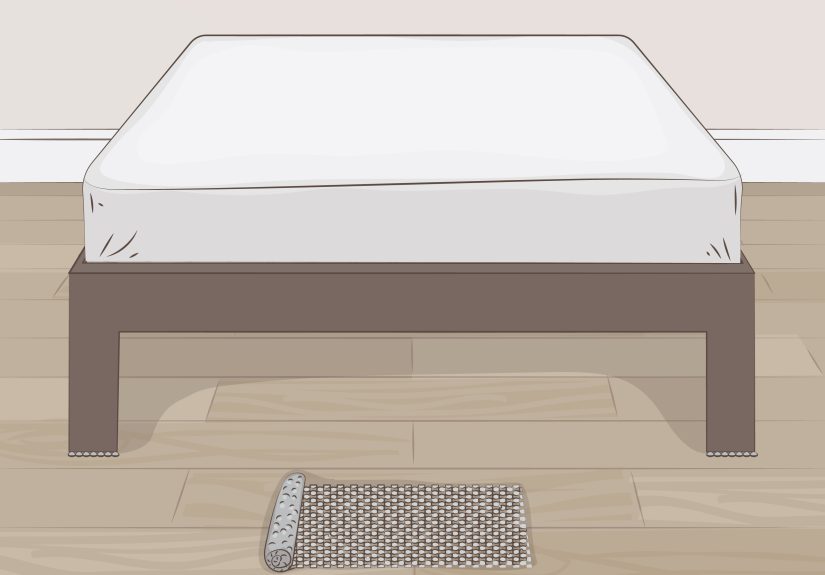
Adding a non-slip pad under the mattress increases friction between the mattress and the bed frameso the mattress stops “walking.”
Many people use rug pad grippers, rubberized non-slip mats, or even non-adhesive shelf liner.
Best for
- Platform beds (especially smooth wood or upholstered platforms)
- Metal frames with slick slats
- Anyone who wants a no-tools solution
What you’ll need
- A non-slip rug pad/gripper pad (rubbery, open-grid styles are common)
- Scissors (to trim)
- Optional: measuring tape
Step-by-step
- Strip the bed down to the mattress (remove bedding and topper).
- Wipe or vacuum the base (platform or slats). Removing dust helps the pad grip better.
-
Cut the pad so it’s slightly smaller than the mattress footprint.
(You don’t want it sticking out where you’ll see it.) - Lay the pad on the base, then place the mattress on top.
- Test it by pushing the mattress from the side. If it still slides, add a second layer in the “problem” zone (often the foot end).
Pro tips (so you don’t create a new problem)
- Choose a breathable option (open-grid styles allow airflow better than solid sheets).
-
Skip super-sticky adhesives as your first move.
Non-slip pads usually work without leaving residue on the frame. -
If your mattress sits on slats, place the pad across the slats, not bunched between them.
Flat contact = better grip.
Most people notice results immediately with this methodespecially on platform beds where the mattress has nothing “catching” it.
If you only try one solution, try this one first.
Way #2: Use targeted grip points (Velcro, carpet tape, or non-slip “grippers”)
When a non-slip mat helps but doesn’t fully solve the problemor when you have a stubborn slide on a specific surface
it’s time for targeted grip points.
Think of this as giving your mattress a few “hands” to hold onto the frame.
Best for
- Mattresses that slide in one direction (often toward the foot of the bed)
- Split setups (like two Twin XL mattresses) that separate
- Very smooth frames where friction alone isn’t enough
Option A: Hook-and-loop (Velcro) strips
Hook-and-loop tape can create a strong hold between mattress/foundation surfacesespecially for toppers and lighter mattresses.
Use it strategically so you get grip without turning your bed into an arts-and-crafts accident.
- Clean and dry the contact surfaces (dust reduces adhesion).
- Apply strips near the corners or along the side that slides most.
- Press firmly and allow time for adhesion (follow the tape’s instructions).
- Test and adjustyou may need more strips on the “moving” side.
Option B: Carpet tape (high grip, higher caution)
Carpet tape is designed to keep rugs from shifting, which makes it tempting for a sliding mattress.
It can workespecially on wood platformsbut it’s more likely to leave residue or pull at finishes.
If you rent, or you love your bed frame more than you love solving problems aggressively, test a small area first.
Option C: Corner “gripper” pads or non-slip pads made for mattresses
Some products are basically purpose-built friction boosters: gripper pads placed under corners or key areas.
They’re often cuttable, discreet, and designed to reduce shifting without adhesives.
When to avoid adhesives
- If your bed frame has a delicate finish or upholstery you don’t want to risk
- If you plan to move soon and don’t want cleanup later
- If the mattress has a fragile cover you might snag
Bottom line: targeted grip points can be extremely effectivejust choose your level of commitment.
Non-slip “grippers” are the friendliest; carpet tape is the “I’m not asking twice” option.
Way #3: Add a physical stop (retainer bar/rails) and tighten the base
If your mattress is sliding because the frame allows itno rails, too much space, wobbly structure
the most permanent fix is to give it something solid to push against.
That can be as simple as a mattress retainer (a low bar at the foot of the bed),
or as basic as making sure the bed frame is tightened and stable.
Best for
- Platform beds with minimal or no side rails
- Metal frames where the mattress slowly migrates
- Households with energetic sleepers, kids, or pets who treat bedtime like a sport
Step-by-step base tune-up (easy, and it helps everything)
- Remove the mattress so you can access the frame hardware.
- Tighten bolts, screws, and brackets. Loose joints can shift under load and encourage sliding.
-
Check slats:
are they evenly spaced, secure, and not bowing?
If slats slide around, the mattress will too. - Confirm the mattress size matches the frame (Queen vs. Full mix-ups happen more than people admit).
Physical stop options
-
Mattress retainer bar (footboard-style stop):
Adds a low barrier at the foot so the mattress can’t creep downward. -
Side rails or “rail extenders”:
Helpful when the mattress shifts sideways on a wider platform. -
Gap fillers / bed bridges (for split setups):
If two mattresses drift apart, a bridge can reduce the gap and discourage migration. -
Wall assist (the simplest “stop”):
If your layout allows, placing the bed so the headboard side is against a wall can reduce shifting in that direction.
A practical example
Let’s say you have a sleek platform bed with no side rails and a foam mattress that’s a tiny bit smaller than the platform.
The mattress slides toward the foot end because there’s nothing stopping it.
In that case, combining a non-slip pad (Way #1) with a retainer bar at the foot (Way #3)
is usually a “set it and forget it” solution.
Extra troubleshooting if your mattress still slides
If you’ve tried one method and the mattress still moves, don’t panicstacking small fixes is normal.
Here are a few add-ons that often make the difference:
- Clean the contact points: vacuum the base and wipe the platform to remove dust and reduce slipping.
- Check the foundation condition: a worn or sagging base can tilt and cause drift.
- Use better-fitting bedding: for toppers, a tight fitted sheet or sheet straps can reduce “layer sliding.”
- Reduce side force: if the bed frame itself shifts on the floor, add grippers under bed legs.
Common mistakes (and how to avoid them)
-
Mistake: Using super-sticky adhesives on a nice frame without testing.
Fix: Test a small hidden area first, or choose a non-adhesive gripper pad. -
Mistake: Buying a pad and leaving it oversized so it sticks out.
Fix: Trim it slightly smaller than the mattress footprint. -
Mistake: Ignoring a loose/wobbly frame.
Fix: Tighten hardware firstgrip solutions work best on a stable base. -
Mistake: Solving the wrong problem (topper sliding vs. mattress sliding).
Fix: Confirm which layer is moving before you buy supplies.
FAQ: quick answers people actually want
What’s the best non-slip solution for a platform bed?
A rug pad gripper or non-slip mat under the mattress is usually the fastest, least fussy fix.
If the bed has no rails and the platform is extra slick, add a retainer bar for a permanent stop.
Can I stop a mattress from sliding without damaging the bed frame?
Yes. Start with non-adhesive options like rug pad grippers, rubberized non-slip mats, or corner gripper pads.
Adhesives can work, but they’re more likely to leave residue or pull on finishes.
What if my mattress slides on a metal frame?
Metal frames can be low-friction, especially with smooth slats.
Try a non-slip pad first, then consider retainer bars or corner grips if the mattress still creeps.
What if it’s my topper, not the mattress?
Toppers often slide because they’re lighter and sit on fabric-on-fabric surfaces.
A tight fitted sheet, sheet straps, Velcro, or a non-slip mat
between topper and mattress can help keep it in place.
Real-life experiences: 3 Easy Ways to Stop a Mattress from Sliding (the “what actually happens” edition)
The internet is full of neat, tidy solutionsbut bedrooms are not neat, tidy science labs.
People solve mattress sliding in the real world while juggling limited time, rental rules, mismatched furniture, and the fact
that nobody wants to wrestle a queen mattress twice in one day.
Here are some realistic scenarios that show how these fixes play out in everyday life.
1) The “slick platform bed + foam mattress” combo
This is the most common story: a modern platform bed looks great, but the surface is smooth and the mattress has a fabric cover that doesn’t grip.
The mattress gradually shiftsusually toward the foot of the beduntil you notice your pillows look like they’re stranded on an island.
In this scenario, the non-slip layer (Way #1) almost always works immediately.
People often buy a rug gripper, cut it to size, and place it under the mattress. The best reactions are basically:
“Wait… that’s it?” Yes. Sometimes it really is that simple.
The only time this gets tricky is when the mattress is a little small for the platform (or the platform is a little big for the mattress).
Then the mattress can still drift because it has room to roam. That’s when adding a retainer bar (Way #3) at the foot end
turns a good fix into a permanent fix. The non-slip mat reduces movement; the retainer bar makes “downward migration” physically impossible.
2) The “renter who refuses to use sticky tape” situation
Lots of renters want to stop a mattress from sliding without risking damage to the frame or leaving adhesive residue.
The happy compromise is usually gripper pads (non-adhesive) or an open-grid rubber mat under the mattress.
People like that it’s reversible: if you move out, you lift the mattress, remove the pad, and leave no evidence behind.
For especially stubborn cases, renters often do a two-step approach: pad under the mattress, then a quick frame check to tighten anything loose.
That combination reduces both the sliding force and the frame wobble that can make sliding worse.
3) The “split setup” or “two mattresses drifting apart” headache
Split king adjustable beds (two Twin XL mattresses) can slowly separate during sleep, creating a gap that feels like a tiny canyon at 2 a.m.
People tend to try to shove the mattresses back togetheronly for them to drift apart again later.
Here, targeted grip (Way #2) shines. A non-slip pad under each mattress helps, but many folks also add
connecting methods like straps designed to pull the mattresses together, or a foam bridge to reduce the gap.
The most effective setups usually combine non-slip pads with a bridge or connector so you get both:
less sliding and less separation.
The common lesson across all these experiences is that the “best” solution depends on what’s actually moving:
if the base is slick, add friction. If the bed frame is loose, tighten it. If there’s empty space, add a physical stop.
And if you’re dealing with multiple layers (mattress + topper + protector), fix the layer that’s doing the slipping.
Once you match the fix to the cause, mattress sliding usually goes from nightly annoyance to “oh yeah, I forgot that used to happen.”
Conclusion: pick the easiest fix first
To stop a mattress from sliding, you don’t need a dramatic makeoveryou need a smart, simple strategy.
Start with a non-slip layer (easy, inexpensive, high success). If you need extra hold, add targeted grip points.
And if the mattress keeps migrating because the frame allows it, install a physical stop and tighten the base.
Your future selfwho just wants to sleep without playing “mattress reset” every morningwill be deeply grateful.