Table of Contents >> Show >> Hide
- Before You Start: Identify Your Stopper Type (So You Don’t Wrestle the Wrong Thing)
- Tools and Supplies (Keep It Simple)
- Easy Way #1: Remove a Lift-and-Turn Stopper
- Easy Way #2: Remove a Push-Pull Stopper
- Easy Way #3: Remove a Toe-Touch (Toe-Tap) Stopper
- Easy Way #4: Remove a Trip-Lever / Pop-Up Stopper (Overflow Plate Style)
- After the Stopper Is Out: Clean the Clog (The Main Event)
- How to Reinstall the Stopper (So It Works Like It’s Supposed To)
- When to Call a Plumber (A.K.A. “This Is Above My Pay Grade”)
- Real-World Experiences: What Usually Happens When People Remove a Tub Drain Stopper
- SEO Tags
If your bathtub is draining slower than a sloth on a coffee break, chances are you’ve got a hair-and-soap-scum
situation happening beneath the stopper. The good news: removing a tub drain stopper is usually a quick DIY win.
The even better news: you don’t need a plumbing degreejust the right “removal move” for the stopper style you’ve got.
Below are four easy ways to remove a tub drain stopper (based on the most common stopper types).
I’ll show you how to identify your stopper, the tools you’ll actually use, and the “don’t do this unless you enjoy
searching for tiny screws on your hands and knees” tips that save time and sanity.
Before You Start: Identify Your Stopper Type (So You Don’t Wrestle the Wrong Thing)
Tub drain stoppers come in a few common designs. The removal method depends on the designso the fastest step is
figuring out what you’re looking at.
Quick ID guide
- Lift-and-turn: Small knob on top; you lift and twist to open/close.
- Push-pull: Knob on top; you pull up to open and push down to close (no twisting to operateusually).
- Toe-touch (toe-tap): Flat cap you press with your foot; “clicks” open/closed.
- Trip-lever / pop-up: A lever on the overflow plate (the round plate under the faucet) controls the stopper.
If you’re still unsure, don’t worryeach method below includes “what it looks like” cues so you can confirm you’re
in the right section before you start turning anything.
Tools and Supplies (Keep It Simple)
Many stoppers come out by hand. But it’s smart to have a few basics nearby because older drains love to collect
gunk, corrosion, and stubbornness.
- Flathead screwdriver and/or Phillips screwdriver
- Allen wrench (hex key) set (some knobs use a tiny set screw)
- Needle-nose pliers (great for small parts)
- Channel-lock pliers (optionaluse gently and with a cloth)
- Old towel or rag (protects finishes and improves grip)
- Flashlight or phone light
- Small bowl or magnetic tray for screws
- Plastic zip tie or plastic drain snake (for hair clogs)
- Gloves (unless you enjoy “mystery drain archaeology” under your nails)
Two quick prep tips
- Protect the finish: Put a towel in the tub around the drain so tools don’t scratch the surface.
- Stop the escape artists: Close the bathroom sink drain or keep a bowl nearby for screwstiny parts love to vanish.
Easy Way #1: Remove a Lift-and-Turn Stopper
This is one of the most common stoppers. It typically has a small knob on top, and the stopper opens/closes by
lifting and twisting.
What it looks like
- Small knob on top (often narrow)
- Stopper body is usually rounded
- May have a hidden set screw on the knob’s side or underneath
Step-by-step removal
- Open the stopper (lift it to the open position).
-
Check for a set screw on the knob. Look around the knob’s base or side.
If you see a small hole with a screw, use the correct Allen wrench or small screwdriver to loosen it
(don’t remove it entirely unless it wants to leave). - Unscrew the knob (if it unthreads). Turn counterclockwise. Some knobs come off easily; others don’t.
-
Lift the stopper body and look for a visible screw or bolt in the center (often attached to the drain crossbar).
Use a screwdriver to remove that center fastener. - Pull the stopper straight up and set it aside.
If it’s stuck (aka “the tub is winning”)
- Use a rag for grip: Wrap the knob and twist by hand first. This protects the finish and helps traction.
- Don’t gorilla-grip chrome: If you use pliers, keep a rag between tool and metal to avoid teeth marks.
- Try gentle wiggling: Lift slightly while twistingsoap scum can act like glue.
Easy Way #2: Remove a Push-Pull Stopper
Push-pull stoppers look similar to lift-and-turn, but the way they operate is different: you pull up to open,
push down to close. Removal is usually quick once you access the fastener under the knob or cap.
What it looks like
- Knob on top is often a bit wider and smoother than lift-and-turn
- Opens/closes by pulling/pushing (no twist needed for normal use)
- Often has a hidden screw beneath the top knob/cap
Step-by-step removal
- Open the stopper (pull it up).
-
Hold the stopper body steady with one hand and unscrew the top knob counterclockwise with the other.
If the knob won’t budge, wrap it with a rag and try again. -
Once the knob is off, look for a set screw on the side of the stopper stem or a visible screw on top.
Loosen/remove it with the appropriate tool. - Lift the stopper straight up and out of the drain.
Common hiccups
- The knob spins forever: You’re likely loosening a cap that isn’t the actual fastenerkeep going until it separates, then look underneath.
- Everything is slippery: This is the one moment a dry towel becomes your best friend.
- You see a brass insert/post: Some designs have a threaded post that screws into the drain crossbarturn it counterclockwise to remove.
Easy Way #3: Remove a Toe-Touch (Toe-Tap) Stopper
Toe-touch stoppers are the “click-clack” styleyou press down to close, press again to pop open. Many toe-touch
stoppers remove by unscrewing the cap, then removing a screw underneath.
What it looks like
- Flat or slightly domed cap (often says “PUSH” or has a textured top)
- No obvious knob like lift-and-turn
- Operates with a spring-loaded “click” action
Step-by-step removal
- Pop it open (press once so it’s in the open position).
-
Twist the cap counterclockwise. Many caps unthread by hand.
If it’s slippery, use a rag for extra grip. - With the cap removed, look for a fastening screw (usually in the center). Remove it with a screwdriver.
- Lift the stopper assembly out.
If the cap won’t unscrew
- Increase friction: Press the stopper down slightly while twisting the cap (sometimes it helps the threads engage).
- Use padded pliers gently: Rag + light pressure. Your goal is “help it move,” not “create abstract art on chrome.”
- Look for a hidden set screw: Some toe-touch designs use a small set screw on the side of the cap.
Easy Way #4: Remove a Trip-Lever / Pop-Up Stopper (Overflow Plate Style)
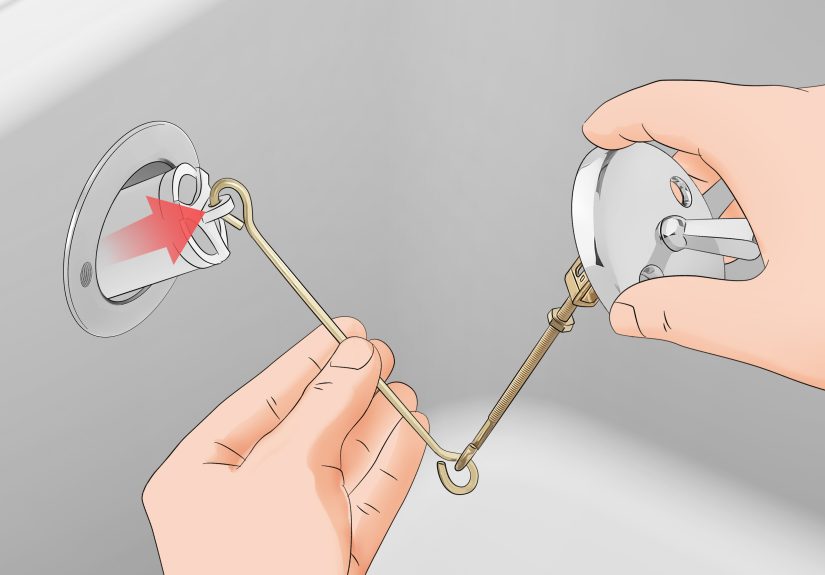
If your tub has a lever on the overflow plate (the round plate below the faucet), your stopper is part of a linkage
assembly inside the overflow pipe. This looks intimidating, but it’s usually just a couple of screws and a gentle pull.
What it looks like
- A lever on the overflow plate controls draining
- You may see a stopper in the drain, or the mechanism may be hidden
- There’s a linkage rod/plunger assembly behind the overflow plate
Step-by-step removal
- Set the lever to the open position (so the stopper is not sealing the drain).
- Remove the overflow plate screws (typically two screws). Support the plate with your hand as you loosen them.
-
Pull the overflow plate straight outslowly. The linkage assembly will come out with it.
Go steady so you don’t bend the rod or snag it on the pipe. - If you feel resistance, wiggle gently and pullsoap scum and mineral buildup can make the plunger stick.
-
Once the linkage is out, you’ll have better access to the drain. Depending on your stopper style, you may then lift the drain stopper out,
or you may simply remove hair and debris while the linkage is out.
Important “don’t regret this later” notes
- Don’t force it: Linkage can be kinked or bent if yanked. Slow and steady wins the drain race.
- Keep track of orientation: If you’re going to reinsert it, note how it went in (a quick photo helps).
- Expect gunk: The plunger and rod can be coatedgloves are a quality-of-life upgrade here.
After the Stopper Is Out: Clean the Clog (The Main Event)
Once you remove the tub drain stopper, you’ll usually find the usual suspects: hair, soap scum, and whatever your
shampoo bottle has been shedding emotionally for the last six months.
Fast, low-drama cleaning options
- Pull out hair by hand (gloves recommended). Use needle-nose pliers if it’s deep.
-
Use a plastic drain snake or a straightened zip tie with notches cut into it.
Insert a few inches, twist, pull, and prepare to be impressed and slightly horrified. - Rinse with hot water for a minute to flush loosened debris.
- Clean the stopper parts with a bathroom cleaner and an old toothbrush.
Safety note: If you use a commercial drain cleaner, follow label directions and never mix products.
Many pros prefer mechanical removal (hair snake + rinse) because it’s effective and gentler on older plumbing.
How to Reinstall the Stopper (So It Works Like It’s Supposed To)
Reinstalling is usually the reverse of removaljust with slightly more confidence and slightly less mystery gunk.
General reinstallation tips
- Align threads carefully and start by hand to avoid cross-threading.
- Tighten snug, not “superhero tight”. Over-tightening can strip screws or damage finishes.
- Test it twice: Fill the tub a few inches and check that it seals; then open and confirm it drains quickly.
Trip-lever reinstall tip
When you slide the linkage back into the overflow, do it slowly and keep the rod straight.
If it feels like it’s catching, pull back a bit and adjust the angleforcing it can bend the linkage.
When to Call a Plumber (A.K.A. “This Is Above My Pay Grade”)
DIY is greatuntil it’s not. Consider calling a pro if:
- The stopper hardware is corroded and you’re stripping screws
- You pull the trip-lever linkage out and it’s broken or won’t go back in properly
- Your tub still drains slowly after removing a big hair clog (could be deeper in the line)
- You notice leaks around the drain or overflow plate
Translation: if you’re one more slip away from inventing new words, it’s okay to hand the baton to someone who owns
three different kinds of wrenches for fun.
Real-World Experiences: What Usually Happens When People Remove a Tub Drain Stopper
Let’s talk about the part nobody mentions in the “easy DIY” headlines: the real-life version of removing a tub drain
stopper. Not the glossy, five-minute demo where every screw turns like it’s been moisturized. The real versionwhere
you learn things, laugh a little, and briefly consider moving to a house with no plumbing at all.
First, there’s the “Which stopper do I even have?” moment. A lot of homeowners start by twisting the top like it’s a
lift-and-turn, only to realize it’s push-pull and the knob isn’t going anywhere. The win here is that once you identify
your stopper type, you stop wasting effort and start making progress. A flashlight and a quick look for a set screw can
save you 15 minutes of unproductive spinning.
Next is the classic: soap scum as industrial adhesive. Even when you’re doing everything “right,” the stopper may feel
stuck because gunk has formed a sticky seal around the edges. People usually succeed by switching from “stronger force”
to “smarter force”: wrap a rag around the cap, add steady pressure, and wiggle slightly while lifting. It’s the difference
between coaxing and combatyour tub prefers coaxing.
Then there’s the tiny-screw reality show. Set screws are small, easy to overlook, and love to hide in shadowy spots under
a knob rim. Once found, they introduce a new challenge: using the right Allen wrench size. Many DIYers discover that
“close enough” rounds out the screw head, turning a 30-second step into a 30-minute problem. The practical experience
here is simple: try a few sizes until the wrench seats firmly, then loosen gently.
If you’re dealing with a trip-lever stopper, the “experience” is usually a mix of confidence and caution. The overflow
plate comes off easilythen the linkage slides out and suddenly you’re holding a surprisingly long, gooey metal assembly
like it’s a prop from a low-budget sci-fi movie. Most people do great when they pull slowly and keep the rod straight.
The main lesson: take a quick photo before removal so reinstallation feels like a reverse step, not a puzzle.
Finally, the moment of truth: the clog reveal. Almost everyone expects “some hair.” What they find is often a dense,
rope-like collection that could qualify as a small pet. The most common success story is mechanical removal: pull the
hair out, use a plastic snake to grab what’s deeper, rinse with hot water, and clean the stopper parts before reinstalling.
The satisfying part? Watching the tub drain like it’s trying to impress you.
The biggest takeaway from real-world DIYers is that patience beats power. Most stopper removals don’t require strength
they require the right tool, the right angle, and a calm refusal to strip screws. And if you do hit a wall, it’s still a win:
you’ve learned what you’re working with, and you can call a plumber with clear info (which usually saves time and money).