Table of Contents >> Show >> Hide
- 1. The Countertop Is Doing Too Much
- 2. There Are Too Many Products, and Half of Them Should Have Retired Years Ago
- 3. Nothing Has a Zone, So Everything Wanders
- 4. The Bathroom Isn’t Using Its Vertical Space
- 5. Towels, Laundry, and Trash Are Sending a Distress Signal
- How to Make a Messy Bathroom Look Better Fast
- What These Messy Bathrooms Usually Look Like in Real Life
- Conclusion
A messy bathroom has a special talent: it can make even a perfectly normal morning feel like a chaotic game show. You reach for toothpaste, knock over three serums, step around a damp towel, and suddenly you’re late, annoyed, and wondering how a room the size of a walk-in closet became such a powerful force in your life.
Professional organizers know that bathroom clutter is rarely just about “too much stuff.” It’s usually about a few specific problems repeating themselves over and over. When pros walk into a messy bathroom, they’re not judging your half-used dry shampoo or your suspicious collection of hotel lotions. They’re scanning for patterns. What’s piling up? What has no assigned home? What’s making the room harder to clean, harder to use, and harder to keep calm?
If your bathroom feels crowded, stressful, or permanently one step away from disaster, the good news is this: organizers tend to notice the same five issues again and again. Once you spot them, you can fix them. Below are the five biggest red flags pro organizers notice right away, why they matter, and what to do instead if you want your bathroom to feel functional, clean, and just a little less feral.
1. The Countertop Is Doing Too Much
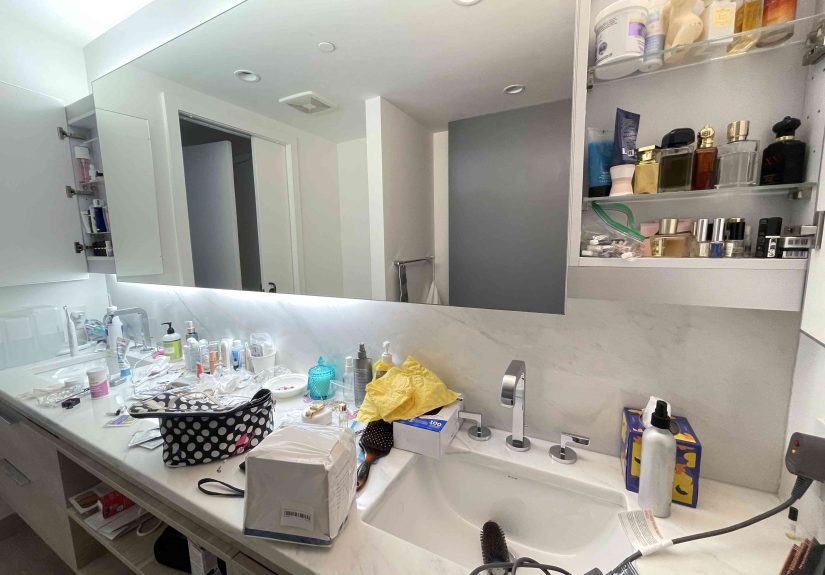
The first thing pro organizers notice is almost always the bathroom counter. Why? Because the counter tells the whole story in five seconds. If it’s covered in skincare bottles, makeup bags, hair tools, cotton pads, jewelry, and one lonely toothpaste cap that has clearly seen things, the surface is acting as both prep station and storage unit. That’s a problem.
Bathroom counters collect clutter fast because they’re convenient. We set things down “for now,” then forget to put them back. But pros know that when every daily-use item lives out in the open, the room instantly feels smaller, dirtier, and more stressful. Even worse, crowded counters make it harder to wipe surfaces, which means dust, toothpaste splatter, and mystery residue stick around longer than anyone invited them to.
What pros see
They notice products scattered instead of contained, cords snaking across the sink, and categories mixed together. Hair products are next to medicine. Makeup is leaning against hand soap. A razor is somehow hanging out beside a candle. The room has no visual breathing room.
What to do instead
Keep only true daily essentials on the counter. Not “I use this every month and emotionally support it,” but genuinely daily. Everything else should move into a drawer, cabinet, or labeled bin. If a few items must stay visible, corral them on a tray. A tray makes a counter look intentional instead of chaotic, and it creates an invisible boundary that says, “This is enough. We are not opening a small pharmacy on the sink.”
A clean counter also changes your routine. You spend less time hunting, less time shuffling bottles around, and less time pretending you’ll clean “later.” Organizers love that because it means the room is easier to maintain, not just prettier for 12 dramatic minutes.
2. There Are Too Many Products, and Half of Them Should Have Retired Years Ago
The second thing pros notice is product overload. Bathrooms are magnets for duplicates, backups, samples, expired cosmetics, nearly empty bottles, and items bought during a brief phase in which we apparently believed we were the kind of person who exfoliates with volcanic sea minerals every Tuesday.
A messy bathroom often isn’t short on storage. It’s overloaded with things that no longer need to be there. Professional organizers can usually tell right away when someone is storing products by habit instead of usefulness. If every drawer is stuffed and every shelf is crowded, the problem may not be a lack of space. It may be too many items competing for it.
What pros see
Multiple shampoos doing the same job. Five lotions open at once. Travel-size toiletries breeding in dark corners. Expired makeup. Skin care you tried twice and never touched again. Medication stored in the wrong place. Products shoved so tightly together that finding one thing becomes an archaeological dig.
Why it matters
Too many products create visual clutter, waste money, and make routines slower. They can also become a hygiene issue. Old cosmetics, worn-out tools, and long-forgotten products can turn your bathroom into a museum of poor decisions. And because bathrooms are warm and humid, some items do not age gracefully there.
What to do instead
Do a full edit. Pull everything out of drawers, cabinets, baskets, and under-sink storage. Group similar items together: dental care, hair care, skin care, first aid, backstock, travel items, cleaning supplies. Then get ruthless. Toss what’s expired, dried out, broken, empty, or never used. Relocate what doesn’t belong in the bathroom. Keep only the amount that fits your space and your real routine.
If you love backups, that’s fine. Just give them one contained zone. One bin for extras is practical. Seven random backup bottles spread across three shelves is how clutter writes fan fiction.
3. Nothing Has a Zone, So Everything Wanders
Pro organizers are obsessed with zones, and honestly, they’re right. A messy bathroom usually has one major problem: there’s no logic to where things live. When items don’t have designated homes, they migrate. They end up wherever your hand last released them, which is how floss winds up near the hairbrush and sunscreen somehow settles in beside the toilet paper.
Zoning means assigning clear areas based on how the bathroom is actually used. It sounds simple, but it changes everything. Organizers do not want you storing items according to vague hope. They want you storing items according to behavior.
What pros see
Daily products mixed with occasional products. Family members sharing drawers without dividers. Bath items stored far from the shower. Tooth care hidden under a sink while random beauty items are front and center. Cleaning supplies taking up premium real estate while everyday essentials are hard to reach.
How zones fix the chaos
When the room is zoned well, your routine gets smoother. Morning items live together. Shower supplies stay near the shower. Hair tools go in one contained place. First-aid items are easy to access but not mixed with makeup. Backstock stays separate from open products. Suddenly, the room works with you instead of testing your patience before coffee.
What to do instead
Create zones based on function:
- Daily routine zone: toothbrush, face wash, deodorant, moisturizer, hairbrush
- Shower zone: shampoo, conditioner, body wash, razors
- Get-ready zone: makeup, hair tools, styling products
- Health zone: first aid, medications stored appropriately, thermometers
- Backstock zone: extra soap, toothpaste, toilet paper, unopened products
Use drawer dividers, small bins, and labels to keep those zones visible. Because let’s be honest: the problem is rarely that you don’t own containers. It’s that the items inside them have entered into a lawless arrangement.
4. The Bathroom Isn’t Using Its Vertical Space
When pro organizers enter a messy bathroom, they immediately look up, around, and behind. Why? Because bathrooms are tiny, and tiny spaces need to work harder. If your walls, cabinet doors, and awkward gaps are doing absolutely nothing, a pro notices that instantly.
Many messy bathrooms rely too heavily on flat surfaces: counters, the top of the toilet, the floor, and the rim of the tub. That’s prime clutter territory. Meanwhile, perfectly usable vertical space sits empty, silently begging for a shelf, a hook, or literally any purpose.
What pros see
An overstuffed vanity with no stackable storage. An empty wall above the toilet. Cabinet doors with unused interiors. Hair tools dumped in drawers without organizers. Towels stacked awkwardly because there are not enough hooks. Cleaning supplies crammed under the sink with no tiers, bins, or separation.
What to do instead
Think vertically. Add shelves over the toilet, hooks behind the door, risers inside cabinets, slim rolling carts beside a vanity, or adhesive bins inside cabinet doors. Use stackable organizers under the sink so you are not wasting the air space above shorter products. Use cups, bins, or divided trays inside drawers so small items do not drift into one giant junk colony.
This is one of the fastest upgrades you can make because it does not require a renovation. It just requires noticing that your bathroom is three-dimensional. Revolutionary, I know.
And here’s the bonus: better vertical storage makes a bathroom easier to clean. When things are off the counter and off the floor, you can wipe, sweep, and reset the room without moving 37 unrelated objects first.
5. Towels, Laundry, and Trash Are Sending a Distress Signal
The final thing pros notice is the support clutter: damp towels, overflowing trash, clothes on the floor, half-used toilet paper rolls, empty bottles in the shower, and other little signs that the bathroom system has broken down. These things may seem minor, but they create an instant feeling of disorder.
A bathroom can be fairly organized and still feel messy if soft goods and waste are unmanaged. In fact, pro organizers often say the issue is not just what you store in the room, but how the room handles the stuff passing through it every day.
What pros see
Towels with no hook or bar, so they land on the floor. Dirty clothes with no hamper nearby, so they pile in corners. Tiny trash cans that overflow by noon. Extra toilet paper sitting out because there is no dedicated storage spot. Bath mats, robes, and washcloths drifting around with no clear landing zone.
Why this matters
These items create instant visual noise. They also make the room feel dirtier than it may actually be. A single towel on the floor can make an otherwise decent bathroom look like it lost a fight.
What to do instead
Give every high-traffic item a simple home. Add enough hooks for the number of people who actually use the bathroom. Put a compact hamper where clothes naturally get dropped. Use a trash can that is large enough for real life, not one that looks cute for exactly six cotton swabs. Store a small amount of extra toilet paper in a basket or shelf nearby and keep the bulk stash elsewhere if space is tight.
Most importantly, build a reset habit. A 3-minute evening sweep, where towels are hung, trash is checked, and surfaces are cleared, keeps the room from sliding back into chaos. Organizers love systems that are boring, repeatable, and easy. That’s because those are the systems that survive Monday mornings.
How to Make a Messy Bathroom Look Better Fast
If you want a quick win, do this in order:
- Clear the counter completely.
- Toss obvious trash and empty containers.
- Remove expired or duplicate products.
- Group what remains by category.
- Put daily items in easy reach and backstock elsewhere.
- Add one tray, one drawer divider, and one bin before buying anything more.
- Use hooks or shelves to get items off the floor and out of visual sightlines.
That alone can change how the whole room feels. You do not need a luxury remodel, a rainbow of acrylic bins, or a personal assistant named Claire who whispers “decant” every time you buy cotton balls. You need less clutter, better zones, and a bathroom that reflects how you actually live.
What These Messy Bathrooms Usually Look Like in Real Life
One of the most common bathroom situations professionals describe is the “morning pileup bathroom.” This is the space where two or more people get ready at once, but the storage setup still acts like one calm minimalist lives there with a single toothbrush and flawless self-control. On the counter, there are skin-care products for one person, beard tools for another, a curling iron left to cool, and makeup squeezed between hand soap and a tissue box. Nothing is technically shocking, but together it creates a traffic jam. Organizers usually notice that the real problem is not laziness. It is that the bathroom was never adjusted for the number of users.
Then there is the “backup stock explosion bathroom.” This one often belongs to someone who loves a good bulk purchase or has a hard time saying no to drugstore deals. There are three body washes open, four bars of soap without a bin, seven mini hotel shampoos for an imaginary travel emergency, and enough cotton rounds to survive a minor weather event. Pros usually find that the owner thinks they are being prepared, but because backups are mixed with daily-use products, the room feels overstuffed all the time. A single labeled backstock bin solves more than people expect.
Another familiar scene is the “tiny bathroom, giant routine” problem. In this case, the bathroom itself is small, but the person using it has a very normal, very human collection of essentials: hair care, skin care, oral care, towels, medications, and cleaning products. The space feels impossible until an organizer notices the wasted wall area, the empty inside of cabinet doors, and the under-sink area packed without any vertical structure. Once shelves, hooks, stackable bins, or slim organizers are added, the bathroom suddenly looks twice as functional without growing by a single inch.
Professionals also talk about the “looks messy even when it’s clean” bathroom. This is the sneaky one. Surfaces may be wiped down, and the floor may be spotless, yet the room still feels chaotic. Why? Because too much is visible. Open shelves are packed, the counter is lined with products, towels are stacked in plain sight, and every category spills into the next. The lesson here is that cleanliness and organization are not the same thing. A bathroom can sparkle and still feel stressful if there is no containment.
And finally, there is the “drop zone bathroom,” where every item that does not have a home ends up making a temporary stop that somehow lasts six months. A bracelet gets left by the sink. A receipt appears on the vanity. A random charger moves in for reasons no one can explain. Professional organizers usually see this as a symptom of weak systems, not bad habits. When a bathroom has no tray, no drawer order, no hook, and no defined zones, it becomes a magnet for delayed decisions.
That is why pros notice patterns before they notice products. They are not just looking at what is in the bathroom. They are looking at what the room is teaching people to do. If the setup encourages piling, dropping, overbuying, and hiding clutter behind closed doors, the mess will come back. If the setup makes it easy to put things away, find what you need, and clean quickly, the room starts behaving better almost on its own. And yes, that may be the closest a bathroom gets to personal growth.
Conclusion
When pro organizers enter a messy bathroom, they are not scanning for perfection. They are looking for clues. Counter clutter, too many products, missing zones, wasted vertical space, and unmanaged towels or trash all point to the same truth: the bathroom needs systems, not scolding. Once you simplify what stays, assign clear homes, and make the room easier to reset, the mess stops feeling permanent.
A well-organized bathroom does more than look nice in photos. It makes mornings faster, cleaning easier, and small spaces feel calmer. And that is the real goal. Not a showroom bathroom no one is allowed to touch, but a practical one that works every single day.