Table of Contents >> Show >> Hide
- Why this matters (besides passing French class)
- Way #1: Identify the verb group first (because French loves categories)
- Way #2: Conjugate with stems + endings (the “LEGO method”)
- Way #3: Conjugate by building the “big three” timeframes
- Way #4: Conjugate by “auxiliary logic” (compound tenses made simple)
- Way #5: Conjugate irregular verbs by “families,” not one-by-one
- Way #6: Conjugate by purpose (mood + meaning), not just charts
- Mini cheat sheet: a smart way to practice conjugation without burning out
- Common mistakes (and how to fix them fast)
- Wrapping it up: Conjugation is a system, not a monster
- Extra: of real-life experiences learners have with French conjugation
French verb conjugation has a reputation for being dramaticlike it shows up wearing a cape, announces
“I have moods,” and then demands you memorize a chart. But here’s the secret: most French verbs
are surprisingly predictable once you know what to look for.
This guide breaks French conjugation into six practical “ways” you can use in real life:
from spotting patterns in verb groups to building compound tenses and surviving irregular verbs without
moving to a cabin in the woods. You’ll get clear steps, smart shortcuts, and specific examples you can copy.
Why this matters (besides passing French class)
Conjugation isn’t just grammar homeworkit’s how you tell time, express plans, describe habits, and share
opinions. If vocabulary is the what, conjugation is the when, who, and how real.
Master a few patterns and you’ll sound instantly more fluenteven with simple words.
Way #1: Identify the verb group first (because French loves categories)
Before you conjugate anything, figure out what kind of verb you’re dealing with. In French, most verbs
fall into predictable “families” based on the infinitive ending:
The three main verb groups
- -ER verbs: the largest group (parler, aimer, regarder). Usually the easiest and most regular.
- -IR verbs: two flavorssome are regular (finir), others are… not (venir).
- -RE verbs: often shorter and a bit quirky (vendre, répondre, attendre), but many follow patterns.
Quick check: Is it a “regular -IR” verb?
Many regular -IR verbs have a present participle ending in -issant. For example:
finir → finissant. If you see that pattern, you’re usually in “regular -IR land,”
where endings behave nicely.
Example: Start with the infinitive
Let’s take three verbs:
parler (-ER), finir (-IR), vendre (-RE).
Once you label them, you can grab the right stem and endings without guessing.
Pro tip: If a verb looks common and refuses to behave, it’s probably irregular.
(French doesn’t prank you with obscure verbs. It pranks you with the ones you use daily.)
Way #2: Conjugate with stems + endings (the “LEGO method”)
A huge chunk of French conjugation is simply:
STEM + ENDING.
You remove the infinitive ending (-er, -ir, -re), keep the stem, and attach the correct ending for the tense and subject.
Present tense endings you’ll use constantly
-ER verbs (parler → “to speak”)
Stem: parl-
- je parle
- tu parles
- il/elle/on parle
- nous parlons
- vous parlez
- ils/elles parlent
Example: Je parle français. (I speak French.)
Regular -IR verbs (finir → “to finish”)
Stem: fin- (and often an extra -iss- appears in plural forms)
- je finis
- tu finis
- il/elle/on finit
- nous finissons
- vous finissez
- ils/elles finissent
Example: Nous finissons à six heures. (We finish at six o’clock.)
-RE verbs (vendre → “to sell”)
Stem: vend-
- je vends
- tu vends
- il/elle/on vend
- nous vendons
- vous vendez
- ils/elles vendent
Example: Ils vendent des livres. (They sell books.)
If you’re thinking, “Wait… those endings look familiar,” you’re right. French often reuses patterns,
especially in spoken language where some endings are silent. That’s not a bugit’s a feature.
Way #3: Conjugate by building the “big three” timeframes
Instead of trying to learn every tense at once, focus on how French expresses three everyday timelines:
now, past, and future. Master one common tense per timeline,
then expand.
Now: Present (le présent)
Use it for habits, facts, and what’s happening:
Je travaille. (I work / I’m working.)
Past: Passé composé (most common “done” past)
The passé composé is a compound tense, meaning it’s built from two parts:
- auxiliary verb (avoir or être) in the present
- past participle (like “spoken,” “finished,” “sold”)
How to form the past participle (quick patterns)
- -ER → -é: parler → parlé
- regular -IR → -i: finir → fini
- -RE → -u: vendre → vendu
Examples (passé composé)
- J’ai parlé. (I spoke / I have spoken.)
- Tu as fini. (You finished.)
- Nous avons vendu. (We sold.)
Important: Some verbs use être instead of avoir, especially many
verbs of movement and all reflexive verbs. Example: Elle est arrivée. (She arrived.)
Future: Futur proche (near future) and simple future
Start with the near future because it’s incredibly useful and easy:
aller (present) + infinitive.
- Je vais manger. (I’m going to eat.)
- Nous allons étudier. (We’re going to study.)
Then learn the simple future for more general “will” statements:
infinitive + future endings (often the same endings you’ll see again in the conditional).
Example: Je parlerai demain. (I will speak tomorrow.)
Way #4: Conjugate by “auxiliary logic” (compound tenses made simple)
Once you understand the auxiliary system, you unlock not just the passé composé, but a whole set of tenses
that work the same way (pluperfect, future perfect, conditional perfect, and more). It’s like learning one recipe
and suddenly being able to cook five dishes.
Step-by-step: Passé composé with avoir
- Choose avoir in the present: j’ai, tu as, il a, nous avons, vous avez, ils ont
- Add the past participle: parlé, fini, vendu, etc.
Example: Nous avons regardé un film. (We watched a movie.)
Step-by-step: Passé composé with être
- Choose être in the present: je suis, tu es, il est, nous sommes, vous êtes, ils sont
- Add the past participle
- Agree the past participle with the subject (often adding -e, -s, or -es)
Examples:
- Il est parti. (He left.)
- Elle est partie. (She left.)
- Ils sont partis. (They left.)
- Elles sont parties. (They left.)
Reflexive verbs (se laver, s’habiller) usually use être
Example: Je me suis réveillé(e). (I woke up.)
If agreement feels annoying, congratulations: you’re emotionally fluent already. The good news is you can
speak well even before you write perfectly. Focus on understanding first; polish later.
Way #5: Conjugate irregular verbs by “families,” not one-by-one
Irregular verbs are the reason French learners develop dramatic sighs. But irregular doesn’t mean random.
Many “weird” verbs share patterns with cousins. Learn them in families and you’ll reduce memorization.
Family 1: -GER and -CER spelling changes (still basically regular)
These verbs are regular in endings, but tweak spelling to keep pronunciation:
- manger: nous mangeons (extra “e” so the g stays soft)
- commencer: nous commençons (ç keeps the soft “s” sound)
Family 2: “Boot verbs” (spelling-change in singular + ils/elles)
Some verbs change the stem in the “boot” forms: je, tu, il/elle/on, ils/elles (but not usually nous/vous).
- acheter → j’achète, tu achètes, il achète, nous achetons
- préférer → je préfère, nous préférons
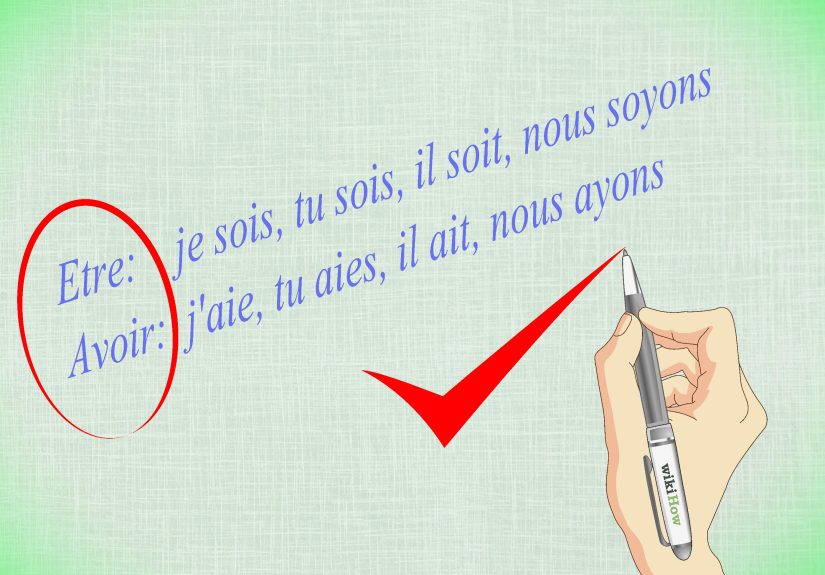
Family 3: The “must-know MVPs” (être, avoir, aller, faire)
These four show up everywhere: as main verbs and as building blocks for other tenses.
Learn them early and your French becomes 10x easier.
Être (to be) present
- je suis
- tu es
- il/elle/on est
- nous sommes
- vous êtes
- ils/elles sont
Avoir (to have) present
- j’ai
- tu as
- il/elle/on a
- nous avons
- vous avez
- ils/elles ont
Aller (to go) present
- je vais
- tu vas
- il/elle/on va
- nous allons
- vous allez
- ils/elles vont
Faire (to do/make) present
- je fais
- tu fais
- il/elle/on fait
- nous faisons
- vous faites
- ils/elles font
Practice trick: Use these verbs to create dozens of real sentences:
Je suis…, J’ai…, Je vais…, Je fais…. That’s not “basic.” That’s “foundational.”
Way #6: Conjugate by purpose (mood + meaning), not just charts
French doesn’t conjugate verbs just to make learners suffer. (Okay, not only for that.)
Tenses and moods carry meaningcertainty, doubt, politeness, wishes, and tone. If you attach a purpose
to each one, they become easier to remember.
Imparfait: past habits and background
Use it for “was doing,” “used to,” or setting the scene:
Quand j’étais petit, je jouais dehors. (When I was little, I played outside.)
Conditional: polite requests and “would”
Want to sound instantly more polite? Conditional is your friend:
Je voudrais un café. (I would like a coffee.)
Subjunctive: feelings, doubt, and “I need you to…”
The subjunctive shows up after expressions like il faut que (it’s necessary that),
je veux que (I want that), bien que (although), and more.
Example: Il faut que tu viennes. (You have to come.)
You don’t need to master every mood today. But if you learn them as “tools for intention”
rather than “random extra grammar,” they stick.
Mini cheat sheet: a smart way to practice conjugation without burning out
If you try to memorize all tenses for all verbs, your brain will file for divorce. Instead, practice
in layerslike building a house, not stacking furniture in midair.
Layered practice plan (15 minutes)
- 2 minutes: pick one verb (e.g., parler) and say it in the present with all subjects
- 5 minutes: make 6 real sentences (one per subject) about your life
- 5 minutes: convert those sentences into passé composé
- 3 minutes: convert two sentences into near future (aller + infinitive)
Example set (parler)
- Present: Je parle avec mes amis.
- Past: J’ai parlé avec mes amis.
- Near future: Je vais parler avec mes amis.
This approach forces your brain to connect conjugation with meaningso it becomes a skill, not a spreadsheet.
Common mistakes (and how to fix them fast)
Mistake 1: Mixing up “avoir” vs “être” in the passé composé
Fix: start with a small list of common être verbs (movement + reflexives), and treat everything else as “avoir”
until proven otherwise. Then refine as you learn more.
Mistake 2: Forgetting silent endings and thinking you’re wrong
In spoken French, several present endings sound the same. For many verbs:
je parle, tu parles, il parle, ils parlent can sound identical.
Fix: focus on listening for pronouns and context, not just the ending.
Mistake 3: Treating every verb as a separate puzzle
Fix: memorize patterns and families. French rewards pattern recognition like it’s paying you rent.
Wrapping it up: Conjugation is a system, not a monster
The fastest way to improve French verb conjugation is to stop seeing it as 1,000 random forms and start
seeing it as a few repeatable methods:
- Identify the verb group
- Use stem + ending patterns
- Anchor to “now, past, future” with common tenses
- Build compound tenses with auxiliaries
- Learn irregular verbs in families
- Connect moods to meaning and purpose
Do that, and French stops feeling like a quiz and starts feeling like a language you can actually use.
And yesyour future self will thank you. Probably in French. Conjugated correctly. With attitude.
Extra: of real-life experiences learners have with French conjugation
If you’ve ever learned French verbs and thought, “Why does this feel like assembling IKEA furniture without
the instructions?” you’re not alone. Many learners describe the first weeks of conjugation as a strange mix of
excitement and betrayal: the vocabulary feels friendlybonjour, merci, croissantand then
verbs show up with endings that change depending on who’s speaking, when it happened, and whether the speaker is
expressing doubt, desire, or emotional chaos.
A common early experience is the “silent ending shock.” Learners carefully write je parle, tu parles,
il parle, and feel prouduntil they hear native speech and realize those three often sound basically the same.
At first, that can feel unfair (like French is hiding the answer key). But over time, students often report a surprising
benefit: they start paying more attention to pronouns, rhythm, and context. The result is better listening comprehension.
In other words, the thing that annoyed them ends up training their ear.
Another classic moment happens with the passé composé. Many learners love it at first because it’s “two pieces” and feels
logicalauxiliary + past participle. Then they meet être verbs and agreement, and the love story becomes a sitcom.
People frequently remember their first “Wait… why is it elle est partie but il est parti?” moment.
The good news is that this confusion is often temporary. Once learners connect agreement to the idea of matching adjectives
(which they already do in French), the rule starts to feel less random and more like “French being French.”
Learners also tend to develop personal “comfort tenses.” Some cling to the present tense and use time words to do the heavy
lifting (“yesterday,” “tomorrow”), while others become near-future addicts because aller + infinitive is so easy and
so useful. That’s a normal stage. It’s also why the “layered practice” approach works: you can keep your comfort tense while
gradually expanding your range.
Finally, there’s the experience of unlocking fluency through a few key verbs. People often notice a sudden leap when they truly
own être, avoir, aller, and faire. It’s not magicalit’s practical. Those verbs show up in
everyday speech constantly, and they power compound tenses and common expressions. Many learners describe this stage as the moment
French stops feeling like a school subject and starts feeling like a tool. And honestly? That’s when it gets fun.