Table of Contents >> Show >> Hide
- Why the Moon Landing Was Really a Team Sport
- 1. Margaret Hamilton, the Software Leader Who Helped Apollo Keep Its Head
- 2. Katherine Johnson, the Mathematician Who Made the Trajectories Trustworthy
- 3. JoAnn Morgan, the Launch Control Expert in the Room Where It Happened
- 4. Frances “Poppy” Northcutt, the Return-to-Earth Specialist Who Helped Bring Crews Home
- 5. Jack Garman, the Young Engineer Who Said “Go” When the Alarms Hit
- 6. Don Eyles, the Programmer Who Helped Write the Lunar Descent Brain
- 7. Eldon Hall, the Hardware Designer Who Helped Make the Apollo Guidance Computer Real
- 8. Hal Laning, the Computer Scientist Who Gave Apollo a Sense of Priority
- The Real Lesson of These Moon Landing Heroes
- What the Apollo Experience Still Feels Like Today
- Conclusion
When people talk about the Moon landing, the spotlight usually swings straight to Neil Armstrong, Buzz Aldrin, and Michael Collins. Fair enough. Walking on the Moon is a pretty strong résumé line. But Apollo 11 was never a three-person miracle. It was the result of thousands of specialists solving impossible problems with slide rules, early computers, hand-built hardware, and the kind of calm that makes modern Wi-Fi complaints feel a little dramatic.
If you zoom out from the famous footprints, a richer story appears. The Moon landing was made possible by software pioneers, trajectory analysts, launch controllers, and computer designers whose names rarely headline documentaries. Some worked in Mission Control. Some worked in labs. Some wrote code so tight it had to fit into laughably tiny memory by today’s standards. Some sat in rooms where one bad call could have turned “one giant leap” into “well, that was awkward for the whole planet.”
This is the story of eight lesser-known players who helped make the Moon landing possible. They were not supporting characters in a side plot. They were part of the engine that made Apollo work. And if there is one thing Apollo proves, it is this: history loves the person holding the flag, but success usually belongs to the people holding the checklists.
Why the Moon Landing Was Really a Team Sport
The Apollo program did not succeed because NASA had a few brilliant astronauts and a really good pep talk. It succeeded because an enormous technical ecosystem worked together under pressure. Calculations had to be exact. Software had to behave. Guidance computers had to keep their priorities straight. Launch systems had to be monitored to the second. Backup plans had to exist for the backup plans. Even the famous landing itself depended on split-second judgments made by people most viewers at home had never heard of.
That is what makes these eight figures so fascinating. Each represents a part of Apollo that the public often overlooks: the mathematics, the code, the mission rules, the hardware, the operational discipline, and the nerve. In other words, the real plumbing of greatness.
1. Margaret Hamilton, the Software Leader Who Helped Apollo Keep Its Head
Margaret Hamilton was not just “someone who worked on the code.” She led the Software Engineering Division at MIT’s Instrumentation Laboratory, where the Apollo flight software was developed. At a time when software was still treated by many as an afterthought to hardware, Hamilton pushed for rigorous engineering practices and helped define what software reliability should look like in a mission where mistakes were not cute.
Why she mattered
The Apollo Guidance Computer had almost no memory by modern standards, yet it had to perform navigation, guidance, and control functions in real time. Hamilton’s team created software that could prioritize critical tasks and recover from overload conditions. That mattered enormously during Apollo 11, when the Lunar Module’s computer triggered the now-famous 1201 and 1202 alarms during descent. Instead of collapsing into digital panic, the system shed lower-priority work and kept the most essential functions alive. That design choice helped make a safe landing possible.
Hamilton’s contribution also mattered culturally. She treated software as a discipline that deserved the same seriousness as hardware design. That idea sounds obvious now, but Apollo helped prove it. Without reliable software engineering, the Moon landing would have been little more than a very expensive optimism exercise.
2. Katherine Johnson, the Mathematician Who Made the Trajectories Trustworthy
Katherine Johnson is more recognized today than she once was, and that is long overdue. Even so, many people still associate her mostly with early Mercury missions. In reality, her calculations also played a critical role in the success of Apollo. Johnson’s work in trajectory analysis helped NASA understand how spacecraft would move through space, return safely, and meet the exact demands of mission planning.
Why she mattered
You cannot land on the Moon with vibes. You land on the Moon with mathematics. Johnson’s calculations contributed to the precision required for lunar missions, including the planning behind launch windows, spaceflight paths, and return trajectories. Her strength was not theatrical. It was foundational. She helped create the mathematical confidence that allowed engineers and astronauts to trust the mission architecture itself.
That may sound less glamorous than hearing “The Eagle has landed,” but that line only happens after thousands of earlier lines, equations, and validations go right. Johnson was part of the reason NASA could believe its own numbers, and in spaceflight, belief without math is just sci-fi with a budget problem.
3. JoAnn Morgan, the Launch Control Expert in the Room Where It Happened
On July 16, 1969, as Apollo 11 lifted off from Kennedy Space Center, JoAnn Morgan sat in the firing room as the only woman there. She served as an instrumentation controller, a role that required monitoring complex systems and making sure the launch vehicle’s instrumentation was doing exactly what it should. There was no room for distraction, symbolism, or grandstanding. The Saturn V either left Earth properly, or everyone had a very bad day.
Why she mattered
Morgan’s job sat at the intersection of engineering precision and launch operations. Apollo 11 did not begin with lunar dust and famous quotations. It began with a launch vehicle that had to function with extraordinary accuracy. Morgan helped verify the health of the systems that made liftoff possible. She was part of the operational discipline that turned a massive rocket into a controlled event rather than a patriotic gamble.
Her presence was historic for another reason too. Apollo was often presented as an all-American triumph, but the public image frequently narrowed that triumph to men in white shirts and astronauts in suits. Morgan reminds us that the mission was already broader, smarter, and more diverse than the standard poster version suggests.
4. Frances “Poppy” Northcutt, the Return-to-Earth Specialist Who Helped Bring Crews Home
Landing on the Moon was only half the problem. Coming back was the part people tended to mention quietly, as if not to jinx it. Frances “Poppy” Northcutt, working with TRW on a NASA contract, became a return-to-Earth specialist during Apollo. She was one of the first women to work in Mission Control support and played a key role in trajectory analysis and backup plans for bringing astronauts home safely.
Why she mattered
Northcutt worked on the math and procedures needed to get crews back from lunar missions, including preparing backup navigational charts in case onboard systems failed. That was not glamorous work, but it was life-preserving work. Apollo missions operated in an environment where redundancy was not a luxury; it was survival in spreadsheet form.
Her work also highlights something essential about Moon mission planning: NASA never viewed the landing as an isolated stunt. Apollo had to be a complete system from launch to splashdown. Northcutt’s role helped close that loop. The Moon landing was only a triumph because the astronauts did not end up becoming permanent residents.
5. Jack Garman, the Young Engineer Who Said “Go” When the Alarms Hit
During Apollo 11’s descent, alarms flashed from the Lunar Module computer. In that moment, Mission Control had to decide whether to abort. One of the key figures behind the decision to continue was Jack Garman, a young NASA engineer who had prepared a detailed list of computer alarms and understood what the 1202 warning actually meant.
Why he mattered
Because he knew the alarms were manageable, Garman could quickly advise that the landing could continue. That judgment helped prevent an unnecessary abort. It is one of the most dramatic examples of hidden expertise in Apollo: a person who had done the homework before the crisis arrived, then made the right call when the room got tense.
That is the sort of contribution history often compresses into a footnote. It should not. Apollo 11 did not succeed just because people were brave in the moment. It succeeded because people like Garman had already done painstaking preparation so courage could be informed instead of improvised.
6. Don Eyles, the Programmer Who Helped Write the Lunar Descent Brain
Don Eyles was one of the young programmers at MIT’s Instrumentation Laboratory who worked on software for the Lunar Module guidance computer. He helped write the onboard guidance software used for the descent and later became one of the clearest explainers of what the computer actually did during the landing. That is useful, because Apollo software history is often told either too vaguely or with the confidence of people who were not there.
Why he mattered
The Lunar Module’s software had to guide a spacecraft through one of the most delicate maneuvers in human history. Eyles helped build that logic. His work contributed to the routines that allowed the module to navigate descent conditions and respond under pressure. The famous landing did not happen because software magically behaved. It happened because engineers like Eyles made it behave.
His career is also a reminder of how young many Apollo contributors were. Some of the people writing mission-critical software were in their twenties. Imagine being 24 and helping guide humans to another world. Most of us at that age are still trying to remember our passwords.
7. Eldon Hall, the Hardware Designer Who Helped Make the Apollo Guidance Computer Real
If Hamilton and Eyles helped give Apollo its software intelligence, Eldon Hall helped give it a body. Hall led the hardware team for the Apollo Guidance Computer at MIT’s Instrumentation Laboratory and strongly backed the use of integrated circuits. That decision helped make the computer compact, reliable, and advanced enough to support lunar missions.
Why he mattered
The Apollo Guidance Computer was one of the most important pieces of electronics in spaceflight history. It had to fit inside the spacecraft, survive extreme conditions, and perform real-time guidance tasks with high reliability. Hall’s leadership on hardware design helped make that possible. He also helped push integrated circuits into a starring role at a time when they were still emerging technology.
In plain English, Hall helped build a computer that could fly to the Moon without acting like a sulky office machine. That is not a small achievement. The Moon landing depended not only on brilliant theory but also on robust hardware choices made years before the mission ever launched.
8. Hal Laning, the Computer Scientist Who Gave Apollo a Sense of Priority
Hal Laning does not usually appear in popular Apollo lists, which is odd because his work shaped how the guidance computer handled multiple tasks. MIT histories credit Laning with developing the programming language for the Apollo Guidance Computer and creating its executive operating system, which used priority scheduling so the most important jobs always got attention first.
Why he mattered
That concept was not just clever; it was mission-critical. Apollo’s computer could not do everything at once. Laning’s approach ensured that essential operations, like controlling the Lunar Module during descent, would outrank lower-priority processes. In other words, he helped teach the machine how not to lose its mind under stress.
When Apollo 11’s computer alarms appeared, the broader architecture of prioritized computing was part of what allowed the system to keep functioning. Laning’s work was deeply technical and mostly invisible to the public, but invisibility is often what success looks like in engineering. If nobody notices your system, it usually means it worked.
The Real Lesson of These Moon Landing Heroes
It is tempting to tell the Moon landing as a clean hero story with astronauts at the center and everyone else arranged in the background like stage furniture. But the deeper truth is more impressive. Apollo was a victory of coordinated expertise. Margaret Hamilton helped make the software resilient. Katherine Johnson helped make the math dependable. JoAnn Morgan helped make launch operations disciplined. Poppy Northcutt helped make safe return possible. Jack Garman helped save the landing decision in real time. Don Eyles helped write the descent logic. Eldon Hall helped create the computer’s physical brain. Hal Laning helped structure how that brain thought under pressure.
None of them planted a flag on the Moon. All of them helped make sure someone could.
That is what makes these lesser-known players so important to remember. They represent the hidden architecture of achievement. Big moments in history are rarely built by fame alone. They are built by teams of people doing exacting work, often far from cameras, often without applause, and sometimes with coffee that was probably terrible.
What the Apollo Experience Still Feels Like Today
One of the most powerful things about the Moon landing is how modern it still feels emotionally, even when the hardware looks charmingly ancient. Read enough about Apollo, and a pattern emerges: the experience was a strange blend of youth, pressure, routine, and wonder. Many of the engineers were remarkably young. They were solving unprecedented problems in rooms full of ashtrays, printouts, and blinking consoles, while knowing the whole world might one day remember their success or their failure.
Imagine being in one of those support rooms during Apollo 11. You are not on television. Your name is not likely to end up in a grade-school history book. But your numbers, your procedures, or your judgment may influence whether two astronauts land safely or whether a mission is called off. That experience had to be intensely human. There was pride, surely, but also stress, exhaustion, repetition, and probably the occasional thought of, “I would really love for this alarm not to happen today.”
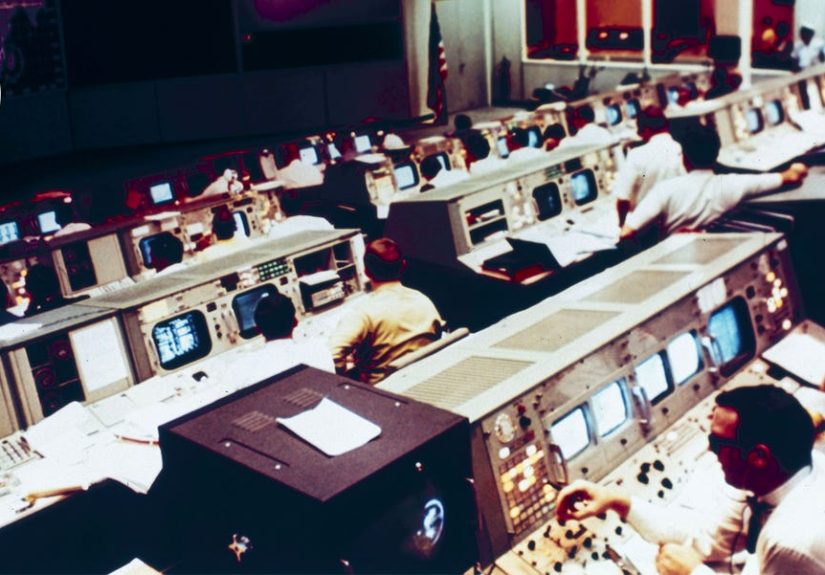
The launch experience had its own flavor. In launch control, every movement had structure. Every console had a purpose. There was no romantic chaos, only disciplined countdown culture. You can almost feel the tension in those rooms: voices measured, eyes fixed, systems checked and rechecked. A rocket launch is not dramatic because people are screaming. It is dramatic because the people who know the stakes are usually speaking very calmly.
Mission software teams lived a different version of that intensity. Their experience was long-form pressure. They had to think ahead to failures that had not happened yet and create logic for handling them before the spacecraft ever left Earth. That kind of work requires imagination with rules. You have to picture disaster, then make it boring. In a sense, Apollo’s programmers were writing calm into the machine so humans could stay calm when it counted.
For trajectory analysts, the experience was even more abstract and no less real. Their world was equations, vectors, timing windows, and backup paths. Yet behind the abstraction was a very physical truth: real people would trust those calculations with their lives. That creates a special kind of responsibility. It is not the cinematic thrill of a countdown, but it is the quieter strain of knowing that precision is mercy.
There is also something deeply relatable in Apollo’s mix of confidence and uncertainty. These teams were brilliant, but they were not omniscient. They simulated relentlessly because they knew surprises were coming. They built redundancy because perfection was not a strategy. They debated, tested, cross-checked, and documented because bold goals become less romantic the moment gravity, fuel margins, and computer limits enter the chat.
That is why Apollo still resonates. It was not just a triumph of technology. It was a triumph of people learning how to trust one another across specialties. The mathematician had to trust the programmer. The programmer had to trust the hardware designer. Mission Control had to trust the analysts. The astronauts had to trust all of them. The experience of Apollo was the experience of shared responsibility at the highest level. And that may be the most inspiring part of the whole Moon story: not just that humanity reached another world, but that it did so by turning thousands of specialized acts of competence into one unforgettable result.
Conclusion
The Moon landing was not powered by celebrity. It was powered by people who understood trajectories, alarms, memory limits, instrumentation, priority scheduling, and the glorious terror of getting the details right. Remembering these eight lesser-known players does more than correct the historical record. It shows how world-changing achievements really happen.
They happen when famous moments rest on invisible excellence. They happen when smart people do difficult work long before the cameras arrive. And they happen when a giant leap is supported by a thousand small acts of precision.