Table of Contents >> Show >> Hide
- How a Failed Buyout Started a Racing War
- Carroll Shelby and Ken Miles Were the Right Men at the Right Wild Moment
- The GT40 Did Not Arrive as a Hero
- What Really Happened at Le Mans in 1966
- Did the Movie Get the Finish Right?
- What Else the Film Changes for Drama
- The Tragedy After the Triumph
- Why the True Story Still Resonates
- Experiences That Make This Story Hit Even Harder
- Conclusion
If you came to Ford v. Ferrari for roaring engines, flaring tempers, and enough high-speed tension to make your popcorn sweat, the movie absolutely delivered. But the true story behind the film is even better. It has ego, engineering, endurance racing, corporate revenge, and one of the most debated finishes in motorsports history. In other words, it is a perfect American sports drama, except it really happened and everyone smelled more like gasoline.
At its heart, the movie tells the story of Ford’s attempt to beat Ferrari at the 1966 24 Hours of Le Mans. That part is true. So is the importance of Carroll Shelby, the ex-racer turned builder with a cowboy grin and a talent for turning impossible ideas into very loud reality. So is the importance of Ken Miles, the brilliant British-born driver and development ace whose feel for a race car bordered on wizardry. The movie gets the emotional shape of their partnership right, even when it rearranges a few details for dramatic effect.
The real story is not simply “Ford versus Ferrari.” It is also about money versus mystique, management versus mechanics, and publicity versus pure competition. The 2019 film turns those tensions into a crowd-pleasing narrative, but the actual history is richer, messier, and more fascinating. To understand why this story still grips racing fans, movie lovers, and anyone who enjoys seeing giant institutions act petty with excellent funding, you have to start before Le Mans.
How a Failed Buyout Started a Racing War
In the early 1960s, Ferrari ruled endurance racing. The Italian marque had won Le Mans year after year, and the company’s aura was nearly mythical. Ford, by contrast, was a manufacturing giant with global ambitions and a growing interest in performance marketing. Henry Ford II wanted more than sales. He wanted prestige. He wanted the kind of glamour that could not be stamped out by the million on an assembly line.
So Ford tried to buy Ferrari.
That sounds like the setup for a joke told at an auto museum bar, but it was real. Ford entered negotiations, hoping to acquire Ferrari and use its racing expertise to elevate the Blue Oval’s image. Then Enzo Ferrari backed out. Depending on whose version you prefer, he objected to control over Scuderia Ferrari, disliked the terms, or simply refused to surrender the one thing that mattered most to him: racing autonomy. However you frame it, the result was the same. Ford walked away humiliated, and humiliation is a powerful fuel. It burns hot, lasts a long time, and usually ignores the budget.
That failed deal became the emotional spark behind Ford’s Le Mans program. If Ferrari would not join Ford, Ford would beat Ferrari. Not eventually. Not politely. On Ferrari’s most sacred ground.
Carroll Shelby and Ken Miles Were the Right Men at the Right Wild Moment
The movie presents Carroll Shelby and Ken Miles as the key figures who gave Ford’s effort a soul, and that is fundamentally accurate. Shelby was already a major name in American racing. Before the GT40 project, he had built the Cobra into a world-beater and helped Shelby American take the fight to Ferrari in GT competition. The Shelby Daytona Coupe, in particular, proved that Shelby’s team could defeat Ferrari on the international stage. That earlier success mattered because it convinced Ford that Shelby’s operation had the practical know-how and competitive edge the company needed.
Ken Miles was just as essential, even if he was less marketable to executives with clean shoes. Born in England, Miles served in World War II, moved to Southern California, built his racing reputation in MG specials and Porsches, and eventually found his place with Shelby. He was not only fast. He was mechanically insightful, brutally honest, and deeply involved in developing race cars. If a machine was unstable, heavy, stubborn, or trying to murder its own brakes, Miles could usually tell you exactly why.
That made him invaluable. It also made him difficult in the way geniuses often are. The film leans into his sharp personality, and while it simplifies him into an underdog hero, the broad outline is fair. Miles was admired for his skill, feared for his candor, and crucial to the success of Shelby’s racing programs. He was not merely the man who drove the GT40. He helped shape it into a winner.
The GT40 Did Not Arrive as a Hero
One of the smartest things the film does is show that Ford’s victory was not inevitable. The GT40 legend can make it seem as though Ford simply built a monster, rolled into France, and flattened Ferrari by pure horsepower. Reality was less tidy.
The early GT40 program struggled. Ford had resources, but resources do not automatically create reliability, balance, or race-day composure. The GT40 had speed, yet endurance racing is where speed goes to be judged by durability. Ford’s 1964 and 1965 Le Mans efforts ended in frustration, with cars failing to finish and Ferrari continuing to look like the standard everyone else was chasing.
That is where Shelby American and drivers like Ken Miles became so important. The GT40 had to be refined, not just hyped. Ford moved toward the more powerful Mk II, built around a 427-cubic-inch V-8. It was brutally fast, but fast in the “please also improve the brakes, aerodynamics, cooling, and gearbox before we all become cautionary tales” sense. Testing and development were relentless. This was not a smooth corporate master plan. It was engineering triage conducted at racing speed.
By 1966, however, Ford’s effort had found real momentum. The company won at Daytona. It won at Sebring. Suddenly, Le Mans no longer looked like a fantasy mission. It looked like the final exam.
What Really Happened at Le Mans in 1966
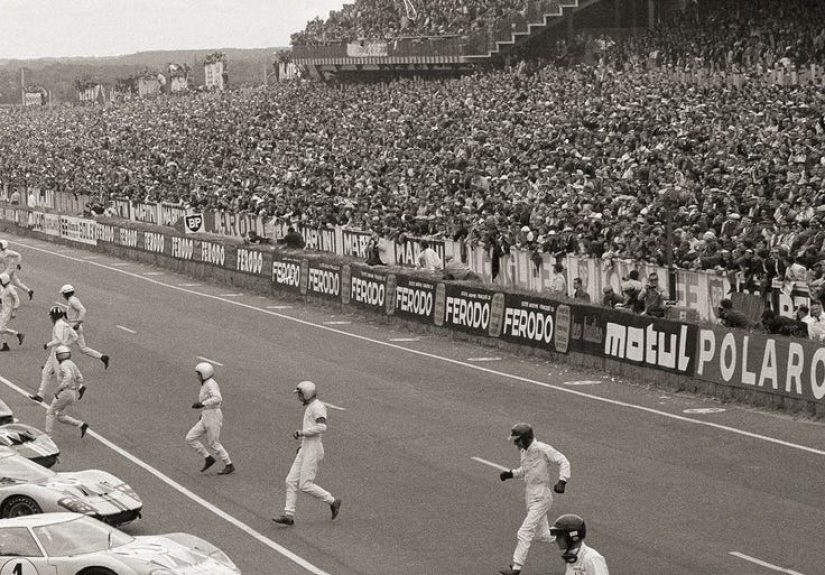
Le Mans is not a race that merely asks whether a car is quick. It asks whether a car, a team, and two drivers can remain fast, disciplined, and mechanically alive for 24 straight hours. In 1966, Ford arrived in force. Ferrari, still dangerous, did not have the same depth. As the race unfolded, the balance shifted toward Ford.
By the closing stages, Ken Miles and Denny Hulme were in a commanding position. Bruce McLaren and Chris Amon were also near the front in another Ford. A third Ford, driven by Ronnie Bucknum and Dick Hutcherson, remained in contention behind them. Ford was finally about to get what it had spent years chasing: not just a win, but domination.
Then came the decision that still shadows the story.
Ford management wanted a formation finish, a choreographed photo opportunity with multiple GT40s crossing together. It would be the perfect image of corporate triumph: a public declaration that Ferrari had not merely been beaten, but overwhelmed. In the film, this moment is framed as both dramatic and tragic, and that is close to the truth. It really was one of those rare cases where a publicity stunt changed sporting history.
The trouble was Le Mans did not simply award victory to whichever car appeared most poetic at the finish line. Because of the old starting procedure and grid positions, Bruce McLaren and Chris Amon had started farther back than Ken Miles and Denny Hulme. That meant that if the two leading Ford cars crossed together after completing the same number of laps, McLaren and Amon would be credited with covering slightly more total distance. And that is exactly what happened.
So, despite leading much of the race and appearing to have the faster road to victory, Miles did not get the official win. McLaren and Amon did. Ford took the top spots, Ferrari was defeated, and the company got its glorious headline. But Miles lost what would have been one of the greatest achievements in endurance racing: a Daytona-Sebring-Le Mans sweep in the same season.
Did the Movie Get the Finish Right?
Mostly, yes. The movie captures the heartbreak, the politics, and the sense that Ken Miles was denied a win he had effectively earned on pace and performance. It is less precise about every logistical detail, but emotionally it lands the punch. The ending works because the real event was already cinematic.
Where the film simplifies things is in turning individuals into cleaner heroes and villains. Leo Beebe, for example, is portrayed as a corporate antagonist with a personal dislike of Miles. In real life, the politics were more complicated. Beebe was involved in the controversial decision, and the formation finish absolutely shaped the outcome. But history tends to be muddier than movies. Decisions at that level usually involve branding concerns, team orders, risk management, and internal priorities all colliding at once.
That does not make the result feel any less cruel. It just means the truth is less comic-book neat.
What Else the Film Changes for Drama
Like most “based on a true story” movies, Ford v. Ferrari trims timelines, sharpens rivalries, and invents or compresses scenes to keep the story moving. That is not unusual. Two and a half hours can hold only so much gearbox engineering before general audiences start checking the snack bar clock.
The film exaggerates some boardroom confrontations, streamlines the development process, and heightens the personal conflict between racers and executives. It also presents certain races and incidents in ways that are cleaner, faster, and more emotionally direct than the historical record. But the movie’s major strengths remain anchored in reality: the Ford-Ferrari feud, Shelby’s leadership, Miles’s genius, the 1966 Le Mans showdown, and the controversial finish.
In that sense, the film does what good historical drama often does. It bends details while protecting the core truth. The core truth here is that Ford really did turn a bruised ego into a full-scale assault on Europe’s greatest endurance race, and Ken Miles really was central to making that assault work.
The Tragedy After the Triumph
If the Le Mans finish had been the end of the story, Ken Miles would still be remembered as one of the finest development drivers in racing history. But the story did not end there. Two months after Le Mans, Miles was killed while testing Ford’s next-generation race car at Riverside in Southern California.
That loss changed how the entire saga would be remembered. It froze Miles in motorsport history as both champion and what-if. He became the man who helped build the winning machine, came painfully close to a historic sweep, and died before the sport could give him another shot. The movie uses that tragedy carefully, and for once Hollywood did not need to overdo it. Reality had already done enough.
Why the True Story Still Resonates
The reason people keep returning to the true story of Ford v. Ferrari is not just because the cars were gorgeous or the speeds were absurd, though both things certainly help. It endures because the story contains a timeless tension. Who really wins in elite competition: the company, the team, or the individual? Is victory still victory when politics shape the finish? Can genius survive inside a corporation, or only despite it?
Ford got the result it wanted. Ferrari lost its streak. Shelby cemented his legend. The GT40 became immortal. Yet Ken Miles remains the emotional center of the story because he represents something purer than corporate revenge. He represents craft, feel, nerve, and the kind of brilliance that cannot be mass-produced. Ford built many cars. There was only one Ken Miles.
Experiences That Make This Story Hit Even Harder
One reason the Ford v. Ferrari story keeps finding new audiences is that it feels bigger once you connect it to real-world experiences. Watching the movie on a couch is fun. Hearing a V-8 rumble through your speakers while Christian Bale glowers at a car like it personally offended him is a pretty good evening. But the story gains weight when you visit a car museum, stand next to a GT40 replica, hear vintage racing footage, or walk through an exhibit filled with race reports, photographs, and hand-sketched engineering notes. Suddenly, this is not a movie about neat old cars. It is a story about human obsession.
Even reading about Le Mans changes the experience. On paper, “24 hours” sounds like a statistic. In your imagination, it becomes a test of darkness, fatigue, weather, heat, noise, and decision-making. You start to realize that the 1966 finish was not merely controversial because of a rule. It was controversial because it came after a full day of risk, labor, and physical punishment. That makes the final call feel heavier. A photo op at the end of a sprint is one thing. A photo op at the end of a 24-hour war is another entirely.
There is also a special pleasure in tracing the story backward. Many people discover Ford’s Le Mans victory through the movie, then stumble into the larger world around it: Carroll Shelby’s earlier Cobra campaigns, the Daytona Coupe’s Ferrari-beating success, the way Southern California hot-rodding culture fed international racing, and the uncomfortable truth that motorsport glory is usually built on equal parts genius and chaos. It is a rabbit hole with excellent engine notes.
For car fans, the experience can become almost tactile. You start noticing design cues, learning why the GT40 sat so low, why the Mk II needed so much development, and why drivers like Miles mattered so much before telemetry became a modern religion. You appreciate that he was not just quick. He could feel what the car wanted, what it hated, and what would fail if someone in management kept confusing speed with readiness.
For non-car fans, the appeal often comes from the human side. The story is about loyalty, ambition, and compromise. It is about a gifted worker inside a giant machine. That is relatable even if you could not tell a Ferrari 330 P3 from a toaster. Plenty of people know what it feels like to do the hard part, only to see the credit drift elsewhere under bright lights and official language.
And maybe that is why the true story lingers. It offers the thrill of victory without the comfort of a perfectly fair ending. It gives you speed, glory, and heartbreak in one package. You leave with admiration for Shelby, sympathy for Miles, and a renewed suspicion of any executive who says, “Let’s make this look good in the photo.”
That combination is rare. It is what turns a good racing story into a lasting legend. The real Ford v. Ferrari is not memorable because Ford won. It is memorable because the win came wrapped in engineering brilliance, bruised pride, and one of the most bittersweet finishes sports has ever produced.
Conclusion
The true story of Ford v. Ferrari is bigger than a movie and sharper than a myth. Yes, Ford set out to beat Ferrari after a failed acquisition. Yes, Carroll Shelby and Ken Miles were essential to making the GT40 a real Le Mans threat. Yes, Ford finally crushed Ferrari’s streak in 1966. But the story endures because it is not clean. It is thrilling, funny, frustrating, and tragic all at once. That is exactly why it still matters. It is not just a tale of horsepower. It is a story about pride, precision, politics, and the cruel little gap between crossing the line and being crowned the winner.