Table of Contents >> Show >> Hide
- What happened in the viral family blowup?
- Why so many readers sided with the mom-to-be
- When sibling jealousy grows up and gets mean
- Pregnancy changes the risk calculus
- Can forgiveness and boundaries exist at the same time?
- What this story says about family loyalty
- The bigger takeaway for anyone dealing with a jealous sibling
- Experiences that mirror this story in real life
- Conclusion
Some family drama is small enough to survive with a group text, a half-hearted apology, and maybe a pie. This was not that kind of family drama. In the viral story that sparked fierce debate online, a pregnant woman decided her sister would not be welcome near her baby after a chaotic holiday clash turned physical, ugly, and deeply personal. On the surface, it sounded like another messy sibling feud. Underneath, it was a much bigger story about jealousy, boundaries, pregnancy stress, family loyalty, and the moment a person realizes that protecting peace matters more than protecting appearances.
That is why the story resonated. It was never just about one explosive Thanksgiving. It was about what happens when lifelong resentment finally stops wearing a polite sweater and kicks the front door down. It was about the uncomfortable truth that not every family member earns unlimited access to your child simply because they share your DNA. And yes, it was also a reminder that some relatives mistake “forgive and forget” for “please continue accepting nonsense forever.”
What happened in the viral family blowup?
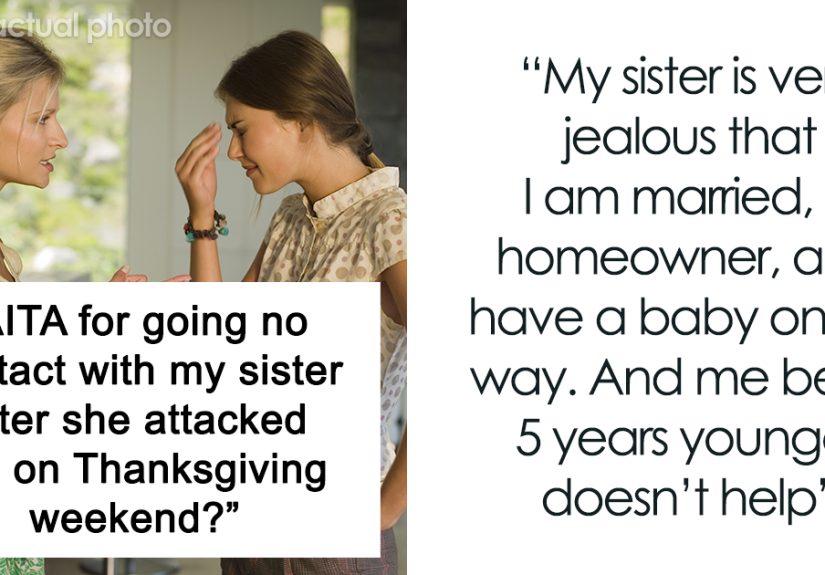
According to the woman’s account, tensions with her sister had been building long before the holiday disaster. The pregnant sister believed the other woman was intensely jealous of her marriage and pregnancy, and that bitterness showed up in tantrums, hostility, and increasingly aggressive behavior. During the Thanksgiving gathering, the conflict escalated beyond snark and side-eyes. The woman described her sister being all over her and forcing her to push her away more than once. That was the breaking point.
Afterward, the pregnant woman made a decision plenty of readers applauded: she cut contact and said her sister would not be near the baby. For many people, that sounded harsh. For others, it sounded like common sense wearing maternity jeans. When a relative has already crossed physical and emotional lines, parenthood changes the equation. The question stops being, “Am I overreacting?” and becomes, “Why would I gamble with my child’s safety and my own sanity?”
The later twist made the story even more human. In an update, the woman said she and her sister had become civil again, but only with firm limits. Her sister was not allowed at the house. The couple stayed in a hotel if the sister hosted. She did not attend family events without her husband and kept her own transportation so she could leave early if needed. That detail matters. Reconciliation, when it happens, does not always look like hugs, happy tears, and matching holiday pajamas. Sometimes it looks like boundaries, exits, and a full tank of gas.
Why so many readers sided with the mom-to-be
Online audiences are not exactly famous for restraint, but the strong reaction to this story came from something real: many people recognized that the pregnant woman was not punishing her sister for having feelings. She was responding to behavior. Jealousy by itself is human. Acting on it through intimidation, cruelty, or aggression is something else entirely.
That distinction matters in families, especially between siblings. A sister can feel left behind, overlooked, unmarried, lonely, resentful, or emotionally raw. Those feelings may deserve empathy. They do not deserve a free pass. Hurt explains behavior; it does not excuse it. The pregnant woman was not banning her sister from the baby because her sister felt insecure. She was drawing a line because insecurity had turned into harm.
Readers also understood something parents learn fast: access to a newborn is a privilege, not a birthright. Families often treat babies like community property with cheeks. But new parents are allowed to decide who visits, who holds the baby, who gets trusted, and who gets a polite but firm no. If a person cannot regulate themselves around the parent, there is no reason to assume they will magically become a safe, soothing presence around the child.
When sibling jealousy grows up and gets mean
Sibling jealousy is often talked about like a childhood phase involving toys, bedrooms, and who got the bigger slice of cake. Adult sibling jealousy is far trickier. It can attach itself to milestones: marriage, pregnancy, financial stability, a loving partner, a better relationship with parents, or simply the feeling that one sibling is moving forward while the other is stuck in place.
That is part of what makes stories like this so compelling. They are not really about one insult or one drunken outburst. They are about years of comparison. The sister in this case seemed to view the pregnancy not as happy news, but as proof that someone else had won a race she felt she was losing. And that is where envy gets dangerous. It stops being private pain and becomes a public performance. Suddenly every family dinner becomes a scoreboard, every holiday becomes a battlefield, and every good thing in one person’s life becomes evidence in someone else’s case for resentment.
Adult sibling rivalry can also get supercharged by old family dynamics. Maybe one child was seen as the dependable one, the pretty one, the troubled one, the favorite one, the one who always needed rescuing, or the one who never got enough. Those roles do not vanish just because everyone starts paying taxes. In fact, they often get louder. Add alcohol, unresolved trauma, family pressure, and a holiday gathering where everyone is pretending to be normal for six straight hours, and you have the emotional equivalent of a gas leak near a candle.
Pregnancy changes the risk calculus
One reason this story hit such a nerve is that pregnancy makes conflict feel higher stakes, because it is. Expecting a baby is not just an emotional season; it is a physical and mental one. Stress, anxiety, poor sleep, and ongoing conflict do not exist in neat little boxes. They affect mood, energy, decision-making, and a person’s sense of safety. That does not mean every argument endangers a pregnancy. It does mean that pregnant women are not being dramatic when they want less chaos and more calm.
It also means that physical aggression should never be minimized as “just family stuff.” Families are weirdly talented at doing this. The same people who would be horrified if a stranger shoved a pregnant woman will sometimes describe a relative’s behavior as “she was just emotional” or “that’s how sisters are.” No. Pregnancy is not the moment to normalize intimidation, grabbing, crowding, screaming, or cornering. If anything, it is the moment to treat those behaviors with even more seriousness.
Then comes the newborn stage, when parents are sleep-deprived, protective, and trying to build a stable environment. This is where the woman’s decision makes even more sense. If a sister has already shown volatility, jealousy, and poor impulse control, the postpartum period is not the time to test whether she can suddenly be trusted. Newborn boundaries are about emotional safety as much as physical safety. Parents do not need extra tension walking through the front door wrapped in a blanket and asking to hold the baby.
Can forgiveness and boundaries exist at the same time?
This story became more interesting after the update because the woman did not stay in permanent no-contact mode. Instead, she created a controlled version of peace. That is a useful lesson for anyone dealing with difficult relatives: boundaries are not always the opposite of love. Sometimes they are the only form of love that does not destroy you.
People often talk about forgiveness as if it requires instant trust. It does not. You can forgive someone and still refuse to hand them your house key, your emotional stability, or your baby. You can hope for healing and still insist on consequences. You can accept that a sibling has pain, history, trauma, or substance issues and still say, “You do not get unrestricted access to me while this remains unresolved.”
That may be the most mature part of the entire story. The woman did not turn reconciliation into denial. She did not say, “Everything is fine now.” She said, in effect, “We can be civil, but we are not going back to pretending this never happened.” That is not cold. That is emotionally literate.
What this story says about family loyalty
There is a particular kind of guilt that shows up in family conflict, especially when children enter the picture. It whispers that being a good daughter, sister, or parent means keeping everyone close no matter what. But healthy family loyalty is not blind loyalty. It is not letting unstable people bulldoze your peace because the calendar says Thanksgiving and the group photo would look nicer that way.
Real loyalty protects the vulnerable. In this case, the vulnerable person was not the loudest one in the room. It was the pregnant woman trying to stay safe and sane. Later, it was the newborn. Families that pressure new parents to ignore serious harm in the name of harmony are not protecting harmony. They are protecting denial.
The story also raises a question many adults eventually face: what do you do when someone you love is clearly struggling but refuses help? The woman’s update suggested her sister had unresolved trauma and possible substance issues. That adds sadness, not permission. You can care deeply about someone and still refuse to be collateral damage. Compassion without boundaries becomes self-abandonment in a hurry.
The bigger takeaway for anyone dealing with a jealous sibling
If this story struck a nerve, it is probably because it touches a common but rarely admitted truth: some sibling relationships are loving, and some are lifelong negotiations with chaos. When jealousy, anger, and comparison turn a family bond into a source of dread, the goal is not to win the argument. The goal is to protect your peace.
That may mean limiting contact. It may mean never being alone with that person. It may mean declining invitations, leaving early, or making sure your partner is always with you. It may mean therapy, mediation, or a long break. And in some cases, it may mean saying no to access to your child until trust is rebuilt through real behavior, not sentimental speeches.
It is tempting to want a prettier ending. We like family stories that end with tears, apologies, casseroles, and maybe a baby photo on the fridge. Real life is often less cinematic and more practical. Sometimes the healthiest ending is not full reunion. Sometimes it is managed distance, reduced chaos, and fewer opportunities for disaster. Not glamorous, but very effective.
Experiences that mirror this story in real life
Plenty of people will read this headline and think, This is extreme. Plenty of others will read it and think, Oh wow, that is basically my family, minus the mashed potatoes. That second reaction is part of why this kind of story travels so fast. It does not feel random. It feels familiar.
One common version of this experience happens when one sibling reaches a major life milestone first. The engagement, the wedding, the pregnancy, the first home, the baby announcement, the perfect holiday card. The sibling who is struggling may genuinely feel happy for them for about six and a half minutes. Then the grief arrives. Maybe it is grief over a breakup, infertility, financial problems, loneliness, or simply the sense that life is not unfolding the way they imagined. If that pain is processed honestly, the relationship can survive. If it gets converted into bitterness, every celebration becomes a trigger.
Another common pattern is the family system that quietly rewards bad behavior. Everyone knows who the explosive sibling is. Everyone knows who ruins holidays, who drinks too much, who lashes out, who says the unforgivable thing and then expects everyone to move on before dessert. But instead of confronting that person, the family pressures the calmer sibling to be flexible, mature, forgiving, understanding, and gracious. Conveniently, “gracious” usually means “please absorb this damage so the rest of us do not have to deal with it.”
People also relate to the postpartum side of this story. Many new parents say the baby did not create boundaries so much as reveal which boundaries were always needed. The arrival of a child forces clarity. The relative who thrives on drama does not suddenly become less dramatic because there is a bassinet in the room. The person who ignores your comfort does not become respectful because they bought a cute onesie. In fact, a baby can make unhealthy family dynamics more obvious, because parents start asking a simple question: Would I want my child around this behavior? Once the answer is no, it becomes hard to justify staying in it yourself.
There is also the experience of partial reconciliation, which this story captured surprisingly well. In real life, many families never get a neat resolution. The difficult sibling may never fully apologize. They may minimize what happened, blame alcohol, blame stress, blame childhood, blame everybody, or claim they do not even remember. And yet some families still find a way to continue, just not in the old carefree way. They meet in public places. They keep visits short. They avoid staying overnight. They do not discuss sensitive topics. They leave the second things feel off. It is not the same relationship, but it can be a livable one.
That reality may not be heartwarming, but it is honest. For many people, healing does not mean full restoration. It means learning how to stop handing the most unstable person in the family the steering wheel.
Conclusion
The reason this story landed so hard is simple: it was never just gossip. It was a case study in what happens when jealousy collides with pregnancy, when family pressure collides with personal safety, and when a woman decides that becoming a mother also means becoming a gatekeeper. The pregnant woman’s refusal to let her sister near the baby was not petty. It was protective.
And maybe that is the real headline beneath the headline. Family love is meaningful, but it is not a hall pass. Boundaries are not cruelty. Distance is not betrayal. And when someone has already turned their pain into your problem, you are allowed to stop volunteering as the target. Even if they are your sister. Especially if you are holding a child.