Table of Contents >> Show >> Hide
- What Is Meditation, Really?
- Benefits of Meditation for Beginners
- How to Meditate for Beginners: Step by Step
- Best Beginner Meditation Tips
- Common Beginner Mistakes to Avoid
- What If Meditation Feels Hard?
- A Simple 5-Minute Meditation Script for Beginners
- Conclusion
- Beginner Experiences: What Meditation Often Feels Like in Real Life
Meditation has a funny reputation. Some people picture a monk on a mountaintop. Others imagine someone whispering “om” while ignoring 47 unread emails, two barking dogs, and the smoke detector that only chirps at 2 a.m. But real meditation for beginners is much less dramatic and much more doable. In most cases, it is simply the practice of paying attention on purpose.
If you can breathe, notice that you are breathing, get distracted by your grocery list, and then notice that too, congratulations: you already understand the basic plot of meditation. The goal is not to become a thoughtless statue. The goal is to build a healthier relationship with your thoughts, stress, and attention.
For beginners, meditation can feel awkward at first. That is normal. Your brain is not “bad at meditating” because it wanders. Your brain is doing what brains do. Meditation is the part where you gently come back. Again and again. No gold medal, no incense requirement, no need to pretend you instantly became a peaceful woodland wizard.
In this guide, you will learn what meditation is, why beginners often struggle with it, how to start a simple practice, what benefits may come with consistency, and what common experiences you may notice along the way.
What Is Meditation, Really?
Meditation is a mental practice that trains attention and awareness. In beginner-friendly terms, it means choosing one point of focus, such as your breath, sounds in the room, body sensations, or a repeated phrase, and returning to it whenever your mind drifts.
That drift is not failure. It is the workout. Think of meditation like a push-up for attention. Each time your mind runs off to plan dinner, replay an awkward text message from 2019, or invent a totally unnecessary argument, you notice it and come back. That “come back” moment is the rep.
There are many styles of meditation, but beginners usually do best with simple, accessible formats:
1. Breath meditation
You focus on the sensation of breathing in and out. This is often the easiest place to start because your breath is always available, free of charge, and mercifully portable.
2. Mindfulness meditation
You observe thoughts, emotions, sensations, and sounds without judging them. Instead of trying to erase what is happening, you notice it with curiosity.
3. Body scan meditation
You move your attention through the body, usually from head to toe or toe to head, noticing tension, warmth, pressure, or discomfort.
4. Guided meditation
You listen to a teacher, app, or recording that walks you through the process. This can be especially helpful if silence makes your brain start hosting a chaotic talent show.
5. Walking meditation
You meditate while moving slowly and paying attention to each step, breath, and sensation. Great for people who would rather not sit still like a decorative pillow.
Benefits of Meditation for Beginners
Meditation is not magic, but it can be genuinely useful. When practiced consistently, it may support both mental and physical well-being. The important word here is consistently. One five-minute session will not transform you into the calmest person in the zip code, but regular practice may create noticeable change over time.
Less stress, more breathing room
One of the biggest reasons people try meditation is stress. Meditation may help calm the body and mind by teaching you to pause, breathe, and step out of autopilot. Instead of immediately reacting to every stressor, you learn to notice it first. That little gap between stimulus and reaction can be surprisingly powerful.
Better emotional awareness
Meditation does not eliminate emotions. It helps you notice them before they grab the steering wheel. For beginners, this can look like recognizing, “Oh, I am irritated,” before snapping at a coworker, family member, or innocent toaster.
Improved focus and concentration
Modern life is basically a distraction buffet. Meditation gives your attention a place to practice staying put. Over time, some beginners notice they can focus longer, return to tasks more easily, and get less dragged around by every notification and random thought.
Support for sleep and relaxation
Meditation is not a sleeping pill, but it may help some people unwind before bed. Breathing exercises, body scans, and guided relaxation can make it easier to settle down, especially if your mind likes to start writing dramatic screenplays at midnight.
A healthier relationship with discomfort
Whether the discomfort is emotional stress, mental chatter, or physical tension, meditation can help you notice it without immediately resisting it. That does not mean enjoying every unpleasant sensation like some kind of enlightened superhero. It means learning that not every uncomfortable moment needs panic, judgment, or a full internal monologue.
How to Meditate for Beginners: Step by Step
Here is a simple meditation routine that almost anyone can try. No fancy gear needed. A chair, a couch, a bed edge, a patch of floor, or even a parked car can work.
Step 1: Pick a realistic time
Start with 3 to 5 minutes. Yes, really. Beginners often make the classic mistake of aiming for 30 minutes on day one and then never trying again. Tiny sessions build consistency. Consistency beats ambition that disappears by Thursday.
Step 2: Get comfortable, not theatrical
Sit in a position that feels steady and relaxed. You do not need to fold yourself into a human pretzel. Keep your spine comfortably upright if possible, but not stiff like you are auditioning for “Person Trying Too Hard.” You can also lie down, stand, or walk if that feels better.
Step 3: Choose your anchor
Your anchor is the thing you return your attention to. For most beginners, the breath is best. Notice the air moving at your nose, chest, or belly. If breathing feels frustrating, use sounds, a simple phrase, or the feeling of your feet on the floor.
Step 4: Notice what happens
You will breathe. Then think. Then remember an email. Then wonder if you are doing it wrong. Then maybe itch your forehead. This is all normal. The practice is simply to notice what happened and return to your anchor.
Step 5: Be kind when your mind wanders
This part matters. Beginners often respond to distraction with instant self-criticism. Try replacing “Ugh, I am terrible at this” with “There goes my mind again.” The tone you use with yourself during meditation is part of the practice.
Step 6: End gently
When your timer ends, do not launch out of meditation like you were ejected from a spaceship. Take a breath. Notice how you feel. Open your eyes if they were closed. Let the practice end on purpose.
Best Beginner Meditation Tips
Keep it short enough to repeat
The best meditation length for beginners is the one you will actually do tomorrow. Three minutes daily is more useful than twenty minutes once every lunar eclipse.
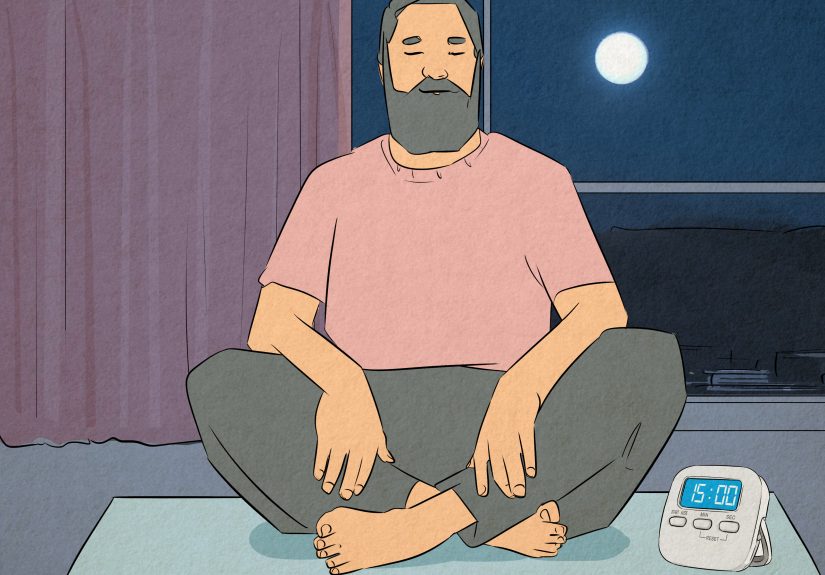
Use a timer
A timer prevents the old “Surely that was ten minutes” moment when it has actually been forty-two seconds.
Try guided sessions first
If silence feels intimidating, guided meditation can be a huge help. It gives your attention gentle instructions and keeps you from feeling like you are alone with a microphone and a thousand thoughts.
Link meditation to an existing habit
Meditate right after brushing your teeth, before checking email, after lunch, or before bed. Habit stacking makes consistency easier because you are not relying on motivation alone.
Do not chase a special feeling
Some days meditation feels peaceful. Other days it feels like sitting next to a leaf blower made of thoughts. Both count. A “good” meditation session is not one that feels blissful. It is one you completed.
Try eyes open if needed
Closing your eyes works for some people, but not everyone. If it makes you anxious, sleepy, or extra distracted, keep your eyes softly open and focus on a spot in front of you.
Use movement if sitting still feels miserable
Walking meditation, gentle stretching, or mindful breathing during a slow walk can make meditation more approachable.
Common Beginner Mistakes to Avoid
Thinking meditation means “empty your mind”
This is probably the most common misunderstanding. Minds produce thoughts. That is their whole thing. Meditation is learning not to get dragged behind every thought like a water-skier on a speedboat.
Judging yourself constantly
If your meditation is filled with thoughts, congratulations again: you are meditating with a human brain. Notice the judgment and come back.
Trying to force relaxation
Ironically, trying very hard to relax can make you feel more tense. Let the practice be about noticing, not controlling every internal experience.
Expecting overnight transformation
Meditation usually works more like exercise than like a switch. The effects tend to build gradually. Think more “steady training,” less “instant life makeover montage.”
What If Meditation Feels Hard?
For many beginners, meditation feels hard because slowing down reveals how busy the mind already is. That can be uncomfortable. Some people feel restless, bored, sleepy, emotional, or even irritated. None of that automatically means you should quit.
Instead, make the practice easier. Shorten the session. Use guided audio. Keep your eyes open. Try walking meditation. Focus on sounds instead of the breath. Sit in a chair instead of the floor. The goal is not to win an imaginary meditation competition. The goal is to build a practice you can live with.
If meditation consistently increases distress or brings up overwhelming emotions, it may help to pause and talk with a licensed mental health professional. Meditation can support wellness, but it is not the only tool, and it is not the right fit in the same way for every person.
A Simple 5-Minute Meditation Script for Beginners
Here is a beginner meditation you can use right away:
Minute 1: Sit comfortably and notice your posture. Relax your shoulders. Let your hands rest.
Minute 2: Bring attention to your breath. Notice the inhale and the exhale without changing them.
Minute 3: When thoughts appear, silently say “thinking” and return to the breath.
Minute 4: Notice any body sensations, such as tension in the jaw, chest, or belly. Let them be there without fighting them.
Minute 5: Take one fuller breath. Notice how you feel. Open your eyes and continue your day like the slightly more grounded legend you are.
Conclusion
Learning how to meditate for beginners is less about doing something perfectly and more about showing up with patience. You do not need a silent cabin, a perfect schedule, or a personality transplant. You need a few minutes, a little curiosity, and the willingness to begin again when your mind wanders.
Meditation can support stress relief, emotional awareness, focus, and a stronger sense of presence, but its biggest gift may be something simpler: it teaches you how to pause. In a world that constantly asks for more speed, more noise, and more reaction, that pause is not small. It is powerful.
So start tiny. Sit down. Breathe in. Breathe out. Get distracted. Come back. That is not a failed meditation. That is meditation.
Beginner Experiences: What Meditation Often Feels Like in Real Life
When beginners first try meditation, they often expect one of two things: instant serenity or total nonsense. The truth is usually somewhere in the middle, with a side of “Wow, I really do think a lot.” That realization alone can be eye-opening.
One common beginner experience is restlessness. You sit down for what seems like a respectable amount of time, only to discover it has been two minutes and your left foot suddenly has a dramatic opinion about everything. You may feel like moving, scratching, stretching, checking your phone, or rearranging your life. This is normal. Stillness can reveal how accustomed you are to constant stimulation.
Another common experience is mental noise. Beginners often say, “Meditation made my mind busier.” Usually, meditation did not make the mind busier; it simply made the noise easier to notice. Thoughts that were already running in the background suddenly step into the spotlight. Grocery lists, old conversations, future worries, random song lyrics, and one weird memory from middle school all make surprise appearances. It can feel messy, but it is also the beginning of awareness.
Some people notice emotional shifts. A short meditation may leave you calmer, lighter, or more patient. On other days, it may bring up sadness, frustration, or fatigue you had been ignoring. That does not mean meditation is broken. It may mean you are finally slowing down long enough to hear what your mind and body have been trying to say.
Beginners also frequently report small, practical wins. You may not float off your chair in a beam of enlightenment, but you might pause before reacting during an argument. You might catch yourself stress-eating out of boredom. You might notice your shoulders are living near your ears and decide to lower them. These tiny moments often matter more than dramatic meditation myths.
There is also the experience of inconsistency. One session feels peaceful. The next feels like wrestling an octopus made of thoughts. That is part of the process. Meditation is not a straight line. Some days your attention is steadier. Some days your brain behaves like it drank six espressos and enrolled in chaos school. Both kinds of days count.
Over time, many beginners find that the practice becomes less mysterious and more familiar. The breath feels easier to return to. The timer feels less annoying. The wandering mind becomes less of an enemy and more of a pattern you understand. You start to see that meditation is not about becoming a different person. It is about getting to know your current self with a little more patience, humor, and honesty.