Table of Contents >> Show >> Hide
- What “$200” Really Means (And How to Actually Hit It)
- The $200-Friendly Design: Small Barrel Vault on a Block Stand
- Materials List + Cost Map (How You Keep It Near $200)
- Tools You’ll Actually Use
- Step-by-Step Build
- Step 1: Pick a safe, sane location
- Step 2: Build the stand (fast, sturdy, cheap)
- Step 3: Add insulation under the cooking floor (your heat-retention “secret sauce”)
- Step 4: Lay the firebrick cooking floor (smooth = happy pizza)
- Step 5: Make a simple arch form (the “vault” template)
- Step 6: Build the barrel vault (inner oven)
- Step 7: Optional (but nice): Add a simple vent or short flue
- Step 8: Insulate the dome/vault (heat stays in, money stays in your wallet)
- Step 9: Add a weather shell (because rain loves ruining your dreams)
- Curing: The Unsexy Step That Saves Your Oven
- How to Fire It for Pizza (Without Turning the Crust Into a Historic Artifact)
- Pizza Workflow: The Fastest Way to Look Like a Pro
- Troubleshooting (Because Pizza Ovens Have Personalities)
- Safety Basics (The Part You’ll Be Glad You Read)
- Conclusion: The $200 Oven That Actually Delivers
- Experience Notes: What It’s Like Building (and Living With) a $200 DIY Wood Fired Pizza Oven
A wood-fired pizza oven in your backyard is basically a cheat code for happiness: crackling fire, blistered crust, and the kind of party trick that makes your friends say, “Wait… you built that?” The problem is most DIY builds drift from “budget-friendly” to “why is my credit card smoking?” So let’s do this the fun way: a compact, legit wood-fired pizza oven that can land around $200 if you shop smart, scavenge a little, and keep the design efficient.
This guide is written for standard American DIYers with standard American tools (a drill, a level, and optimism). It’s also built for real life: the “I want pizza oven performance without pouring a concrete monument” crowd.
What “$200” Really Means (And How to Actually Hit It)
If you buy everything new at big-box retail, a true firebrick-and-refractory build often lands closer to $250–$450 depending on your size and finish. The $200 target becomes realistic when you:
- Build smaller (a 12-inch pizza oven beats a 16-inch “pizzeria beast” on budget).
- Dry-stack where you can (use mortar only where heat demands it).
- Scavenge (free concrete blocks, leftover pavers, scrap angle iron, used chimney pipe).
- Spend money where heat is brutal: the cooking floor, inner dome, and hot-face mortar.
- Use budget insulation (vermiculite/perlite mixes) instead of premium blanket/board.
The $200-Friendly Design: Small Barrel Vault on a Block Stand
The most cost-effective “real oven” shape for DIY is a compact barrel vault (arched tunnel). It uses fewer specialty cuts than a perfect dome, can be built with a simple plywood arch form, and heats fast. Target an internal cooking area that comfortably fits a 12-inch pizza with turning room.
Suggested dimensions (budget sweet spot)
- Internal width: 16–18 inches
- Internal depth: 24–28 inches
- Internal height: ~10–12 inches at the crown
- Door height: roughly 60–65% of internal height (helps draft and heat retention)
Materials List + Cost Map (How You Keep It Near $200)
Costs vary by region, season, and whether the DIY gods bless you with free materials from someone’s patio project. Use this as a planning template.
Core materials (the “don’t cheap out too hard” list)
- Concrete blocks (cinder blocks) for the stand: 16–24 blocks (often cheap, sometimes free).
- Pavers or a top slab for the stand: 2–4 large concrete pavers, or a small poured slab.
- Firebrick for the cooking floor and inner vault (plan ~35–55 bricks for a small oven).
- Refractory mortar for hot-face joints (one small bag may be enough for a compact build).
- Vermiculite or perlite + Portland cement for insulation (base + outer shell).
- Stucco/render mix (or sand/cement/lime) for weather shell.
Budget hacks (legit ones)
- Check local surplus and salvage: masonry leftovers, broken pavers, partial firebrick lots. A “my project is done, please take this” listing is your best friend.
- Use standard brick outside the heat (stand, decorative arch, outer enclosure).
- Skip a fancy chimney at first; add a short flue later if you find used pipe.
Sample budget (one realistic way to hit ~$200)
| Item | Target cost | How to keep it low |
|---|---|---|
| Concrete blocks + pavers | $0–$60 | Marketplace/curb finds; reuse old pavers |
| Firebrick (35–55) | $70–$140 | Buy smaller quantity; look for partial pallets |
| Refractory mortar | $20–$60 | Smallest bag that works; keep joints thin |
| Vermiculite/perlite + cement | $25–$50 | One bag of aggregate + small cement bag |
| Stucco/render + wire | $15–$40 | Basic stucco mix; chicken wire offcuts |
| Total (typical) | $155–$290 | Scavenge 1–2 categories to hit ~$200 |
Tools You’ll Actually Use
- Level, tape measure, pencil/marker
- Rubber mallet
- Trowel (and a bucket for mixing)
- Angle grinder with masonry blade (or a brick set + patience)
- Drill/driver (helpful for the arch form)
- Gloves, dust mask, safety glasses
Step-by-Step Build
Step 1: Pick a safe, sane location
You’re building a fire-breathing pizza dragon. Give it space. Set up on level ground, non-combustible surface (gravel, pavers, concrete), and away from anything that can burn. Also: check local rules and burn bans.
Step 2: Build the stand (fast, sturdy, cheap)
Dry-stack your concrete blocks into a U-shape or rectangle so you have wood storage underneath. Aim for a working height that doesn’t destroy your backusually a cooking floor around 40–44 inches from the ground feels good.
- Stack blocks in a staggered pattern (like brickwork).
- Check level side-to-side and front-to-back as you go.
- Top with large concrete pavers (or a small slab) to create a flat platform.
Step 3: Add insulation under the cooking floor (your heat-retention “secret sauce”)
This is where many budget builds fail: they make a beautiful oven that also heats the entire planet under it. You want insulation under the floor so the firebrick gets screaming hot without bleeding heat into the stand.
A budget-friendly method is a vermiculite/perlite concrete (“vermicrete/perlicrete”) layer. Mix lightweight aggregate with cement and water until it holds shape but isn’t soupy.
- Thickness: 2–4 inches is a solid DIY range for a small oven.
- Tip: Let it dry thoroughly. It holds water like a sponge and water hates being trapped under firebrick.
Step 4: Lay the firebrick cooking floor (smooth = happy pizza)
Lay your firebricks tightly together in a rectangular floor. Avoid thick mortar joints in the floorpizza peels find bumps like it’s their job. You can set the floor dry (preferred) so individual bricks can be replaced later.
- Tap bricks level with a rubber mallet.
- Check for lip edges; grind or swap bricks if needed.
- Keep the floor as smooth as possibleyour launch will thank you.
Step 5: Make a simple arch form (the “vault” template)
Cut two identical arch ribs from plywood for the inner vault shape and connect them with scrap strips. You’ve now created a removable form to support bricks while you build the arch. Keep it simple: this isn’t a cathedral; it’s a pizza tunnel.
Step 6: Build the barrel vault (inner oven)
Use firebrick for the hot face (the inside of the oven). Butter joints with refractory mortar. Keep joints thinthin joints mean less shrinkage, fewer cracks, and better heat behavior.
- Back wall: Stand bricks for the rear wall and tie it into the side walls.
- Side walls: Build up to the spring line (where the arch starts).
- Arch/vault: Set bricks over the form, alternating sides to keep things balanced.
- Front opening: Create an entry arch; keep it wide enough for turning pizzas comfortably.
Important: Don’t use standard red clay bricks in the hot face. They aren’t designed for repeated high-heat cycles and can crack or spall. Use firebrick where flame and peak heat will live.
Step 7: Optional (but nice): Add a simple vent or short flue
A chimney helps smoke exit forward and up, rather than into your face like a rude campfire. For a budget build, keep it basic:
- Build a small “smoke chamber” just outside the oven mouth.
- Add a short section of used stovepipe or a small clay flue liner if you can source one cheaply.
- If you skip it, the oven can still cook great pizzajust expect more smoke management early on.
Step 8: Insulate the dome/vault (heat stays in, money stays in your wallet)
Two common insulation paths:
- Premium: ceramic fiber blanket/board (excellent performance, often pricier).
- Budget: vermiculite/perlite insulating layers around the vault (effective, bulky, slower to dry).
For the $200 goal, you’ll likely use the budget method: build a 2–4 inch insulating shell around the vault using vermicrete/perlicrete. This isn’t just “extra”it’s the difference between pizza in 90 seconds and pizza in “eventually.”
Step 9: Add a weather shell (because rain loves ruining your dreams)
Once insulation is dry, wrap the exterior with chicken wire or mesh, then apply a stucco/render coat. This protects insulation from weather and gives the oven a clean finish.
- Do a base coat, let it firm up, then a finish coat.
- Slope surfaces so water runs off.
- Consider a simple roof cover if your climate is wetwater is the long-term villain.
Curing: The Unsexy Step That Saves Your Oven
Masonry holds moisture. Fire turns moisture into steam. Steam expands. Expansion creates cracks. So curing is basically “slowly convincing your oven not to explode emotionally.”
- Air dry first: give it several days if possible (more if humidity is high).
- Small fires: start with small kindling fires, gradually increasing heat over multiple sessions.
- Watch the oven: you may see damp spots; keep curing until the outside stays dry.
How to Fire It for Pizza (Without Turning the Crust Into a Historic Artifact)
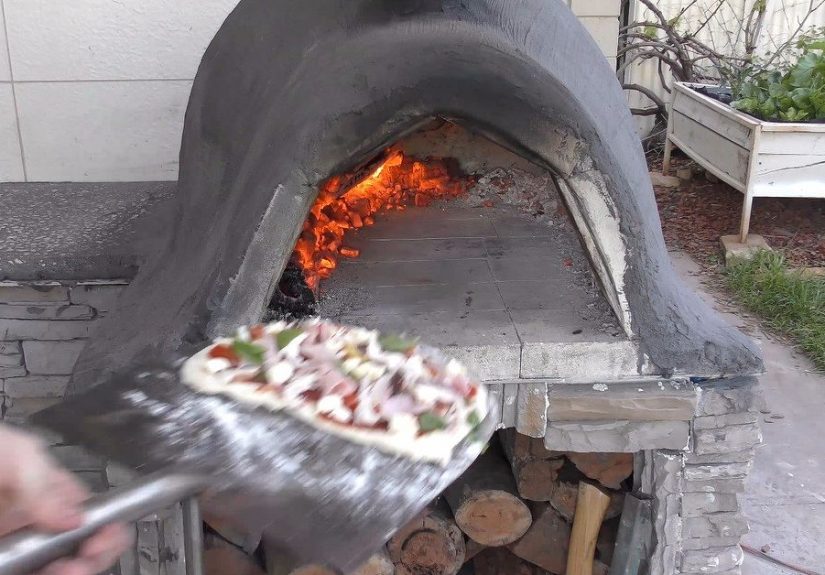
Wood-fired pizza is a dance between floor heat and dome heat. Your goal is a hot floor (for crisp bottom) and a hot dome (for fast top browning).
- Start the fire in the center to heat the floor, then push it to the side.
- Preheat time varies by mass and insulation; small insulated ovens can heat faster than heavy, uninsulated ones.
- Use dry, seasoned hardwood for cleaner burn and better heat control.
What “ready” looks like
- Floor is hot enough that flour browns quickly, not instantly incinerates.
- Dome interior starts to look “cleaner” as soot burns off in hotter areas.
- You can maintain flame while cooking (live flame = top heat).
Pizza Workflow: The Fastest Way to Look Like a Pro
- Prep a launch zone: light dusting of flour/semolina on peel.
- Launch fast: hesitation is how pizzas become calzones against their will.
- Turn often: rotate every 15–25 seconds in smaller ovens.
- Mind the flame: if the top is pale, feed the fire; if the bottom is dark, cool the floor with a brief mop or shift cooking spot.
Troubleshooting (Because Pizza Ovens Have Personalities)
Problem: Bottom burns before the top is done
- Floor is too hot relative to dome.
- Keep a livelier flame for more top heat.
- Cook slightly farther from the coal bed and rotate faster.
Problem: Oven won’t get hot enough
- Insulation may be too thin (or still damp).
- Wood may be wet/green.
- Airflow may be restrictedconsider a better front opening or adding a simple vent/flue.
Problem: Cracks in stucco
- Hairline cracks are common from heat cycling.
- Seal and patch to keep water out; water intrusion causes bigger problems than cosmetic cracking.
Safety Basics (The Part You’ll Be Glad You Read)
- Clearance matters: keep distance from structures, fences, and anything combustible.
- Have extinguishing tools nearby: hose, bucket, extinguisher, or sand.
- Mind wind and burn bans: don’t fire on high-wind days or restricted days.
- Keep kids/pets back: establish a “no-go zone” around the oven.
- Use proper fuels: clean, seasoned woodno trash, no treated lumber, no mystery scraps.
Conclusion: The $200 Oven That Actually Delivers
A DIY wood fired pizza oven for $200 is totally possible when you build compact, insulate smart, and scavenge like a responsible raccoon. Keep firebrick and refractory mortar in the hot zone, use vermiculite/perlite mixes for budget insulation, and protect everything from weather.
The payoff is huge: crackling fires, blistered crust, and a backyard centerpiece that makes every cookout feel like a tiny vacation. And if your first pizza comes out shaped like a state you’ve never visited? Congratulations. You’re officially a wood-fired pizza person now.
Experience Notes: What It’s Like Building (and Living With) a $200 DIY Wood Fired Pizza Oven
The first “experience” I had with a budget oven build wasn’t pizza. It was shoppingand yes, that counts as cardio if you’ve ever sprinted to grab “free pavers” before someone else does. The $200 target changes your mindset: you stop thinking like a contractor and start thinking like a resourceful backyard wizard. Every leftover brick becomes a possibility. Every cracked paver becomes “character.” And every friend who renovated a patio becomes a person you text with suspicious enthusiasm.
Building the stand is the confidence phase. Stacking blocks feels productive, fast, and strangely calminglike grown-up LEGO, but heavier and more likely to pinch your fingers. The first real lesson shows up when you try to level everything. “Close enough” is a lie your oven will punish. If the platform is out of level, your cooking floor gets weird, your arch form shifts, and your brick layout starts improvising. The good news: leveling takes patience, not money. The best tool is still a level, followed closely by stubbornness.
The insulation step is where budget builds become either brilliant or heartbreak. Vermicrete/perlicrete is cheap, but it dries slowly, and impatience is expensive. If you rush and trap moisture under the floor or inside the shell, your first hot fire will try to turn that moisture into steam… and steam does not negotiate. The win is giving the oven time: letting it air dry, doing gradual curing fires, and accepting that the oven needs a “warm-up relationship” before it becomes a high-heat soulmate.
Cooking day is where the oven starts talking backin a good way. The learning curve is real. Your first session often produces one pizza that’s perfect, one that’s “still great,” and one that looks like it lost a fight with a dragon. The trick is understanding heat zones: the spot right next to the fire browns tops fast, while the cooler side gives you more control. Turning becomes a rhythm, and suddenly you’re rotating pies like you’ve been doing it for years. The best surprise is how quickly a small, insulated oven can get into the pizza zone compared to a big, heavy, under-insulated build.
Long-term, the experience is mostly joy with a side of maintenance. A budget stucco shell will eventually show hairline cracks. That’s not failure; it’s physics. Heat cycles expand and contract everything. The real enemy is water. If rain finds its way into your insulation layer, performance drops and freeze/thaw can do real damage. The “grown-up” move is sealing cracks, keeping a simple cover on the oven in wet months, and treating the oven like the outdoor appliance it is.
The biggest payoff isn’t even the pizza (though yes, the pizza is absurdly good). It’s the way a wood-fired oven changes gatherings. People drift toward it. Conversations happen next to the fire. Someone always wants to try launching a pizza. Someone always says, “We should do this every weekend,” and sometimes you actually do. For about $200 and some weekend effort, that’s a ridiculous return on investmentespecially if you measure ROI in smiles per slice.