Table of Contents >> Show >> Hide
- Why the Xerox Alto Still Matters
- The Failure: A Historic Computer Goes Quiet
- What Is Electromigration?
- Why This Failure Was So Tricky
- The Alto’s Hardware Was Brilliant, But Not Immune to Time
- Electromigration and the Lesson of Current Density
- Why Museums Keep Vintage Computers Running
- What Modern Builders Can Learn From This Fail
- The Broader Irony: The Future Almost Lost to a Contact Problem
- How Electromigration Nearly Killed the Alto, Step by Step
- Experience Notes: Lessons From Restoring and Troubleshooting Old Hardware
- Conclusion
- Note
- SEO Metadata
Some computer failures announce themselves with smoke, sparks, and the dramatic flair of a tiny electrical opera. Others are sneakier. They wait quietly for decades, hiding inside connectors, power rails, backplanes, solder joints, and metal traces until one day a legendary machine simply refuses to wake up. That is what makes the story behind “Fail Of The Week: Electromigration Nearly Killed This Xerox Alto” so fascinating. It is not just a tale about an old computer breaking. It is a detective story about history, physics, restoration, and one very stubborn failure mechanism that moved metal atoms around like microscopic furniture.
The Xerox Alto is not just another vintage computer with beige panels and a personality disorder. Developed at Xerox PARC in the early 1970s, the Alto helped shape the way modern people use computers. A graphical user interface, a mouse, networking, document editing, email, WYSIWYG publishing, raster graphics, and a personal workstation model all lived inside this machine long before most homes had anything resembling a desktop computer. In many ways, the Alto looked less like a relic from the 1970s and more like a visitor from the office of the future.
So when a working Xerox Alto at the Living Computers Museum stopped operating after time on display, it was not merely a maintenance issue. It was a reminder that even the most important machines in computing history are still physical objects. Their legends may be immortal, but their connectors are not.
Why the Xerox Alto Still Matters
To understand why this failure attracted so much attention, you first have to understand the Alto’s place in computer history. The Xerox Alto was designed as an experimental personal computer system at Xerox PARC. It was not a mass-market home computer in the later Apple II or IBM PC sense. Instead, it was a research workstation built around the radical idea that one person could sit at one machine and interact with information visually, directly, and creatively.
The Alto’s portrait-style display resembled a sheet of paper. That sounds ordinary now, but at the time it was almost science fiction. Most computing still involved command lines, terminals, punched cards, batch processing, or shared machines that made users feel like they were borrowing time from a steel refrigerator. The Alto put a high-resolution bitmapped display, keyboard, mouse, removable storage, networking, and interactive software into one cohesive system.
It supported influential software such as Bravo, one of the earliest WYSIWYG document editors, and environments that helped shape object-oriented programming and graphical user interfaces. Ethernet, created at PARC, was part of the broader Alto world. The machine also connected to laser printers, giving researchers a preview of the modern networked office years before the rest of the business world caught up.
In other words, the Alto was not just “old tech.” It was a blueprint. When people say modern computing owes a debt to Xerox PARC, the Alto is one of the reasons. Windows, icons, mice, networked workstations, graphical editing, and the idea that computers should respond to human gestures instead of making humans memorize cryptic rituals all trace some lineage back to this environment.
The Failure: A Historic Computer Goes Quiet
The failure that inspired the Hackaday “Fail of the Week” story involved a Xerox Alto that had arrived in working condition and was placed on exhibit. For a museum, a working vintage computer is a treasure and a headache in the same cabinet. Visitors love seeing old machines run, but operation stresses hardware that may already be older than many of the engineers maintaining it.
After about a year, this Alto stopped functioning properly. At first glance, the symptom pointed toward the kind of problem technicians fear and secretly enjoy: power was not reaching parts of the machine. That could mean a bad power supply, a cracked solder joint, a failing connector, a broken trace, oxidation, a loose cable, or the gremlin who lives inside all old electronics and feeds exclusively on free time.
The restoration team began tracing the issue. The Alto’s design included multiple circuit cards connected through a backplane. A backplane is basically the machine’s nervous system: boards plug into it, signals move across it, and power is distributed through it. If something goes wrong there, diagnosis can become a slow-motion chess match played with multimeters, schematics, extender cards, and patience.
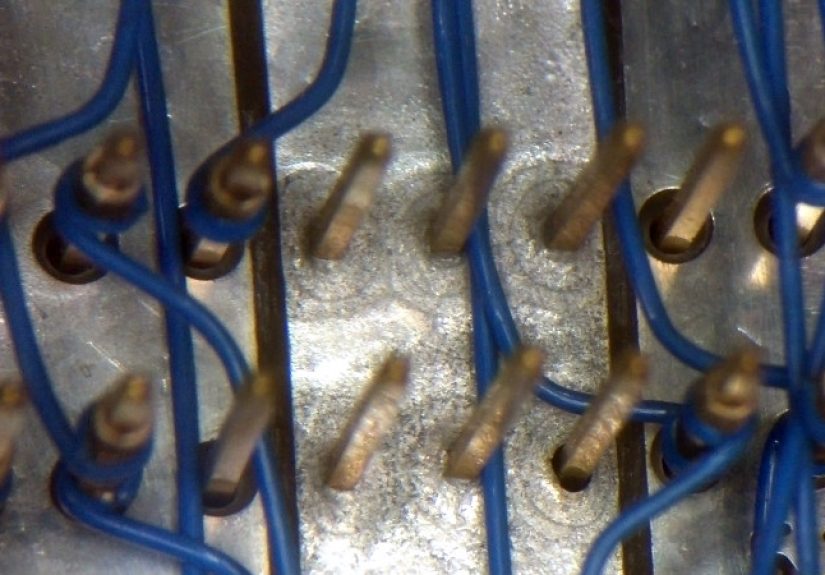
Eventually, the problem pointed to an unusual culprit: electromigration. The contacts between power supply pins and backplane traces had degraded. The computer was not failing because the design was silly or because someone had spilled coffee into history. It was failing because electric current, over a long enough period, had physically altered conductive material.
What Is Electromigration?
Electromigration is the gradual movement of metal atoms in a conductor caused by the momentum transfer from flowing electrons. That definition sounds like it escaped from a semiconductor reliability textbook, so here is the kitchen-table version: when enough current flows through metal for enough time, the electrons can nudge atoms out of place. Not dramatically. Not all at once. More like geological erosion, except the river is made of electrons and the canyon is inside your hardware.
In modern electronics, electromigration is often discussed in relation to integrated circuits, where tiny metal interconnects carry high current densities. As components shrink, the same amount of current can be forced through smaller pathways, increasing stress. Over time, this can create voids, hillocks, opens, shorts, and other reliability problems with names that sound like fantasy monsters but are much less fun.
The Xerox Alto case is especially interesting because the issue appeared in power distribution hardware, not simply inside a microscopic chip. High current through connector regions, combined with age, heat, contact geometry, and decades of service, can produce subtle physical changes. A conductor does not have to melt to fail. It can slowly become a worse conductor until the machine starts behaving like a genius with a bad extension cord.
Why This Failure Was So Tricky
Vintage computer restoration often begins with predictable suspects: capacitors, corroded contacts, bad RAM, brittle cables, disk drive alignment, dried lubricants, or power supplies that have developed strong opinions about retirement. Electromigration is more elusive. You cannot always spot it with a quick glance. It may look like a connection problem, a power delivery issue, or a mysterious intermittent failure.
That is why this Xerox Alto repair is such a strong example of practical troubleshooting. The team did not simply swap boards and hope the museum spirits would be pleased. They followed the failure path. They checked where power should be, where it was missing, and what physical path connected those two facts. Good troubleshooting is not magic. It is disciplined curiosity.
The backplane made the situation more challenging. In machines like the Alto, many boards plug into a dense structure that routes signals and power. Access can be awkward. Measurements may require extender boards or careful probing. A failure in the power distribution system can masquerade as a logic problem because chips downstream may behave unpredictably when voltage is weak, missing, or unstable.
Modern technicians see similar patterns every day. A laptop that refuses to boot might have a bad charger port rather than a bad motherboard. A server that randomly crashes might have a voltage regulator problem rather than defective memory. A vintage workstation with a dead subsystem may not be dead at all; it may simply be starving for current.
The Alto’s Hardware Was Brilliant, But Not Immune to Time
One reason the story resonates is that the Alto was such an advanced machine for its time. It had microcoded architecture, a bitmapped display, a mouse-driven interface, networking, and software ideas that later became mainstream. Yet none of that made it immune to the quiet chemistry and physics of aging hardware.
The Alto’s circuit cards, power supplies, disk systems, and backplane were real 1970s engineering. They were designed for research use, not for starring in museum exhibits half a century later. Engineers of the era were not building for bloggers in 2026 to admire under LED lights while whispering, “Please don’t fail.” They were solving immediate research problems with available parts, constraints, and budgets.
That makes surviving Altos even more remarkable. These machines carry both intellectual history and physical fragility. Every working unit is a living artifact. When one boots, it does more than run code; it demonstrates an entire philosophy of computing before the market fully understood it.
Electromigration and the Lesson of Current Density
The practical villain in this story is not current alone. It is current density: how much current flows through a given cross-sectional area. A wide, healthy conductor can carry current comfortably. A narrow path, stressed contact, corner, constricted trace, or degraded connection can concentrate current. That concentration increases heating and accelerates atomic movement. The result is a feedback loop: degradation makes the path worse, which raises stress, which causes more degradation.
This is why electrical engineers care about connector ratings, trace width, thermal design, and contact resistance. A connector that seems “good enough” on paper may become a weak point after thousands of hours. A power rail that behaved perfectly in a lab may suffer in a museum environment where a machine is powered repeatedly, moved, displayed, or exposed to changing temperature and humidity.
In the Alto case, electromigration damaged the contacts enough to interrupt power delivery. The failure was nearly fatal not because the machine exploded, but because the root cause was rare, subtle, and easy to misdiagnose. A less careful repair effort might have blamed irreplaceable logic boards or retired the machine unnecessarily.
Why Museums Keep Vintage Computers Running
Some people wonder why museums operate old computers at all. Why not put them behind glass, label them, and let them enjoy a peaceful afterlife as extremely expensive furniture? The answer is simple: a working computer communicates history in a way a silent box cannot.
Seeing a Xerox Alto display windows, respond to a mouse, open documents, or communicate over a network changes the visitor’s understanding. It proves that many “modern” ideas were alive decades ago. It also shows how design choices evolved. The Alto is not just historically important because of what it contains, but because of how natural it can feel to use.
Of course, running old hardware is risky. Every power cycle stresses components. Every hour of operation adds wear. Restoration teams must balance access with preservation. They may build modern bridges, emulators, replacement interfaces, or carefully controlled demonstrations to reduce risk while keeping the experience alive.
What Modern Builders Can Learn From This Fail
The Xerox Alto electromigration story is not only relevant to museum technicians. It offers useful lessons for anyone building, repairing, or designing electronics today.
1. Power Problems Often Pretend to Be Logic Problems
Before blaming a CPU, memory board, controller, or rare custom chip, verify power distribution. Check voltages at the load, not just at the supply. A supply can be healthy while a connector, trace, fuse, switch, or backplane path quietly ruins the party.
2. Connectors Are Components, Not Afterthoughts
Connectors age. Contacts oxidize, loosen, heat, arc, and degrade. In high-current areas, even small resistance increases matter. Treat connectors as active reliability risks, especially in older machines or power-heavy designs.
3. Heat Makes Small Problems Grow Up Fast
Electromigration is temperature-sensitive. So are capacitors, plastics, solder joints, and many failure mechanisms. If hardware runs warmer than expected, the calendar starts moving faster. Cooling is not glamorous, but neither is explaining why a historic workstation died because airflow was treated like a suggestion.
4. Documentation Is a Superpower
Schematics, manuals, restoration notes, photographs, and measurement logs turn impossible repairs into merely difficult ones. The Alto restoration community benefits from people who document their work carefully. Future technicians depend on today’s notes.
The Broader Irony: The Future Almost Lost to a Contact Problem
There is something beautifully ironic about a Xerox Alto nearly being taken down by power contacts. This machine helped imagine the future of computing, yet its survival depended on the humble reliability of metal-to-metal connections. The grand ideas of graphical interfaces, networked offices, and interactive software still needed electrons to pass through physical conductors.
That irony is not a weakness. It is what makes computer history tangible. The Alto was not a myth. It was a machine. It had boards, pins, screws, supplies, disks, cables, fans, and failure modes. Its brilliance existed inside ordinary materials doing extraordinary work.
The repair also shows why “failure” is often the most educational part of engineering. A perfectly working machine is impressive, but a broken one tells secrets. It reveals assumptions, stresses, aging patterns, and design trade-offs. When a machine fails, it becomes a teacher with a bad attitude.
How Electromigration Nearly Killed the Alto, Step by Step
The short version is simple: the Alto stopped working because parts of the system were not receiving power. Investigation traced the problem to degraded contact between supply pins and backplane traces. Electromigration had slowly damaged the conductive path. Once that path became unreliable, the machine could no longer function normally.
The longer version is more useful. Current flowed through a power connection over time. The connection likely experienced localized stress where geometry, pressure, contact area, and current density made conditions worse. Atoms in the conductor gradually shifted. The affected region became less capable of carrying current. The voltage distribution suffered. The Alto failed.
This is not the kind of failure that looks dramatic in a movie. No villain pulls a lever. No screen flashes “ELECTROMIGRATION DETECTED.” Instead, the machine simply becomes unreliable, then dead enough to demand attention. The drama belongs to the people debugging it.
Experience Notes: Lessons From Restoring and Troubleshooting Old Hardware
Anyone who has spent time around vintage electronics learns that old machines have moods. They may run perfectly for three hours, fail when a visitor arrives, revive after a connector is reseated, and then act offended when you bring out the oscilloscope. The Xerox Alto story fits that world perfectly. It reminds restorers that the obvious failure is not always the real failure.
One useful experience from working with aging systems is to begin with the boring checks. Measure the power rails. Confirm ground continuity. Inspect connectors under light and magnification. Look for discoloration, heat marks, cracked solder, corrosion, bent pins, and mechanical stress. It is tempting to chase exotic explanations first, especially when the machine itself is exotic. But many “mysterious” failures begin with power, contact, or grounding problems.
Another lesson is to respect intermittent behavior. If a machine changes state when a board is gently flexed, when temperature changes, or when a connector is touched, it is trying to confess. Do not ignore that confession. Mechanical sensitivity often points toward a physical connection problem rather than a purely logical fault. In vintage computers, sockets, edge connectors, wire-wrap posts, and backplanes deserve suspicion.
Patience also matters. Restoration is not the same as ordinary repair. With a modern commodity device, replacing a board may be acceptable. With a rare Xerox Alto, every original part carries historical value. The goal is not only to make the machine work, but to preserve what it is. That means taking careful measurements, avoiding unnecessary modifications, documenting changes, and choosing reversible repairs whenever possible.
The Alto electromigration case also encourages humility. Electromigration is usually discussed in advanced reliability contexts, but here it appeared as a practical museum problem. That teaches a useful rule: physics does not care whether a device is famous. A legendary workstation and a cheap power connector both obey the same laws. Current density, heat, material properties, and time will eventually write their opinions into the hardware.
For hobbyists, the story suggests a simple maintenance habit: do not assume a connector is healthy because it looks fine. Clean contacts carefully when appropriate, verify resistance, check for heat under load, and pay attention to voltage drops. A connector can pass a continuity test and still fail under real current. Continuity is a handshake; load testing is a conversation.
For designers, the experience is a warning against treating power distribution as dull plumbing. Power paths need margin. Connector ratings should be conservative. Sharp current bottlenecks should be avoided. Thermal conditions should be considered early. Serviceability matters too. A design that is easy to probe, isolate, and repair will age far more gracefully than one that turns every diagnosis into a puzzle box.
Finally, the Xerox Alto reminds us why preservation is worth the trouble. A working historic computer lets people experience ideas instead of merely reading about them. Watching a decades-old machine demonstrate familiar interface concepts can be more powerful than a timeline on a wall. The Alto’s near-death by electromigration makes the story even richer. It shows that preserving computing history requires both respect for big ideas and attention to tiny details. Sometimes the future survives because someone cared enough to check a power pin.
Conclusion
“Fail Of The Week: Electromigration Nearly Killed This Xerox Alto” is more than a quirky repair story. It is a compact lesson in computing history, materials science, and careful troubleshooting. The Xerox Alto helped define the future of personal computing, but its near failure came from a deeply physical problem: metal atoms moving under electrical stress until power delivery broke down.
That is what makes the story memorable. The same machine that helped introduce graphical computing, mouse-driven interaction, networking, and WYSIWYG work almost fell victim to a degraded conductor path. It is a reminder that great technology is still made of ordinary matter, and ordinary matter has limits.
For engineers, restorers, collectors, and curious readers, the lesson is clear: never underestimate power distribution, never dismiss connectors, and never assume a silent machine has nothing left to teach. Sometimes the most important debugging clue is not in the software, the CPU, or the glamorous parts of the design. Sometimes it is hiding in a contact, quietly proving that even history needs a good electrical connection.
Note
This article is written for web publication in original language and is based on real technical and historical information about the Xerox Alto, vintage computer restoration, power-distribution failures, and electromigration. Source links are intentionally not inserted in the article body.