Table of Contents >> Show >> Hide
- What Is a Helicopter Chain Saw, Exactly?
- Why Utilities Use Aerial Saws
- How the Machine Actually Works
- Where Aerial Saws Make the Most Sense
- The Safety and Regulatory Side
- The Environmental and Landowner Angle
- Why the Internet Is Obsessed With It
- Helicopter Chain Saw vs. Traditional Tree Trimming
- The Real Meaning of the Helicopter Chain Saw
- Experiences Around the Helicopter Chain Saw: What It Feels Like on the Ground
- Conclusion
- SEO Tags
If the phrase helicopter chain saw sounds like something invented by an action-movie screenwriter on too much coffee, that is completely understandable. It sounds fake. It looks fake. It sounds like somebody mashed together three dangerous nouns and hoped OSHA would not notice. And yet, this machine is very real. Utilities and specialized contractors in the United States use helicopter-mounted aerial saw systems to trim vegetation along transmission corridors, especially in remote, steep, wet, or environmentally sensitive areas where bucket trucks, climbers, and ground equipment have a harder time working efficiently.
That viral, jaw-dropping machine people call a helicopter chain saw is usually better described as an aerial saw. It is not a regular handheld chainsaw dangling from a rope like a bad life decision. It is a purpose-built trimming system suspended beneath a helicopter, designed to cut limbs and vegetation growing too close to power lines and rights-of-way. In plain English, it is one of the wildest-looking tools in modern vegetation management, and also one of the most practical.
What Is a Helicopter Chain Saw, Exactly?
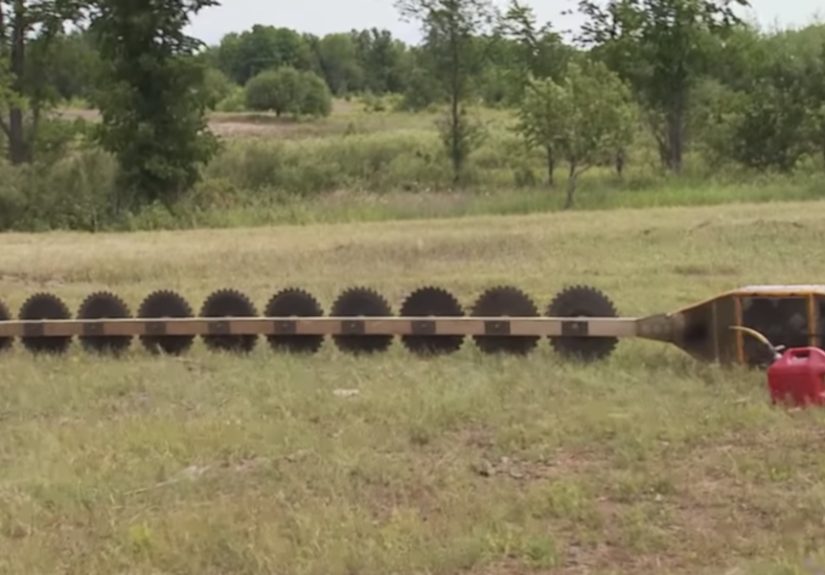
The popular nickname makes the machine sound improvised, but the real setup is engineered for a very specific job. A helicopter carries a vertical boom fitted with multiple circular saw blades. Depending on the operator and configuration, the number and size of blades can vary, which is why one video may show a slightly different setup than another. Some systems use long aluminum booms and multiple rotary blades to create a tall cutting surface that can trim a tree canopy from top to bottom in a single pass.
That is why the machine looks less like a lumberjack’s tool and more like a flying mechanical caterpillar with anger issues. The helicopter hovers with extraordinary precision while the saw assembly moves through branches near utility corridors. The result is controlled side trimming that helps maintain safe clearance around transmission lines.
In other words, the helicopter is not there to be dramatic. It is there because terrain, access, and efficiency make flight the best option. When utilities need to clear long stretches of corridor in mountainous areas, muddy rights-of-way, wetlands, storm-damaged zones, or places where heavy ground equipment would struggle or cause damage, the aerial saw becomes a very attractive solution.
Why Utilities Use Aerial Saws
The biggest reason is simple: trees and power lines are famously bad roommates. Limbs can grow into conductors, sway into them during wind events, or fall during storms, causing outages, equipment damage, and public safety risks. Utilities are required to manage vegetation around transmission corridors because maintaining clearance is not just a good idea; it is a reliability issue.
That reliability angle matters more than most people realize. A lot of power interruptions are tied to weather and vegetation. Heavily forested regions are especially vulnerable to branches falling into lines during snow, ice, and wind events. So when a utility deploys a helicopter saw, it is not doing it for novelty points. It is trying to reduce the odds that your lights go out just as your leftovers are finally reheating.
Utilities also use aerial saws because they can cover ground quickly. Industry and utility sources repeatedly emphasize that a helicopter saw can complete in hours or days what might take conventional ground crews several days, weeks, or even months depending on terrain and line length. That time advantage matters when utilities are managing hundreds of miles of corridor on cyclical maintenance schedules.
Speed Is Only Part of the Story
Efficiency is not just about getting done faster. It is also about where the work can happen. In rough terrain, steep hillsides, swampy land, river crossings, and rights-of-way that are difficult to access, the helicopter can do the trimming without sending large amounts of equipment over sensitive ground. That can reduce road damage, limit disruption to private land, and avoid repeated trips by heavy vehicles.
There is another benefit utilities mention often: worker exposure. Traditional trimming near energized corridors can involve climbing trees, operating bucket trucks, or spending long hours in difficult conditions. An aerial saw does not eliminate risk; aviation never gives out free safety trophies. But it can reduce the amount of time workers spend in some of the most hazardous positions on the ground.
How the Machine Actually Works
At a high level, the helicopter flies slowly alongside the corridor while the suspended saw assembly cuts vegetation along the edge of the right-of-way. The blades are powered by an onboard motor mounted with the saw structure. Limbs are cut cleanly and typically fall downward, often helped by airflow from the rotor wash.
That last part is important, because this is not random airborne landscaping. It is coordinated work. Ground crews are usually involved before, during, and after the trimming pass. They may handle traffic control, monitor the work area, move cut limbs from roads or streams, and perform cleanup. They also help identify hazards and support the overall operation.
So the helicopter chain saw is not a one-machine miracle. It is more like the flashy lead singer in a band that still needs a very competent drummer, bassist, sound engineer, road crew, and somebody who remembers where the extension cords are.
Where Aerial Saws Make the Most Sense
Aerial saws are most effective in rural or hard-to-reach corridors, particularly along transmission lines. They are valuable in mountainous areas, flood-prone routes, wetlands, forested easements, and long rights-of-way where access is limited. They can also be useful after storms, when debris or damaged roads make ground access difficult.
What they are not is an all-purpose substitute for every kind of tree work. Utilities and contractors are clear about that. An aerial saw is one tool in a broader vegetation management program. It is often combined with manual pruning, mechanical trimming, ground crews, inspections, and other methods. That mixed approach is part of what utility vegetation managers call integrated vegetation management.
And no, the helicopter saw is generally not the preferred method for trimming in tight residential neighborhoods. Utilities typically emphasize rural corridors, hard-to-access locations, and areas where safety buffers and planning make the method appropriate. The machine may look like it could cut your hedges in about four terrifying seconds, but that does not mean anyone wants it anywhere near your backyard barbecue.
The Safety and Regulatory Side
Because the saw is an external load suspended beneath a helicopter, these operations fall into a serious regulatory and safety framework. The Federal Aviation Administration treats external-load helicopter work as a specialized area with defined load classes and operating considerations. That alone should tell you this is not “guy with helicopter plus giant saw equals business plan.”
Utilities, contractors, arborists, and pilots also operate within a web of work-zone safety rules, vegetation-management standards, easement limits, and internal operating procedures. Planning matters. Weather matters. Airspace coordination matters. Ground support matters. Communication matters. And public notification often matters too, especially when operations happen near roads, homes, or private property.
Industry standards have also evolved around mechanical pruning. That matters because the helicopter chain saw lives in a space where arboriculture, aviation, utility operations, and public safety all overlap. The machine may look like a meme, but the operational culture around it is deeply procedural.
Why the Operation Looks So Precise
One reason people get mesmerized by helicopter saw videos is the sheer control involved. Pilots have to manage aircraft position, load behavior, wind, rotor wash, obstacle awareness, and work-zone coordination while trimming near infrastructure. Specialized operators and contractors train extensively for this type of mission. It is not ordinary flying, and it is definitely not ordinary tree work.
That precision is also why weather can slow or stop the job. Wind, visibility, and other conditions can affect safety and productivity. In other words, even the most intimidating flying saw in the world still has to respect the atmosphere. Nature always keeps the final veto stamp.
The Environmental and Landowner Angle
One of the more interesting arguments for aerial saw use is that it can reduce the ground disturbance associated with repeated vehicle access. In wetlands, riparian areas, muddy corridors, or sensitive landscapes, that can be a meaningful benefit. Less equipment on the ground can mean less rutting, fewer repeated trips, and fewer impacts on roads or soft terrain.
Utilities also frame aerial trimming as a landowner-relations issue. If work can be completed faster and with less equipment crossing a property, that often reduces the inconvenience to the people who live or work nearby. That does not mean landowners love hearing a helicopter overhead at breakfast time, but it can mean the disruption is shorter and more contained than a prolonged ground operation.
Still, responsible use depends on communication. Utilities commonly notify property owners in advance, flag corridor boundaries, and coordinate cleanup. The machine may be airborne, but the success of the job is still very grounded in planning, easement compliance, and community outreach.
Why the Internet Is Obsessed With It
The helicopter chain saw became internet-famous because it hits a very specific part of the human brain: the part that loves improbable machines. It looks dangerous, futuristic, loud, absurd, and oddly elegant all at once. It is the rare industrial tool that makes both engineers and random people on social media stop and say, “Well, that seems aggressively effective.”
Part of the fascination comes from contrast. Tree trimming is usually imagined as slow, manual, and local. Then along comes a helicopter carrying a towering array of spinning blades, slicing a corridor with surgical efficiency. It feels like the ordinary rules of yard work have been kidnapped by heavy metal.
But the fascination also hides something useful: this machine is a reminder that infrastructure maintenance is often invisible until it becomes dramatic. Power reliability depends on a lot of unglamorous work, and vegetation management is one of those critical systems that most people ignore until a storm drops a branch across a line and suddenly everyone becomes an expert in grid resilience.
Helicopter Chain Saw vs. Traditional Tree Trimming
Traditional trimming still has advantages. Ground crews can work selectively, handle urban or suburban settings more appropriately, and perform fine-detail pruning that an aerial saw is not designed to do. Manual and bucket-truck operations remain essential across the utility and tree-care industries.
Where the aerial saw wins is scale, access, and corridor efficiency. It is especially strong when utilities need broad side-trimming in places where trucks cannot easily reach, where terrain is punishing, or where maintenance windows are tight. It is a specialized solution for a specialized problem, not a universal replacement for arborists with ropes, pole pruners, and patience.
That is why the smartest way to understand the helicopter chain saw is not as a gimmick, but as a niche productivity tool. It looks outrageous because the job is outrageous. Clearing vegetation around critical infrastructure in mountains, forests, wetlands, and storm-damaged corridors is not exactly a leaf-blower kind of challenge.
The Real Meaning of the Helicopter Chain Saw
In the end, the helicopter chain saw is one of those machines that perfectly represents modern infrastructure work: highly specialized, weirdly elegant, expensive-looking, safety-intensive, and built to solve a problem most people never think about. It exists because transmission corridors must stay clear, because trees keep growing, because storms keep happening, and because there are places where the sky is the most practical road.
It is also a great reminder that reality often outperforms fiction. If a movie pitched “flying saw tower trims trees near power lines,” most viewers would probably roll their eyes and call it too much. Meanwhile, in the real world, utilities have been doing versions of this work for decades.
So yes, the helicopter chain saw is real. It is not a stunt. It is not a meme with rotors. It is a serious vegetation-management tool used to protect reliability, improve access, and reduce some kinds of field exposure in the right conditions. It just happens to look like the final boss in a landscaping video game.
Experiences Around the Helicopter Chain Saw: What It Feels Like on the Ground
Seeing a helicopter chain saw in person is a completely different experience from watching a ten-second clip online. On a phone screen, it looks like a wild machine doing a strangely satisfying job. From the ground, it feels bigger, louder, and much more deliberate. First there is the sound. Before most people even spot the aircraft, they hear a low mechanical thunder rolling across the corridor. Then the helicopter appears, and below it hangs this long vertical structure that looks too dramatic to be real. Your first reaction is usually disbelief. Your second reaction is a very respectful appreciation for whoever has to fly that thing with precision.
For landowners and nearby residents, the experience is often a mix of curiosity and caution. People step outside, look up, and instantly understand that this is not routine neighborhood tree trimming. Even when utilities provide notice, the visual impact is unforgettable. The machine does not creep into view politely. It arrives like a public reminder that the electric grid has a maintenance budget and a flair for theatrics.
For crews on the ground, though, the experience is less spectacle and more choreography. Everyone has a role. Some workers are watching the corridor, some are managing roads or access points, some are handling cleanup planning, and some are communicating about hazards and timing. From that perspective, the helicopter saw is not just a cool machine. It is one part of a fast-moving coordinated operation. The excitement people feel from the roadside is replaced on the job by concentration.
There is also an odd emotional contrast to the work. The cutting itself can look quick and almost effortless, but the operation around it reflects just how much planning went into making those few seconds possible. Boundaries may have been flagged weeks in advance. Property owners may have been notified. Hazards may have been marked. Cleanup crews may already know where debris will go. That means the “experience” of helicopter chain saw work really begins long before the aircraft ever lifts off.
And then there is the aftermath. Once the helicopter moves on, what remains is not chaos, but evidence of a highly targeted pass: trimmed corridor edges, cleared space around lines, and crews handling the material left behind. The public often remembers the sound and the surreal image of spinning blades beneath a helicopter. Utilities remember the miles completed, the hazards reduced, and the maintenance cycle improved.
That difference says a lot about the machine’s reputation. To the public, it feels unbelievable. To the professionals who use it, it feels useful. The most interesting experience around the helicopter chain saw may be that tension between drama and routine. It looks like something outrageous, but in the right corridor, with the right crew, it becomes just another day of keeping power reliable. A very loud day, admittedly, but still a day at work.
Conclusion
The helicopter chain saw is one of the most visually unforgettable tools in utility vegetation management, but its real value is practical rather than theatrical. It helps maintain power-line clearances, improves access in rough terrain, supports reliability goals, and works best as part of a larger vegetation-management strategy. It is fast, specialized, and deeply dependent on planning, safety, and coordination.
So the next time you see one online and wonder whether humanity has finally gone too far with power tools, the answer is: maybe aesthetically, but operationally, not really. This machine exists because the problem it solves is real, recurring, and expensive. And if it happens to look like a chainsaw centipede flying under a helicopter, well, that is just the bonus feature.