Table of Contents >> Show >> Hide
- Markets Have Memory, Even When They Claim to Have Models
- How Collective Memory Turns Into a Market Cycle
- Why Different Generations See the Same Market Differently
- Institutions Remember Too
- How Smarter Investors Use Memory Without Becoming Trapped by It
- A Longer Reflection on Experience, Memory, and the Market
- Conclusion
Markets like to pretend they are cold, rational machines. Numbers flash, analysts model, traders hedge, economists publish, and everyone acts as if the whole show runs on spreadsheets and caffeine alone. But beneath the charts and earnings calls sits a much messier operating system: memory. Investors remember crashes, booms, layoffs, inflation shocks, wild rallies, and that one cousin who bought a “can’t-miss” stock right before it missed spectacularly. Those memories do not just color opinion. They shape risk appetite, valuations, sentiment, and, over time, entire market cycles.
That is the core idea behind modern behavioral finance research. Our memories are not tidy archives. They are selective, emotional, and surprisingly bossy. We tend to overweight recent events, recall dramatic outcomes more vividly than ordinary ones, and project our lived experience into the future. In plain English: when the market has been kind, we start acting like kindness is a law of nature. When the market has been brutal, we begin to treat pain as permanent. That swing between selective optimism and selective fear is one of the hidden engines behind boom-and-bust cycles.
Markets Have Memory, Even When They Claim to Have Models
Economists have long studied how personal experience affects financial behavior. People who live through deep downturns, inflation spikes, credit crunches, or years of strong returns do not come out the same on the other side. They carry those experiences into future decisions. Someone shaped by a major crash may keep more cash, avoid leverage, and view every rally with the suspicious squint of a detective in a crime movie. Someone shaped by a long bull market may treat volatility like bad weather: annoying, brief, and probably over by lunch.
This is not just colorful storytelling. Research on “experience effects” argues that lifetime exposure to returns, inflation, and macroeconomic shocks can leave a long-lasting imprint on beliefs and risk-taking. That helps explain why two investors with the same income, the same age, and access to the same information can still make wildly different decisions. They are not just analyzing the market in front of them. They are also consulting the market stored in their heads.
Memory matters because belief formation is not purely objective. A rising market does more than increase account balances. It changes what people recall and how positively they recall it. After years of gains, investors do not simply notice good returns. They begin to remember past experience through a more optimistic lens. Then they forecast the future accordingly. That belief channel can become self-reinforcing: optimism supports more buying, more buying supports higher prices, and higher prices make optimism look smart. For a while, everyone feels like a genius. Wall Street has always loved that part.
Recency Bias: The Market’s Favorite Party Trick
If memory had a signature bad habit, it would be recency bias. We give too much weight to what just happened and too little weight to longer history. During strong runs, investors start to believe recent performance is destiny. During selloffs, they start to think the market has personally sworn revenge. Neither mindset is especially useful.
Recency bias shows up everywhere. It shows up when investors chase the hottest sector because it has gone up lately. It shows up when credit looks safest right before risk finally wakes up. It shows up when people assume inflation is dead forever because it has been quiet for years, or that inflation is unbeatable because the last two years were loud and expensive. Markets do not need every participant to make this mistake at once. They just need enough people to lean in the same direction at the same time.
This is why long expansions often breed overconfidence. As bad outcomes fade from memory, caution fades with them. A generation that has not personally felt a banking panic, credit seizure, or prolonged bear market can begin to treat those events as distant museum pieces rather than living possibilities. That is where trouble starts. Nothing says “late cycle” quite like people confidently announcing that the old rules no longer apply.
How Collective Memory Turns Into a Market Cycle
Market cycles are not caused by memory alone, of course. Rates matter. Earnings matter. Policy matters. Credit conditions matter. But memory helps determine how investors interpret all of those things. The same data can produce very different reactions depending on what the crowd remembers most vividly.
Stage One: The Fresh Scar
Right after a crisis, memory is sharp. Investors remember losses, liquidity disappears faster, and risk management gets religion. Lending standards tighten. Valuations stay cautious. Regulators rewrite rules. Boards ask harder questions. Households save more. In this stage, fear is not theoretical. It is personal. The market becomes more defensive because the cost of being wrong was recently obvious.
History offers several examples. The Panic of 1907 was severe enough to help push the United States toward creating the Federal Reserve. The Great Inflation of the 1970s and early 1980s rewired how markets thought about prices, policy credibility, and inflation expectations. The Great Recession of 2007 to 2009 left such a deep mark that even years later it still influenced risk appetite, regulation, and portfolio choices. Crises do not just destroy wealth. They educate, scar, and sometimes over-educate.
Stage Two: The Calm That Feels Permanent
Then comes the slow fade. Time passes. Defaults stay low. Volatility eases. Policy appears supportive. A recovery becomes an expansion, then a habit, then an identity. The market starts to forget why it was cautious in the first place. This is the sweet spot where collective memory gets dangerous: the pain is no longer fresh enough to restrain behavior, but the gains are fresh enough to encourage it.
Credit cycles fit this pattern especially well. When defaults have been low for a while, investors begin extrapolating that calm into the future. Credit can look safer than it really is, spreads can look too skinny, and refinancing feels easy. Researchers studying credit sentiment have shown how investors often extrapolate past defaults or the lack of them, which helps explain the “calm before the storm” feeling that shows up late in the cycle. In other words, the market starts whispering, “Relax, nothing bad has happened lately,” which is not always the comforting statement it sounds like.
Stage Three: Euphoria With Better Branding
At the top of the cycle, memory becomes highly selective. People remember the winners, the recoveries, the breakouts, and the innovations. They forget the bankruptcies, the funding squeezes, and the way leverage can turn a stumble into a face-plant. This is the phase where narratives become magical. A hot asset class is not just rising; it is “redefining value.” A speculative market is not overheated; it is “democratized.” Expensive valuations are not expensive; they are “the new baseline.” The vocabulary changes because memory has changed.
None of this means the underlying story is always false. Booms often contain real innovation and real growth. The problem is that memory makes people overgeneralize. A good trend becomes an eternal truth. A successful quarter becomes a ten-year prophecy. A low-default environment becomes proof that risk itself has matured and moved to the suburbs.
Stage Four: The Snapback
Then reality reintroduces itself. Sometimes it arrives through higher rates, weaker earnings, tighter credit, or a policy mistake. Sometimes it comes through an asset that looked safe until it did not. When the break happens, memory reverses direction with dramatic flair. Investors stop extrapolating good times and begin extrapolating bad ones. Risk models tighten, redemptions rise, lending slows, and the crowd suddenly rediscovers every reason it should have been cautious months earlier.
That reversal is why busts can feel faster than booms. Optimism usually builds by staircase. Fear tends to take the elevator.
Why Different Generations See the Same Market Differently
One of the most fascinating parts of this topic is that market memory is not evenly distributed. Different generations bring different mental maps to the same price chart. An investor whose formative years were shaped by the Great Recession may have a permanently lower tolerance for leverage than one whose formative years were shaped by the long bull market that followed it. Someone whose financial adulthood began during the inflation shocks of the early 2020s may react to price pressures far more aggressively than someone whose investment worldview was formed during a long era of low inflation.
This helps explain why debates about valuation, rates, and risk can feel strangely personal. They are personal. Investors are not only arguing over facts. They are arguing from memory. One group hears “temporary slowdown” and remembers every recovery. Another hears the same phrase and remembers the first crack before a major downturn. Both believe they are being rational. Both are, in part, remembering.
Institutions Remember Too
It is tempting to blame retail investors for emotional behavior, but institutions are not memory-proof. Fund managers, banks, regulators, boards, and policy makers also learn from experience, and sometimes overlearn. After a crisis, institutions become more conservative. After a long calm period, they can drift toward complacency. Rules change. Underwriting changes. Capital allocation changes. Even official policy frameworks evolve in response to what previous eras taught, or appeared to teach.
That is why market cycles are partly psychological and partly institutional. Memory does not live only in individual brains. It gets embedded in lending standards, risk committees, portfolio construction, research language, and regulation. Then, as personnel changes and old scars fade, the institutional memory weakens. A new cycle has room to grow.
How Smarter Investors Use Memory Without Becoming Trapped by It
The goal is not to erase memory. That would be worse. Memory is useful because it preserves lessons that price charts alone cannot teach. The goal is to stop memory from becoming a dictator.
- Zoom out on purpose. A one-year chart feeds emotion. A twenty-year chart feeds perspective.
- Separate vivid from probable. The event you remember most clearly is not automatically the event most likely to happen next.
- Build rules before drama arrives. Rebalancing plans, risk limits, and diversification work best when written during calm rather than invented during panic.
- Question the dominant story. Whenever everyone sounds certain, memory may be doing more work than analysis.
In practical terms, the best defense against memory-driven mistakes is a process. Not a vibe. Not a hunch. Not a tweet thread with twelve rocket emojis. A process. Investors who define asset allocation, rebalancing discipline, liquidity needs, and risk tolerance ahead of time are less likely to let recent experience hijack long-term decisions.
A Longer Reflection on Experience, Memory, and the Market
Experience is where this whole subject becomes more human. Ask investors what shaped them most, and they usually do not start with an equation. They start with a moment. Their first crash. Their first bonus during a bull run. The first time inflation made a grocery bill feel insulting. The first time a “safe” asset did something deeply unsafe. These moments become financial landmarks. People navigate the future by them.
Someone who watched parents lose a home or a job during a downturn may grow up treating debt with suspicion. Someone who began investing during a roaring market may sincerely believe that every dip is a gift basket from the financial gods. Someone who lived through years of near-zero rates may view higher yields as unnatural. Someone shaped by an inflation surge may see sticky prices lurking behind every economic headline like a villain in the final act. None of these instincts are irrational in a vacuum. They are experiences translated into expectations.
The same thing happens in careers. A portfolio manager who survived a liquidity squeeze will never hear the word “liquidity” the same way again. A founder who raised capital in easy conditions may think funding is a normal feature of the landscape rather than a weather pattern. A banker who came of age after a crisis may underwrite conservatively for years, while a banker trained during a prolonged expansion may treat tighter terms like unnecessary pessimism. The market looks identical on the screen, but it is being interpreted through entirely different emotional histories.
What makes this powerful is that experience often feels like wisdom. Sometimes it is. Sometimes it is just a well-dressed bias. If the last decade rewarded one style, one sector, or one macro view, people naturally start treating that experience as durable truth. Then the cycle changes, and the same memory that once protected them starts misleading them. Yesterday’s scar becomes today’s blind spot. That is the tricky part: memory can make us both safer and slower, wiser and narrower, disciplined and stubborn.
There is also a social side to it. We inherit market memory from other people. Families pass down stories about the Depression, the 1970s, the dot-com bust, the housing crash, and every “hot tip” that turned into a cold shower. Financial culture is built from those stories. They shape what communities fear, what they chase, and what they dismiss. In that sense, market memory is not just personal biography. It is shared folklore with brokerage access.
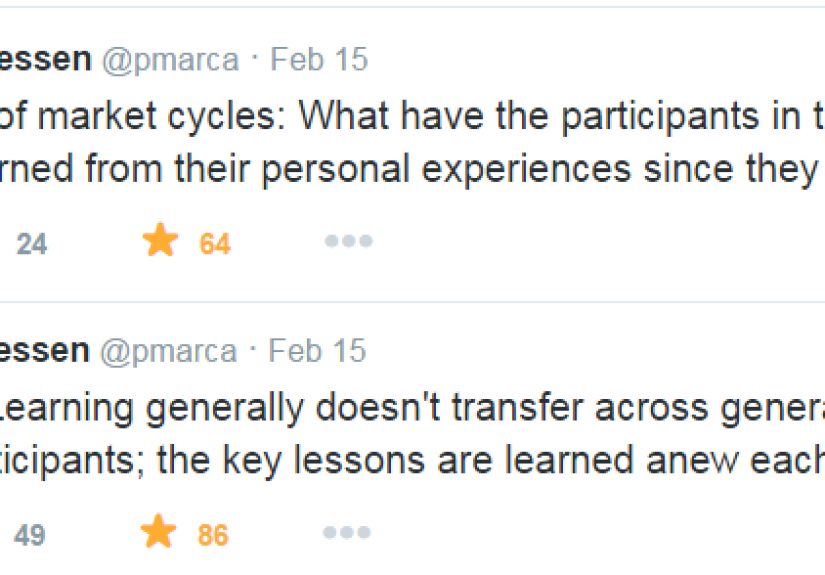
That is why market cycles keep recurring in new outfits. The technology changes, the slogans change, the asset class changes, but human memory keeps doing its old work. We forget just enough to take risk again, then remember just enough to panic when risk bites back. The investors who handle cycles best are not the ones with no memory. They are the ones who can examine memory, learn from it, and still leave room for the possibility that the next cycle will rhyme with history rather than copy it word for word.
Conclusion
In the end, market cycles are not driven only by data, rates, and earnings. They are also driven by what people remember, what they forget, and what they emotionally project forward. Fresh pain can suppress risk for years. Fresh gains can make risk look civilized. Between those two states lies the recurring drama of finance: boom, confidence, overreach, shock, caution, recovery, and repeat.
Understanding how memory shapes market cycles does not make anyone magically immune to fear or greed. But it does make the pattern easier to spot. And that matters. Because the moment you realize the market is not just processing information but also replaying memory, you stop treating every cycle as a mysterious accident. You start seeing it for what it often is: human psychology, dressed up in ticker symbols.