Table of Contents >> Show >> Hide
- Step 1: Confirm the law before you buy a single leaf of lettuce
- Step 2: Choose a secure enclosure with room to roam
- Step 3: Build a substrate that stays moist but not swampy
- Step 4: Get humidity right and keep it consistent
- Step 5: Keep temperatures warm and stable
- Step 6: Add hides, climbing surfaces, and a little environmental interest
- Step 7: Feed a varied plant-based diet, not a one-vegetable rut
- Step 8: Make calcium available all the time
- Step 9: Provide water carefully and keep the tank clean
- Step 10: Handle gently and never grab by the shell
- Step 11: Plan for eggs before eggs happen
- Step 12: Watch your snail’s behavior like a good detective
- Common mistakes to avoid
- Final thoughts
- What the Experience Is Really Like: 500 Extra Words From the Human Side of Snail Care
- SEO Tags
Important note: In the United States, giant African land snails are heavily restricted because they are invasive. This guide is for educational purposes and assumes care is legal and properly permitted where you live.
Giant African land snails are the kind of pets that make people do a double take. They are quiet, oddly charismatic, and somehow manage to look ancient, elegant, and slightly judgmental all at once. But caring for them well is not just a matter of tossing in a lettuce leaf and hoping for the best. These snails need the right enclosure, the right humidity, the right calcium, and a keeper who understands that “slow” does not mean “low-maintenance by magic.”
If you are learning about how to care for giant African land snails, the big picture is simple: recreate a warm, humid, secure environment, feed a varied plant-based diet, protect shell health, and stay obsessive in the nicest possible way about hygiene and escape prevention. The details, of course, are where the snail slime meets the road.
Here is the full guide in 12 practical steps, with real-world care advice, common mistakes to avoid, and the little things that make a huge difference over time.
Step 1: Confirm the law before you buy a single leaf of lettuce
Why this comes first
Before you think about habitat size, feeding schedules, or naming your snail Sir Slimes-a-Lot, check whether keeping giant African land snails is legal where you live. This is not one of those “technically the HOA frowns on it” situations. These snails are considered highly invasive in the U.S., and the legal restrictions are serious for good reason.
What smart keepers do
Only proceed if possession is lawful and properly permitted in your area. Never buy from shady sellers, never move snails across borders casually, and never assume that because something is sold online it must be legal. That assumption has launched many a terrible idea.
Starting with legal, ethical sourcing protects local ecosystems and saves you from building a habitat for an animal you should not be keeping in the first place.
Step 2: Choose a secure enclosure with room to roam
The right kind of setup
A giant African land snail needs an enclosure that holds humidity well, offers climbing space, and closes securely. A glass aquarium or sturdy plastic terrarium works well. For a single adult, many keepers start with something around a 10-gallon setup, but larger is better because these snails are active at night and appreciate space to explore.
What matters most
The lid should fit tightly. Snails are not fast, but they are persistent, and a determined snail can turn a small gap into a full-scale prison break. Good ventilation matters too, but not so much that the enclosure dries out every five minutes.
A good rule is to think in terms of floor space plus climbing surface. These snails do not just sit around looking philosophical. They cruise the walls, investigate corners, and treat the tank like a tiny jungle gym.
Step 3: Build a substrate that stays moist but not swampy
Why substrate is a big deal
Substrate is not decoration. It is where your snail burrows, rests, and often lays eggs. A poor substrate can lead to dryness, stress, bad shell growth, or egg trouble. A great one supports moisture, cleanliness, and natural behavior.
What works best
Use a few inches of natural, fertilizer-free substrate such as coconut fiber, peat-free compost, or clean soil-based bedding with a neutral pH. For adult snails, deeper substrate is helpful because they need enough depth to burrow comfortably and, if mature, to lay eggs.
Avoid anything treated with chemicals, fertilizers, or perfumes. Wood shavings are not ideal, and sandy mixes dry too quickly. Moss can help hold moisture, but it should support the main substrate, not replace it.
The texture should feel like a wrung-out sponge: damp, loose, and workable. If it drips, it is too wet. If it crumbles into desert dust, your snail will not be thrilled.
Step 4: Get humidity right and keep it consistent
Humidity is not optional
Warmth gets the spotlight, but humidity is the co-star. Giant African land snails thrive in humid conditions. If the enclosure is too dry, they may seal themselves up, become inactive, or struggle with normal body function. If it is too wet, the substrate can go sour and the environment can become unhealthy.
How to manage it
Mist the enclosure regularly with clean water and use a hygrometer so you are not just guessing based on vibes. The goal is a humid habitat with light moisture on surfaces, not puddles that make the tank feel like a failed rice field.
Pay attention to your room conditions too. A setup that holds perfect humidity in summer may dry out quickly in winter if indoor heating is running. Good snail care is not “set it and forget it.” It is “set it, monitor it, and quietly become the kind of person who cares deeply about condensation.”
Step 5: Keep temperatures warm and stable
Snails like comfort, not surprises
These snails do best in a warm, stable environment. If the tank gets too cold, activity slows and the snail may go dormant. If it gets too hot, the enclosure can dry out fast, which is just as bad. Stability matters more than dramatic swings.
Practical temperature tips
A mild, steady warmth is ideal. If your room runs cool, use a heat source designed for terrariums and place it so the snail can move away from the warmer side when it wants to. Side-mounted heating is generally better than heating from underneath because it helps prevent the substrate from drying too aggressively.
Do not place the enclosure in direct sunlight. That is not “natural lighting.” That is how you accidentally turn a terrarium into a humid little oven.
Step 6: Add hides, climbing surfaces, and a little environmental interest
Yes, enrichment matters
Snails are not exactly hosting obstacle course competitions, but they do benefit from an environment that lets them hide, climb, and move naturally. A barren tank can leave them stressed and inactive.
Easy upgrades
Add cork bark, clean branches, terracotta hide pieces, or safe plant cover. The idea is to create shade, shelter, and variety. A fake plant or two can work well if it is sturdy and easy to clean.
Think of the setup as a miniature forest floor. Your snail should be able to tuck itself away during the day and explore different surfaces at night. If the tank looks like a very damp minimalist apartment, it probably needs more structure.
Step 7: Feed a varied plant-based diet, not a one-vegetable rut
What giant African land snails eat
A varied diet is one of the best ways to support growth, shell quality, and long-term health. Offer rotating vegetables and fruits rather than feeding the same thing every day. Leafy greens, cucumber, carrot, zucchini, broccoli, apple, and similar produce can all be useful parts of a rotation.
What makes a better menu
Dark leafy greens are more valuable than watery salad alone. Lettuce can be part of the mix, but it should not be the whole show. A snail that eats nothing but watery greens is basically on the gastropod version of junk food.
Wash produce thoroughly and use pesticide-free foods whenever possible. Remove leftovers before they mold, especially in a humid tank where yesterday’s snack can become tomorrow’s biology experiment at alarming speed.
A mixed diet is the goal. Variety helps cover nutritional gaps and keeps feeding more natural.
Step 8: Make calcium available all the time
This is the shell-saving step
If there is one care point you should tattoo on your brain, it is this: snails need calcium constantly. Their shells are made mostly of calcium carbonate, and a calcium shortage can lead to thin, fragile, poorly formed shell growth.
The easiest way to do it
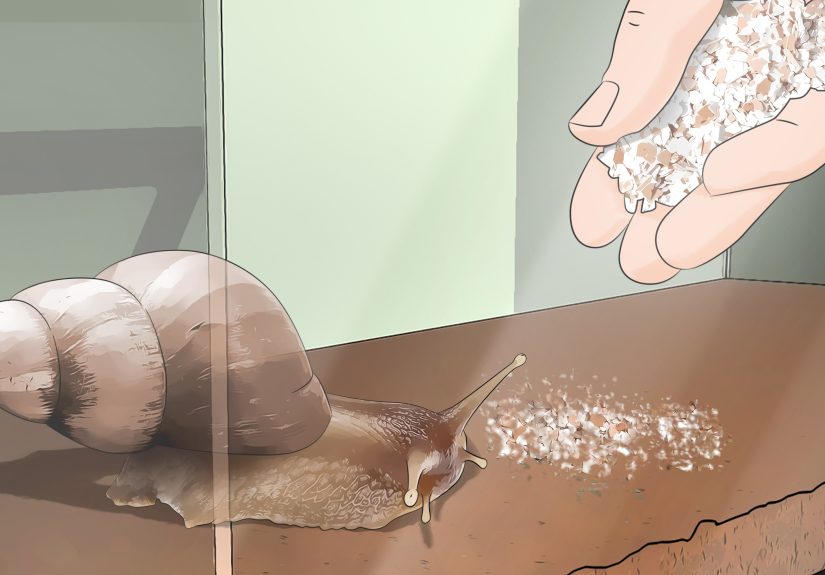
Keep a cuttlebone in the enclosure at all times or provide another safe calcium source recommended for snails. Some keepers also use finely ground eggshell or oyster shell, but cuttlebone is easy, reliable, and widely used.
Do not assume the snail will “probably get enough” from vegetables alone. That is a risky gamble, and your snail’s shell is the thing that pays the price.
Step 9: Provide water carefully and keep the tank clean
Hydration without hazards
Snails get much of their moisture from food and ambient humidity, but a very shallow water dish can still be helpful. Keep it shallow enough to avoid any drowning risk and easy to clean. A stone or textured surface inside the dish can help with traction.
Cleaning routine that actually works
Spot-clean daily. Remove old food, wipe excess slime from walls when needed, and replace substrate before it becomes foul or compacted. In a humid enclosure, waste and leftovers break down quickly, and that can change the whole environment.
Cleanliness also matters for human health. Use gloves if recommended, wash your hands after handling the snail or anything in its tank, and keep food-prep areas far away from terrarium gear. Your kitchen and your snail station should not become close friends.
Step 10: Handle gently and never grab by the shell
The biggest handling mistake
Do not pick up a snail by its shell. It can damage the mantle, the delicate tissue that attaches the body to the shell, and that can cause severe injury. If you need to move the snail, let it crawl onto your hand or gently support the whole body from underneath.
How often to handle
Snails are better as observing pets than cuddle champions. Occasional gentle handling is fine where legal and appropriate, but constant lifting, poking, and showing them off to every visitor named Chad is not enriching. It is stressful.
Always wash your hands before and after handling. Before protects the snail from residues like soap, lotion, or salt. After protects you.
Step 11: Plan for eggs before eggs happen
The reproduction problem
Giant African land snails are prolific. Very prolific. “Wow, that is a lot of eggs” prolific. If you keep mature snails, you need a plan for monitoring the substrate and dealing with eggs responsibly and legally.
What responsible care looks like
Check the substrate regularly, especially if your snail has been burrowing more than usual. Do not ignore egg clutches and hope nature will sort itself out in a glass box. It absolutely will, and you may regret how efficiently it does so.
Also, never release unwanted snails or eggs outdoors. Not ever. That is how ecological nightmares get a sequel.
Step 12: Watch your snail’s behavior like a good detective
Healthy snail signs
A well-kept snail is typically active at night, responsive to moisture, interested in food, and carrying a shell that looks solid and well-formed. Occasional rest and retreat are normal. Permanent withdrawal, inactivity, shell softening, bad odor, or repeated sealing up can point to husbandry problems.
What to troubleshoot first
If something seems off, check the basics before assuming the worst: humidity, temperature, substrate condition, calcium availability, food freshness, and sanitation. For many invertebrates, health issues begin as care issues.
In other words, when a snail looks unhappy, the tank is often confessing before the snail can.
Common mistakes to avoid
The most common errors in giant African land snail care are also the most preventable: using poor substrate, skipping calcium, overfeeding one watery vegetable, letting mold build up, making the enclosure too dry, soaking it into a bog, and underestimating reproduction. Another classic mistake is assuming that because the animal is quiet, you can ignore it for days at a time. Snails may be peaceful, but good care is still active care.
Final thoughts
Learning how to care for giant African land snails is really about learning to manage a tiny ecosystem. When the enclosure is warm, humid, clean, enriched, and calcium-rich, these snails can be fascinating to watch. They glide, climb, investigate, and make even ordinary feeding time feel weirdly majestic.
The best keepers are patient, observant, and consistent. They understand that a secure lid matters, a shallow water dish matters, a cuttlebone matters, and yes, removing that suspicious half-eaten cucumber slice absolutely matters. Snail care is a game of small details, and the details are what keep the shell strong, the animal active, and the habitat healthy.
What the Experience Is Really Like: 500 Extra Words From the Human Side of Snail Care
One of the strangest and most delightful experiences in caring for a giant African land snail is how quickly your definition of “interesting evening” changes. At first, it seems like there cannot possibly be much to watch. It is a snail. It moves at the speed of a slow thought. And yet, once the lights dim and the enclosure wakes up, you start noticing patterns. A healthy snail becomes surprisingly routine-driven. It may emerge from the same hide, test the air with its tentacles, make a slow lap around the glass, and then commit with absolute seriousness to a slice of zucchini like it is starring in a food documentary.
Another common experience is realizing just how much condition affects behavior. When the humidity is perfect, the snail is active, extended, glossy, and curious. When the tank is too dry, the difference is immediate. Activity drops. The body stays tucked in. The whole animal seems to say, “I did not agree to this climate.” That teaches keepers fast. You stop thinking of misting as a chore and start thinking of it as part of the daily rhythm, like checking a thermometer or refilling a water bottle.
Feeding is its own kind of education. People often begin with the assumption that one or two favorite foods are enough. Then they watch how a snail responds to variety. Dark greens, crunchy vegetables, softer produce, calcium nearby, old food removed before it sours; it all adds up. Experienced keepers often say the same thing in different words: the shell tells the story. A smooth, sturdy shell usually reflects months of good care, while weak growth often points back to preventable problems like poor nutrition or inconsistent calcium.
There is also something oddly grounding about snail care. These are not loud pets. They do not demand attention every second. They reward steadiness instead. If you are observant, you start noticing tiny changes: a new growth line on the shell, a favorite sleeping spot, more burrowing before egg laying, extra activity after evening misting. Caring for them trains patience. It makes you slower in a good way.
That said, no honest keeper would pretend it is all mystical calm and botanical glamour. Sometimes snail care is finding a forgotten carrot slice that has turned into a horror movie prop. Sometimes it is wiping slime trails off glass while questioning your life choices. Sometimes it is realizing that “I should probably check the substrate for eggs” was not a casual suggestion but a very urgent sentence.
And still, people who enjoy these animals tend to really enjoy them. There is satisfaction in getting the environment just right and seeing the snail thrive because of it. It is quiet evidence that details matter. For many keepers, that is the real appeal: not that the snail is flashy, but that it turns careful, thoughtful care into something visible every single day.