Table of Contents >> Show >> Hide
- Why Cleaning a Water Dispenser Matters (Even If the Water Is “Clean”)
- Bleach vs. Vinegar: Which One Should You Use?
- What You’ll Need
- Quick Dilution Cheat Sheet (Safe Starting Point)
- Before You Start: Prep the Dispenser the Right Way
- Step-by-Step: Clean a Top-Load Water Dispenser
- Step-by-Step: Clean a Bottom-Load Water Dispenser
- Countertop Dispensers and Bottleless (Plumbed-In) Units
- Don’t Forget the Parts People Actually Touch
- How Often Should You Clean a Water Dispenser?
- Troubleshooting: “I Cleaned It… So Why Does It Still Taste Weird?”
- What NOT to Do (Unless You Like Bad Ideas)
- FAQ
- Experiences & Real-World Lessons: What Cleaning a Water Dispenser Looks Like in Everyday Life
Your water dispenser is basically a tiny “hydration hotel” for water: guests check in, hang out in a reservoir,
and then leave through the spigots. If you don’t clean it, you can end up hosting the wrong kind of visitors
(biofilm, funky odors, mineral buildup). The good news: cleaning a water dispenser isn’t hard. The even better
news: you can do it with two things many homes already havebleach or vinegar.
This guide walks you through safe, step-by-step cleaning for common dispenser types (top-load, bottom-load, and
countertop), explains when bleach is the better choice vs. vinegar, and shows you how to rinse properly so your
next glass tastes like waternot “pool day.”
Why Cleaning a Water Dispenser Matters (Even If the Water Is “Clean”)
Even when you use sealed bottles or filtered, plumbed-in water, dispensers can develop buildup over time:
- Biofilm: a slippery layer that can form inside wet tubing/reservoirs. It’s not a horror moviejust biology.
- Mineral scale: especially in hard-water areas, minerals can cling to surfaces and affect taste or flow.
- Odors and stale taste: often from residue, old water sitting too long, or a neglected drip tray.
Most manufacturers recommend cleaning every few months, and more often if the unit gets heavy use (office,
big family) or sits in a warm spot.
Bleach vs. Vinegar: Which One Should You Use?
Use Vinegar When…
- You want to remove mineral scale (hard-water deposits).
- You’re dealing with mild odor or “stale water” vibes.
- You prefer a less harsh-smelling option (still smellsjust salad-adjacent).
Vinegar is excellent at breaking down buildup and deodorizing. But it’s not a top-tier disinfectant compared to
registered disinfectantsso think of it as a strong cleaner/descaler, not a “kill everything” button.
Use Bleach When…
- You want a more serious sanitizing/disinfecting approach.
- You notice persistent funk that keeps coming back after a vinegar clean.
- The dispenser has been neglected for months (no judgment… okay, a tiny bit).
Bleach is highly effective when diluted correctly and used safely. The key phrase is: diluted correctly.
Too strong can damage parts and leave an odor you’ll never emotionally recover from.
Very Important Safety Rule (Read This Twice)
Never mix bleach and vinegar. Bleach + acids (like vinegar) can release dangerous fumes.
Always choose one method, rinse thoroughly, then switch methods another day if needed.
If you’re under 18, it’s smart to have an adult handle the bleach steps.
What You’ll Need
- Clean microfiber cloths or paper towels
- Dish soap (mild)
- A soft bottle brush or small cleaning brush
- A bucket or large bowl
- White distilled vinegar or unscented household bleach
- An empty bottle/jug (helpful for top- or bottom-load systems)
- Optional: gloves, especially if using bleach
Quick Dilution Cheat Sheet (Safe Starting Point)
Because dispenser designs vary, always check your manual first. If you don’t have it, these are common,
manufacturer-style “routine cleaning” concentrations:
- Bleach (routine sanitizing): 1 tablespoon bleach per 1 gallon of water
- Vinegar (descaling/cleaning): 1 part vinegar to 3 parts warm water (or similar mild mixes)
Some brands use specific recipes (for example, measured vinegar/bleach added to a couple gallons of water in an
empty bottle used as a “cleaning bottle”). Follow the manual when available.
Before You Start: Prep the Dispenser the Right Way
- Unplug the dispenser. Safety first. Also: your dispenser doesn’t need to be powered to be cleaned.
- Turn off hot/cold switches (if your unit has them). Let hot water cool down.
- Remove the bottle (top-load) or the bottle from the cabinet (bottom-load).
- Drain remaining water. Dispense water from both spigots until flow slows. If there’s a drain plug on the back, use it with a bucket.
- Take off removable parts. Drip tray, baffle/splash guard, nozzles (if removable). These are your easiest wins.
Step-by-Step: Clean a Top-Load Water Dispenser
1) Wash removable parts (drip tray, baffle, nozzles)
- Wash with warm water + a little dish soap.
- Rinse well.
- Set aside on a clean towel to air dry.
2) Clean the reservoir (choose ONE method)
Option A: Vinegar Clean (great for scale + odor)
- Mix 1 part white vinegar with 3 parts warm water in a pitcher or bucket.
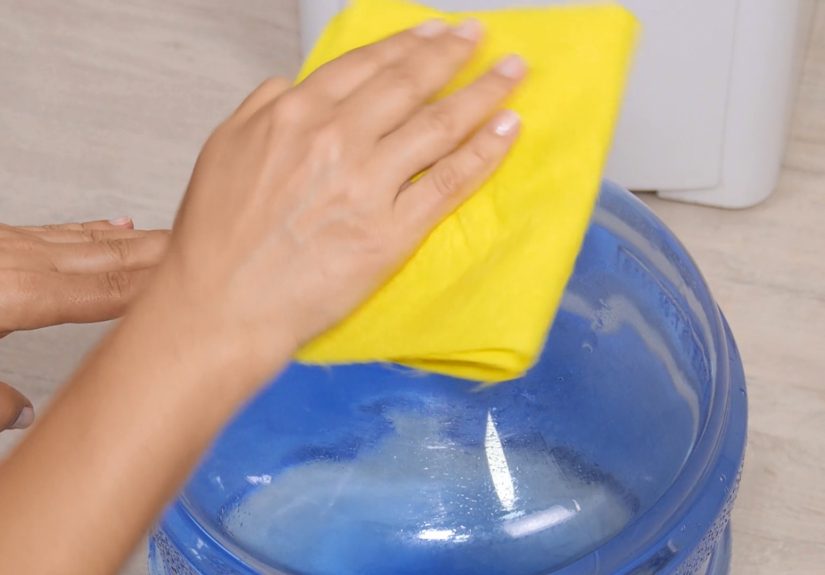
- Pour the solution into the reservoir (the area where the bottle feeds water).
- Let it sit 5–10 minutes.
- Use a soft cloth or brush to gently wipe reachable surfaces.
- Dispense the solution through both spigots until the reservoir is mostly emptied.
Option B: Bleach Clean (for stronger sanitizing)
- Mix 1 tablespoon unscented household bleach per 1 gallon of water.
- Pour into the reservoir carefully.
- Let it sit about 5 minutes (or the time your manufacturer recommends).
- Dispense some solution through both spigots to pull it through internal lines.
3) Rinse like you mean it
Rinsing is what separates “clean” from “my water tastes like a science experiment.”
- Fill the reservoir with clean water (or install a fresh bottle) and dispense through both spigots.
- Repeat until no vinegar smell and no bleach smell remains.
- As a rule of thumb, plan on at least 2 full rinse rounds for vinegar and 2–3 rounds for bleach.
4) Reassemble and restart
- Reinstall baffle/splash guard and drip tray.
- Install a fresh bottle.
- Plug the dispenser back in, turn switches on, and discard the first few cups of water.
Step-by-Step: Clean a Bottom-Load Water Dispenser
Bottom-load models often work best with an “empty bottle cleaning method,” because you can feed the cleaning
solution through the intake system like normal operation.
1) Drain and remove the bottle
- Unplug and turn off hot/cold switches.
- Remove the bottle from the cabinet and drain remaining water through the spigots.
2) Make a cleaning bottle (choose ONE)
Option A: Vinegar cleaning bottle
- In an empty bottle/jug, add vinegar + warm water (common manufacturer approach uses a couple cups of vinegar with a couple gallons of water).
- Attach the bottle to the dispenser intake as if it were a water bottle.
- Allow the solution to fill internal reservoirs.
- Dispense through both spigots until you’ve moved the solution through the system.
Option B: Bleach cleaning bottle
- Use a mild bleach dilution (often manufacturer-style guidance uses a small measured amount of bleach in several gallons of water).
- Run it through both spigots so internal lines get treated.
- Do not exceed recommended concentrationsmore is not “more clean,” it’s “more regret.”
3) Rinse thoroughly
- Remove the cleaning bottle.
- Install a fresh water bottle.
- Dispense and drain several rounds until there’s no odor or taste of the cleaner.
Countertop Dispensers and Bottleless (Plumbed-In) Units
Countertop units are usually a simplified version of top-load cleaning: unplug, remove the bottle,
clean the reservoir, run solution through spigots, rinse thoroughly.
Bottleless units often include filters. Follow the manufacturer instructions for filter removal and
replacement, and avoid soaking filters in bleach or vinegar unless the manual explicitly says it’s safe.
If your unit has a “self-clean” function (often ozone-based), treat it as a helpernot a lifetime exemption from
real cleaning.
Don’t Forget the Parts People Actually Touch
Spigots and buttons
These get touched constantly, so wipe them regularly with mild soap and water. If you’re doing a bleach-cleaning
cycle internally, you can also wipe exterior surfaces with a properly diluted solution and then rinse/wipe with
clean water. Always keep bleach away from fabrics and anything you don’t want “mysteriously lighter.”
Drip tray
If your dispenser smells “off,” the drip tray might be the culprit. Remove it, scrub it, rinse well, and dry.
Standing water in the tray is basically a spa day for microbes.
How Often Should You Clean a Water Dispenser?
- Every 3–4 months: a common baseline for routine cleaning in many manuals and cleaning guides.
- Monthly: if it’s in an office, a busy household, or a warm/humid location.
- Immediately: if you notice slime, mold, persistent odor, or a taste that makes you side-eye your cup.
Also consider cleaning after long periods of non-use (vacation home, dorm move-in, etc.).
Troubleshooting: “I Cleaned It… So Why Does It Still Taste Weird?”
If you used vinegar
- Likely issue: Not enough rinsing.
- Fix: Run additional rinse cycles and discard the first few cups.
- Tip: If hard-water scale is heavy, repeat the vinegar clean (it may take two rounds).
If you used bleach
- Likely issue: Bleach mix too strong or not rinsed enough.
- Fix: Flush with multiple full reservoirs/bottles of clean water until odor is gone.
- Tip: Next time, stick to a manufacturer-friendly mild solution.
If the taste is “plastic”
- Likely issue: New unit break-in, or parts need a simple soap-and-water wash.
- Fix: Wash removable parts, rinse thoroughly, run a vinegar cycle, then rinse.
If flow is slow
- Likely issue: Mineral buildup or a clogged nozzle/baffle.
- Fix: Vinegar soak for removable parts; consider filter replacement for bottleless units.
What NOT to Do (Unless You Like Bad Ideas)
- Don’t mix bleach and vinegar. Ever.
- Don’t “eyeball” bleach. Measure it. Your lungs will appreciate the precision.
- Don’t clean while the unit is plugged in. Electricity + water is a terrible buddy comedy.
- Don’t soak filters in bleach unless the manufacturer says it’s okay.
- Don’t skip rinsing. Cleaning solution should not become a beverage flavor.
FAQ
Is it safe to clean a water dispenser with bleach?
Yeswhen diluted properly and followed by thorough rinsing. Use unscented household
bleach and stick to mild concentrations commonly recommended for routine sanitizing unless your manual specifies
something different.
Is vinegar enough to disinfect a water dispenser?
Vinegar is great for cleaning and mineral deposits, but it’s not considered a high-level disinfectant the way
properly diluted bleach is. Many people use vinegar for routine maintenance and bleach periodically for deeper
sanitizingon separate days, never mixed.
Can I use cleaning vinegar instead of white distilled vinegar?
Cleaning vinegar is more acidic than standard white vinegar, which can make it more aggressive on buildup. If you
use it, dilute it and rinse well. When in doubt, regular white distilled vinegar is the safer default.
Do I need to clean a brand-new dispenser?
Many new units are “ready out of the box,” but a quick wash of removable parts and a full rinse cycle can help
remove manufacturing dust or packaging odors. If the first water tastes odd, a mild vinegar rinse often helps.
Experiences & Real-World Lessons: What Cleaning a Water Dispenser Looks Like in Everyday Life
People rarely clean their water dispenser because they wake up inspired by the idea of “sanitizing internal lines.”
They clean it because something happens. The water tastes a little flat. The drip tray starts smelling like a damp
gym bag. Or someone in the house says, “Is the water supposed to taste… spicy?” (Spoiler: no.)
One common experience in busy households is the “end-of-bottle lull.” When the bottle is low, the dispenser gets
used up quickly, and the new bottle goes in right away. That’s convenient, but it can also mean you go months
without ever seeing the inside reservoir areaout of sight, out of mind. The first sign you’ve waited too long is
often not a visible problem, but a subtle change in taste. In those cases, a vinegar clean tends to feel like
magic: the slightly stale taste improves, and the unit smells fresher. The lesson: vinegar is fantastic for
routine maintenance, especially in hard-water areas where scale creeps up quietly.
In office break rooms (or any place where “someone else will handle it” is the official motto), dispensers can get
a double dose of neglect: heavy use plus nobody owning the cleaning schedule. The real-world fix that actually
sticks is making cleaning “event-based” instead of “calendar-based.” For example: clean every time you finish a
case of water bottles, or every time the coffee supplies are restocked. It creates a rhythm people remember. In
those higher-traffic settings, a mild bleach sanitizing cycle every few monthsfollowed by serious rinsingoften
helps reset the dispenser when vinegar alone can’t keep up with the funk.
Another experience people report: cleaning the reservoir and still getting odor. The culprit is frequently the
drip tray and spigots. Those areas are touched constantly and splashed often. If the tray is removable, it can
hide a lot of gunk in corners and grooves. A simple habitemptying and washing the drip tray weeklyprevents that
“mystery smell” from returning right after you’ve done a deep clean. It’s the cleaning equivalent of brushing
your teeth instead of relying on mouthwash once a year.
Bottom-load dispensers come with their own real-life quirk: people forget they still need cleaning because the
bottle is tucked away behind a door. The “cleaning bottle” trick is a game-changer here. Filling an empty bottle
with your vinegar or mild bleach solution and letting the dispenser pull it through like normal water feels
satisfyinglike you’ve tricked the machine into cleaning itself. Just remember that the rinse step matters even
more for bottom-load units because the internal water path is longer. If you’re still tasting vinegar after one
rinse cycle, it doesn’t mean the dispenser is broken. It means you’ve discovered the secret truth of cleaning:
rinsing is most of the job.
Finally, many people learn the “less is more” rule with bleach the hard way. They assume stronger means cleaner,
then spend the next hour rinsing and wondering why the water tastes like a swimming pool. A mild bleach solution
(and patience with rinsing) is usually the best experience: effective sanitizing without turning hydration into a
chemistry lab. The practical takeaway is simple: measure carefully, never mix products, ventilate the area, and
rinse until there’s no hint of odor. Do that, and your water dispenser goes back to being what it should be:
boring, clean, great-tasting waterno surprises.