Table of Contents >> Show >> Hide
- What Is a Mixed Number (and Why Does It Feel So… Mixed)?
- The Core Method: Multiply Mixed Numbers in 4 Steps
- Step-by-Step Examples of Multiplying Mixed Numbers
- Shortcut Skills: How to Simplify Faster (Without Guessing)
- Alternative Strategy: Multiply Mixed Numbers with the Distributive Property
- Common Mistakes (and How to Avoid Them)
- Quick “Check Yourself” Checklist
- Extra Practice Problems (with Answers)
- Experiences That Make Mixed-Number Multiplication “Click” (About )
- Conclusion
Mixed numbers are like a fraction wearing a whole-number hoodie: they look friendly… until you try to multiply them and your brain briefly turns into a loading icon.
The good news? Multiplying mixed numbers is not a mysterious ancient ritual. It’s a repeatable process with a few clean stepsand once you learn the “convert, multiply, simplify” rhythm,
you’ll start spotting shortcuts like a math magician (minus the cape, unless you’re into that).
In this guide, you’ll learn exactly how to multiply mixed numbers step-by-step, see several fully worked examples, learn quick simplification tricks,
and avoid the most common mistakes that turn a correct answer into a sad trombone sound.
What Is a Mixed Number (and Why Does It Feel So… Mixed)?
A mixed number is a whole number plus a proper fraction, like 2 1/3 or 5 3/4.
It’s just another way to write a value greater than 1. Mixed numbers are super common in real liferecipes, woodworking, sewing, and anywhere measurements show up.
When you multiply mixed numbers, the easiest path is to temporarily stop using the “whole + fraction” format and switch to an improper fraction
(a fraction where the numerator is greater than or equal to the denominator). Then you multiply like normal fractions.
The Core Method: Multiply Mixed Numbers in 4 Steps
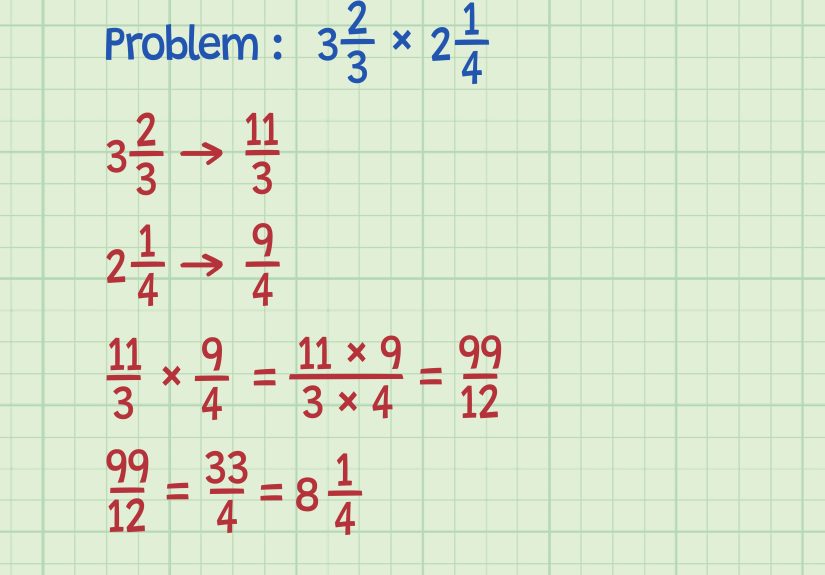
Step 1: Convert each mixed number to an improper fraction
Use this reliable recipe (pun intended):
(whole × denominator) + numerator becomes your new numerator, and the denominator stays the same.
Example conversion: Convert 3 3/4 to an improper fraction.
- Whole = 3, denominator = 4, numerator = 3
- (3 × 4) + 3 = 12 + 3 = 15
- So, 3 3/4 = 15/4
Step 2: Multiply the numerators
Once everything is in fraction form, multiply straight across:
numerator × numerator.
Step 3: Multiply the denominators
Same idea for the bottoms: denominator × denominator.
Step 4: Simplify (reduce) and convert back to a mixed number if needed
If your answer can be reduced, reduce it. If the result is an improper fraction, you can convert it back to a mixed number
(unless your teacher or instructions prefer improper fractionsalways check).
That’s the whole method. It’s basically: convert → multiply → simplify.
No secret handshake required.
Step-by-Step Examples of Multiplying Mixed Numbers
Example 1: Multiply two mixed numbers
Problem: 1 1/2 × 2 1/3
-
Convert to improper fractions:
- 1 1/2 = (1×2 + 1)/2 = 3/2
- 2 1/3 = (2×3 + 1)/3 = 7/3
- Multiply: (3/2) × (7/3) = (3×7)/(2×3) = 21/6
- Simplify: 21/6 = 7/2
- Convert to a mixed number: 7/2 = 3 1/2
Answer: 3 1/2
Example 2: Multiply and use simplification to make life easier
Problem: 3 3/4 × 1 2/5
-
Convert:
- 3 3/4 = (3×4 + 3)/4 = 15/4
- 1 2/5 = (1×5 + 2)/5 = 7/5
-
Before multiplying, look for cross-canceling:
- 15/4 × 7/5 → 15 and 5 share a factor of 5
- 15 ÷ 5 = 3, and 5 ÷ 5 = 1
- Now it’s 3/4 × 7/1
- Multiply: (3×7)/(4×1) = 21/4
- Convert: 21/4 = 5 1/4
Answer: 5 1/4
Example 3: Multiply a mixed number by a whole number
Problem: 4 2/3 × 6
- Convert 4 2/3 = (4×3 + 2)/3 = 14/3
- Rewrite 6 as 6/1
-
Cross-cancel to simplify early:
- 14/3 × 6/1 → 6 and 3 share a factor of 3
- 6 ÷ 3 = 2, and 3 ÷ 3 = 1
- Now it’s 14/1 × 2/1
- Multiply: 14 × 2 = 28
Answer: 28
Example 4: A real-world style word problem
Problem: A recipe uses 1 1/4 cups of flour per batch. You’re making 3 1/2 batches.
How much flour do you need?
- Convert: 1 1/4 = 5/4 and 3 1/2 = 7/2
- Multiply: (5/4) × (7/2) = 35/8
- Convert: 35/8 = 4 3/8
Answer: 4 3/8 cups
Shortcut Skills: How to Simplify Faster (Without Guessing)
1) Cross-cancel before you multiply
If you see a factor in one numerator and a factor in the opposite denominator, reduce first.
This keeps numbers smaller, lowers the chance of arithmetic mistakes, and makes you look like you know what you’re doing (because you do).
Quick reminder: Cross-cancel means dividing one numerator and the other fraction’s denominator by the same number.
2) Simplify the final fraction (reduce to lowest terms)
To simplify, divide the numerator and denominator by their greatest common factor (GCF). If you’re not sure of the GCF,
start with small primes (2, 3, 5, 7…) and work up. If both numbers are even, 2 is your best first friend.
3) Convert improper fractions to mixed numbers cleanly
If your result is improper (top bigger than bottom), divide numerator ÷ denominator:
the quotient becomes the whole number, and the remainder becomes the new numerator.
Example: 21/4 → 21 ÷ 4 = 5 remainder 1 → 5 1/4
Alternative Strategy: Multiply Mixed Numbers with the Distributive Property
The “convert to improper fractions” method is the standard and fastest for most problems.
But sometimes a visual or distributive method helps you understand what’s happening.
Distributive idea
Think of a mixed number as a sum: 2 1/2 = 2 + 1/2.
Then you can multiply like this:
(a + b)(c + d) = ac + ad + bc + bd.
Example with distributive thinking
Problem: 2 1/2 × 1 3/4
- Rewrite: (2 + 1/2)(1 + 3/4)
- Multiply parts: 2×1 + 2×3/4 + 1/2×1 + 1/2×3/4
- = 2 + 6/4 + 1/2 + 3/8
- Simplify: 6/4 = 3/2
- Now add: 2 + 3/2 + 1/2 + 3/8
- 3/2 + 1/2 = 4/2 = 2 → so 2 + 2 + 3/8 = 4 3/8
Notice the answer matches the improper-fraction method: 2 1/2 = 5/2 and 1 3/4 = 7/4, so (5/2)(7/4)=35/8=4 3/8.
Same destinationdifferent route.
Common Mistakes (and How to Avoid Them)
Mistake 1: Forgetting to add the numerator after multiplying
When converting to an improper fraction, it’s (whole × denominator) + numerator. The “+ numerator” part is not optional.
Forgetting it is like making a sandwich and stopping after the bread.
Mistake 2: Multiplying the whole numbers and fractions separately (without distributing correctly)
Doing “whole×whole and fraction×fraction” is not a valid shortcut for mixed-number multiplication.
If you want to avoid improper fractions, use the distributive property properlyotherwise, convert and keep it simple.
Mistake 3: Not simplifying
Many problems expect answers in simplest form. If 21/6 becomes 7/2, do the simplification.
It’s not just neatnessit’s accuracy and standard math convention.
Mistake 4: Converting back to a mixed number incorrectly
When converting an improper fraction like 35/8:
35 ÷ 8 = 4 remainder 3 → 4 3/8.
The remainder is your numerator, and the denominator stays the same.
Quick “Check Yourself” Checklist
- Did I convert every mixed number to an improper fraction correctly?
- Did I multiply numerators together and denominators together (straight across)?
- Did I cross-cancel or simplify the final fraction?
- If the result is improper, did I convert it back to a mixed number correctly?
- Does the answer size make sense (rough estimate)?
A fast estimate trick: round mixed numbers to whole numbers and multiply. If your exact answer is wildly off,
it’s a sign you might have converted or simplified incorrectly.
Extra Practice Problems (with Answers)
- 2 1/3 × 1 1/2 = 3 1/2
- 5 2/5 × 2 = 10 4/5
- 1 3/4 × 3 1/3 = 5 5/6
- 4 1/2 × 2 2/3 = 12
Tip: Work them using the 4-step method first. After you’re comfortable, try cross-canceling earlier to speed up.
Experiences That Make Mixed-Number Multiplication “Click” (About )
If multiplying mixed numbers has ever made you feel like you’re juggling pizzas, rulers, and confusion all at oncewelcome to the club.
A very normal experience is understanding fractions separately and whole numbers separately, then feeling betrayed when a mixed number shows up like,
“Surprise! I’m both.” The breakthrough usually happens when you stop treating the mixed number as two disconnected pieces and start seeing it as
one single value that can be rewritten in a friendlier format (the improper fraction).
One common “aha” moment shows up during cooking or DIY measuring. Say you’re doubling a recipe that uses 1 1/2 cups of something.
Most people don’t panic therethey instinctively think, “Half of 1 1/2 is 3/4, so double is 3.” That’s actually the distributive property in disguise:
2 × (1 + 1/2) = 2×1 + 2×1/2. The math was always workingyou were just doing it with everyday logic. When students connect that feeling
to the formal steps, the process becomes less “rules” and more “oh, that’s what I was doing anyway.”
Another experience that helps is noticing how much easier the arithmetic becomes when you simplify early. The first time you cross-cancel and turn
something like 15/4 × 7/5 into 3/4 × 7/1, it feels like discovering a secret door in a video game. Suddenly your numbers are smaller,
your multiplication is faster, and you’re less likely to make a mistake copying giant products. People often report that their confidence spikes
not because they learned a brand-new method, but because they learned how to make the standard method smoother.
There’s also a super relatable “wait… does this answer make sense?” moment. Imagine multiplying 1 1/4 × 3 1/2.
Even before calculating, you can predict the answer should be a little bigger than 1×3.5 = 3.5, because 1 1/4 is bigger than 1.
So if someone gets 2 1/8, their brain should go, “Hold upmath is being suspicious.” Building that habitdoing a quick estimateturns mixed-number
multiplication into something you can self-check, not just hope-check.
Finally, many learners find it empowering to switch between methods. Improper fractions are fast. Distributive/area model thinking is visual.
When you can do both, you’re not stuck if a problem feels weird. You can say, “Fine, I’ll convert,” or “Fine, I’ll distribute,” and either way
you’re in control. That’s the real experience goal: mixed numbers stop being a “gotcha” and start being just another form you can rewrite
whenever it’s convenient.