Table of Contents >> Show >> Hide
- What Is Algebraic Chess Notation?
- Step 1: Learn the Names of the Squares
- Step 2: Memorize the Piece Letters
- Step 3: Read Normal Moves
- Step 4: Understand Captures
- Step 5: Decode Check, Checkmate, and Game Results
- Step 6: Learn Castling, Promotion, and En Passant
- Step 7: Handle Ambiguous Moves and Annotation Symbols
- A Full Example of Algebraic Chess Notation
- Why Learning Chess Notation Makes You Better
- Common Beginner Mistakes When Reading Algebraic Notation
- Practice Section: Read These Moves
- Extra Experience: What It Feels Like to Learn Algebraic Chess Notation
- Conclusion
Algebraic chess notation looks intimidating the first time you see it. A move like Nf3 seems harmless enough, but then chess books start throwing around things like Raxd1, exd8=Q+, and O-O-O, and suddenly it feels as if the pieces joined a secret government agency. Relax. Algebraic notation is not a code designed to keep beginners out of the clubhouse. It is simply the standard way chess players write down moves.
Once you learn how to read algebraic chess notation, you can follow master games, understand chess books, review your own games, use a scoresheet in tournaments, and replay famous battles without needing someone to push the pieces for you. Even better, the system is logical. Every square has a name, every piece has a symbol, and every move tells a tiny story: which piece moved, where it went, whether it captured something, and whether the king is now having a very bad afternoon.
This guide explains how to read algebraic chess notation in 7 steps, with practical examples, beginner-friendly explanations, and enough humor to keep your brain from castling away from the topic.
What Is Algebraic Chess Notation?
Algebraic chess notation is the most widely used system for recording chess moves. It uses board coordinates, piece abbreviations, capture symbols, check symbols, and special move symbols to describe what happens in a game. In simple terms, it turns a chess game into a readable move-by-move script.
For example, the move 1. e4 means White’s first move is a pawn move to the square e4. The reply 1… e5 means Black also moves a pawn to e5. The move 2. Nf3 means White moves a knight to f3. Congratulations: you are already reading chess notation. Your membership card is in the mail, probably delivered by a bishop on the long diagonal.
Step 1: Learn the Names of the Squares
The chessboard has 64 squares. In algebraic notation, each square has a unique name made from one letter and one number. The letters a through h name the vertical columns, called files. The numbers 1 through 8 name the horizontal rows, called ranks.
The board is always named from White’s perspective. That means White’s left corner is a1, and White’s right corner is h1. Black’s back rank is the eighth rank, so Black’s original king starts on e8, while White’s king starts on e1.
Quick square examples
- e4: a central square often used by White’s king pawn.
- d5: another central square, frequently involved in pawn tension.
- a1: White’s queenside rook starts here.
- h8: Black’s kingside rook starts here.
If you want to get comfortable fast, practice naming random squares. Look at a board and say, “That square is c6,” or “That one is f2.” At first, you may count files like a sleepy accountant. After a little practice, the coordinates become automatic.
Step 2: Memorize the Piece Letters
In algebraic notation, most pieces are represented by capital letters. The king is K, the queen is Q, the rook is R, the bishop is B, and the knight is N. The knight uses N because the king already grabbed K and refuses to share. Very royal behavior.
Piece abbreviations
- K = King
- Q = Queen
- R = Rook
- B = Bishop
- N = Knight
Pawns are different. They do not get a letter in normal algebraic notation. If a pawn moves to e4, the move is written simply as e4, not Pe4. Pawns do all the hard work and still get no initials. Chess is not always fair.
Step 3: Read Normal Moves
A basic move in algebraic chess notation usually combines the piece letter with the destination square. The destination square tells you where the piece lands, not where it started.
Examples of normal piece moves
- Nf3 means a knight moves to f3.
- Bc4 means a bishop moves to c4.
- Qh5 means the queen moves to h5.
- Re1 means a rook moves to e1.
For pawn moves, you only write the destination square:
- e4 means a pawn moves to e4.
- d5 means a pawn moves to d5.
- c3 means a pawn moves to c3.
The move number tells you where you are in the game. In 1. e4 e5, White’s first move is e4 and Black’s first move is e5. Sometimes Black’s move is shown with three dots, like 1… e5, especially when the notation begins with Black’s reply.
Step 4: Understand Captures
Captures are marked with the letter x. That little x is chess notation’s way of saying, “Something was removed from the board, and it probably had plans.”
Piece captures
- Bxe5 means a bishop captures a piece on e5.
- Nxd4 means a knight captures a piece on d4.
- Qxf7 means the queen captures something on f7.
Pawn captures are slightly different. Since pawns do not use a piece letter, the notation shows the file the pawn came from, then x, then the destination square.
Pawn capture examples
- exd5 means a pawn from the e-file captures on d5.
- cxb4 means a pawn from the c-file captures on b4.
- gxh8=Q means a pawn from the g-file captures on h8 and promotes to a queen.
This origin file matters because pawns capture diagonally. A pawn on e4 does not capture forward onto e5; it captures diagonally onto d5 or f5. Notation follows that movement pattern.
Step 5: Decode Check, Checkmate, and Game Results
Algebraic notation also tells you when the king is under attack. A plus sign + means check. A hash sign # or sometimes double plus ++ means checkmate, depending on the notation style used. Modern chess writing most commonly uses # for checkmate.
Check and checkmate examples
- Qh5+ means the queen moves to h5 and gives check.
- Bb5+ means the bishop moves to b5 and gives check.
- Qxf7# means the queen captures on f7 and delivers checkmate.
Game results are usually written at the end of the score:
- 1-0 means White wins.
- 0-1 means Black wins.
- 1/2-1/2 means the game is a draw.
So if you see a game end with Qh7# 1-0, White has delivered checkmate and won. If you are Black in that position, this is a good time to develop a sudden interest in post-game handshakes.
Step 6: Learn Castling, Promotion, and En Passant
Special moves have special notation. Fortunately, there are only a few to memorize.
Castling notation
Castling kingside is written as O-O. Castling queenside is written as O-O-O. These are capital letter O’s, not zeroes, though many fonts make them look similar. Kingside castling uses two O’s because the king moves toward the rook on the shorter side. Queenside castling uses three O’s because it is the longer side, and apparently notation enjoys dramatic flair.
- O-O = kingside castling
- O-O-O = queenside castling
Promotion notation
When a pawn reaches the last rank, it promotes. In notation, the promoted piece is shown with an equals sign.
- e8=Q means a pawn moves to e8 and promotes to a queen.
- d1=N+ means a pawn promotes to a knight on d1 and gives check.
- axb8=R means a pawn from the a-file captures on b8 and promotes to a rook.
En passant notation
En passant is the special pawn capture that makes beginners say, “Wait, is that legal?” Yes, it is. In algebraic notation, an en passant capture is usually written like a normal pawn capture, sometimes with e.p. added for clarity.
- exd6 may indicate an en passant capture if the position allows it.
- exd6 e.p. explicitly says the capture was en passant.
The important detail is that the destination square is where the capturing pawn lands, not where the captured pawn was standing. En passant is weird, but the notation handles it neatly.
Step 7: Handle Ambiguous Moves and Annotation Symbols
Sometimes two pieces of the same type can move to the same square. When that happens, algebraic notation adds extra information so you know which piece moved. This is called disambiguation, which is a long word meaning “please don’t make me guess.”
Ambiguous move examples
- Nbd2 means the knight from the b-file moves to d2.
- Rae1 means the rook from the a-file moves to e1.
- R1e2 means the rook from the first rank moves to e2.
Without the extra file or rank, the move would be unclear. If two knights can both land on d2, simply writing Nd2 would not identify the correct knight. Adding b in Nbd2 solves the problem.
You may also see symbols used in chess books and game annotations. These are not part of the basic move itself, but they tell you how strong or weak a move is.
Common annotation symbols
- ! = good move
- !! = brilliant move
- ? = mistake
- ?? = blunder
- !? = interesting move
- ?! = questionable move
For example, Nxf7! means the knight captures on f7 and the annotator thinks it is a good move. Qh5?? means the queen moved to h5 and the annotator is probably shaking their head into a cup of coffee.
A Full Example of Algebraic Chess Notation
Let’s look at a short opening sequence:
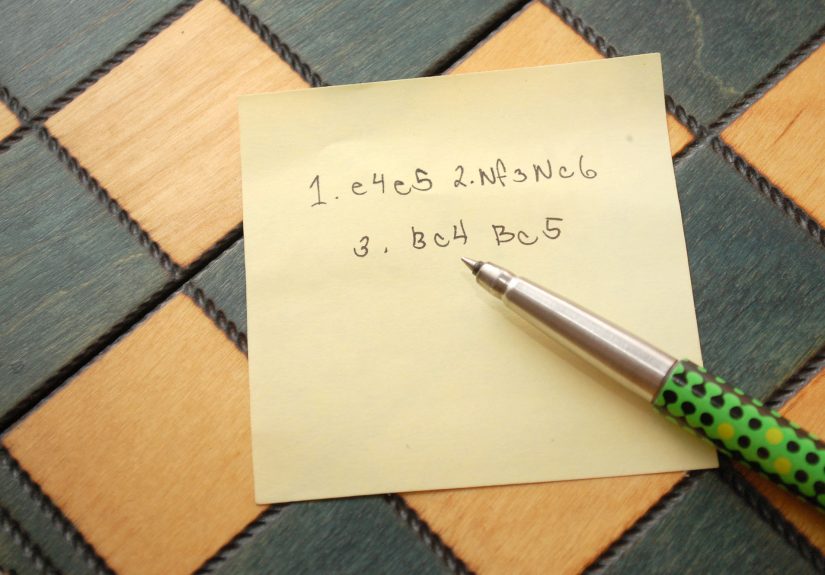
1. e4 e5 2. Nf3 Nc6 3. Bb5 a6
Here is how to read it:
- 1. e4: White moves a pawn to e4.
- 1… e5: Black moves a pawn to e5.
- 2. Nf3: White moves a knight to f3.
- 2… Nc6: Black moves a knight to c6.
- 3. Bb5: White moves a bishop to b5.
- 3… a6: Black moves a pawn to a6.
This is the beginning of the Ruy Lopez, one of the most famous chess openings. Once you can read notation, openings become easier to study because you can follow the sequence instead of relying only on diagrams.
Why Learning Chess Notation Makes You Better
Reading algebraic chess notation is not just about looking sophisticated at the chess club, though that is a nice bonus. It directly improves your chess learning. When you understand notation, you can replay your games, find mistakes, study grandmaster games, read chess books, solve puzzles, and communicate positions clearly.
Notation also helps you slow down and think. Writing a move on a scoresheet after making it encourages awareness of the position. Reviewing the written game later can reveal patterns: maybe you move the same piece too often, miss tactics on the f-file, or forget that your queen is not a superhero with legal immunity.
For online players, notation is everywhere. Game review tools, databases, opening explorers, and puzzle trainers all use algebraic notation. If you know the language, you can learn faster and waste less time trying to decode moves.
Common Beginner Mistakes When Reading Algebraic Notation
Confusing the starting square with the destination square
In standard algebraic notation, the square shown is usually the destination. Nf3 means a knight goes to f3, not that a knight starts on f3.
Writing pawn moves with P
Do not write Pe4 in standard notation. Pawns are written only by destination square, such as e4 or h6.
Forgetting the origin file on pawn captures
A pawn capture needs the starting file. Write exd5, not just xd5.
Mixing up castling symbols
O-O is kingside castling. O-O-O is queenside castling. Think of the extra O as the queen’s dramatic entrance music.
Practice Section: Read These Moves
Try reading these moves out loud:
- Qxe5+: The queen captures on e5 and gives check.
- Nbd7: The knight from the b-file moves to d7.
- O-O: The player castles kingside.
- cxd8=Q#: A pawn from the c-file captures on d8, promotes to a queen, and gives checkmate.
- Rfe1: The rook from the f-file moves to e1.
If you understood those, you are no longer staring at notation like it is a mysterious restaurant receipt. You are reading chess.
Extra Experience: What It Feels Like to Learn Algebraic Chess Notation
Learning algebraic notation often feels awkward at first, especially if you are used to simply dragging pieces online and letting the computer handle everything. The first experience is usually something like this: you see 1. e4 and think, “Okay, pawn to e4. Easy.” Then you see 2. Nf3 and pause because the knight is represented by N, not K. Then a move like exd5 appears, and your brain briefly opens fifteen tabs at once.
That confusion is normal. The trick is to connect notation to the board physically. Set up a real chessboard or use a board editor online. Read one move at a time and make that move. Do not rush. The goal is not to memorize a dictionary of symbols in one sitting. The goal is to build a habit: piece, destination, capture, check, special detail.
One helpful exercise is replaying a famous short game. Choose a miniature game with fewer than 25 moves. Cover the board diagram if there is one, then use only the notation to play through the game. At first, you will stop often. You may move the wrong knight. You may confuse b5 with g5. You may castle the wrong way and briefly invent illegal chess. That is fine. Mistakes make the coordinates stick.
Another useful habit is saying the move in plain English. For example, when you see Bb5, say, “Bishop to b5.” When you see Nxd4, say, “Knight captures on d4.” When you see Qh5+, say, “Queen to h5 check.” This turns abstract symbols into meaningful chess actions.
If you play over-the-board games, practice writing your own moves after you make them. Do not worry about creating museum-quality handwriting. Just make it clear enough that future-you can understand it. Future-you is the person who will later analyze the game and ask, “Why did I sacrifice that bishop?” Clear notation gives future-you a fighting chance.
For beginners, the hardest part is often board coordinates. Many players know how pieces move but do not instantly recognize squares. A simple drill can help: name all the squares along a file, such as a1 to a8, then a diagonal, such as a1-b2-c3-d4-e5-f6-g7-h8. This builds board vision. Strong players do not calculate by staring at the board like it owes them money; they see coordinates, patterns, and routes.
Algebraic notation also makes chess more social. You can text a friend, “I missed Nxf7!” and they will understand the idea. You can follow a commentator discussing Rae1 without needing the camera angle to be perfect. You can read classic games and modern analysis. It is like learning the alphabet of chess literature.
The best part is that notation becomes invisible with practice. At first, you read Qxe5+ as symbols. Later, you instantly see the queen swooping to e5 with check. That shift is powerful. Once notation stops feeling like homework, it becomes a tool for improvement, memory, and enjoyment. And unlike some chess openings, algebraic notation will not betray you on move seven.
Conclusion
Learning how to read algebraic chess notation is one of the most useful skills a chess player can develop. It helps you record games, study openings, follow tactics, understand chess books, analyze mistakes, and communicate clearly with other players. The system may look strange at first, but it is built on simple ideas: every square has a coordinate, every major piece has a letter, captures use x, checks use +, checkmates use #, and special moves have special symbols.
Start with the board coordinates, memorize the piece letters, practice normal moves, then add captures, checks, castling, promotion, en passant, and ambiguous moves. Soon, notation will feel less like a secret code and more like a game transcript. Once you can read it smoothly, every chess book, database, puzzle, and scoresheet becomes easier to use. That is a small skill with a big payoff.