Table of Contents >> Show >> Hide
- Before You Start: Set Yourself Up for Success
- How to Wheelie on a BMX Bike in 8 Steps
- Step 1: Start at a Comfortable Rolling Speed
- Step 2: Get into the Right Body Position
- Step 3: Set Your Power Pedal
- Step 4: Punch the Pedal and Shift Your Weight Back
- Step 5: Keep Your Chest Up and Your Arms Fairly Straight
- Step 6: Cover and Feather the Rear Brake
- Step 7: Steer with Balance, Not Big Handlebar Turns
- Step 8: Practice Safe Bailouts and Repeat in Short Sessions
- Common BMX Wheelie Mistakes and How to Fix Them
- Wheelie vs. Manual: What Is the Difference?
- What Learning a BMX Wheelie Actually Feels Like: Real Experience and Practice Notes
- Final Thoughts
- SEO Tags
A wheelie is one of those BMX skills that looks effortless right up until you try it and discover your bike has suddenly become a small, stubborn horse. The good news? Learning how to wheelie on a BMX bike is absolutely doable for beginners when you break it down into simple parts: body position, timing, rear-brake control, and a lot of calm repetition.
If you are picturing a clean, floating front wheel, a relaxed posture, and a smooth roll across the pavement, you are not wrong. But the path to that dreamy BMX wheelie usually starts with short pops, awkward wobbles, and the occasional emergency foot-to-ground bailout. That is normal. In fact, it is practically a rite of passage.
This guide walks you through 8 practical steps to learn a BMX wheelie safely and efficiently. You will also get common mistake fixes, real-world practice tips, and a longer section on what the learning experience actually feels like, because nobody talks enough about the emotional roller coaster of trying to lift a front wheel with dignity.
Before You Start: Set Yourself Up for Success
Before you work on any BMX trick, make the boring decisions that keep you in one piece. Wear a properly fitted bike helmet, make sure your brakes work well, and check your tire pressure. On a BMX bike, the rear brake matters a lot when learning wheelies because it is your main “nope” button when the front end comes up too high.
Pick a safe practice spot too. A smooth, open parking lot is ideal. A very slight uphill can make learning easier because it slows the bike just enough to help you find control without feeling like you are rocketing into the next zip code. Avoid traffic, crowded paths, loose gravel, and any place where a failed attempt could turn into a handshake with a parked car.
If your BMX has flat pedals, great. If not, use whatever gives you the easiest, quickest exit. Wheelies are much easier to learn when you know you can step off cleanly instead of having a dramatic argument with your pedals.
How to Wheelie on a BMX Bike in 8 Steps
Step 1: Start at a Comfortable Rolling Speed
You do not need a huge run-up. In fact, too much speed makes beginners tense, and tense riders rarely do elegant anything. Roll at a moderate, steady pace that feels controlled. Think “casual neighborhood cruise,” not “trying to qualify for the Olympics.”
On a typical single-speed BMX bike, you are not choosing gears like you would on a mountain bike. Instead, your setup comes from speed and pedal timing. You want enough momentum to keep moving once the front wheel lifts, but not so much that the trick feels wild.
A slight incline can help here because it naturally slows you down and gives your pedal stroke more purpose. It is like training wheels for confidence, except much cooler and far less adorable.
Step 2: Get into the Right Body Position
A good BMX wheelie starts with your body, not your arms. Stay relaxed, keep your chest proud instead of folded forward, and keep a light bend in your elbows. If you are death-gripping the handlebars like they owe you money, loosen up.
You will usually learn the pedal wheelie best while seated or hovering very lightly near the saddle, depending on your bike setup and comfort level. Either way, your weight needs to be ready to move backward smoothly. Think of your body as the counterweight that helps the front wheel rise.
Keep your eyes looking ahead, not straight down at the front tire. Looking down makes your posture collapse and your line wander. A wheelie is already a balance challenge. No need to add “accidental snake path” to the job description.
Step 3: Set Your Power Pedal
This is one of the most important pieces beginners miss. Put your stronger foot in the “power” position near the top of the pedal stroke, roughly around 12 o’clock to 1 o’clock. This gives you a strong downstroke to initiate the lift.
Why does this matter? Because a wheelie is not just yanking up on the bars. The real magic comes from combining a purposeful pedal punch with a weight shift. If the pedal is in a weak position, your wheelie attempt will usually look like a confused shrug from the front wheel.
Take a few slow rolls where you only practice finding that power position. It sounds simple, and it is, but it teaches your body when the move actually begins.
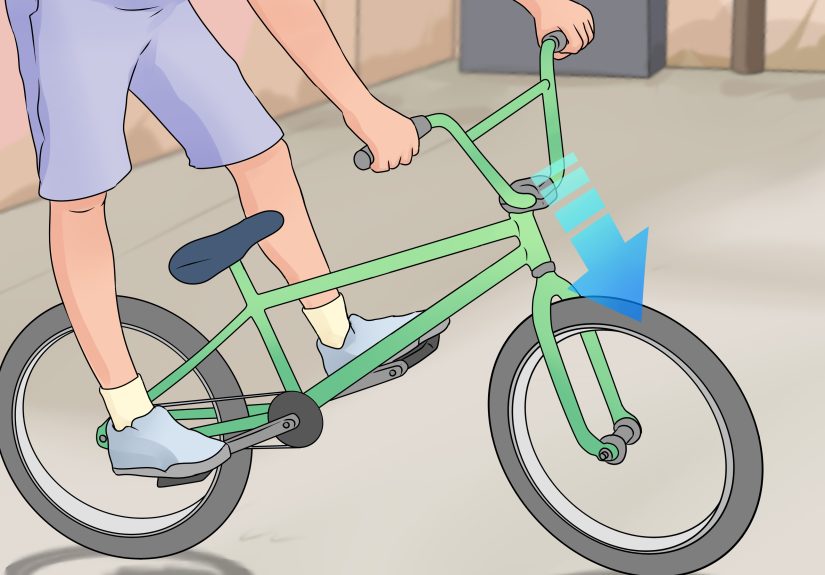
Step 4: Punch the Pedal and Shift Your Weight Back
Now the fun starts. As your power pedal comes down, drive it firmly and shift your weight backward at the same time. This is the moment where the wheelie is born. The goal is to create a smooth, connected movement, not two separate actions.
Do not think “pull the bars up.” Think “push through the pedals and let the front end rise.” Your arms can guide the bike, but your legs and hips are doing the heavy lifting. If you only yank with your arms, you will usually get a jerky little pop followed by disappointment.
On a BMX bike, which is compact and responsive, the front wheel can come up quickly. That is why this step should feel deliberate rather than explosive. Controlled power beats wild drama every time.
Step 5: Keep Your Chest Up and Your Arms Fairly Straight
Once the front wheel comes up, resist the urge to curl the handlebars into your lap. That is a common beginner move, and it makes the bike wobble. Instead, keep your chest up and your arms more extended than bent. This helps the bike track straighter and gives you better balance.
Think about creating space between your torso and the bars. You are not trying to cuddle the BMX. You are trying to guide it. A wheelie becomes easier to control when your upper body stays calm and open instead of cramped and twitchy.
If the bike starts drifting side to side, check your shoulders. Riders often twist without realizing it. Square shoulders and a calm head usually clean up a sloppy line in a hurry.
Step 6: Cover and Feather the Rear Brake
If there is one skill that separates “I almost wheelied” from “I can actually learn this,” it is rear-brake control. Keep at least one finger ready on the rear brake lever. When the front wheel rises too high, gently tap the rear brake to bring it back down.
This is what saves you from looping out, which is the deeply memorable experience of tipping too far backward and discovering gravity still works. The rear brake is your safety net, your reset button, and your confidence booster all at once.
Practice this on purpose. Lift the front wheel a little higher than usual, tap the rear brake, and feel how the bike settles. The more your brain trusts that brake, the less panic you will carry into each attempt.
Step 7: Steer with Balance, Not Big Handlebar Turns
When you first learn how to wheelie on a BMX bike, you will probably drift left or right. That is normal. The fix is usually not a huge steering correction. Big handlebar turns often make the wobble worse.
Instead, think about steering with subtle body adjustments. A slight shift in hips, knees, or shoulders can help straighten the bike. Gentle handlebar inputs are fine, but they should be tiny. Wheelies reward calm, small corrections, not wrestling moves.
Also remember that continued pedaling helps maintain balance. If the front wheel starts dropping too soon, another measured pedal stroke can bring it back. Wheelies are dynamic, not frozen. You are constantly making little decisions.
Step 8: Practice Safe Bailouts and Repeat in Short Sessions
You are not really learning wheelies until you also learn how to get out of bad attempts safely. If the bike gets away from you, step off behind it or to the side in a controlled way. Do not wait until you are fully panicking to decide you would like your feet back on the ground.
Keep sessions short and focused. Ten to twenty minutes of quality practice beats an hour of tired, messy attempts. When your form falls apart, your learning slows down and your risk goes up.
A simple session might look like this: five minutes of power-pedal setup, five minutes of front-wheel lifts, five minutes of wheelie attempts with rear-brake taps, and then you call it a day feeling like a disciplined BMX wizard instead of a cooked noodle.
Common BMX Wheelie Mistakes and How to Fix Them
You Are Pulling Too Hard with Your Arms
If the front wheel jerks up and crashes down immediately, you are probably muscling the trick instead of timing it. Focus on pushing through the pedal and moving your hips back. The bars should come up because the bike is responding, not because you are trying to row a canoe.
You Are Not Leaning Back Enough
If the wheel barely lifts, your body position is likely too far forward. Many riders stay timid over the bars because they are afraid of going backward. That is understandable, but it also makes the wheelie almost impossible. Trust the rear brake and let your weight move back more decisively.
You Forget the Rear Brake
Beginners often remember the rear brake in theory and forget it completely in action. Drill it until it becomes automatic. A BMX wheelie feels much less scary when you know one light tap can end the chaos.
You Practice Too Fast
More speed is not more skill. If you are rushing across the lot, reduce your entry speed. Learning happens faster when you can actually feel the balance point instead of blasting past it.
You Keep Looking Down
Look forward. Your body tends to follow your eyes. Looking down folds your posture and makes steering messy. Pick a point ahead and ride toward it like you meant to be there all along.
Wheelie vs. Manual: What Is the Difference?
This confuses a lot of riders, so let’s clear it up. A wheelie uses pedaling to keep the front wheel up. A manual is done without pedaling, relying more on momentum and body position. On a BMX bike, both skills are useful, and they do overlap a bit, but they are not the same thing.
If you are a beginner, start with the wheelie. Pedaling gives you another tool to keep the bike balanced and moving. Manuals are awesome, stylish, and very fun, but they usually feel trickier at first because there is less forgiveness once the bike starts to drop.
What Learning a BMX Wheelie Actually Feels Like: Real Experience and Practice Notes
The first few sessions are usually humbling. You roll in feeling confident, tell yourself “Today is the day,” and then spend ten minutes lifting the front wheel about three inches. That is still progress. One of the weird truths about learning a wheelie is that your body understands the move before your brain trusts it.
Early on, most riders go through a pattern. Attempt one: not enough lift. Attempt two: too much arm pull. Attempt three: “Oh wow, that was actually close.” Attempt four: panic tap on the brake. Attempt five: accidental swerve into a line that would make a drunk shopping cart look stable. This is all part of the process. The skill is not built in one magical breakthrough. It is built from dozens of tiny corrections that slowly start sticking.
A lot of riders also discover that fear shows up in sneaky ways. You may think you are leaning back, but video will reveal that you are barely shifting at all. Or you may keep your finger near the rear brake, but never actually use it because your body freezes. That is why short drills help so much. Practice the rear-brake tap by itself. Practice finding the power pedal by itself. Practice little front-wheel lifts without trying to hold them. When you isolate each piece, the full wheelie becomes less mysterious.
Another common experience is the sudden “almost got it” moment. You do one clean attempt where the front wheel comes up higher, the bike feels lighter, and for one beautiful second everything lines up. Then it disappears on the next try. That can be frustrating, but it is actually a good sign. It means your body has found the pattern at least once. Now you are no longer guessing what success feels like. You are trying to repeat it.
Riders who progress fastest usually keep their ego out of the parking lot. They do not insist on holding a hero wheelie for fifty feet on day one. They celebrate the small wins: smoother lift, cleaner line, calmer shoulders, better brake timing. That mindset matters. BMX is full of skills that look flashy from the outside but are built on quietly repetitive practice.
It also helps to expect uneven progress. Some days the wheelie clicks. Other days it feels like your bike has forgotten the arrangement. Fatigue, confidence, surface conditions, and even your mood can affect the session. Do not confuse inconsistency with failure. Skill learning is messy. One good attempt can teach you more than twenty bad ones, but twenty bad ones also teach you what not to do. Annoying? Yes. Useful? Also yes.
Eventually, the wheelie starts feeling less like a stunt and more like a conversation with the bike. You punch the pedal, shift back, keep the chest up, touch the brake, and make micro-corrections without overthinking every detail. That is the real reward. Sure, it looks cool. Very cool. But the bigger payoff is the feeling of control. When a BMX wheelie finally comes together, it is not just a trick. It is proof that patience, repetition, and a healthy respect for the rear brake can turn chaos into style.
Final Thoughts
If you want to learn how to wheelie on a BMX bike, do not obsess over making it look perfect right away. Focus on the basics: safe practice space, power-pedal timing, a smooth weight shift, chest-up posture, rear-brake control, and consistent repetition. That is the formula.
The best BMX riders make wheelies look casual because they have repeated these fundamentals a thousand times. Your goal is not to be instantly flawless. Your goal is to be slightly better every session. Keep it controlled, keep it patient, and keep one finger on that rear brake like it is your favorite insurance policy. The front wheel will follow.