Table of Contents >> Show >> Hide
- Why This Project Is Worth Your Time
- Step 1: Decide What “Calculate Pi” Means
- Step 2: Create Your Python File and Import the Right Modules
- Step 3: Print Python’s Built-In Value of Pi
- Step 4: Write a Function That Approximates Pi with the Leibniz Series
- Step 5: Add Decimal When You Want Better Precision Control
- Step 6: Estimate Pi with a Monte Carlo Simulation
- Step 7: Combine Everything into One Complete Python Program
- Common Mistakes That Make a Pi Program Go Sideways
- Example of What the Output Might Look Like
- Extra Experience: What You Learn When You Actually Build Pi Programs
- Conclusion
- SEO Tags
Note: This article is provided as clean <body>-only HTML for web publishing. It uses English content only and removes unnecessary artifacts.
Pi is the celebrity constant of mathematics. It shows up in circles, trigonometry, geometry, simulations, engineering, and in the occasional argument about whether pie or cake deserves more respect. If you are learning Python, writing a program to calculate pi is one of those classic projects that looks simple at first glance and then quietly teaches you a lot about loops, functions, precision, randomness, and performance.
That is what makes this project so useful. You are not just printing a famous number. You are learning how Python handles built-in constants, how approximation formulas behave, and why some methods are elegant but painfully slow. In this guide, you will build a practical Python program in 7 clear steps. Along the way, you will see three smart approaches: using Python’s built-in value, approximating pi with the Leibniz series, and estimating pi with a Monte Carlo simulation.
Why This Project Is Worth Your Time
Writing a Python program to calculate pi is beginner-friendly, but it does not stay shallow for long. At the most basic level, you learn how to import modules, define functions, use loops, and print formatted output. At the next level, you learn a bigger lesson: not every correct mathematical idea is equally good for programming.
For example, some formulas for pi are mathematically valid but converge slowly, meaning your code works while your patience files a complaint. Other approaches are fast, but they are estimates instead of exact-looking results. That trade-off is the heart of real programming. Your code can be correct, readable, fast, or precise, and sometimes you have to balance all four.
Step 1: Decide What “Calculate Pi” Means
Before you write a single line of code, decide what kind of answer you want. In Python, “calculate pi” can mean several different things:
- Use the built-in constant: Great for real programs that simply need the value of pi.
- Approximate pi with a series: Great for learning loops, arithmetic, and mathematical convergence.
- Estimate pi with random sampling: Great for learning simulation, probability, and experimentation.
For this tutorial, the smartest move is to build a program that compares all three. That gives you something educational, practical, and a lot more interesting than a one-line script that just says 3.141592653589793 and calls it a day.
Step 2: Create Your Python File and Import the Right Modules
Open your code editor and create a file named calculate_pi.py. Then import the tools you need. Think of this as packing your backpack before a hike. Yes, technically you can still walk without snacks, but why make life harder?
Starter Imports
Each import has a job:
mathgives you Python’s built-in value of pi.randomlets you generate random points for a Monte Carlo estimate.Decimalandgetcontexthelp you control precision more carefully.perf_counterlets you time how long each method takes.
Right away, you are learning an important Python habit: use the standard library instead of reinventing everything from scratch. Clever code is fun, but clear code wins more often.
Step 3: Print Python’s Built-In Value of Pi
Let’s start with the easiest version. If your goal is to use pi in a real application, this is the best method. It is clean, fast, and accurate enough for normal programming tasks.
That line prints Python’s built-in constant for pi. It is the simplest solution, and in production code it is usually the correct one. No loops, no simulation, no dramatic speeches about infinite series.
Still, if you stop here, you miss the fun part. Printing math.pi teaches you how to access a module, but it does not teach you much about how pi can be approximated. So now we level up.
Step 4: Write a Function That Approximates Pi with the Leibniz Series
The Leibniz formula is one of the most famous ways to approximate pi:
In other words, you add and subtract fractions in an alternating pattern, then multiply the final sum by 4. It is elegant, memorable, and perfect for learning loops. It is also slower than a Monday morning in a waiting room, but that is part of the lesson.
Leibniz Function
Here is what this function does:
totalstores the running sum.signflips between positive and negative.- The denominator follows the odd-number pattern: 1, 3, 5, 7, 9, and so on.
- Multiplying by 4 at the end turns the series into an estimate of pi.
This version is beginner-friendly and readable. That matters. Many new programmers try to impress themselves with short code and end up writing something they cannot explain two days later. If future-you cannot read present-you, that is not advanced coding. That is sabotage.
Test It
You will notice the estimate improves as the number of terms grows. You will also notice it improves slowly. Very slowly. So slowly that the formula begins to feel like it is charging by the digit.
Step 5: Add Decimal When You Want Better Precision Control
Python’s regular floating-point numbers are fast and useful, but they are based on binary fractions. That means many decimal values cannot be represented exactly. If you want tighter control over precision, the decimal module is a great upgrade.
That does not magically make the Leibniz formula fast. It only lets you manage precision more carefully. This is an important distinction. Precision and convergence are not the same thing. One is about how numbers are stored and rounded. The other is about how quickly a formula gets close to the truth.
Decimal Version
Use it like this:
This is especially useful when you want neat output or when you are experimenting with higher precision arithmetic. Just remember: if the underlying formula is slow, prettier arithmetic does not suddenly turn it into a sports car.
Step 6: Estimate Pi with a Monte Carlo Simulation
Now for the method that makes programming students feel like they are doing science in a movie montage: Monte Carlo simulation.
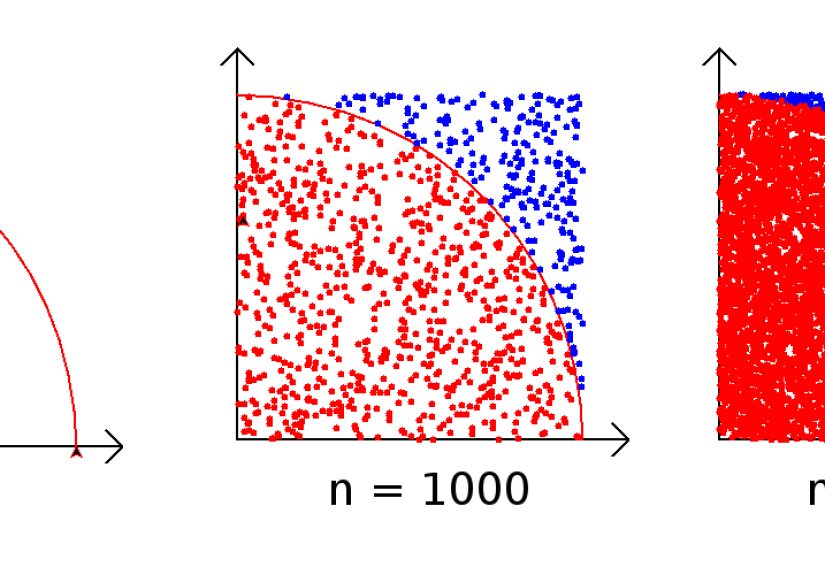
The idea is simple. Imagine a square with a quarter-circle drawn inside it. If you throw random points into the square, the fraction that lands inside the quarter-circle will be close to the area ratio. Since that ratio is pi / 4, you can estimate pi by multiplying the fraction by 4.
Monte Carlo Function
This is a fantastic teaching tool because it connects geometry, probability, and Python in one compact function. It also behaves differently from the Leibniz series:
- The result changes from run to run unless you set a random seed.
- More samples usually improve the estimate.
- The method is intuitive, but it is still an estimate rather than a neat deterministic sum.
Try it with different sample sizes:
The more samples you use, the more stable the estimate becomes. It is a little like guessing how many jellybeans are in a jar by taking more and more careful peeks.
Step 7: Combine Everything into One Complete Python Program
Now let’s build a full script that compares all three approaches: built-in pi, Leibniz approximation, and Monte Carlo estimation. This gives you a complete, useful project instead of a loose pile of code fragments.
Full Program
This script is solid for learning because it shows you the trade-offs side by side. It is not just “a Python program to calculate pi.” It is a mini lab on numerical thinking.
Common Mistakes That Make a Pi Program Go Sideways
- Using too few terms: The Leibniz series needs a large number of terms to look impressive.
- Expecting Monte Carlo to match exactly: It is random, so your answer will move around slightly.
- Confusing precision with speed:
Decimalhelps with precision handling, not with fast convergence. - Formatting nothing: Raw output works, but formatted output makes your program easier to read.
- Comparing methods unfairly: Always look at both runtime and error.
Example of What the Output Might Look Like
Your numbers will vary, especially for Monte Carlo. That is normal. If your Monte Carlo result comes out a little high one time and a little low the next time, your code is probably behaving exactly as it should.
Extra Experience: What You Learn When You Actually Build Pi Programs
One of the most useful experiences people have with a project like this is realizing that “more math” does not always mean “better code.” Beginners often expect the fanciest-looking formula to be the best solution. Then they write the Leibniz series, run it with a few hundred terms, and wonder why pi still looks a little wobbly. That moment is incredibly valuable because it teaches a deeper programming lesson: elegance on paper does not always translate into efficiency on a computer.
Another common experience is discovering that randomness feels strange at first. When someone writes a Monte Carlo pi program and gets a slightly different answer every run, the first reaction is often suspicion. “Did I break it?” Usually, no. Usually, the code is fine and the programmer is just meeting probability face to face. That is a healthy experience because it forces you to think beyond exact answers and into statistical thinking. In real computing, especially in simulations and data work, that mindset matters a lot.
There is also a practical lesson about output and readability. Many beginners focus so hard on getting the calculation right that they forget to present results clearly. Then the screen fills with long numbers, no labels, and enough confusion to power a small storm cloud. Once you add formatted printing, error comparisons, and runtime measurements, the program becomes much more useful. You stop writing code that merely runs and start writing code that communicates.
Working with Decimal creates another eye-opening moment. A lot of new Python programmers assume that if they switch from float to Decimal, every number problem disappears in a shower of mathematical confetti. It does not work that way. What really happens is more interesting: you start to understand the difference between representation, rounding, and convergence. That is a mature programming insight, and this small pi project teaches it surprisingly well.
There is also something satisfying about comparing methods side by side. The built-in math.pi value wins for practical use. The Leibniz series wins for clarity and mathematical charm. Monte Carlo wins for intuition and experimentation. When you put them together, you learn that programming is not about worshipping one “perfect” technique. It is about choosing the right tool for the job. That is a professional habit hiding inside a beginner project.
Perhaps the best experience of all is realizing that a short script can teach big ideas. A pi calculator looks small, but it introduces modules, loops, functions, simulation, numerical error, precision control, formatted output, and performance timing. That is a lot of value from one friendly project. So yes, you can absolutely write a Python program to calculate pi in 7 steps. But more importantly, you can use that program to become a sharper, calmer, more thoughtful programmer. And that result is even better than 3.1415926535.
Conclusion
If you want the practical answer, use math.pi. If you want to learn how formulas behave in code, build the Leibniz version. If you want a more visual and probabilistic approach, try Monte Carlo. The best learning path is not choosing just one method. It is comparing them, testing them, and seeing how Python handles each one.
That is why this project remains such a strong exercise for beginners. It starts with a famous number, but it ends by teaching structure, precision, performance, and programming judgment. Not bad for a constant that never actually ends.