Table of Contents >> Show >> Hide
- The Story That Turned a PTO Request Into a Career Exit
- Why This Story Struck a Nerve
- What U.S. Workplace Rules Actually Say
- The Real Workplace Issue: Favoritism Dressed Up as Fairness
- Why Workers Quit Over One “Small” Decision
- What Better Management Would Have Looked Like
- The Bigger Conversation: Parents Need Support, and So Does Everyone Else
- Experiences Related to This Topic From the PTO Trenches
- Conclusion
Every office has its own version of chaos. Some have broken printers. Some have mysterious yogurt theft. And some have managers who treat the vacation calendar like a game show wheel. In this now-viral workplace drama, a woman requested holiday leave well in advance, got it approved, made plans, and then watched her manager yank it back so a newer employee who had recently become a mom could get the time off instead. The result? Hurt feelings, workplace outrage, and one very predictable resignation.
The headline sounds like pure internet popcorn, but the reason this story landed so hard is simple: it taps into one of the most combustible topics in modern work culturefairness. Not “who deserves kindness more,” but “what happens when management rewrites the rules after people have already made life plans?” That is where a scheduling issue transforms into a trust issue. And once trust packs its bags, it rarely leaves a forwarding address.
So let’s talk about why this story blew up, what it says about workplace leave policies in America, why “supporting parents” and “treating employees consistently” should not be enemies, and how one badly handled time-off decision can make a reliable employee walk straight out the door.
The Story That Turned a PTO Request Into a Career Exit
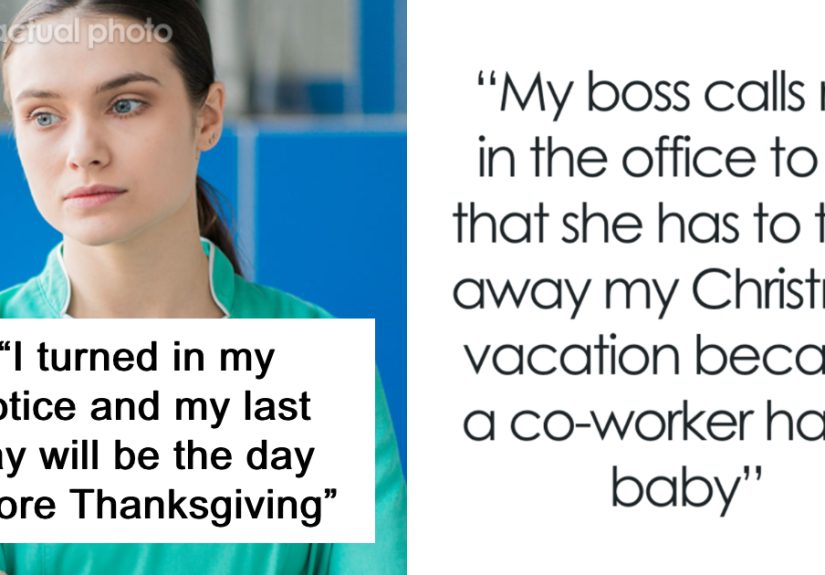
At the center of the controversy is a worker who had already done what employers constantly tell people to do: request time off early, plan ahead, and follow the process. She reportedly secured approval, organized travel, and assumed the matter was settled. Later, management reversed course and reassigned the holiday leave to a newer mother, framing the decision around family priorities and the emotional importance of a baby’s first holiday season.
That framing is exactly why the internet split into camps so quickly. One side focused on compassion for a new mom. The other side focused on the employee whose approved leave was canceled after the fact. But the most useful reading of the story is not “parents versus non-parents.” It is “policy versus favoritism.” If a company wants to prioritize caregivers, it needs an actual written system for doing that. It cannot improvise morality on a Tuesday afternoon and expect nobody to notice.
That is where the employee’s line“I am the villain”hits so hard. In many workplaces, the person who objects to an unfair decision instantly gets recast as selfish, cold, or “not a team player.” Translation: the company broke the process, but somehow the employee who noticed is now the problem. Office alchemy is a strange art.
Why This Story Struck a Nerve
Approved Leave Feels Like a Promise
Employees do not treat approved time off as a casual suggestion. They buy tickets, coordinate family schedules, pay deposits, arrange pet care, book hotels, and, in many cases, mentally survive rough weeks by staring at that one square on the calendar that says “out of office.” When a manager cancels approved leave, the company is not just moving a shift. It is interfering with money, relationships, and the fragile emotional scaffolding holding an overworked adult together.
That is why these moments can feel so personal. The employee hears, “Your plans matter less.” Worse, she may hear, “Your life matters less.” If another worker’s family status becomes the unofficial tie-breaker, the message gets even uglier: your needs count only if they fit management’s preferred definition of “real life.”
The New Mom Wasn’t the Villain Either
This part matters. Supporting new parents is not unfair. In fact, many American workplaces still do a mediocre job of helping parents, especially mothers, navigate return-to-work stress, childcare demands, sleep deprivation, and the career penalties that often follow caregiving. New moms need flexibility. They need leave. They need sane management. They need employers to stop acting shocked that babies require logistics.
But none of that justifies taking approved leave away from someone else without a clear, consistent, preexisting policy. A manager who solves one employee’s hardship by creating another is not displaying leadership. That is just redistributing misery with a sentimental speech attached.
People Are Exhausted by Selective Compassion
Employees can tolerate a lot when they believe the rules are fair. What burns them out is selective empathy. If management shows compassion only when a situation looks socially sympathetic, workers start competing for moral legitimacy instead of relying on policy. Suddenly the office becomes a terrible talent show called Convince HR Your Life Counts. Nobody wins that game except resentment.
What U.S. Workplace Rules Actually Say
In the United States, not all leave is created equal. Federal law under the Family and Medical Leave Act gives eligible workers unpaid, job-protected leave for certain family and medical reasons. That is different from ordinary PTO, vacation days, or holiday scheduling, which are usually governed by employer policy and, in some cases, state law.
In plain English, that means a company may have broad discretion over vacation scheduling, but it still needs to apply its own rules consistently. If an employer advertises first-come, first-served requests, seniority-based rotations, holiday fairness rules, or manager approval standards, those systems need to mean something. Otherwise, the policy becomes decorative wallpaper with a login screen.
There is also an important legal and cultural distinction between accommodating caregiving and discriminating based on stereotypes about caregiving. U.S. equal employment guidance makes clear that decisions involving parents and caregivers can become unlawful if they are based on protected characteristics such as sex, pregnancy, or related assumptions. So while “help the new mom” sounds compassionate, managers still need to be careful that workplace decisions are grounded in real policynot assumptions about who should sacrifice, who should be flexible, or whose personal life matters more.
None of that automatically means the employee in this story had a lawsuit. It does mean she had a management problem. And management problems are often what create turnover long before lawyers ever get involved.
The Real Workplace Issue: Favoritism Dressed Up as Fairness
This is where the story becomes bigger than one employee quitting. Favoritism is one of the fastest ways to damage morale because it destroys predictability. Once workers believe decisions depend on who is liked, who is louder, who has children, who has a manager’s sympathy, or who creates the most guilt, every future policy becomes suspect.
Researchers have repeatedly found that unfair treatment is strongly linked to burnout, disengagement, and employee turnover. That makes sense. Burnout is not just about long hours or too many meetings that could have been emails. It is also about emotional friction. People burn out faster when they feel unsupported, singled out, ignored, or manipulated.
And here is the ironic part: managers often create this damage while trying to avoid conflict. Instead of telling the newer parent, “I’m sorry, but the approved holiday schedule stands,” they choose the path of least immediate discomfort. They reverse the earlier decision, hope the dependable employee will absorb the hit, and assume loyalty equals elasticity. Then they act stunned when the dependable employee finally snaps like an overcooked breadstick.
Reliable employees are especially vulnerable to this treatment. They are the ones who covered holidays before, worked extra shifts, solved emergencies, stayed late, and gained a reputation for “understanding.” Eventually, some managers stop seeing that as generosity and start seeing it as inventory. That is how good employees become the default shock absorbers for broken staffing plans.
Why Workers Quit Over One “Small” Decision
From the outside, resigning over canceled leave can sound dramatic. It is not. People rarely quit over one isolated event. They quit when one event clarifies the truth about the entire relationship. A revoked vacation day can reveal years of imbalance in a single ugly moment.
Maybe the employee had already worked multiple holidays. Maybe she had already covered for others. Maybe she had already accepted being the “easy” person to disappoint because she did not have children, or because she was single, or because she was simply competent enough to survive another scheduling mess. The canceled leave does not create the resentment out of nowhere. It removes the final layer of denial.
That is why these stories resonate so strongly with readers. Many people have lived some version of them. Not always with Christmas. Not always with parenthood. But with the same core insult: your compliance has been mistaken for infinite flexibility.
Once a worker decides the rules are rigged, quitting starts to feel less like overreaction and more like self-respect wearing sensible shoes.
What Better Management Would Have Looked Like
1. Keep the Approved Leave Approved
If the request was already approved, that should have been the end of it unless there was a true emergency. Not a preference. Not a sympathy contest. An actual emergency.
2. Support the New Parent Without Punishing Another Worker
Managers had other options: voluntary shift swaps, temporary staffing help, incentive pay, rotating holiday priority, or a transparent holiday system for future seasons. Helping one employee should not require blindsiding another.
3. Use a Clear Holiday Policy
Companies that rely on vibes for holiday scheduling are basically outsourcing conflict to their own staff. A written policyfirst come, first served; rotating priority; seniority with limits; mandatory holiday rotationprevents drama before it starts.
4. Stop Ranking Lives
A worker visiting elderly parents, a worker spending time with children, a worker going on a long-awaited trip, and a worker staying home in fuzzy socks to recover from a brutal year all deserve respect. Managers should evaluate requests by policy, timing, and staffing needsnot by auditioning whose personal life sounds the most Hallmark-worthy.
The Bigger Conversation: Parents Need Support, and So Does Everyone Else
One reason stories like this explode online is that they expose a real tension inside American work culture. Parents, especially mothers, do face structural challenges. Flexibility matters. Leave matters. Childcare realities are brutal. Many women still absorb a disproportionate share of family labor, and workplaces often reward workers who can pretend they have no responsibilities outside the building.
But solving that problem by casually penalizing child-free employees, unmarried employees, or workers without visible caregiving roles is not justice. It is just another bias with better branding. Fair workplaces do not ask employees to compete for humanity points. They build systems that acknowledge different lives without degrading anyone’s plans.
The healthiest organizations understand this. They do not frame flexibility as a prize available only to parents. They treat schedule control, predictable leave, and respect for personal time as quality-of-work issues for everyone. That approach not only helps mothers stay in the workforce; it also reduces resentment among colleagues and increases the odds that good employees stick around.
In other words, the answer is not “care less about new moms.” The answer is “care more competently about all employees.” Radical concept, I know.
Experiences Related to This Topic From the PTO Trenches
If this story feels familiar, that is because versions of it play out in offices, hospitals, retail stores, restaurants, schools, and call centers all the time. One worker asks for time off months early. Another employee has a more emotionally compelling reason later. Management panics, improvises, and decides the easiest person to disappoint is the person who already followed the rules. It is such a common pattern that many employees can spot the ending before the meeting even starts.
One of the most common versions happens around major holidays. The dependable employee has worked Thanksgiving three years in a row, covered Christmas Eve last year, and volunteered for New Year’s because “someone had to.” This time, she finally wants one holiday with family. But a manager says a newer coworker “really needs it more.” That phraseneeds it moreis workplace dynamite. It sounds compassionate, but employees often hear it as code for “the policy changed because we feel like it.”
Another familiar version happens when employers quietly divide workers into categories: parents, non-parents, singles, newlyweds, younger employees, older employees, “people with real obligations,” and everyone else. Once managers start sorting people this way, fairness gets weird fast. A child-free worker gets asked to stay late because “you don’t have kids.” A single employee gets the undesirable schedule because “you’re more flexible.” A married employee gets pressured to give up leave because “you can always celebrate later.” Everyone’s life gets reduced to a stereotype, and morale slides downhill in flip-flops.
There is also the emotional trap of being the reliable one. Workers who rarely complain often become magnets for extra inconvenience. They are the ones managers call first, because they usually say yes. Over time, these employees learn a painful lesson: being helpful can accidentally turn into being taken for granted. They are praised as team players right up until they want one thing for themselves. Then suddenly they are “difficult,” “cold,” or “not collaborative.” It is amazing how quickly sainthood expires in the break room.
In some workplaces, employees do not even quit because of the canceled leave itself. They quit because of the reaction that follows. HR shrugs. Coworkers guilt-trip them. Managers frame the issue as a personal failing instead of a policy failure. The employee realizes there will be no apology, no correction, and no sign the same thing will not happen again. That is when resignation stops feeling impulsive and starts feeling practical.
The consistent lesson across these experiences is simple: people can survive busy seasons, long shifts, and imperfect schedules. What they struggle to forgive is disrespect wrapped in managerial logic. Employees want to know that if they follow the rules, the rules will not evaporate the moment someone else’s story sounds more sympathetic. Once that confidence is gone, even a decent paycheck may not be enough to keep them. And that is how one canceled leave request becomes a flashing neon sign that says, “You should probably update your resume.”
Conclusion
The woman in this story was called the villain for refusing to quietly absorb an unfair decision. But the real problem was not her resignation. It was the managerial choice that made resignation feel rational. Approved leave should not be a temporary illusion. Support for parents should not come at the expense of basic consistency. And no employee should have to prove that their personal life is meaningful enough to deserve the time they were already granted.
At its core, this viral moment is a lesson in workplace trust. Good management is not about deciding whose life matters most on any given holiday. It is about building systems that respect employees before conflict starts. When companies fail to do that, they should not be shocked when the most dependable person in the room finally decides to stop being dependable somewhere else.
Note: This article is a commentary piece based on publicly reported accounts and U.S. workplace research and guidance. It is written for informational purposes and is not legal advice.