Table of Contents >> Show >> Hide
- Who Was Ed Smylie?
- Apollo 13: The Mission That Became a Rescue
- The Carbon Dioxide Problem: Too Much Breathing, Not Enough Scrubbing
- Ed Smylie’s Famous Hack: The “Mail Box”
- Why the Apollo 13 Fix Still Matters
- The Team Behind the Tape
- From Mississippi to Mission Control
- Ed Smylie’s Legacy in Engineering Culture
- In Memory of a Quiet Problem-Solver
- Experience and Lessons: What Ed Smylie’s Apollo 13 Hack Teaches Us Today
- Conclusion
Some heroes arrive with capes. Some arrive with slide rules, coffee breath, and the kind of calm expression that says, “Yes, we can probably fix a spacecraft with tape.” Ed Smylie belonged to the second group. He was not floating in space during Apollo 13. He was on Earth, leading a team through one of the most famous engineering emergencies in American history. Yet his work reached all the way to the crippled spacecraft, where three astronauts desperately needed clean air, power, water, and a path home.
Robert Edwin “Ed” Smylie, the NASA engineer remembered for helping solve the Apollo 13 carbon dioxide crisis, died in 2025 at age 95. His name may not be as instantly recognizable as Jim Lovell, Jack Swigert, Fred Haise, or Gene Kranz. But if the Apollo 13 story is a symphony of nerve, mathematics, teamwork, and stubborn optimism, Smylie helped conduct one of its most unforgettable movements: the famous “square peg in a round hole” fix.
This is the story of Ed Smylie, Apollo 13, duct tape, lithium hydroxide canisters, and a moment when practical engineering became poetryvery sweaty, sleep-deprived poetry, but poetry all the same.
Who Was Ed Smylie?
Ed Smylie was born in Lincoln County, Mississippi, and earned bachelor’s and master’s degrees in mechanical engineering from Mississippi State University. Before joining NASA in 1962, he worked in aviation, including at Douglas Aircraft. When President John F. Kennedy set the United States on its lunar mission, Smylie wanted in. Not everyone gets to help build the road to the Moon, and he clearly had no intention of watching from the sidewalk.
At NASA’s Manned Spacecraft Center in Houston, later known as Johnson Space Center, Smylie worked on life-support and environmental control systems. That sounds tidy on paper, but in practice it meant answering a terrifyingly simple question: how do you keep humans alive inside a machine surrounded by vacuum?
Smylie’s responsibilities touched spacecraft systems and spacesuits used during the Apollo lunar missions. He was part of the generation of engineers who turned impossible ideas into procedures, checklists, fittings, filters, hoses, valves, and backup plans. In spaceflight, glory often goes to the launch, the landing, and the dramatic radio call. But survival depends on the unglamorous stuff: breathable air, manageable temperature, clean water, and equipment that does exactly what it promised to do.
Apollo 13: The Mission That Became a Rescue
Apollo 13 launched on April 11, 1970, with Commander James A. Lovell, Command Module Pilot John L. “Jack” Swigert, and Lunar Module Pilot Fred W. Haise. The mission was supposed to be NASA’s third crewed lunar landing, targeting the Fra Mauro region of the Moon. By then, some people had started treating lunar missions as routine, which is a charmingly human way to describe launching three people on top of a skyscraper-sized rocket and sending them toward another world.
Two days into the mission, an oxygen tank exploded in the service module. The crew lost critical systems. The Moon landing was canceled. The command module Odyssey, which was supposed to bring the astronauts home, had to be powered down to preserve its limited resources for reentry. The lunar module Aquarius, designed to carry two astronauts down to the Moon and back for a short period, suddenly became a lifeboat for three men on a cold, dangerous trip around the Moon and back to Earth.
The phrase “Houston, we’ve had a problem” became legendary. But behind that sentence stood dozens of problems, each with the personality of a locked door. Power had to be conserved. Navigation had to be improvised. Water had to be rationed. Temperatures dropped. The spacecraft’s future became a stack of urgent questions, and every answer had to work the first time.
The Carbon Dioxide Problem: Too Much Breathing, Not Enough Scrubbing
Among the mission’s dangers was carbon dioxide buildup. Astronauts exhale carbon dioxide, and spacecraft must remove it from the cabin atmosphere. Apollo used lithium hydroxide canisters to scrub carbon dioxide from the air. The command module had enough canisters, but the astronauts were now living in the lunar module. Unfortunately, the two spacecraft used differently shaped canisters.
The command module canisters were square. The lunar module’s system accepted round canisters. There it was: one of the most famous engineering mismatches in history. NASA had enough filtering material, but not in a form the lunar module could easily use. It was like having the right phone charger and the wrong port, except the battery was three human lives and there was no customer service desk on the far side of the Moon.
The lunar module had been designed for two men for a limited time, not three men for several days. As the astronauts continued breathing, the carbon dioxide level rose. If NASA could not adapt the command module’s square lithium hydroxide canisters to work with the lunar module’s round environmental control system, the crew would be in grave danger before they ever reached home.
Ed Smylie’s Famous Hack: The “Mail Box”
Ed Smylie and his team attacked the problem with a rule that every maker, mechanic, farm kid, and practical engineer understands: use what you actually have. They could not send new hardware to Apollo 13. There was no overnight shipping, no replacement kit, no “click here for compatible adapter.” The only available materials were the items already aboard the spacecraft.
That inventory included plastic bags, cardboard-like covers, hoses, suit parts, and gray tape. In other words, the universe had handed NASA a terrifying emergency and a junk drawer.
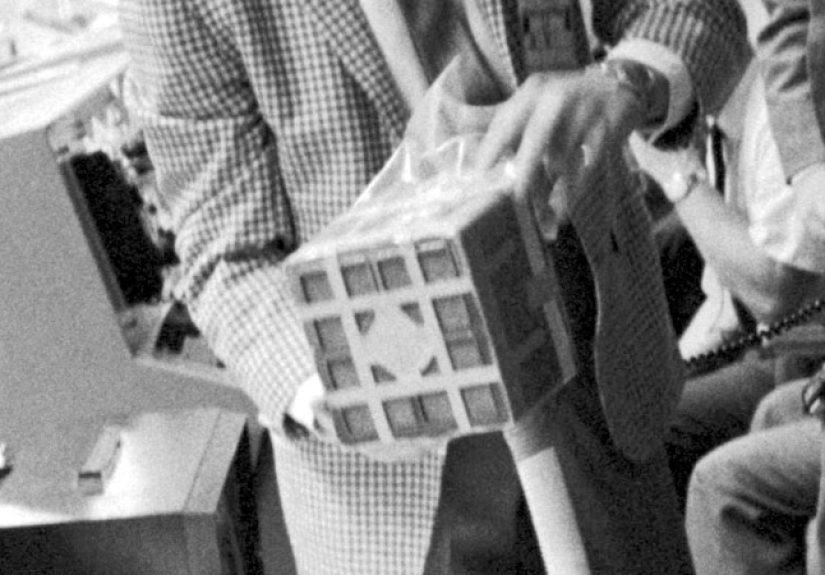
Smylie’s team designed and tested an adapter on the ground that allowed the astronauts to use the command module’s square lithium hydroxide canisters with the lunar module’s round system. The device became known as the “mail box,” partly because of its boxy look. It was not pretty. It would not win a furniture-design award. Nobody was going to place it on a modern kitchen island next to a succulent. But it worked, and in engineering, “it worked” is the most beautiful phrase in the English language.
The astronauts built the device in space while Mission Control read up the instructions. The process required careful communication, because every step had to be clear to tired men in a cramped, cold spacecraft. Once assembled, the improvised scrubber began reducing the carbon dioxide level. A deadly invisible problem was brought under control by a ground team, a flight crew, and a roll of tape doing more than anyone had a right to expect from office-supply-adjacent material.
Why the Apollo 13 Fix Still Matters
The Apollo 13 CO2 scrubber hack has endured because it represents something deeper than clever improvisation. It shows how preparation and creativity work together. Smylie’s team could improvise because they understood the spacecraft, the materials, the airflow, the filters, and the limitations. This was not random tinkering. It was disciplined problem-solving under pressure.
That distinction matters. People often celebrate the duct tape, and yes, duct tape deserves its standing ovation. But tape alone did not save Apollo 13. Knowledge did. Training did. Systems thinking did. A culture of testing did. The courage to make a workable decision with imperfect conditions did. Duct tape was the tool; engineering judgment was the magic trick.
Smylie himself was famously modest about the fix. He emphasized that many people contributed to the solution. According to later accounts, he described the problem as something a mechanical engineering student could figure out. That humility is part of why his legacy feels so strong. Great engineers often know that the best solution is not the one that makes the solver look brilliant. It is the one that keeps people alive, gets the job done, and can be explained clearly enough for someone else to build it under pressure.
The Team Behind the Tape
One of the most important truths about Apollo 13 is that no single person “saved” the mission alone. The safe return of Lovell, Swigert, and Haise required astronauts, flight directors, engineers, contractors, technicians, mathematicians, communicators, and specialists working in concert. Smylie’s contribution was vital, but he consistently treated it as part of a larger team achievement.
That is exactly what makes his role worth remembering. In a culture that loves lone-genius myths, Apollo 13 offers something better: a team-genius reality. The mission operations team did not have the luxury of ego. They had a damaged spacecraft, a ticking clock, and three people depending on them. The question was never, “Who gets credit?” The question was, “What works?”
President Richard Nixon awarded the Apollo 13 Mission Operations Team the Presidential Medal of Freedom after the crew returned safely. The honor recognized the extraordinary performance of the people on the ground who helped transform a near disaster into what NASA would later call a “successful failure.” That phrase remains one of the best summaries of Apollo 13: the mission failed to land on the Moon, but succeeded in bringing its crew home.
From Mississippi to Mission Control
Smylie’s journey from Mississippi to NASA reflects a larger American story of the space age. The Apollo program was not built only by astronauts in white spacesuits or executives behind polished desks. It was built by thousands of people who brought math, machinery, craftsmanship, curiosity, and practical judgment to the table.
Smylie’s Southern remark about duct tape has become part of his legend: if something moves and it should not, tape it. The line is funny because it sounds like garage wisdom. It is also profound because it reminds us that advanced engineering still depends on practical thinking. Spacecraft may be complex, but sometimes the winning move is to ask, “What is in the storage list, and how can we make it fit?”
That mindset is valuable far beyond spaceflight. Teachers use it when a lesson plan collapses five minutes before class. Nurses use it when they adapt calmly to a changing patient situation. Software developers use it when production breaks at 2 a.m. Parents use it when a science project is due tomorrow and the glitter has staged a rebellion. The Apollo 13 “mail box” is famous because it happened in space, but its spirit belongs to anyone who has ever solved a serious problem with limited tools and no time for drama.
Ed Smylie’s Legacy in Engineering Culture
Ed Smylie’s legacy is not merely that he helped design a clever adapter. It is that he embodied the engineering values people still try to teach: know your system, respect constraints, test your idea, communicate clearly, and stay humble when the applause arrives.
Modern aerospace teams still study Apollo 13 because it remains a masterclass in crisis response. The mission shows how redundancy matters, how simulation matters, and how human flexibility can rescue a system when hardware fails. But it also shows that technical skill must be paired with trust. The astronauts trusted Mission Control. Mission Control trusted the engineers. The engineers trusted the physics. Everyone trusted the process enough to keep moving.
That kind of trust is not invented during an emergency. It is built over years. Smylie and his colleagues had spent their careers learning the Apollo systems in detail. When disaster struck, they were not starting from zero. They were drawing from deep familiarity, and then bending that knowledge into a new shapesquare canister, round hole, no excuses.
In Memory of a Quiet Problem-Solver
Remembering Ed Smylie means remembering the people whose names do not always fit into movie posters. It means honoring the engineer who sees panic approaching and reaches for the checklist. It means recognizing that “hack” can be a noble word when it describes creative, careful, life-saving adaptation.
Apollo 13 has been retold in books, documentaries, classrooms, museums, and the celebrated 1995 film. Each retelling tends to return to the same emotional center: the human refusal to give up. Smylie’s “mail box” fix fits perfectly inside that theme. It was not elegant in the showroom sense, but it was elegant in the survival sense. It used available materials. It solved the immediate problem. It could be built by the crew. It bought time. It turned breath back into something safe.
That is a remarkable achievement. And it is made more remarkable by the fact that Smylie never seemed eager to inflate his own legend. He knew that Apollo 13 was a team effort. He knew many hands and minds had shaped the rescue. But history can hold both truths at once: the team saved Apollo 13, and Ed Smylie’s leadership in the carbon dioxide scrubber solution deserves a bright, permanent place in that story.
Experience and Lessons: What Ed Smylie’s Apollo 13 Hack Teaches Us Today
The most useful lesson from Ed Smylie’s Apollo 13 story is not “always carry duct tape,” although, honestly, that remains excellent advice. The deeper lesson is that constraints can sharpen creativity. When everything is available, people often wander. When almost nothing is available, the mind starts sorting reality with beautiful urgency: what do we have, what must happen, what cannot change, and what can we bend without breaking?
Anyone who has worked on a difficult project knows this feeling. A website crashes right before launch. A school presentation refuses to load. A small business loses a supplier two days before a big order. A home repair reveals that the previous owner apparently believed plumbing was a freestyle art form. In those moments, the Apollo 13 mindset is priceless. You do not waste energy wishing for perfect tools. You inventory the tools you have.
Smylie’s story also teaches the importance of calm communication. A solution is only useful if it can be transferred from one mind to another. NASA engineers could build and test the “mail box” on the ground, but the astronauts had to recreate it in space. That meant the instructions had to be practical, sequential, and understandable. Under stress, clarity is kindness. It is also survival.
Another experience connected to this topic is the value of cross-functional teamwork. The Apollo 13 rescue required people from different specialties to cooperate without turning the room into a contest of professional pride. Good teams do not simply gather smart people; they create conditions where smart people can combine their knowledge quickly. Smylie’s humility helped reinforce that culture. He did not present himself as a lone wizard. He recognized the power of the group.
For students, makers, engineers, and leaders, this story is a reminder that preparation is not boring. It is the thing that makes improvisation possible. The “mail box” looked improvised because it used ordinary materials, but it worked because experts understood extraordinary systems. Practice, study, testing, and documentation may not feel dramatic in the moment. Later, they may become the reason a crisis has an answer.
Finally, Ed Smylie’s famous hack reminds us that great solutions do not always look polished. Sometimes the best answer is taped together, awkwardly shaped, and deeply unimpressed with aesthetics. But if it protects life, restores function, or gets people home, it is beautiful. Apollo 13 did not need perfection. It needed enough. Smylie and his team delivered enough at exactly the right time, and that is why his memory continues to breathe inside the history of space exploration.
Conclusion
Ed Smylie’s life and work deserve to be remembered not only because of one famous Apollo 13 hack, but because that hack revealed the best qualities of engineering under pressure. He understood systems. He trusted teamwork. He respected practical materials. He communicated clearly. And when the situation became dangerous, he helped transform a box of mismatched parts into a lifeline.
The Apollo 13 crew returned safely to Earth on April 17, 1970. The mission did not land on the Moon, but it landed permanently in the imagination of anyone who values courage, competence, and creative problem-solving. In that story, Ed Smylie remains the quiet engineer behind one of history’s greatest fixesa man who helped prove that sometimes the road home is built from knowledge, teamwork, cardboard, plastic, hoses, and a very heroic roll of tape.