Table of Contents >> Show >> Hide
- What Is the Lumina Naomi Pinza Clip Light?
- Key Features & Technical Specs (In Plain English)
- Where the Lumina Naomi Pinza Shines (Literally)
- Naomi Pinza vs. Typical Clip-On Lights
- Choosing the Right Bulb for the Naomi Clip Lamp
- Installation, Adjustment, and Safety Tips
- Durability, Sustainability, and Maintenance
- Real-World Experiences with the Lumina Naomi Pinza Clip Light
- Is the Lumina Naomi Pinza Clip Light Right for You?
Some lamps quietly sit in the corner and pretend they’re part of the furniture.
The Lumina Naomi Pinza clip light is not one of those lamps. This is the sort of
Italian-designed clamp lamp that grabs onto your desk, swings into position, and
says, “Okay, what are we working on today?”
Designed by Israeli designer Yaacov Kaufman for Italian lighting brand Lumina,
the Naomi Pinza (often called the Naomi clip lamp or Naomi morsetto) is a compact,
metal clip-on light with a fully adjustable arm and a rotating shade. It’s made
to clamp onto the edge of a table, shelf, or headboard and then put bright,
focused light exactly where you need it. The result is a minimalist clip-on task
light that feels more like serious studio gear than a flimsy book light.
If you’re curious about whether the Lumina Naomi Pinza is right for your home
office, studio, or reading nook, this guide breaks down its design, specs,
real-world use, and who will love it most.
What Is the Lumina Naomi Pinza Clip Light?
A quick snapshot
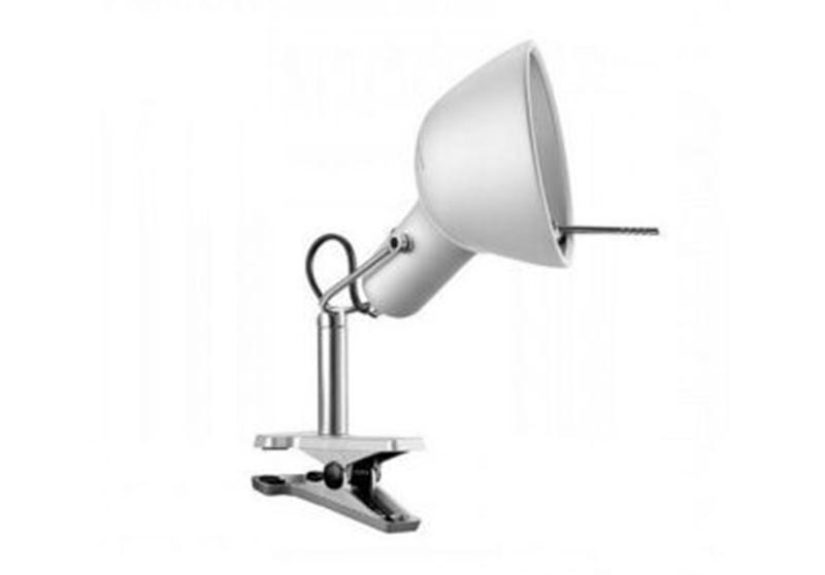
The Lumina Naomi Pinza is a metal clamp lamp with:
- An aluminum alloy body and shade
- An extensible articulated arm
- A clamp that fits most table tops and shelves up to about 50–52 mm thick
- A rotating reflector head (around 350–360° of rotation)
- An on/off switch conveniently located on the lamp head
- A standard E27/E26 socket that works with halogen or LED bulbs up to 75 W halogen equivalent
In plain English: it clips, it bends, it twists, and it beams a solid cone of
light onto your work – without eating up any precious desk space.
Italian design roots
Lumina is a long-established Italian lighting brand known for minimalist,
technical fixtures like the Daphine, a classic adjustable task light from the
1970s that still shows up in design museums and high-end studios. The company’s
philosophy is all about “lots of light, not much lamp,” meaning you get functional,
purposeful lighting without visual clutter.
The Naomi family follows that approach: the arm is made of soft, curved aluminum
elements, and the mechanisms that allow it to move are largely hidden. Instead of
obvious knobs and levers, the lamp’s form itself is what lets you position it
precisely. It’s a very “designer” way to think about a clip light: technical, but
calm and understated rather than fussy.
Key Features & Technical Specs (In Plain English)
Size, materials, and finish
Exact dimensions vary slightly by retailer, but you can expect the Naomi Pinza
to have:
- Shade diameter around 13 cm (about 5 inches)
- Overall depth/arm reach around 25–27 cm from the clamp to the shade
- Shade height around 20–21 cm
- Clamp suitable for surfaces up to roughly 5–5.2 cm thick
The lamp is constructed mainly from anodized aluminum and steel, which keeps it
light but sturdy. The most common finish you’ll see is a matte aluminum or
silver-grey tone that blends easily with modern desks, white shelving, and
neutral decor. No shiny chrome, no random plastic accentsjust a clean,
industrial-but-polished look.
Light source and bulb compatibility
The Naomi Pinza uses a standard E27/E26 bulb socket and is rated up to a
maximum 75 W halogen lamp. In practice, most people will use an LED bulb, since:
- LED bulbs run cooler, which is nice for a small shade near your face
- They use a lot less energy for the same brightness
- You can choose from warm (2700K), neutral (3000–3500K), or cooler (4000K+) color temperatures
The fixture itself usually doesn’t include fancy dimming electronics. However, it
is compatible with dimmable LED or halogen bulbs as long as they match the
socket and any external dimmer you use. Want a cozy glow for late-night reading?
Use a warm, lower-lumen LED. Need a punchy beam for sketching or drafting? Pop
in a bright, neutral-white LED.
Clamp and adjustability
The “Pinza” part of the name refers to the clamp. Instead of a base that sits on
your desk, you get a padded clamp that can grab onto the edge of:
- Desktops
- Floating shelves
- Headboards
- Side tables and consoles
The articulated arm lets you extend the light away from the clamp and then tilt
and swivel the head to get the angle just right. The reflector and arm are
designed to rotate roughly 350–360°, so you can point the beam downward onto a
keyboard, across your drawing board, or even up at the ceiling for softer,
bounced light.
An on/off switch on the head means you don’t have to reach down the cord or
crawl under your desk to turn the light off. You can just tap it as you stand
up and get on with your life.
Where the Lumina Naomi Pinza Shines (Literally)
Home offices and compact desks
If your “office” is a laptop, a mug of coffee, and half a dining table, a
clip-on light like the Naomi Pinza is ideal. Because it clamps to the table
edge, it leaves the entire surface free for laptops, notebooks, or the
inevitable pile of mail you swear you’ll sort later.
Set the clamp on the far corner, swing the arm over your work surface, and you
get focused task lighting without a traditional base. It’s especially useful if:
- Your desk is shallow and doesn’t have room for a heavy table lamp
- You share a table and want a light that’s “yours” but easy to move
- You work from home and stash your setup at the end of the day
Tiny apartments and rental spaces
Renters love clip lights because they don’t require drills, wall anchors, or
landlord phone calls. With the Naomi Pinza, you can:
- Clip it to a shelf and use it as a pseudo-wall light
- Attach it to a headboard as a reading light
- Move it from room to room without leaving a single hole in the wall
The slim, neutral design also means it won’t fight with your existing decor. It
works just as well with Scandinavian-style plywood as it does with black metal
shelves or a simple white desk.
Studios, craft tables, and workbenches
The Naomi Pinza is especially useful for people who need precise, adjustable
lighting: sketch artists, illustrators, crafters, and anyone doing detailed
work. Because you can swing and angle the light, you can:
- Minimize shadows on a drawing or sewing project
- Highlight a small area of a workbench
- Point light from the side instead of straight down to enhance texture
It’s also a nice companion to a computer monitor. Aim the beam to the side or
behind your screen to reduce contrast and eye strain instead of blasting your
eyeballs with a super-bright spot.
Naomi Pinza vs. Typical Clip-On Lights
You might be wondering, “Why not just buy a cheap clip lamp online?” Fair
question. Here’s where the Naomi Pinza stands apart.
Build quality and materials
Most budget clip lights are plastic with a basic metal clamp. The Naomi Pinza is
almost the opposite: a thoughtfully engineered aluminum and steel body, smooth
joints, and a clamp that feels secure instead of flimsy. This gives it:
- More precise positioning that doesn’t sag over time
- A longer lifespan, since metal parts don’t get brittle or yellow
- A refined aesthetic that looks intentional, not like a temporary hack
Light quality and control
Many inexpensive clip lamps come with integrated LEDs that lock you into a
specific brightness and color temperature. The Naomi Pinza uses a standard
bulb socket, so you control:
- How bright the light is (by choosing the lumen output)
- How warm or cool the light feels (2700K vs. 4000K, for example)
- Whether it’s dimmable (by using a dimmable lamp and compatible control)
That flexibility makes the Naomi Pinza feel less like a gadget and more like a
permanent part of your lighting plan.
Price and value
There’s no way around it: the Lumina Naomi Pinza costs significantly more than
generic clamp lights. You’re paying for:
- Italian design and manufacturing
- Higher-grade materials and precision joints
- A product that’s meant to last years, not just a semester of college
If you just need a quick light for a garage sale or a temporary dorm setup, a
cheaper clip lamp might be fine. But if you care about reliability, aesthetics,
and long-term usability, the Naomi Pinza feels more like a small piece of
“forever lighting” rather than a disposable accessory.
Choosing the Right Bulb for the Naomi Clip Lamp
Because the Naomi Pinza leaves the bulb choice up to you, picking the right one
makes a big difference in how the lamp feels and performs.
Color temperature
- 2700K (warm white): Cozy and relaxinggreat for reading in bed or creating a soft glow.
- 3000–3500K (warm/neutral): Balanced and versatileideal for home offices and multi-purpose desks.
- 4000K and up (cool/neutral): Crisp and brightbetter for detailed work or garages and studios.
Brightness and beam
For focused task lighting, look for:
- LED bulbs in the 450–800 lumen range (roughly 40–60 W incandescent equivalent)
- A more directional bulb shape (like a standard A19 or slightly spotty LED) rather than an ultra-wide decorative globe
If you want softer, ambient light, drop down to a lower-lumen bulb and let the
lamp act as a secondary light instead of your main illumination.
Installation, Adjustment, and Safety Tips
Getting the clamp right
To keep your Naomi Pinza secure and wobble-free:
- Choose a flat, solid surface; avoid very rounded or beveled edges
- Make sure the surface isn’t thicker than the specified clamp capacity (about 50–52 mm)
- Tighten the clamp firmly but don’t over-torque it on delicate wood
Once it’s clamped, gently move the arm through its range of motion. If it
wiggles or shifts, re-seat the clamp or move it to a sturdier edge.
Managing heat and glare
If you ever use a halogen bulb at higher wattage, the shade can get warm. That’s
normal for metal task lights, but still:
- Keep fabric and paper away from the exposed front of the shade
- Aim the beam so you don’t stare directly into it while working
- Consider LED bulbs if you’re sensitive to heat or plan to use the lamp for hours at a time
Cord placement
The Naomi Pinza has a standard cable with a plug, so basic cord management is
key:
- Route the cord along the back edge of your desk or shelf
- Use clips or cable ties so it doesn’t dangle where you’ll bump it
- Keep the plug accessible if you like to unplug the lamp when not in use
Durability, Sustainability, and Maintenance
One of the appeals of Lumina fixtures in general is their focus on durable,
repairable products made from recyclable materials. The Naomi Pinza’s aluminum
and steel construction means:
- No brittle plastic to crack or yellow over time
- A stable clamp and joints that hold their position for years
- A lamp that can be re-bulbed and refreshed as lighting technology evolves
Maintenance is simple:
- Dust the arm and shade with a soft cloth regularly
- Use a slightly damp cloth for fingerprints, then dry immediately
- Avoid harsh cleaners or abrasives that can scratch the anodized finish
Treat it well and the Naomi Pinza should outlast a few laptops, several
notebooks, and at least one “I’m going to totally reorganize this desk” phase.
Real-World Experiences with the Lumina Naomi Pinza Clip Light
Specs are great, but what is it actually like to live with the Lumina Naomi
Pinza clip light day in and day out? Let’s walk through what you can realistically
expect based on how people typically use this kind of high-quality clip lamp.
Day one: “Wait, that’s it?” (in a good way)
Unboxing the Naomi Pinza usually feels surprisingly simple. There’s no huge
assembly process, no pile of mystery hardware. You clamp it, plug it in, add a
bulb, and you’re off. The first impression is often about how solid the arm and
clamp feel compared with inexpensive clip lightsyou can move it around without
the joints flopping or twisting under the weight of the shade.
The second reaction? Realizing how much desk space you just gained. If you’re
used to a traditional table lamp hogging one corner of your workspace, having
that area suddenly free feels oddly luxurious, like you just upgraded to a
bigger desk without moving.
Week one: finding “your” sweet spot
During the first week, most people experiment with different positions:
- Clamped to the left vs. right side of the desk
- Arm pulled in close for focused light vs. extended out for a broader wash
- Shade tilted slightly away to bounce light off the wall for softer illumination
One of the subtle pleasures of the Naomi Pinza is how easily you can make those
micro-adjustments. Need a bit more light on a notebook? Small nudge of the arm.
Glare on your monitor? Swing the shade a few degrees. That fine-tuned
adjustability is where the engineering really shows.
Living with it in a home office
For remote workers, the Naomi Pinza tends to become part of the daily ritual:
laptop open, coffee poured, clip light on. Because the on/off switch is right on
the head, turning it on becomes a very tactile “time to focus” momentalmost
like flipping the sign from “closed” to “open” at a small shop.
Many people end up using two different “lighting modes” with the same lamp:
- Work mode: Bright, neutral-white bulb aimed at the keyboard and papers.
- Evening mode: Slightly dimmer or warmer bulb pointed more toward the wall for a softer glow.
Because you can swap bulbs whenever you like, it’s easy to evolve your setup as
your schedule changes. You might start with a brighter bulb when you’re working
late nights and then later switch to something softer once your hours settle
down.
In a studio or craft space
In creative spaces, the Naomi Pinza really earns its keep. On a drafting table or
sewing station, the combination of a stable clamp and a swiveling shade means
you can chase shadows and adjust angles as your project moves around. For
example:
-
An illustrator might keep the lamp just above the drawing surface, tilted to
minimize shadows from their drawing hand. -
A sewer or quilter could clamp it to a shelf above the machine, shining the
beam right where the needle meets the fabric. -
A model builder might use it as a side light to highlight tiny details that
overhead lighting misses.
Over time, that combination of precision and reliability means you stop thinking
about the lamp entirelywhich, honestly, is the dream for any piece of task
lighting. It quietly does its job so you can focus on yours.
Long-term impressions: still worth it?
The biggest “experience” takeaway with the Lumina Naomi Pinza is usually that it
doesn’t feel disposable. Years down the line, a lot of clip-on lamps get loose,
rattly, or discolored. The Naomi Pinza is designed to be the opposite: a
long-term tool that can move with you from apartment to apartment or from one
desk to the next without falling apart.
If you’re the kind of person who appreciates good pens, comfortable chairs, and
well-made tools, this lamp fits right into that mindset. It may not be the
cheapest clip light you can buy, but it’s the kind that you’re still using and
appreciating long after the bargain options have been tossed or donated.
Is the Lumina Naomi Pinza Clip Light Right for You?
The Lumina Naomi Pinza clip light is a great fit if you:
- Want a high-quality, adjustable task light that doesn’t hog desk space
- Prefer minimalist, metal fixtures over plastic gadgets
- Move often or rearrange your space and need a light that can move with you
- Care about long-term durability and design
On the other hand, if you just need something quick, cheap, and temporary for a
short-term setup, the Naomi Pinza may feel like overkill. Its strengthssolid
construction, thoughtful engineering, and Italian designreally shine when
you’re looking for a clip-on lamp that will be part of your daily routine for a
long time.
Think of it as a little investment in seeing what you’re doingclearly, comfortably,
and with a lamp that’s as serious about good light as you are about your work.