Table of Contents >> Show >> Hide
- What Is the MT-LB APC?
- Why Ukraine Became a Laboratory for MT-LB Mutations
- The Most Notorious MT-LB Variants in Ukraine
- The Russian “Frankenstein” MT-LBs
- Why These Mutant Vehicles Matter
- Strengths of the MT-LB Platform
- Weaknesses and Battlefield Risks
- Old Armor in a Drone-Dominated War
- Specific Examples of Battlefield Creativity
- What the MT-LB Teaches About Modern War
- Experience-Based Lessons: Living With the MT-LB Reality
- Conclusion
In the Ukraine war, old armored vehicles have started looking less like museum pieces and more like workshop monsters with tracks. One of the strangest stars of this battlefield improvisation is the MT-LB, a Soviet-era multipurpose armored carrier that was never meant to be glamorous. It was designed to tow guns, haul troops, cross mud, float through water, and generally do the unheroic jobs that keep armies moving. Yet in Ukraine, the humble MT-LB has become a rolling experiment: part armored personnel carrier, part artillery platform, part anti-aircraft truck, part “who welded that on there?”
The phrase “mutant Soviet armored vehicles” sounds dramatic, but it fits. Both Russian and Ukrainian forces have modified MT-LB APCs with naval gun turrets, anti-aircraft cannons, anti-tank guns, rocket pods, drone-era cage armor, and improvised fire-control solutions. Some conversions look surprisingly practical. Others look like they escaped from a post-apocalyptic garage sale. But behind the odd shapes is a serious story about battlefield pressure, equipment shortages, industrial creativity, and the brutal reality of modern warfare.
What Is the MT-LB APC?
The MT-LB is a Soviet light armored multipurpose tracked vehicle introduced during the Cold War. Its name comes from a Russian phrase meaning “multi-purpose towing vehicle, light armored.” That description may not sell posters, but it explains the vehicle perfectly. The MT-LB was built to tow artillery, carry infantry, move supplies, serve as a mobile command platform, and operate in terrain where wheeled trucks would sink, stall, or become very expensive lawn ornaments.
Standard MT-LB vehicles typically have a crew of two and can carry up to eleven passengers. They use a diesel engine, torsion-bar suspension, and wide tracks that give them strong mobility in mud, snow, and broken terrain. The vehicle is also amphibious, a useful feature in Eastern Europe’s river-cut geography. Protection is modest: thin welded steel armor can stop small-arms fire and shell fragments, but it is not designed to shrug off modern anti-tank missiles, large-caliber autocannons, artillery strikes, or first-person-view drones.
In its basic form, the MT-LB is closer to an armored tractor than a true infantry fighting vehicle. That is the key to understanding why its Ukrainian war variants look so strange. The chassis is available, adaptable, relatively simple to repair, and strong enough to carry more than its designers probably imagined. When an army needs firepower yesterday, “good enough and moving” can beat “perfect but unavailable.”
Why Ukraine Became a Laboratory for MT-LB Mutations
The war in Ukraine has consumed armored vehicles at a pace that shocked many outside observers. Tanks, infantry fighting vehicles, armored personnel carriers, artillery tractors, and supply vehicles have all been destroyed, damaged, captured, repaired, and reused. In this environment, the MT-LB became valuable not because it is modern, but because it is everywhere. Russia inherited large numbers from the Soviet Union. Ukraine also operated many MT-LBs and captured additional Russian examples during the war.
That abundance created opportunity. A damaged MT-LB with a working engine might become an ambulance. A captured hull might become a mobile anti-tank gun. A spare anti-aircraft cannon might be bolted to the roof. A naval turret sitting in storage might suddenly find itself on land, probably wondering what happened to the ocean.
The result is a family of improvised armored vehicles that reveals how war rewards adaptation. Traditional military procurement moves slowly. Frontline improvisation moves with a welder, a crane, spare parts, and a commander willing to try something unusual. Not every experiment succeeds, but every experiment teaches something.
The Most Notorious MT-LB Variants in Ukraine
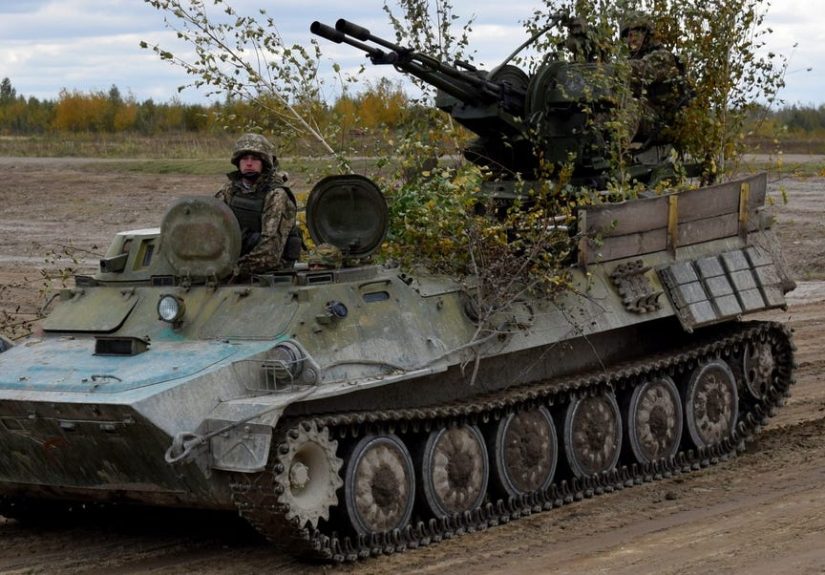
MT-LB With ZU-23-2 Anti-Aircraft Guns
One of the most common MT-LB modifications is the addition of the ZU-23-2, a twin-barrel 23 mm anti-aircraft gun. Originally designed to engage aircraft, the ZU-23-2 has long been used in ground combat because it fires fast, hits hard, and can chew through light cover. Mounted on an MT-LB, it becomes a rough but useful fire-support vehicle.
This combination makes sense. The MT-LB provides mobility and some protection. The ZU-23-2 adds serious direct-fire capability against infantry positions, light vehicles, drones at low altitude, and exposed targets. It is not a replacement for a modern infantry fighting vehicle, but it can give second-line units a mobile punch they otherwise lack.
MT-LB-12 With MT-12 Rapira Anti-Tank Gun
Ukraine has developed MT-LB-based platforms carrying the 100 mm T-12 or MT-12 Rapira anti-tank gun. The Rapira is an old but powerful smoothbore weapon originally intended to defeat armored vehicles. In modern combat, it can still threaten lighter armor, fortified positions, and personnel. Mounting it on an MT-LB turns a towed gun into a self-propelled system, reducing the time needed to shoot and move.
This is not a perfect marriage. A 100 mm gun produces serious recoil, and an MT-LB chassis was not born dreaming of artillery stardom. Some Ukrainian designs have used stabilizing claws at the rear to help manage recoil. Without proper stabilization, accuracy for follow-up shots can suffer. Still, the battlefield logic is clear: a mobile gun that can relocate quickly has a better chance of surviving drones and counter-battery fire than a static towed weapon.
MT-LB With D-44 and Other Older Field Guns
Some MT-LBs have been seen carrying older artillery pieces such as the 85 mm D-44 field gun. These weapons are not cutting-edge, but in a war where ammunition, range, and mobility all matter, an older gun can still be useful. If it can fire high-explosive rounds at enemy trenches, tree lines, and light fortifications, it has a job.
These vehicles show a recurring theme: Ukraine and Russia are not simply asking, “Is this weapon modern?” They are asking, “Can this weapon still solve a battlefield problem?” Often, the answer is yesprovided the crew understands its limits.
MT-LB With S-60 57 mm Anti-Aircraft Gun
The S-60 57 mm anti-aircraft gun is another Cold War weapon that has found new life in Ukraine. Mounted on an MT-LB, it creates a mobile medium-caliber fire-support platform. The 57 mm shell has more punch than 23 mm ammunition and can be dangerous against light armor, buildings, trenches, and vehicles.
When paired with drone spotting and digital fire-control aids, even older guns can become more effective. A drone can find a target, correct fire, and help a crew adjust quickly. This blend of old steel and new sensors is one of the defining patterns of the war: the weapon may be vintage, but the targeting loop can be very modern.
The Russian “Frankenstein” MT-LBs
Russia has produced some of the most visually bizarre MT-LB modifications of the war. These include vehicles carrying naval gun mounts, aircraft rocket pods, and even anti-submarine rocket launchers. Some of them look intimidating. Others look like the result of a heated argument between a shipyard and a tractor factory.
MT-LB With 2M-3 Naval Turret
One of the strangest Russian variants is the MT-LB fitted with a 2M-3 twin 25 mm naval gun turret. The 2M-3 was originally designed for Soviet ships, not armored tractors bouncing across muddy fields. Its guns are arranged vertically, giving the vehicle a distinctive and awkward silhouette.
On paper, twin 25 mm guns sound useful. In practice, the installation raises major questions about stabilization, aiming, crew protection, ammunition handling, and battlefield role. A naval turret designed for a ship does not automatically become an effective land weapon just because someone bolted it to a roof. The result may offer suppressive fire, but it is unlikely to match the performance of a purpose-built infantry fighting vehicle with stabilized sights and integrated fire-control systems.
MT-LB With RBU-6000 Anti-Submarine Rocket Launcher
Perhaps the most dramatic mutation is the Russian MT-LB carrying an RBU-6000 naval anti-submarine rocket launcher. The RBU-6000 was designed to fire heavy rockets against underwater threats from ships. On an MT-LB, it becomes an improvised short-range rocket artillery system. It is strange, heavy, awkward to reload, and not especially precise.
Yet it exists because war creates demand for any system that can throw explosive weight toward enemy positions. A launcher that made sense on a ship becomes questionable on a light armored carrier, but if it fires and the crew can survive long enough to move away, someone may consider it worth trying.
Aircraft Rocket Pods on MT-LB Hulls
Both sides have experimented with aircraft rocket pods mounted on ground vehicles. Pods designed for S-5 or S-8 rockets can deliver a burst of unguided fire. Accuracy is limited, especially without proper aircraft-style aiming systems, but the concept works as a kind of mini-rocket artillery. Think less “precision strike” and more “angry metal rain in the general direction of trouble.”
These vehicles highlight a harsh battlefield calculation: when precision ammunition is scarce, area fire still has value. It can suppress, disrupt, and force enemy troops to take cover. The downside is obvious. Poor accuracy wastes ammunition and can expose the vehicle to return fire or drone attacks.
Why These Mutant Vehicles Matter
It is easy to laugh at improvised armored vehicles because some of them truly look ridiculous. But dismissing them completely would be a mistake. MT-LB mutations matter because they reveal the stress points of both militaries.
First, they show shortages. If Russia had unlimited modern infantry fighting vehicles, it would not need to mount old naval guns on armored tractors. If Ukraine had endless modern self-propelled guns, it would not need to convert captured MT-LBs into mobile Rapira carriers. Improvisation is often a symptom of need.
Second, they show industrial resilience. Ukraine’s ability to repair, modify, and redeploy captured or aging platforms has become an important part of its defense. Small workshops, state enterprises, volunteer networks, and military repair units all contribute to keeping vehicles alive. In a long war, maintenance can be as decisive as manufacturing.
Third, these vehicles show how drones have changed everything. A static gun is vulnerable. A vehicle that can shoot and move is better. A vehicle with camouflage, cage armor, electronic warfare support, and drone spotting is better still. The MT-LB is not a miracle machine, but it can be adapted to survive a little longer in a battlefield where anything that moves may be watched from above.
Strengths of the MT-LB Platform
The MT-LB’s greatest strength is versatility. It has enough internal space for troops or cargo, enough towing power for artillery, enough mobility for rough terrain, and enough mechanical simplicity to be repaired under wartime conditions. Its wide tracks make it useful in mud, snow, forests, and broken rural terrainthe kind of geography that defines much of eastern and southern Ukraine.
Another advantage is familiarity. Ukrainian and Russian mechanics know the platform well. Spare parts can be scavenged from damaged vehicles. Crews understand how it drives. Commanders know what it can and cannot do. In wartime, familiar equipment has hidden value because training time is short and repair capacity is precious.
The MT-LB is also relatively low-profile compared with larger armored vehicles. That does not make it invisible, especially in the drone age, but a smaller target is still useful. When modified carefully, the vehicle can serve as a mobile mortar carrier, ambulance, anti-drone platform, fire-support vehicle, or troop carrier.
Weaknesses and Battlefield Risks
The biggest weakness is protection. The MT-LB was not built to fight like a tank. Its armor is thin, and the roof is especially vulnerable to drones, artillery fragments, and top-attack weapons. Add a large gun or rocket system on top, and the vehicle may become taller, heavier, less stable, and easier to spot.
Another problem is integration. A modern armored fighting vehicle is not just a gun on tracks. It is a system: stabilized weapon, optics, sensors, communications, ammunition storage, crew ergonomics, protection, and mobility all designed together. An improvised MT-LB may have firepower, but firepower without stability, targeting, and protection can become a liability.
There is also the issue of recoil and weight. Heavy guns stress the chassis. Large turrets change the center of gravity. Rocket launchers can overload the vehicle. A conversion that looks impressive in a photo may be difficult to reload, aim, maintain, or operate safely under fire.
Old Armor in a Drone-Dominated War
The MT-LB story is also a drone story. Ukraine has shown how drones can locate, track, and destroy armored vehicles. Russia has adapted with its own drone tactics. The result is a battlefield where armor can no longer rely on thickness alone. Vehicles need concealment, mobility, electronic protection, overhead defenses, and constant coordination with reconnaissance units.
This has pushed both sides toward improvised protection. MT-LBs have appeared with slat armor, cage armor, spare tracks, sandbags, camouflage nets, and field-made drone screens. Some additions may help against certain threats. Others mainly make crews feel better until physics files a complaint. But the trend is clear: armor crews are trying to survive an era where cheap drones can threaten expensive vehicles.
In that environment, the MT-LB remains useful because it can be risked in roles where a more valuable vehicle might be held back. It can move ammunition, evacuate wounded soldiers, carry infantry, tow guns, or provide short bursts of fire support. It is not glamorous, but wars are rarely won by glamorous machines alone.
Specific Examples of Battlefield Creativity
Several examples stand out. Ukrainian MT-LB-12 vehicles with 100 mm Rapira guns show practical adaptation: take a towed anti-tank gun, mount it on a tracked chassis, and create a mobile fire-support system. Ukrainian MT-LBs with BPU-1 turrets or heavy machine guns show another route: improve the carrier’s direct-fire ability without overloading the hull too severely.
Russia’s naval-turret MT-LBs show a different kind of adaptation. They may reflect a shortage of proper armored fighting vehicles, but they also show access to old naval weapons in storage. The RBU-6000 carrier is even more extreme: a ship weapon pressed into land service because explosive firepower was needed somewhere fast.
These machines are not equal. Some are clever. Some are desperate. Some are both. The best conversions respect the limits of the MT-LB chassis and integrate weapons with reasonable crew protection and aiming systems. The worst conversions simply stack weight and danger on top of a vehicle already working hard to stay alive.
What the MT-LB Teaches About Modern War
The mutant MT-LB phenomenon teaches a simple lesson: modern war is not only about the newest equipment. It is about adaptation speed. A 1970s vehicle with a 1950s gun can still matter if it fills a gap, supports infantry, saves a crew, or delivers fire at the right moment. At the same time, old equipment becomes deadly only when paired with tactics, sensors, maintenance, and trained crews.
For Ukraine, MT-LB conversions reflect a survival strategy: repair everything, reuse everything, improve everything, and never let a usable chassis sit idle. For Russia, bizarre MT-LB variants reveal both resourcefulness and strain. A country with deep stockpiles can keep fielding vehicles, but the quality and coherence of those vehicles may vary widely.
The MT-LB will not decide the war by itself. It is too light, too old, and too vulnerable for that. But it represents something larger: the return of battlefield improvisation at industrial scale. The war in Ukraine has turned workshops into arsenals, mechanics into designers, and old Soviet carriers into strange but sometimes useful combat tools.
Experience-Based Lessons: Living With the MT-LB Reality
From the perspective of soldiers, mechanics, analysts, and military observers, the MT-LB experience is a reminder that equipment is judged differently at the front than it is in a brochure. On paper, an old light armored tractor may look unimpressive beside a modern infantry fighting vehicle. In the field, however, the question becomes more personal: Can it move today? Can it carry the wounded? Can it get ammunition through the mud? Can it provide enough protection to keep small-arms fire out while the crew escapes a bad road? Those practical questions explain why the MT-LB remains valuable.
For crews, the MT-LB is a compromise machine. It gives more protection than a pickup truck but far less than a modern armored vehicle. It can cross ugly terrain, but it is noisy, cramped, and vulnerable from above. A crew using an improvised MT-LB must think constantly about concealment, route planning, and how long to remain in one place after firing. In the drone age, lingering is a bad habit. The vehicle that shoots and moves has a chance. The vehicle that shoots and waits may become a highlight reel for someone else’s drone unit.
For mechanics, the MT-LB is both a blessing and a headache. Its Soviet simplicity makes it repairable, and its widespread use means parts can sometimes be scavenged. But every improvised variant creates new problems. A heavy gun stresses the suspension. A roof-mounted turret changes balance. Extra armor adds weight. Rocket pods require safe mounting and careful wiring. What looks like a simple field conversion can become a long chain of practical questions: Where does the ammunition go? How does the crew reload under fire? Can the driver still see? Does the vehicle still float, or has amphibious capability quietly retired?
For commanders, MT-LB mutants offer flexibility but demand discipline. Used wisely, they can support infantry, deliver suppressive fire, move supplies, and evacuate casualties. Used carelessly, they can be mistaken for proper assault vehicles and sent into situations they cannot survive. The best lesson is not that old vehicles are suddenly modern. The lesson is that old vehicles can remain useful when commanders understand their limits.
For readers watching the war from afar, the MT-LB is a visual symbol of adaptation under pressure. It may look funny at first glance, but the humor fades when you remember why these vehicles exist. They are built because soldiers need mobility, firepower, and protection right nownot after a five-year procurement cycle. The MT-LB’s strange second life in Ukraine shows that war rewards creativity, punishes waste, and turns yesterday’s leftovers into tomorrow’s battlefield experiments.
Conclusion
The MT-LB APC began life as a humble Soviet armored tractor, but in Ukraine it has become one of the war’s most recognizable platforms for improvisation. Some versions carry anti-aircraft guns. Others mount anti-tank weapons, naval turrets, rocket pods, or improvised armor. Some are practical. Some are questionable. A few look like they were assembled during a thunderstorm by people who had skipped lunch. Yet all of them tell the same story: when modern war consumes equipment faster than factories can replace it, armies adapt with whatever they have.
Mutant Soviet armored vehicles are not just battlefield curiosities. They are evidence of shortage, creativity, desperation, and resilience. The MT-LB’s continued relevance shows that even old military platforms can matter when they are available, repairable, and flexible. In Ukraine, the armored tractor has become a rolling lesson in survival: not pretty, not perfect, but still moving.