Table of Contents >> Show >> Hide
- Why Character-And-Creature Bonds Hit So Hard
- What Makes A 30-Illustration Series Feel Cohesive
- The Visual Tools That Make These Bonds Believable
- Why Audiences Keep Coming Back To Human-And-Creature Stories
- What This Collection Says About Modern Illustration
- Experiences That Make This Theme Feel So Personal
- Final Thoughts
Some art is technically impressive. Some art is emotionally memorable. And then there is the rare kind that does both while making you grin like a kid who just found a secret door in a tree. That is the magic behind illustration series built around characters and creatures. They do not simply give us a cool design to admire. They suggest history, loyalty, danger, comfort, mischief, and the kind of wordless understanding that often says more than a page of dialogue ever could.
A collection built around 30 character-and-creature pairings works especially well because it turns one charming image into a full visual language. A single drawing can hint at companionship. Thirty can build an entire emotional ecosystem. One pairing might feel heroic, another funny, another slightly chaotic in the best way. Together, they start to answer a bigger question: why are we so drawn to stories where humans and creatures depend on each other?
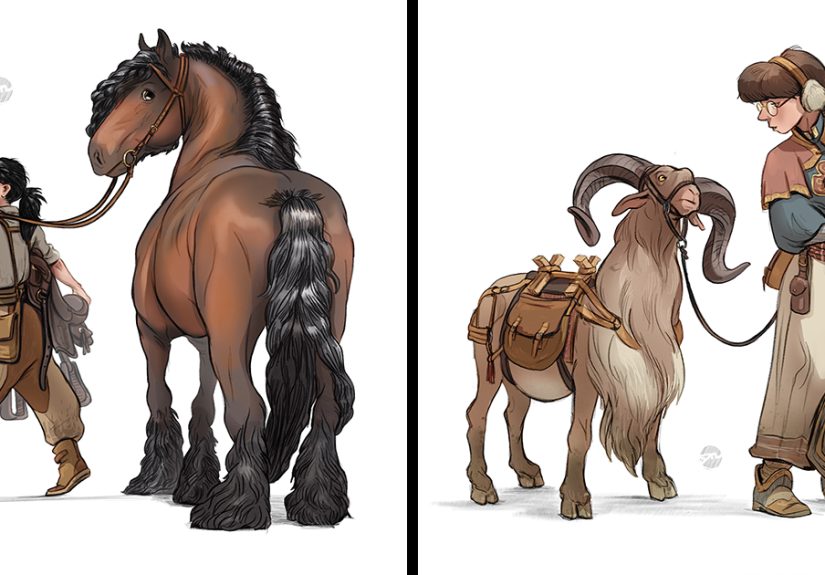
The answer is not just “because fantasy art is cool,” although that certainly does not hurt. Creature companions allow illustrators to push scale, shape, texture, and emotion farther than strictly realistic scenes often permit. A lion beside a traveler instantly changes the power balance of the image. A pig beside a battle-ready fighter adds comedy and tenderness at the same time. A suspicious goat next to a bookish character introduces attitude before anyone even opens their mouth. Suddenly, the drawing is not only about who the character is. It is about who they become in the presence of another being.
Why Character-And-Creature Bonds Hit So Hard
The strongest illustrations do not rely on spectacle alone. They rely on relationships. That is why character-and-creature art feels so sticky in the brain. A sword, a cloak, and a dramatic background may catch the eye for a second. But a look exchanged between a person and a beast, a protective lean, a playful nudge, or a shared sense of direction keeps the image alive in the viewer’s mind long after the scroll ends.
What makes this kind of bond so compelling is that it feels ancient and fresh at the same time. Humans have told stories about animals, guardians, companions, tricksters, mounts, and mythic beings for centuries. Yet every illustrator gets to re-stage that relationship in a new emotional register. One creature can be a bodyguard. Another can be a mirror of the character’s inner world. Another can be a walking disaster with fur, horns, feathers, or teeth. That range is exactly what gives a 30-image collection so much narrative fuel.
Wordless Communication Does the Heavy Lifting
One of the great tricks of creature-centered illustration is that it gives artists permission to amplify feeling without making the image noisy. A bond between two humans often relies on facial nuance, dialogue context, or recognizable social cues. A bond between a person and a creature can be broader and cleaner. A paw placed near a boot, a head tilted toward a shoulder, a protective stance, or a creature turning before the human turns can communicate trust with almost ridiculous efficiency.
That is why these images feel instantly readable. They tap into body language. The viewer can tell who is nervous, who is brave, who is soft-hearted, and who is bluffing with the confidence of someone who has never once won a fair fight. In the best illustrations, the creature is not an accessory. It is the second half of the sentence.
Creatures Expand Emotion Without Breaking Believability
There is also a practical storytelling bonus here: creatures let artists heighten emotion without losing sincerity. A huge furry companion can make protection feel visible. A bird can turn freedom into a compositional idea. A tiger can add danger without requiring an actual explosion in the background. A pig or goat can introduce humor while still feeling affectionate rather than gimmicky. The creature becomes a visual shortcut to mood, but a good illustrator never lets it become lazy symbolism. The best pairings still feel specific to the characters involved.
What Makes A 30-Illustration Series Feel Cohesive
A single strong image is one thing. A cohesive series is another beast entirely, and yes, that pun was waiting by the door from the start. For a 30-piece collection to work, the artist needs more than a cool premise. The series needs consistency in voice, even if the settings, species, and personalities vary wildly.
That cohesion usually comes from a few core choices. First, there is the emotional thesis. In a series like this, the thesis is not “look at all these creatures.” It is “look at all the ways companionship can be visualized.” Second, there is the design logic. The artist must create people and creatures that feel like they belong to the same universe, even when one image is playful and another is dramatic. Third, there is rhythm. Thirty illustrations cannot all shout. Some should whisper. Some should wink. Some should act like they know a secret and will absolutely not tell you.
Each Pairing Needs A Backstory, Even If It Is Never Written
The best series feel as though every image is the visible tip of a much bigger iceberg. You do not need a full novel to believe the relationship. You just need enough clues to sense one exists. Maybe the rider sits casually on a dinosaur-like mount, suggesting long familiarity instead of fear. Maybe an archer stands beside a tiger with the ease of a duo that has survived many bad decisions together. Maybe a lion’s calm posture makes the human beside it look less lonely, less decorative, more grounded.
This is where good illustration sneaks into storytelling territory. Viewers start filling in the blanks. Who found whom first? Who protects whom? Is the creature tame, wild, magical, or simply choosing to stay? Great art does not answer every question. It places just enough breadcrumbs on the path to make the audience walk voluntarily into the forest.
Variation Keeps The Collection Alive
Thirty images also create room for tonal diversity. That matters. If every drawing leans epic, the collection gets heavy. If every drawing leans cute, it gets sugary. The strongest series mix tension with warmth, elegance with absurdity, and fantasy with emotional recognizability. That is how an illustrator builds momentum rather than repetition.
In practical terms, that means varying posture, scale, palette, environment, and emotional distance. Some pairings should stand shoulder to shoulder like equals. Some should feel guardian-like. Some should suggest that the creature is clearly in charge, while the human is just trying to look organized. That kind of variation does more than entertain. It proves the artist understands relationships, not just rendering.
The Visual Tools That Make These Bonds Believable
If an illustration about companionship works, it is because the artist has made dozens of invisible decisions correctly. Viewers may describe the result as “cozy,” “epic,” “heartwarming,” or “awesome,” but what they are really responding to is design discipline disguised as emotion. That is the sweet spot.
Shape Language Matters More Than Most People Realize
Friendly characters often lean into rounder forms. Protective figures may feel stable and grounded. Dangerous or unpredictable ones tend to sharpen. In creature design, shape language is basically emotional architecture. A broad, rounded beast can feel trustworthy even at an intimidating size. A narrow, angular animal can feel alert, unstable, or threatening before the viewer consciously understands why.
When a character and creature share visual echoes, the bond becomes stronger. Maybe both are built from soft curves. Maybe one is angular while the other is rounded, creating a “storm cloud meets cup of tea” contrast that somehow still works. That push and pull is what makes pairings memorable. Design is doing psychological work without waving a giant sign that says, “Hello, I am symbolism.”
Color And Texture Carry Emotional Subtext
Color does not just decorate the scene. It controls emotional weather. Warm earth tones can make a bond feel old, steady, and lived-in. Cooler palettes can turn the relationship mysterious or distant. Saturated accents can point the eye toward the emotional center of the image: a scarf, a set of eyes, a bit of fur, a glowing talisman, a weapon nobody should lend to a stranger.
Texture matters too. Fur, feathers, scales, leather, metal, linen, and worn boots create tactile contrast, and tactile contrast creates belief. When the creature feels touchable, the relationship feels more real. Viewers may never say, “Excellent use of material differentiation,” but they will feel it. And feeling is the whole job.
Gesture Beats Detail
Artists love detail. Viewers love detail. Detail is wonderful. Detail is also a trap if it replaces clarity. In bond-based illustration, gesture almost always matters more. A giant companion leaning its head ever so slightly toward the human can say more than twenty decorative armor straps. The angle of a hand, the spacing between bodies, or the shared line of sight can transform a beautiful image into a meaningful one.
This is why strong portfolios are not just collections of polished drawings. They are collections of readable emotions. One image full of heart can tell a story just as effectively as a sequence. That is especially true when creatures are involved, because they concentrate attention on action and relation rather than speech.
Why Audiences Keep Coming Back To Human-And-Creature Stories
There is a reason these images resonate across fantasy art, children’s books, animation, comics, and editorial illustration. They speak to something deeply recognizable: the idea that connection does not always require sameness. A person and a creature can differ in species, scale, language, instinct, or world, and still clearly belong to one another. That is a beautiful story engine. It also happens to be emotionally efficient.
Viewers respond to these pairings because they recognize pieces of real life inside imaginative forms. Loyalty, care, play, protectiveness, curiosity, grief, and comfort are not abstract concepts. We know them. We have lived them. Even when the creature in the image is fantastical, the relationship often feels emotionally true. That truth is what gives fantasy its staying power. The design may be invented. The feeling is not.
There is another reason these illustrations land so well: creatures soften the boundary between spectacle and intimacy. A huge beast can make the world feel bigger, but the relationship makes the world feel personal. That combination is hard to resist. It offers adventure without emotional emptiness. It gives the viewer a reason to care beyond “wow, neat horns.” Though, to be fair, neat horns are still doing some useful labor.
What This Collection Says About Modern Illustration
A project like this also reflects where illustration thrives today. Audiences are hungry for art that is instantly legible but not shallow, imaginative but emotionally specific, stylized but not sterile. Character-and-creature collections check all those boxes. They invite fans of fantasy, comics, animation, folklore, and creature design into the same room, then politely lock the door and hand everyone snacks.
They also show how modern illustrators build community. A themed series is easy to share, easy to revisit, and easy for viewers to talk about. People can pick favorites. They can imagine stories. They can debate whether the tiger would tolerate the human’s nonsense or whether the goat is secretly the strategist of the whole operation. In other words, the work becomes participatory. That is a huge advantage in an online art ecosystem where attention is short and emotional clarity matters.
Most importantly, a 30-illustration collection proves stamina. It shows the artist can return to a central theme again and again without flattening it. That is not a small achievement. It requires not only drawing skill, but narrative intelligence. The artist has to keep discovering new shapes of affection, tension, humor, and visual chemistry. That is the difference between a fun prompt and a body of work.
Experiences That Make This Theme Feel So Personal
What makes a title like My 30 Illustrations Showcasing The Unique Bonds Between Characters And Creatures especially effective is that it taps into something many viewers already carry with them. Almost everyone has experienced some version of a creature relationship, whether that creature was a household pet, a wild animal glimpsed at exactly the right moment, a horse at a summer camp, a cartoon sidekick from childhood, or a fictional beast they loved so much they tried to draw it in the margins of a math notebook that was definitely not asking for a dragon upgrade.
That personal memory matters because it changes how we read the art. We are not just evaluating composition or brushwork. We are bringing our own history to the image. A character resting a hand on a creature’s back may remind one viewer of a childhood dog waiting by the door every afternoon. Another may think of a rescue cat who decided, with royal authority, that their keyboard was now shared property. Another may remember the first time a nature documentary made them realize animals were not decorative background to human life, but emotional beings with patterns, bonds, and moods of their own.
Illustrations about characters and creatures often become emotional mirrors in that way. They can recall trust, companionship, and comfort, but also independence, misunderstanding, and the slow process of earning connection. Anyone who has ever tried to befriend a shy animal knows that relationships are built through attention rather than force. Good illustrators understand that. The most convincing images are usually not the loudest ones. They are the ones where the body language feels earned.
There is also a creative experience wrapped into this theme. Artists are drawn to creature companions because they make imagination feel bigger without making emotion feel fake. A human figure alone can tell a story. Add a creature, and suddenly the artist has more ways to explore contrast, scale, rhythm, silhouette, and mood. A tiny person beside a giant beast can suggest protection, vulnerability, or comic inconvenience depending on posture. A proud warrior beside a grumpy pig can become instantly lovable. A scholarly traveler with a horned companion can feel mysterious before the viewer knows a single plot detail.
For many people, that is exactly why these illustrations linger. They do not just look good on a screen. They feel like fragments of larger worlds we want to revisit. They remind us that companionship is one of storytelling’s most durable themes, and that creatures, whether realistic or fantastical, give artists a uniquely rich way to explore it. You can admire the costumes, the textures, the anatomy, and the color choices, sure. But what keeps you staring is the bond. That invisible line between two beings is the real subject every time.
And honestly, that may be the secret behind the appeal of collections like this. They give us wonder with a heartbeat. They offer fantasy that still feels emotionally familiar. They let us believe that somewhere beyond the edge of the ordinary world there is still room for a rider and a beast, a wanderer and a lion, a dreamer and a bird, a protector and a creature with very questionable manners but excellent loyalty. In a noisy digital world, that kind of visual storytelling feels less like decoration and more like a gentle reminder that connection is still the most powerful design element of all.
Final Thoughts
My 30 Illustrations Showcasing The Unique Bonds Between Characters And Creatures is the kind of title that promises fantasy, but its real success comes from emotional precision. The creatures may be striking, strange, adorable, fierce, or gloriously weird, yet the heart of the work is relationship. That is what gives the images staying power. They are not just showcases of style. They are small story engines built from gesture, shape, contrast, and trust.
In the end, that is why character-and-creature illustration remains so powerful across art forms. It gives us spectacle with intimacy, imagination with recognizability, and visual charm with emotional depth. And when an artist can sustain that across 30 distinct images, the result is more than a gallery. It becomes a world viewers want to step into, wander around, and maybe never fully leave.