Table of Contents >> Show >> Hide
- What “Touching the Sun” Actually Means (Spoiler: No One Landed)
- The Thermal Problem: Temperature Isn’t Heat (and Space Is Weird Like That)
- Meet the Thermal Protection System: A Heat Shield With Main-Character Energy
- Getting Close Without Dying: Records, Reality, and the “Low-Density Furnace”
- Power in the Inferno: Water-Cooled Solar Arrays (Yes, Water)
- Science Instruments That Dare to Peek Out
- Autonomy: The Probe’s “Don’t Burn Me” Reflex
- Why Heat-Resistant Technology Matters Beyond This Mission
- Engineering Lessons From “Touching the Sun”
- Experience Add-On: What It “Feels Like” to Engineer a Spacecraft That Can Take the Sun’s Punch
“Touch the Sun” sounds like a dare you hear right before someone loses their eyebrows. But NASA’s Parker Solar Probe did itwithout melting into a sad little puddle of expensive regret. The secret isn’t magic. It’s a ruthless, elegant mix of materials science, thermal engineering, autonomous spacecraft control, and the kind of teamwork that makes you wonder why your group project in college couldn’t even agree on a font.
Parker Solar Probe is designed to fly through the Sun’s outer atmosphere (the corona), where the environment is punishing: intense sunlight, searing radiation, and plasma that can be hotter than a million degrees. Yet the spacecraft’s sensitive electronics and instruments must stay cool enough to do real science. That’s the engineering puzzle in one sentence: “Please go into the furnace… and keep the laptops comfy.”
What “Touching the Sun” Actually Means (Spoiler: No One Landed)
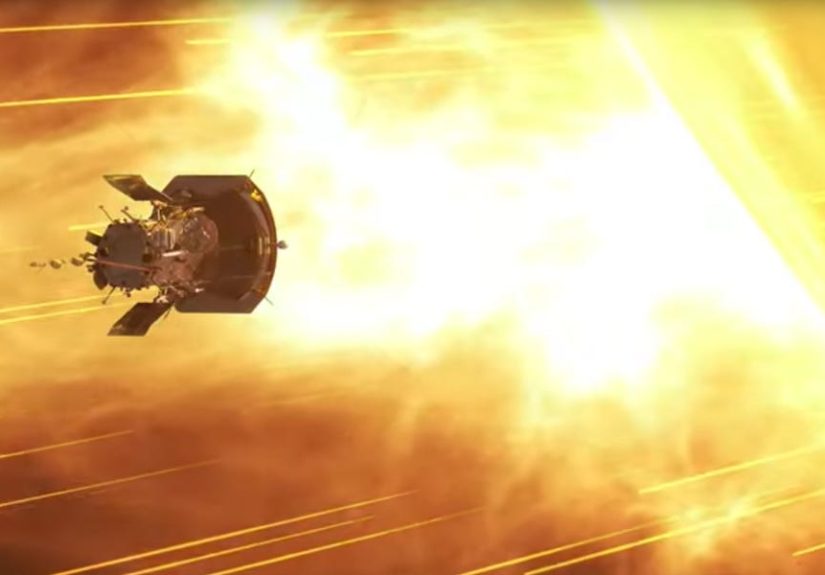
When NASA says Parker “touched the Sun,” it doesn’t mean the probe dipped a toe in the visible surface like it’s testing bathwater. It means the spacecraft flew through the corona, the Sun’s upper atmosphere, and directly sampled particles and magnetic fields theresomething no mission had done before. That’s “touching” in the same way walking into fog counts as “touching a cloud,” except the fog is electrified, supersonic, and has opinions.
Why does it matter? Because the corona is where big mysteries live: why the Sun’s atmosphere is so much hotter than the surface, how the solar wind is accelerated, and how energetic particles get flung across the solar system. Parker’s job is to stop guessing from far away and start measuring up close.
The Thermal Problem: Temperature Isn’t Heat (and Space Is Weird Like That)
Here’s the part that breaks people’s brains (in a fun way): the corona can be extremely hot, but it’s also extremely low-density. Temperature measures how fast particles are moving; heat is how much energy they actually transfer. If there aren’t many particles to bump into your spacecraft, there’s less heat transferreddespite the scary temperature number. That’s why an oven can be hotter than boiling water, yet boiling water burns you faster. (Please don’t test this with your hands.)
But Parker’s biggest enemy isn’t the sparse coronal plasmait’s the Sun’s relentless light. Direct sunlight near the Sun is brutally intense, and it can cook hardware quickly. That’s why Parker’s thermal strategy is basically: block the light, reflect what you can, radiate away what you absorb, and keep delicate systems in permanent shade.
Meet the Thermal Protection System: A Heat Shield With Main-Character Energy
The star of the show is the Thermal Protection System (TPS), Parker’s heat shield. It’s the reason you can say “spacecraft” and “Sun” in the same sentence without immediately adding “and then it exploded.”
A carbon-carbon sandwich with a foam core (yes, foam)
The TPS is a composite “sandwich”: two panels of reinforced carbon-carbon composite with a lightweight carbon foam core in between. It’s thickabout 4.5 inchesand broadabout 8 feet acrossbig enough to cast a protective shadow (umbra) over most of the spacecraft. The foam core is incredibly light, which matters because every extra pound makes it harder to achieve the wild orbit Parker needs.
Carbon-carbon is a superstar material for extreme heat. It keeps its structural strength at temperatures that would make many metals surrender and quietly leave the chat. The foam core helps reduce heat conduction, acting like thermal “dead air space,” but engineered to survive spaceflight and continuous thermal punishment.
White coating: sunscreen for a spacecraft
The Sun-facing side is coated with a specially formulated white layer designed to reflect as much solar energy as possible. It’s not just “paint,” and it’s not just “white.” It’s engineered to minimize absorption and keep the shield from taking on extra heat it doesn’t need. This is one of those moments where “the color matters” isn’t fashion adviceit’s mission-critical physics.
Hot outside, comfy inside
At closest approach, the sunward surface of the shield can reach roughly 2,500°F, while the spacecraft body behind it can remain around a comfortable room-like temperature (about 85°F). The TPS is also mounted to minimize heat conduction into the spacecraft structurebecause you don’t want the shield to act like a giant frying pan handle conducting heat into your electronics bay.
Getting Close Without Dying: Records, Reality, and the “Low-Density Furnace”
Parker’s close approaches are record-breaking on two fronts: distance and speed. The closer you go, the faster you have to travel (orbital mechanics is basically the universe’s way of saying “no free rides”). In 2024, NASA reported Parker achieved a record close pass of about 3.8 million miles from the Sun’s surfacecosmically speaking, that’s basically leaning over the railing for a better look.
And here’s the thermal nuance: the corona can exceed a million degrees Fahrenheit, but because it’s low-density, the TPS is expected to warm to around 1,800°F in the corona, even though it was designed to tolerate a hotter case (up to about 2,600°F by design margin). Engineering loves margins. They’re the grown-up version of “just in case.”
Power in the Inferno: Water-Cooled Solar Arrays (Yes, Water)
The Sun is Parker’s science target…and also its power source. Solar panels make electricity, but near the Sun, solar panels also try to become toast. Parker solves this with one of its most surprisingly relatable features: a water-cooling system. Because sometimes the best solution is the one you’d use on Earthjust redesigned to survive vacuum, radiation, launch vibration, and the occasional existential dread.
How the Solar Array Cooling System works
Parker’s Solar Array Cooling System circulates deionized water through tiny channels embedded in parts of the solar arrays. The water absorbs heat, then flows to radiators that dump that heat into space. The system is designed to keep the partially exposed solar arrays below roughly 302°F, even while the heat shield’s sunward side gets far hotter.
The details are deliciously specific: a heated tank prevents freezing at launch, pumps push the coolant, and multiple radiators (with carefully chosen materials for corrosion resistance and thermal performance) reject heat. NASA has described the system as first-of-its-kind for a science mission using water-cooled solar array thermal managementbecause “normal spacecraft” generally don’t need their solar panels to survive conditions that can bully molten lava.
Why deionized water is the hero (and why it’s not just “because it’s cheap”)
Water was selected because it can operate across the mission’s required temperature range when properly pressurized, and it carries heat efficiently without demanding a heavier system. Deionizing removes minerals that could contaminate channels or damage components over time. In other words: the probe uses water, but it’s “space water,” which is somehow both ordinary and extremely picky.
Even the solar arrays themselves are designed with lessons learned from prior missions that flew closer to the Sun than most spacecraft, helping engineers tackle degradation from intense ultraviolet exposure and manage heat flow through the panel structure.
Science Instruments That Dare to Peek Out
Parker carries four main instrument suites that measure fields, particles, energetic particles, and images of coronal structures. The trick is that some sensors must “look” or “touch” what’s outside the shieldmeaning they’re exposed to brutal conditions. That forces instrument engineering into a special category: “What can we build that won’t panic at 2,500°F?”
SWEAP: tasting the solar wind without becoming it
SWEAP (Solar Wind Electrons Alphas and Protons) measures the solar wind’s most common particles and their properties. Its Solar Probe Cup is a Faraday cup that faces the Sun to directly sample the stream of charged particles. The cup uses high-temperature materials and clever electrical isolation to survive. NASA has described designs using materials like tungsten (for grids that must handle extreme heat) and sapphire components to electrically isolate parts while tolerating harsh radiation and thermal stress.
Testing this kind of hardware is not subtle. Engineers must simulate intense solar heating and radiation in ground facilities, because “we’ll find out if it works when it gets to the Sun” is not a respectable test plan.
FIELDS: antennas that stick into sunlight on purpose
The FIELDS suite measures electric and magnetic fields in the near-Sun environment. Some antennas extend beyond the heat shield into direct sunlight and face extreme temperatures. NASA has noted these antennas are made from materials like niobium alloys chosen for high-temperature resiliencebecause standard antenna materials would tap out fast in Parker’s neighborhood.
WISPR: seeing the corona without getting blinded
WISPR (Wide-Field Imager for Parker Solar Probe) is the mission’s camera system. Imaging the faint corona near the blinding Sun is like trying to photograph fireflies next to a stadium spotlight. WISPR uses the heat shield as a light blocker and relies on carefully designed baffles and occulters to suppress stray light reflected or diffracted from the shield edge and spacecraft structures.
Even WISPR’s detector choices reflect the environment: radiation-hardened sensors and rugged optics are used because cosmic rays, energetic particles, and dust impacts are serious concerns close to the Sun.
Autonomy: The Probe’s “Don’t Burn Me” Reflex
Parker can’t rely on real-time joystick piloting from Earth. Radio signals travel at the speed of light, and that still takes about eight minutes to cross the distanceso if something goes wrong, you don’t have time to ask Earth what to do. The spacecraft must protect itself.
Parker uses an autonomous system to keep the TPS pointed at the Sun and maintain the spacecraft in the shield’s shadow. NASA has described sensors mounted along the edge of the shadow line; if those sensors detect sunlight where it shouldn’t be, the spacecraft can correct its attitude to get back into the safe zone. Think of it like a self-correcting “stay under the umbrella” instinctexcept the umbrella is carbon-carbon, and the rain is starfire.
This autonomy isn’t just convenientit’s survival. A few degrees off-angle at the wrong time could expose temperature-sensitive parts to direct sunlight, and “direct sunlight near the Sun” is not the same as “direct sunlight on your patio.”
Why Heat-Resistant Technology Matters Beyond This Mission
Parker’s heat-resistant technology isn’t just a one-off stunt. It’s a toolkit for future missions that operate near high-radiation, high-thermal-load environmentswhether that’s near the Sun, near Mercury-like conditions, or in any mission scenario where high-intensity illumination and thermal gradients dominate design.
The TPS demonstrates how lightweight, high-temperature composites can enable trajectories previously considered too risky. The solar array cooling system demonstrates that active thermal managementusing fluids, pumps, radiators, and smart controlcan keep power systems operating in environments where passive thermal design would fail. And the autonomy approach shows how spacecraft can survive in communication-limited conditions by detecting threats and responding instantly.
Engineering Lessons From “Touching the Sun”
- Thermal design is systems design: The shield, the structure, the arrays, the instruments, and the software all work togetheror none of them work for long.
- Materials science is mission-enabling: Carbon-carbon composites, refractory metals, specialized coatings, and radiation-tolerant components aren’t upgrades; they’re requirements.
- Margins aren’t paranoia: Designing for worst cases and keeping the spacecraft safe in uncertain conditions is how you buy reliability in deep space.
- Autonomy is not optional near the Sun: If you can’t respond in minutes, your spacecraft must respond in seconds.
Experience Add-On: What It “Feels Like” to Engineer a Spacecraft That Can Take the Sun’s Punch
Imagine you’re on the engineering team, and your job is to make sure a spacecraft doesn’t turn into a cautionary tale. The first “experience” isn’t a dramatic launch countdownit’s a meeting where someone calmly says, “We need the sunward surface to tolerate thousands of degrees Fahrenheit, but the instruments behind it should behave like they’re in a pleasant office.” Everyone nods like that’s a normal Tuesday request.
Then comes the hands-on reality: thermal-vacuum testing, material samples, coatings that look deceptively simple, and endless debates about interfaces. A heat shield isn’t just a big plate; it’s a precision structure that must stay aligned, survive vibration, and remain stable through repeated heating and cooling cycles. You learn quickly that “insulation” in space is not a blanket solutionliterally. It’s geometry, conduction paths, radiative balance, and the discipline to design every bolt, bracket, and mount like it matters (because it does).
The TPS brings a special kind of emotional roller coaster. Carbon-carbon is strong at high temperatures, but it’s not the same as designing with common metals. You think differently about joints, thermal expansion, and how to keep heat from creeping into the spacecraft like an uninvited guest. The mounting approach becomes a story of restraint: connect the shield firmly enough to survive launch, but cleverly enough to minimize heat conduction into the spacecraft structure. The “experience” here is learning that the best thermal pathway is often the one you refuse to create.
The solar array cooling system experience is even more relatablebecause it’s basically spacecraft HVAC, except the coolant can freeze during launch, the radiators must work in a vacuum, and the pumps must be dependable while the entire vehicle is getting hammered by radiation. You start appreciating words like “deionized,” “pressurized,” and “mini-channels” in a whole new way. You also learn that power systems become personal: the spacecraft is powered by the very arrays that need cooling, so your cooling design has to be efficient, robust, and not addicted to energy.
And then there’s autonomythe quiet hero that never sleeps. You get used to thinking in “what if” chains: what if the spacecraft drifts slightly? What if a sensor sees sunlight at the wrong edge? What if we’re behind the Sun and can’t talk to the probe? This is where software and hardware stop being separate teams and become one organism. Sensors, attitude control, and fault protection must react fast enough that the spacecraft stays in the TPS shadow without waiting for Earth’s advice. The experience is humbling: you’re designing reflexes for a robot that’s about to face a star.
The best part of this engineering “experience,” though, is the payoff: every successful close pass proves that the physics was understood, the margins were real, the materials behaved, and the system-level thinking held together under maximum stress. It’s not just surviving the heatit’s surviving while doing precise science. In a way, Parker Solar Probe’s heat-resistant technology is the most practical kind of wonder: it turns something that sounds impossible into a repeatable, testable, measurable reality. And that’s the kind of “touch” that changes what humans can do next.