Table of Contents >> Show >> Hide
- When a Staircase Stops Being a Staircase
- Who Is Leon Tarasewicz, and Why Does This Feel So Different?
- The Beauty of Controlled Chaos
- Why This Work Feels So Modern
- Why the Internet Fell in Love With It
- Painting Beyond the Canvas
- What the Staircase Really Does to the Viewer
- A Related Experience: What Works Like This Feel Like in Real Life
- Conclusion
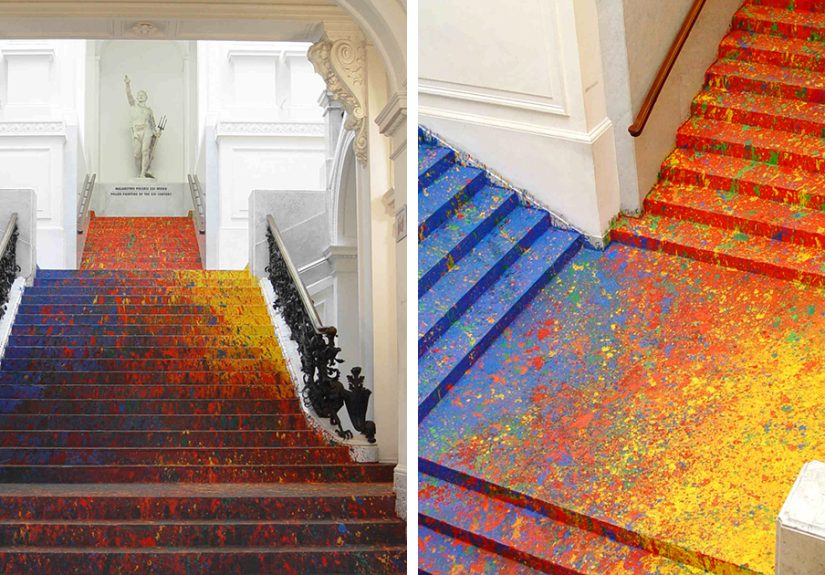
Some art asks you to stand back, fold your arms, and nod thoughtfully like you’re auditioning for a documentary. And then there’s the kind of art that grabs you by the eyeballs before you even make it past the front steps. That is exactly why Leon Tarasewicz’s paint-splashed staircase intervention at Poland’s Zachęta National Gallery still hits so hard years later. It does not whisper. It does not politely introduce itself. It explodes across the architecture and turns the museum’s grand entrance into something between a painting, a performance, and a joyful color ambush.
The viral headline makes it sound like a wild act of artistic mischief, as if somebody handed a brilliant painter several buckets of color and said, “Do your worst.” But the real magic is that the work feels spontaneous while being deeply intentional. The staircase looks splattered, streaked, and gloriously unbuttoned, yet the visual impact comes from disciplined color relationships, a commanding sense of movement, and a rare understanding of how viewers physically experience a museum. You do not simply see this work. You walk through it, climb beside it, and become part of its rhythm.
When a Staircase Stops Being a Staircase
Tarasewicz’s intervention is so memorable because it performs a neat little miracle: it takes one of the most functional parts of a museum and turns it into the emotional opening scene. A staircase is normally a transitional space. It says, “Keep moving, the art is upstairs.” Tarasewicz flips that logic on its head. Suddenly the staircase is the event. The path becomes the picture. The architecture becomes the canvas. Even people who would usually speed through a gallery entrance are forced to slow down and recalibrate.
That shift matters. Museums often train us to think of art as something separate from the building that houses it. Paint goes on canvas. Sculpture goes on a pedestal. Visitors behave. Tarasewicz cheerfully ignores all that. By carrying color over steps, floors, and surrounding surfaces, he treats the gallery interior as a living field rather than a neutral container. The result is immersive without being gimmicky. It feels painterly, but it also feels physical, almost athletic. Color runs downhill. Surfaces pulse. Perspective changes with every step.
And that is why the work photographs so well but lands even better in person. In a photo, you get the drama. In space, you get the sensation. The eye follows stripes, splashes, and bands of color, but the body also feels guided by them. It is hard not to think of it as a route, a current, a visual river flowing through a formal institution that suddenly looks much less formal.
Who Is Leon Tarasewicz, and Why Does This Feel So Different?
Leon Tarasewicz is not the kind of painter who seems content to leave color trapped inside a polite rectangle. His career has long pushed painting beyond the standard canvas and into environments, public spaces, and architectural settings. That larger context helps explain why the Zachęta staircase does not feel like a stunt. It feels like part of a larger mission: to let painting breathe, spread, and misbehave a little.
His visual language often draws energy from landscape, rhythm, light, and the changing relationships between colors. That background gives his work a fascinating double character. On one hand, it can look abstract, even wildly abstract. On the other, it often feels rooted in the natural world, in movement, growth, and atmosphere. He understands that color is never just decorative. It changes how a place feels. A red beside a yellow does one thing. Blue against stone does another. A painted surface can make architecture seem heavier, lighter, warmer, stranger, or suddenly alive.
That sensitivity is exactly what gives the staircase piece its staying power. The colors are vivid, but they are not random noise. They create momentum. They energize the hall. They make the building appear to participate in the painting rather than merely display it. Tarasewicz is not throwing color at architecture as an act of rebellion. He is having a sophisticated conversation with it, even if that conversation looks delightfully unruly from a distance.
The Beauty of Controlled Chaos
Let’s talk about the obvious thing: yes, it looks chaotic. Wonderfully, gloriously, joyfully chaotic. But good art often hides its discipline inside apparent freedom. That is part of the thrill. Tarasewicz’s staircase does not read as a neat geometric mural or a tidy decorative scheme. It feels more alive than that. The paint appears to surge and collide. It evokes the messiness of action painting, the directness of public art, and the immersive force of installation art all at once.
Yet the work never collapses into visual nonsense. Why? Because the color relationships do the heavy lifting. Primary tones and their combinations create a kind of muscular harmony. The eye keeps finding structure inside the splash. The architecture itself also provides order. Stairs, landings, walls, and edges keep the composition from floating away into pure disorder. The building acts like a frame, but a frame with a pulse.
This balance between freedom and structure is a huge part of what makes the piece so satisfying. Too much order, and it would look decorative. Too much disorder, and it would feel careless. Instead, it lands in that sweet spot where viewers think, “How on earth is this such a mess and such a masterpiece at the same time?”
Why This Work Feels So Modern
One of the smartest things about this staircase installation is that it refuses the old fantasy of the museum as a pristine, untouched temple. Contemporary audiences are used to immersive experiences, large-scale environments, and art that engages the whole body. But Tarasewicz’s work does not chase trends in a flashy, digital, selfie-bait way. It feels modern because it understands that people experience space dynamically. We move. We glance. We pivot. We climb. We don’t always stand still in front of a frame for ten uninterrupted minutes while contemplating brushwork and mortality.
By turning a high-traffic passageway into a painterly environment, the work acknowledges how museums are actually used. People enter with expectations, distractions, and momentum. This installation meets them in motion. It catches them mid-transition and says, “Nope, the experience starts right now.” In that sense, it is generous. It does not hide in a side room waiting to be discovered by the most patient viewer. It comes to meet the public where the public already is.
That idea has shaped many memorable site-specific museum works over the years. Artists who activate walls, floors, ceilings, lobbies, and corridors often reveal something that traditional display can miss: architecture is never neutral. It influences mood, pace, and attention. Tarasewicz’s staircase makes that truth impossible to ignore. Once you see it, you can’t really go back to pretending a museum hallway is just a hallway.
Why the Internet Fell in Love With It
It is not hard to understand why this work became catnip for art lovers online. First, it is instantly legible. Even someone who has never heard of Polish contemporary painting can look at the staircase and think, “Okay, that rules.” Second, it combines two things the internet adores: visual surprise and transformation. People love before-and-after thinking, even when the “before” is a stately neoclassical interior and the “after” is a color storm.
But the work also survives the internet’s worst habit, which is flattening everything into a quick scroll. Many viral images look amazing for six seconds and then evaporate from memory. Tarasewicz’s staircase sticks because it carries a bigger idea inside the spectacle. It is not just pretty. It asks what painting can be. It asks whether institutions must remain visually conservative. It asks if beauty can be loud, messy, physical, and a little disobedient without losing seriousness.
That is a big reason people keep returning to it. The work is accessible without being shallow. You can admire the colors immediately, then spend much longer thinking about the relationship between art and architecture, public experience and elite space, spontaneity and planning, surface and environment. That’s a pretty impressive return on investment for one staircase.
Painting Beyond the Canvas
Tarasewicz’s intervention also belongs to a larger story in contemporary art: the steady expansion of painting beyond the canvas. For decades, artists have questioned whether painting must remain flat, framed, and politely hung at eye level. Some have moved into shaped supports, murals, environments, floors, or sculptural hybrids. Others have used color to alter entire rooms or buildings. What makes Tarasewicz distinctive is the way he keeps the essence of painting intact even as he blows past its traditional boundaries.
He does not abandon painting. He enlarges it. He treats architecture as a place where painting can continue rather than end. In lesser hands, that could turn into visual gimmickry. Here, it becomes a serious proposition: maybe painting is not merely an object but a condition, an atmosphere, a way of reorganizing how we move through space.
That idea is especially powerful inside a national gallery, where history and institutional authority are always hovering in the background. To cover such a formal environment with forceful, exuberant color is not just aesthetically striking. It suggests that museums do not have to remain frozen in the visual manners of the past. They can be charged, porous, and unexpectedly alive.
What the Staircase Really Does to the Viewer
The best way to think about this work may be less as a painted surface and more as an altered state of arrival. Before the staircase, you are entering a museum. On the staircase, you are entering a world of color. That distinction matters. Great installation art changes not just what you look at but how you behave. Tarasewicz’s piece encourages curiosity. It disrupts routine. It sharpens awareness. Suddenly you notice the rise of the steps, the sweep of the balustrade, the volume of the hall, the echo between painted areas and untouched ones.
There is also something pleasantly democratic about it. Because the work occupies a passage space, it reaches everyone. You do not need specialist knowledge to be affected by it. You do not need to decode symbolism, memorize theory, or pretend to understand ten pages of curatorial language. You just need eyes, feet, and a willingness to be delighted. And honestly, that is one of contemporary art’s most underrated virtues.
At the same time, the piece rewards deeper looking. Spend a little more time with it and you begin to appreciate how the colors carve paths, how the splatters resist symmetry without losing coherence, and how the painting seems to animate the building from the inside out. It is playful, yes, but it is also rigorous. The joke, if there is one, is that something this exuberant is also this smart.
A Related Experience: What Works Like This Feel Like in Real Life
Art like this has a strange effect on memory. Long after you forget the title of a show, the staircase stays with you. You remember the surprise of seeing a formal museum setting suddenly behave like a living painting. You remember the instinctive grin that creeps across your face before your brain has even caught up. There is a childlike pleasure in it, the kind that says color still has the power to ambush adults who thought they had become much too sophisticated to be ambushed by anything.
Anyone who has ever walked into a museum and felt slightly intimidated will recognize why this matters. Grand halls, polished floors, and historic architecture can be beautiful, but they can also make visitors feel as though they should lower their voices, straighten their posture, and refrain from having any emotions larger than “mild appreciation.” A work like Tarasewicz’s staircase breaks that spell. It gives the space back to sensation. Suddenly the museum is not a place where you passively receive culture; it is a place where culture charges at you in full color.
There is also a physical memory attached to works like this. You do not simply recall what they looked like. You recall where your body was in relation to them. Maybe you were halfway up the steps when the composition finally snapped together. Maybe you turned around and realized the colors made a different kind of sense from above. Maybe you stopped on a landing and watched other people react, which is often one of the best parts of installation art. Some smile. Some stare. Some immediately reach for a camera. Some do the universal museum move of pretending to be casual while clearly being thrilled.
These experiences matter because they remind us that art is not only about interpretation. It is also about encounter. A painted staircase can turn a routine act of climbing into something memorable. It can make architecture feel less fixed, less bossy, less burdened by its own prestige. It can transform a national gallery from a place that presents art into a place that performs it.
And maybe that is the deepest reason this work continues to resonate. It shows that beauty does not have to behave. It can spill a little. It can race across a stairway. It can catch a serious institution off guard and, in doing so, make the institution feel more open, more human, and more exciting. Tarasewicz’s intervention is not beautiful because it makes the gallery cleaner, calmer, or more orderly. It is beautiful because it makes the space feel more alive.
That is the kind of experience people chase when they travel for exhibitions, wander into museums on rainy afternoons, or click on art stories they did not expect to care about. They want to be surprised. They want to feel something immediate before the analysis starts. They want a reminder that even in highly curated spaces, art can still behave like an event. Tarasewicz’s staircase delivers exactly that. It is color with momentum, painting with nerve, and architecture caught in the act of becoming something much more fun than architecture usually allows itself to be.
Conclusion
Leon Tarasewicz’s painted staircase at Zachęta remains such a compelling work because it does several things at once. It is visually bold, intellectually sharp, and instantly approachable. It transforms a transitional space into the main attraction without sacrificing seriousness. Most of all, it proves that painting does not have to stay inside the lines drawn for it by tradition. Sometimes the best thing a painting can do is leave the canvas entirely, charge down a staircase, and make everyone who sees it rethink what a museum can feel like.