Table of Contents >> Show >> Hide
- Why Running DOOM on an Atari ST Is Such a Big Deal
- The Hardware Problem: Why the Atari ST Fights Back
- Two Different Roads to Hell: STDOOM and Doom8088ST
- How the Port Pulls Off the Illusion
- What Running DOOM on an Atari ST Actually Looks Like
- Why This Port Matters Beyond the Meme
- Conclusion
- Extended Experience: What It Feels Like to See DOOM on an Atari ST
- SEO Tags
There are two kinds of people in retro computing: the sensible ones, and the ones who look at a mid-1980s Atari ST and ask, “Yes, but can it run DOOM?” Thankfully, history is powered by the second group. And that is exactly why running DOOM on an Atari ST has become one of the most delightful stories in modern retro gaming. It is equal parts software archaeology, hardware abuse, and technical magic trick.
On paper, the idea sounds mildly ridiculous. The original DOOM exploded onto PCs in December 1993 and helped redefine action gaming with fast rendering, multiplayer, modding, and the kind of speed that made office productivity take an unscheduled lunch break. The Atari ST, by contrast, arrived in 1985 from a different computing era. It was famous for affordability, MIDI, desktop publishing, and a loyal fan base, not for chewing through texture-mapped demon corridors at high speed. That mismatch is exactly what makes the port so fascinating.
This is not just a novelty story about forcing a famous game onto an unlikely machine. It is a story about how programmers bend old hardware to their will, how clever compromises can rescue impossible ideas, and why the phrase “but can it run DOOM?” still has enough life in it to kick open a retro computer’s floppy drive and yell, “Rip and tear, but politely.”
Why Running DOOM on an Atari ST Is Such a Big Deal
To understand why this port matters, you have to appreciate the gap between DOOM’s expectations and the Atari ST’s reality. Classic PC DOOM expected a 386SX-class IBM-compatible machine, MS-DOS, VGA graphics in 320×200 with 256 colors, and 4 MB of RAM. Even by early 1990s standards, that made it a game designed for a more capable and more graphics-friendly platform than the base ST.
The Atari ST typically lived with an 8 MHz Motorola 68000, much less RAM in stock configurations, and display modes such as 320×200 in 16 colors or 640×200 in 4 colors. The later Atari STe improved things with more colors, a blitter, DMA sound, and easier expansion, but it still was not born as a natural home for a game engine like DOOM. In other words, asking an ST to run DOOM is like asking a stylish 1980s hatchback to join a modern rally race. It may not win, but the crowd is going to love it.
That challenge is why the recent Atari ST DOOM efforts have earned so much attention. They are not pretending the ST suddenly became a 486 tower. Instead, they prove that with enough optimization, enough compromise, and enough refusal to accept “no” as an answer, the machine can still deliver something recognizably DOOM.
The Hardware Problem: Why the Atari ST Fights Back
The biggest obstacle is not just raw speed. It is the whole way the machine thinks about graphics. A classic DOOM engine prefers chunky pixel handling, where each pixel can be treated more directly. The Atari ST, however, uses bitplanes. That means pixel color data is spread across planes in memory instead of packed neatly in a way a texture-heavy 3D engine would love. For programmers, that turns every frame into a logistics problem.
Imagine trying to paint a wall, but your paint colors are stored in four separate rooms and every brush stroke requires a jog between them. That is roughly the emotional experience of pushing a fast pseudo-3D engine through ST graphics memory. This is why Atari programmers have long cared about chunky-to-planar conversion, or c2p. If you want effects that look more modern on ST hardware, you need fast ways to turn “easy to calculate” pixels into “possible to display” pixels.
And then there is color. Original DOS DOOM loved its VGA palette. A stock ST in low resolution gives you just 16 colors on screen at once. That is not a lot when your source material includes fireballs, metal corridors, toxic slime, and an atmosphere of industrial hell. The solution is not one single miracle. It is a stack of little miracles: dithering, palette tricks, reduced detail, clever rendering, and aggressive decisions about what absolutely must survive the trip from PC to ST.
Two Different Roads to Hell: STDOOM and Doom8088ST
The most interesting thing about the current scene is that there is not just one way to get DOOM onto Atari ST hardware. There are at least two notable approaches, and they reveal two very different philosophies.
STDOOM: The More Faithful Approach
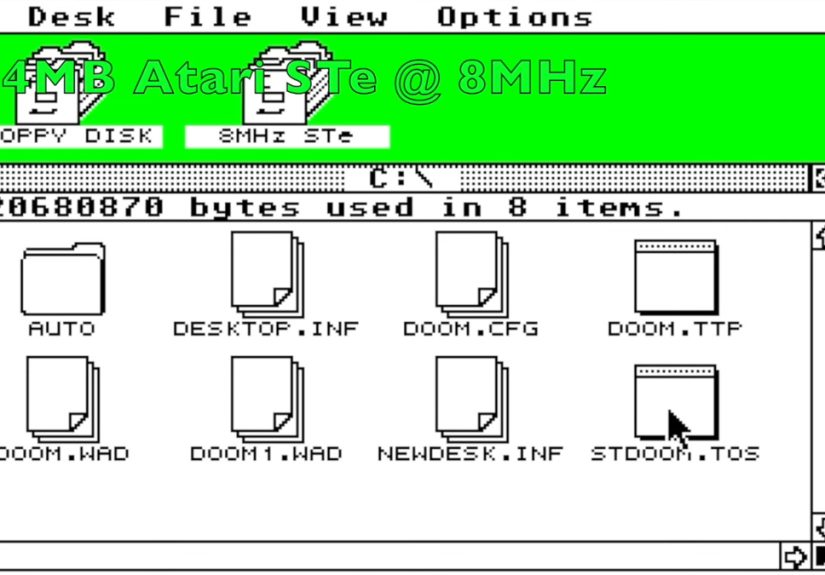
STDOOM is the version that made a lot of retro enthusiasts do a double take. It is a port that can run DOOM and DOOM II on Atari ST machines, supports low resolution and medium resolution display modes, includes a zoomed mode for better performance, and offers sound options that take advantage of STe hardware. It also works with original WAD files, which is a huge deal because that means this is not simply a themed imitation. It is a real attempt to bring the actual game logic and data pipeline onto Atari territory.
There is a catch, of course, because there is always a catch. STDOOM needs at least 4 MB of RAM, and a 16 MHz machine is recommended. The developer notes that an 8 MHz machine should work, but is expected to be unplayably slow. Benchmarks back that up: on an 8 MHz STe, performance can hover around roughly one frame per second in standard conditions, climbing when the view is reduced; on faster or accelerated configurations, it becomes far more convincing. So yes, STDOOM runs on Atari ST hardware, but it runs best when that hardware has had a little coffee, a little therapy, and maybe a tasteful upgrade.
Doom8088ST: The Ruthless Compromise Machine
The other road is Doom8088ST, a Motorola 68000 edition derived from the ultra-lean Doom8088 lineage. This version is much more brutal about what it sacrifices. It supports only DOOM Episode 1, drops music, skips save and load support, removes multiplayer, rejects PWADs, and even cuts visual niceties such as texture-mapped floors and ceilings and light diminishing. In exchange, it becomes much more practical on weaker systems, including Atari ST machines with as little as 512 KB of RAM, though 1 MB is recommended.
That is the genius of Doom8088ST. It is not trying to preserve every last luxury. It is trying to preserve the feeling. The corridors are there. The movement is there. The enemies are there. The “I should not be doing this on this machine, but somehow I am” feeling is definitely there. Hackaday described the low-detail mode as suitable for stock 8 MHz machines, with a very playable frame rate. That makes Doom8088ST less of a museum piece and more of a mischievous practical joke that somehow turned into real software.
How the Port Pulls Off the Illusion
The visual trickery is half the fun. One of the recent STDOOM showcases highlighted 16-color output with heavy dithering and even palette effects such as the red damage flash. Those details matter. They are not just eye candy. They help sell the illusion that this really is DOOM, even when the hardware is making every scene pass through a tiny visual customs office with a strict luggage policy.
Dithering does the heavy lifting because 16 colors are nowhere near enough to reproduce VGA-style gradients and texture richness directly. By carefully mixing pixels in patterns, the port suggests more shades than the machine is literally showing. STDOOM’s source code even references Bayer-dithered pixel handling for Atari framebuffers, which tells you this is not accidental roughness. It is deliberate engineering.
Then there is screen scaling and reduced detail. STDOOM offers a zoomed mode that improves speed by shrinking the active view. Doom8088ST goes even further with effective resolutions like 120×128, 60×128, or 30×128 depending on the mode. That sounds tiny by modern standards, but resolution is not everything. If the player can move, aim, dodge, and identify a shotgun guy before he turns the room into a lead-flavored weather event, the game has kept its soul.
What Running DOOM on an Atari ST Actually Looks Like
It looks like DOOM after spending a semester abroad in a low-color, high-ingenuity exchange program. The image is dithered. Fine detail is reduced. Smoothness depends heavily on your exact machine and settings. Some versions trade accuracy for performance, while others stay more faithful and demand stronger hardware. Yet the important thing is that it still reads instantly as DOOM.
The walls still loom. The maps still feel like mazes built by industrial demons with a flair for ambush design. The damage flash still gives you that old panic spike. And because this is Atari ST territory, there is also a pleasing sense that every frame is being negotiated into existence. You are not watching brute-force computing. You are watching elegant stubbornness.
| Port | Main Goal | Hardware Profile | Major Trade-Offs |
|---|---|---|---|
| STDOOM | More faithful DOOM experience | At least 4 MB RAM, 16 MHz recommended | Slow on 8 MHz systems, relies on scaling and optimization |
| Doom8088ST | Playable on weaker 68000-class systems | 512 KB minimum, 1 MB recommended | No save/load, no music, no PWADs, reduced visuals, Episode 1 only |
Why This Port Matters Beyond the Meme
The phrase “can it run DOOM?” became a meme because DOOM sits at a sweet spot: iconic, portable, and historically important. But the Atari ST story shows why the meme survives. These ports are not funny only because they are absurd. They are meaningful because they expose the design of old machines. They teach us where the limits really are, which shortcuts matter, and how software can reinterpret hardware that was never meant for a task.
They also remind us that game history is not fixed. A game released in 1993 and a home computer launched in 1985 can still form a new relationship in 2025 and beyond, thanks to modern reverse engineering, source releases, archival documentation, and obsessive hobbyist talent. That is one of the best things about retro computing: the past is not done. It is still being edited.
Conclusion
Running DOOM on an Atari ST is a triumph of compromise, creativity, and technical nerve. The ST does not become a perfect DOOM machine, and no honest person should pretend otherwise. A stock 8 MHz system is still a harsh environment for a fast 3D shooter, and every Atari port has to negotiate with memory limits, color limits, CPU limits, and the machine’s famously awkward graphics layout.
But that is exactly why the achievement matters. STDOOM proves that a surprisingly faithful port can exist on Atari hardware with the right resources. Doom8088ST proves that a stripped-down version can preserve playability on far humbler configurations. Together, they turn a retro-computing thought experiment into a living, runnable reality.
And honestly, that is the magic. Not that the Atari ST runs DOOM perfectly. It is that the Atari ST runs DOOM at all, and still somehow manages to look like it is having the time of its life.
Extended Experience: What It Feels Like to See DOOM on an Atari ST
Watching DOOM boot on an Atari ST feels a little like seeing a leather-jacketed heavy-metal guitarist walk into a polite chamber music recital. At first, your brain resists the image. The Atari ST belongs to one mental box: MIDI studios, GEM desktops, neat floppy labels, and a vibe that says “serious home computer with artistic ambitions.” DOOM belongs to another box entirely: roaring shotguns, demon closets, flashing corridors, and the eternal certainty that some monster has heard you breathe through a door. When those two boxes collide, the result is deeply, gloriously wrong in the best possible way.
The first sensation is disbelief. You see the title screen, or the level view, and your mind immediately starts checking for excuses. Is this a fake? Is it a video trick? Is someone streaming frames from another machine while the Atari merely stands nearby looking innocent? But then the movement happens. The player turns. The status bar updates. The familiar room geometry scrolls across a machine that should, by all rights, be busy loading a desktop publishing app or sequencing synth lines. The disbelief turns into laughter, then admiration.
The second sensation is appreciation for every compromise. On modern hardware, players complain if a shadow looks slightly soft or if a frame rate dips below whatever number is fashionable this month. On an Atari ST, every recognizably DOOM-like moment feels earned. Dithering is not a flaw; it is diplomacy. Reduced resolution is not laziness; it is strategy. Missing features are not a failure; they are the cover charge for entering a club this hardware was never supposed to access. Once you accept that, the entire experience becomes more charming. You stop asking, “Why doesn’t it look exactly like DOS DOOM?” and start asking, “How on earth are they getting this much of DOOM through that tiny old doorway?”
There is also something emotionally satisfying about hearing old hardware pushed into new relevance. Retro computing can sometimes drift into static nostalgia, where machines are admired like museum pieces and rarely challenged. A project like this does the opposite. It turns the Atari ST back into a battlefield. It makes the machine active again. It says this computer is not just something to remember; it is something to test, improve, benchmark, tweak, and celebrate.
Most of all, running DOOM on an Atari ST feels like a conversation between eras. The 1980s hardware says, “I was built with very different assumptions.” The 1990s game says, “I became a legend because I pushed hardware hard.” The 2020s developer says, “That sounds like a fun argument. Let me mediate.” And the result is not merely a port. It is a demonstration that enthusiasm can outlive product cycles, corporate roadmaps, and even common sense. The demons still charge, the corridors still stretch ahead, and the Atari ST, somehow, still has one more outrageous surprise left in it.