Table of Contents >> Show >> Hide
- Why a Sailboat Would Ditch the Motor (Besides Spite)
- The Sensor Array: What They Added Instead of Horsepower
- The backbone: making electronics behave like a team
- Wind + weather: because guessing is how sails tear
- Depth, speed, and water temperature: the “don’t hit that” trio
- AIS and collision awareness: being seen and seeing others
- Weather intelligence: routing with real forecasts, not vibes
- Energy monitoring: the part everyone forgets until the screens go dark
- Docking Without a Motor (How to Avoid Becoming a Legend)
- Tradeoffs, Safety, and the Fine Art of Not Over-Trusting Screens
- How to Build Your Own “Motorless + Sensor Array” Setup
- Is This the Future: Less Motor, More Data?
- Conclusion
- Experiences: What It Feels Like to Sail “After the Motor Splash” (500+ Words of Reality)
Every sailboat owner has two personalities: the romantic poet who whispers “wind, my old friend,” and the exhausted mechanic
who mutters “if I ever see another oil filter…” at 1:00 a.m. by headlamp. This story is about the moment the mechanic won.
Our hero looked at the auxiliary motorheavy, leaky, loud, and always somehow “one small part away” from workingand decided
it belonged in the sea. (Please don’t actually yeet your engine into the ocean. We’ll talk about responsible removal. Humor
is not a disposal plan.)
In its place? A tidy, modern “sensor array”: wind, depth, GPS, AIS, battery data, weather inputsthe kind of kit that makes
a sailboat feel less like a floating cabin and more like a very polite spacecraft that occasionally yells, “SHOAL!” This
article breaks down why someone would go (nearly) motorless, what a practical sensor array looks like, and how to keep the
whole experiment from ending with you drifting sideways into a marina like a slow-motion apology.
Why a Sailboat Would Ditch the Motor (Besides Spite)
Weight, drag, and the tyranny of maintenance
Motors are wonderfulright up until they’re not. An inboard diesel or a bulky outboard adds weight, complexity, and an
ongoing relationship with fuel, filters, belts, impellers, and the mysterious “new noise” that only appears when guests are
aboard. Even if the engine runs perfectly, you’re hauling a big metal box whose best trick is turning money into heat.
Some sailors simplify by removing the engine to reclaim space, reduce maintenance, and commit fully to sailing technique.
In performance terms, less weight can improve acceleration out of tacks and reduce pitching. In lifestyle terms, it means
fewer weekends spent performing ritual sacrifices to the goddess of “parts backorder.”
Noise, smell, and the “I came here to sail” factor
Sailing is supposed to be quiet. If your “sailing day” begins with a smoke puff and a vibration that rattles your fillings,
you can see the appeal of a cleaner, calmer boat. Going engineless (or engine-light) also pushes you toward renewable
onboard energysolar, wind, hydrogenerationbecause you lose the easy “just run the alternator” button.
The uncomfortable question: what about calm weather and tight quarters?
Here’s the reality check: engines aren’t just for laziness. They’re for safety and controlespecially in crowded marinas,
narrow channels, strong currents, or unexpected squalls. A motor gives you a reliable way to maneuver when the wind is
wrong, the space is small, and your pride is fragile.
So if you remove propulsion, you replace it with skills, planning, and information. That’s where the
sensor array earns its keep: it reduces surprises, improves decision-making, and helps you sail with intention rather than
improvisation.
The Sensor Array: What They Added Instead of Horsepower
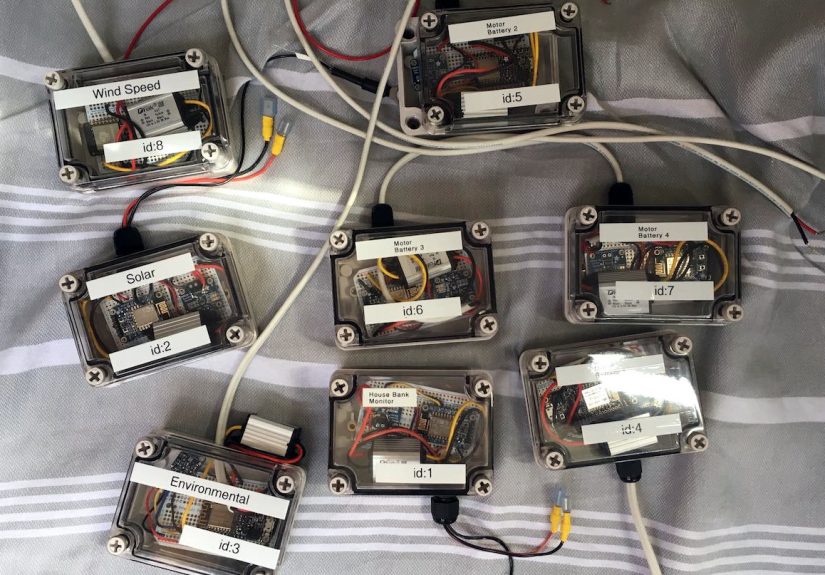
“Sensor array” sounds like something you install to detect alien lifeforms, but on a cruising sailboat it simply means an
integrated set of instruments that measure what the boat and the environment are doingthen share that data where it’s
useful: at the helm, at the nav station, and increasingly on a phone or tablet.
The backbone: making electronics behave like a team
Modern boats often network instruments so the GPS can talk to the autopilot, the wind sensor can feed the chartplotter,
and the depth transducer can keep everyone appropriately afraid. Many systems use an NMEA 2000-style network architecture:
a “backbone” (main trunk) with devices connected by drop cables. This reduces one-off wiring and lets devices share data
across the boat.
If you’re building a sensor array, start by deciding what must be shared. For example: GPS position and speed, wind angle
and speed, depth, AIS targets, heading/compass data, and battery state. That data-sharing is the difference between “a pile
of gadgets” and a boat that feels cohesive.
Wind + weather: because guessing is how sails tear
A proper wind instrument is the heart of sail trim. With a motor gone, you’re more committed to sailing efficiently, which
means you’ll care about subtle shifts you once ignored because “we can always motor.” A wind sensor gives you apparent wind
angle/speed; with heading and speed inputs, many systems can calculate true wind, which is gold for routing and sail choice.
Add an onboard weather station and you get air temperature, barometric pressure, and humidityuseful for spotting changes
and validating forecasts. Ultrasonic wind sensors (no moving parts) are popular because they’re less prone to wear and the
classic “the anemometer cups have launched into low Earth orbit” problem.
Depth, speed, and water temperature: the “don’t hit that” trio
Depth is not merely a number; it’s a lifestyle. A dedicated depth display is still a smart choice because it remains useful
when your main screen is busy with charts, AIS targets, and your crew’s ongoing debate about lunch. A modern depth/speed/temp
sensor can also supply speed-through-water and water temperature, which helps with current calculations and performance
tuning.
If your boat is going motorless, depth awareness becomes even more valuable because “just power out” stops being an option.
You want early warning, not last-second drama.
AIS and collision awareness: being seen and seeing others
AIS (Automatic Identification System) is essentially digital awareness over VHF: it can show you nearby vessels, their
course and speed, and closest point of approach. For a sailboat that’s committed to sailing (even when it’s inconvenient),
AIS is like having an extra set of eyes that never blinks, never gets seasick, and doesn’t argue about whether that light
is “definitely a fishing boat.”
Many recreational sailors choose AIS Class B transceivers for visibility, while certain commercial vessels are required to
carry AIS Class A. Even if you’re not required, the safety case is compellingespecially offshore, at night, or in reduced
visibility.
Weather intelligence: routing with real forecasts, not vibes
Your sensor array is only as smart as the information you feed it. Marine forecasts commonly cover wind, waves, visibility,
and significant weather over multiple days, and sailors often supplement text forecasts with gridded forecast data (commonly
used in routing apps and chartplotter overlays). The point isn’t to turn your sailboat into a floating meteorology labit’s
to make fewer bad bets.
When you’ve removed the motor, avoiding calms and timing tides matter more. A forecast that helps you pick a departure
window, avoid a head sea, or dodge a thunderstorm line isn’t “nice to have.” It’s how you avoid becoming a slow-moving
leaf with a VHF radio.
Energy monitoring: the part everyone forgets until the screens go dark
No engine means no easy alternator charging. So your sensor array should include a serious energy plan: battery monitor,
charge controllers, solar input data, and alerts for low voltage. When electronics become central to safe navigation, power
management becomes a safety system, not a comfort system.
Practical approaches include larger solar arrays, smarter charging profiles, and disciplined power habits (dim screens, turn
off unused transmitters, schedule “high draw” tasks when generation is strong). If you love data, congratulations: you’re
about to learn exactly how expensive your chartplotter’s backlight is.
Docking Without a Motor (How to Avoid Becoming a Legend)
The marina is where motorless dreams go to be tested by crosswinds, currents, and the guy filming from his stern rail.
The good news: docking is mostly preparation and geometry. The bad news: it’s also timing and humility.
Prep like you’re about to land a small airplane
- Rig fenders early (more than you think you need; confidence is not a fender).
- Pre-set docklines so you can grab and secure quickly.
- Brief the crew with clear roles: who steps off, who handles the bow line, who stays on board.
- Have an exit plan: where you’ll go if the approach isn’t right.
Use wind and current on purpose
Wind direction changes everything. A headwind can slow you (nice), but it can also stop you (not nice). A tailwind can push
you onto the dock (sometimes helpful, sometimes horrifying). Current can be your friend if you plan for it, or your nemesis
if you ignore it.
Many seamanship guides emphasize approaching at controlled angles based on wind direction and keeping steerage way until
you’re ready to stop. The trick is to arrive with enough momentum to steer, but not so much that your boat becomes a
battering ram with a nice paint job.
Carry “oops” tools that don’t require combustion
- Anchor ready to deploy for an emergency stop or to hold position.
- Kedge or stern anchor for controlled maneuvers in tight spaces.
- Dinghy assist (a small outboard on the tender can be the compromise that saves your gelcoat).
- Tow plan: know how you’d accept a tow safely if needed.
Tradeoffs, Safety, and the Fine Art of Not Over-Trusting Screens
AIS, VHF, and what “required” actually means
AIS carriage requirements apply to specific vessel types and operating contexts, and most recreational sailboats aren’t
mandated to carry AIS. But “not required” doesn’t mean “not smart.” Think of AIS as a seatbelt: you don’t install it
because the universe promised you a crash. You install it because you don’t control everything on the water.
Redundancy is the grown-up version of confidence
If your sensor array becomes central, build it with failure in mind:
- Backup navigation: handheld GPS or tablet with offline charts.
- Backup power: reserve battery, portable charger, or an emergency power plan.
- Backup awareness: radar reflector, good nav lights, and disciplined watchkeeping.
- Analog sanity: paper chart for the area, plus a simple compass and depth readout.
Lightning and electrical hygiene
Electronics on a boat live a hard life: salt, vibration, moisture, and occasional existential threats from lightning.
Use proper fusing, wire sizing, chafe protection, waterproof connectors, and thoughtful bonding/grounding practices.
Marine electrical standards exist for a reason, and following them is cheaper than replacing everything after one nasty
incident.
How to Build Your Own “Motorless + Sensor Array” Setup
Step 1: Decide what problems you’re solving
The goal isn’t maximum gadgets. It’s maximum usefulness. A sensible sensor array usually covers:
navigation (GPS/plotter), depth, wind, heading, AIS, VHF, and energy monitoring. Offshore sailors may add satellite
messaging, weather downloads, and more robust routing tools.
Step 2: Design the network before you buy devices
If you’re going to network instruments, sketch the system first: where the backbone will run, where power will feed it,
which devices will connect, and how you’ll keep the wiring accessible. A good plan avoids the classic outcome where you
install a “simple” upgrade and accidentally build a spaghetti museum behind your nav station.
Step 3: Install like you’ll be troubleshooting at sea (because you might)
- Label everything (future-you is tired and deserves kindness).
- Keep spare connectors and fuses onboard.
- Mount sensors thoughtfully for accuracy: wind sensors clear of turbulence, depth transducers where they’ll read reliably.
- Calibrate wind angle, depth offsets, and speed where possible.
Step 4: Practice the sailing techniques that make the system meaningful
A sensor array doesn’t magically replace propulsion. What it does is make your decisions sharper. Practice sailing in and
out of open anchorages, learn how your boat behaves under different trim, and get comfortable with “abort and reset” when
an approach doesn’t look right.
Is This the Future: Less Motor, More Data?
For many sailors, the sweet spot won’t be “throw the motor overboard.” It’ll be “use the motor less.” Electric auxiliaries,
hybrids, and better energy systems are expanding options, and more boats are treating electronics as a coherent system rather
than a random assortment of screens.
The bigger idea behind this title isn’t the splashit’s the shift in mindset. If you rely more on wind, you start caring
more about information: wind trends, weather windows, current flows, depth contours, and nearby traffic. A sensor array
becomes the boat’s nervous system, helping you sail smarter, safer, and with fewer unpleasant surprises.
Conclusion
“Sailboat throws motor overboard, adds sensor array” is funny because it’s dramaticand because a tiny part of every sailor
has wanted to do it at least once. In real life, the smart version is simpler: reduce dependency on the engine, upgrade the
boat’s awareness, and build the skills to maneuver confidently under sail.
If you’re tempted by the motorless path, treat it like any serious refit: plan it, budget it, test it, and build redundancy.
Then go sail, listen to the water, and enjoy the weird satisfaction of docking cleanly with nothing but wind, tide, and a
cockpit full of calm, well-informed humans.
Experiences: What It Feels Like to Sail “After the Motor Splash” (500+ Words of Reality)
The first thing sailors report after going (mostly) motorless isn’t fearit’s attention. You start reading
the world like a book you used to skim. Ripples on the water become wind arrows. Channel markers become timing cues. You
stop asking “Can we make it?” and start asking “What’s the plan if we can’t?”
One common experience is how quickly you become obsessed with departure timing. With an engine, you can
“force” a schedule. Without one, you negotiate with tide and breeze. That negotiation sounds annoying until you realize it
makes your sailing calmer: you leave when conditions are aligned, and you arrive with fewer ugly surprises. The sensor array
helps hereespecially wind history, barometer trends, and a good forecast viewbecause it turns your planning from guesswork
into a reasonable bet.
Another theme: confidence grows in specific places first. People usually start by practicing in wide,
forgiving areasopen anchorages, uncrowded mooring fields, familiar waterways. They learn how much speed they need for
steerage, how their boat coasts, and how quickly it bleeds momentum when pointed too high. A depth display becomes a comfort
blanket; not because it removes risk, but because it removes ambiguity. You’ll still respect shoals, but you’ll do it with a
plan rather than panic.
Docking stories are where motorless sailors develop both humility and excellent fender collections. The “wins” aren’t always
cinematic. Often they’re quiet: a controlled approach, a clean stop, one line on, done. The losses tend to be loud:
an approach that looked fine until the bow fell off and the boat drifted sideways like it was auditioning for interpretive
dance. The experienced folks do two things that beginners skip: they abort early and they brief the
crew like it’s a real procedure. Your sensor array helps, but your crew’s clarity helps more.
People also discover a surprising benefit: better sail trim. When you can’t “cheat” with throttle, you pay
more attention to telltales, twist, reef timing, and apparent wind changes. Over time, this makes the boat faster and the
day less tiring. Autopilots and wind instruments, when properly calibrated, can reduce workload offshoreespecially when the
crew is smallbecause the boat can steer consistently while you manage sails and navigation. The key is not letting the
screens replace seamanship; they should support your judgment, not override it.
The hardest adjustment is usually power management. Without an alternator bailout, sailors become
intentional: they dim screens, schedule downloads, and treat battery percentage like a weather forecastsomething you check
early and often, not when it’s already too late. The funny part is that after a few weeks, many people prefer it. The boat
feels quieter, simpler, and more “alive” under sail. The sensor array doesn’t make the boat less humanit just gives you
better senses, like glasses for your situational awareness.
The best summary I can offer is this: going motorless (or motor-light) makes sailing more honest. You don’t fight the day;
you collaborate with it. You’ll plan more, practice more, and occasionally accept help. And if you build a good sensor array,
you’ll make that collaboration a lot less stressfulbecause the boat will tell you what’s happening before it turns into a
story you have to explain to your insurance company.